
Grounds for Claiming Damages for Emotional Distress in Divorce and Key Considerations
Based on 10 consultation cases · Updated · Translated from the Korean original.
In a divorce, damages for emotional distress are compensation for emotional harm claimed from the person responsible for the breakdown of the marriage; they are separate from division of property. Whether a claim can be made and the amount depend on the specific circumstances, including how the marriage broke down, the degree of responsibility, when the claim is brought, and whether the conduct was forgiven.
At a glance
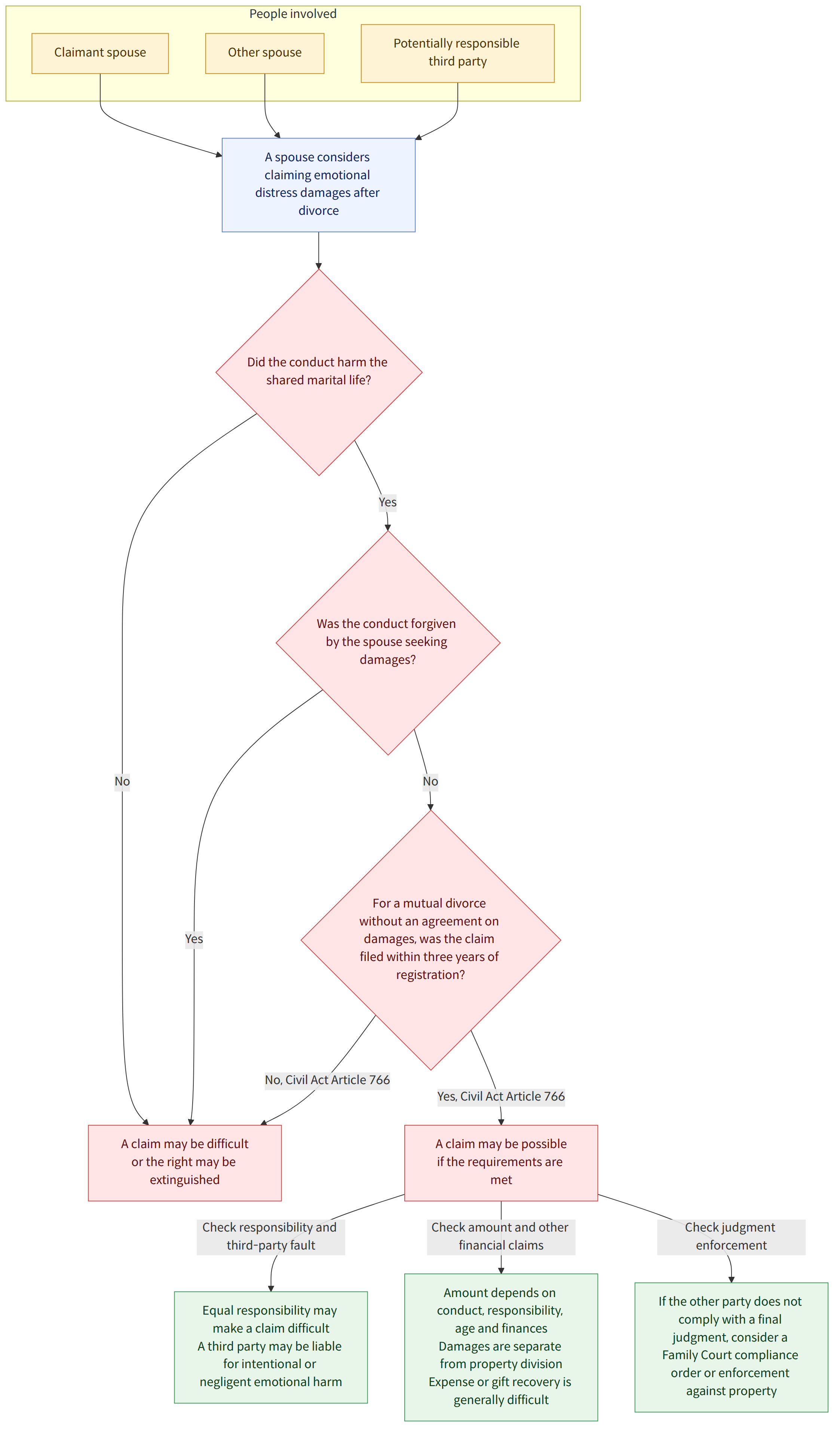
Key points
- Damages for emotional distress compensate for emotional harm resulting from the breakdown of a marriage. Their purpose differs from division of property, which divides assets jointly accumulated by the parties. The amount is determined by considering various circumstances, including the circumstances and seriousness of the conduct giving rise to fault, the causes of the breakdown and each party’s responsibility, and the parties’ ages and financial circumstances (Supreme Court Decision 2003므2251).
- If the parties did not agree on damages for emotional distress when divorcing by mutual agreement, the case guidance says a claim must be brought within three years from the date the divorce was registered (Civil Act, Article 766 (민법 제766조)).
- If both parties were responsible for the breakdown of the marriage and their degree of responsibility was equal, a claim for damages for emotional distress may be difficult. However, a claim may be possible if their respective degrees of responsibility can be distinguished (Supreme Court Decision 93므1273).
- If a spouse forgives the other spouse’s infidelity, the right to seek a divorce and the right to claim damages for emotional distress based on that conduct may be extinguished. Even if the marital relationship breaks down again later, it may be difficult to assert rights that have already been extinguished (Seoul Family Court Decision 96드96056).
- If the marriage had already broken down beyond repair before one spouse engaged in infidelity with a third party, it may be difficult to claim damages for emotional distress because it may be difficult to find that the conduct harmed the spouses’ shared marital life (Supreme Court Decision 2011므2997).
- As a general rule, it is difficult to claim reimbursement for expenses incurred during married life or the return of wedding or betrothal gifts, or damages equivalent to their value, on the ground of divorce. An exception may apply if special circumstances make the situation effectively equivalent to the marriage never having been established (Supreme Court Decisions 2014므329, 336, 343).
- Damages for emotional distress may also be claimed from a third party who caused the breakdown of the marriage if it is established that the third party intentionally or negligently caused emotional harm. The case examples include the person who had an affair with a spouse, as well as family members who engaged in severe abuse or interference (Civil Act, Article 750 (민법 제750조)).
- If the other party does not comply with a final judgment for damages for emotional distress, you may consider applying to the Family Court for an order requiring compliance or enforcing the judgment against the other party’s property (Family Litigation Act, Article 64 (가사소송법 제64조)).
Frequently asked questions
Q. We did not agree on damages for emotional distress when we divorced by mutual agreement. Can I claim them later?
According to the guidance in the case, even if the parties divorced by mutual agreement, a claim for damages for emotional distress may still be made if they did not separately agree on such damages. However, the claim must be brought within three years from the date the divorce was registered. If that period has passed, it is likely to be difficult to bring the claim.
Q. How is the amount of damages for emotional distress determined?
The amount is determined by considering various circumstances, including the circumstances and seriousness of the conduct that led to fault, the causes of the breakdown of the marriage and each party’s responsibility, and the parties’ ages and financial circumstances. There is no fixed amount that applies in every case.
Q. Can I claim damages for emotional distress later even if I forgave my spouse for being unfaithful?
The case explains that if a spouse forgives the other spouse’s infidelity after it occurs, the right to claim damages for emotional distress based on that conduct may be extinguished. The result may depend on what the forgiveness meant and the circumstances at the time, so after forgiving the conduct, it may be difficult to bring a claim based solely on that past conduct.
Q. Can I receive damages for emotional distress in a divorce if both spouses were at fault?
If both parties are responsible for the breakdown of the marriage and their degree of responsibility is equal, it may be difficult to claim damages for emotional distress. However, a claim may be possible if their responsibility can be distinguished based on factors such as who was at fault first, the degree of fault, and each party’s contribution to the breakdown.
Q. Can I claim damages for emotional distress from the person who had an affair with my spouse without getting divorced?
According to the case’s explanation concerning a concubinage agreement, damages for harm caused by a relationship between a married man and his concubine may be claimed even if the marriage has not broken down. However, the claim may be limited if forgiving the relationship is interpreted as waiving the right to claim damages.
Q. Can I claim damages for emotional distress if my spouse saw someone else while we were living apart?
Living apart does not, by itself, determine the outcome. If the spouses’ shared marital life had already broken down beyond repair and neither intended to restore it, it may be difficult to claim damages for emotional distress based on infidelity that occurred afterward.
Q. Can I get wedding expenses or wedding and betrothal gifts back when I divorce?
As a general rule, it is difficult to claim reimbursement for expenses incurred for married life or the return of wedding gifts or betrothal gifts, or damages equivalent to their value. An exception may apply if special circumstances make the situation effectively equivalent to the marriage never having been established.
Q. I have a judgment ordering payment of damages for emotional distress, but the other party will not pay. What can I do?
You may consider applying to the Family Court for an order requiring compliance or enforcing the judgment against the other party’s property. Enforcement may involve seizure and auction proceedings and can take time.
Relevant laws
- Civil Act, Article 766 (민법 제766조)
- Civil Act, Article 750 (민법 제750조)
- Family Litigation Act, Article 64 (가사소송법 제64조)
Watch out for
- The case guidance says that a claim for damages for emotional distress following a divorce by mutual agreement must be brought within three years from the date the divorce was registered. Take care not to delay bringing the claim.
- If the infidelity was forgiven, the right to claim damages for emotional distress may be interpreted as having been extinguished. The circumstances and meaning of the forgiveness may therefore be disputed.
- Whether the infidelity occurred after the marriage had broken down, and which party bears greater responsibility for the breakdown, may depend on the specific facts.
- Even if a judgment for damages for emotional distress has been issued, if the other party does not pay voluntarily, you may need to separately consider applying for an order requiring compliance or pursuing enforcement proceedings.
Source cases
This guide was compiled by AI from the following Korea Legal Aid Corporation consultation cases (in Korean).
This guide is general legal information about Korean law, not legal advice for your situation. For a specific case, consult a lawyer or the Korea Legal Aid Corporation (call 132 in Korea).