
Guide to the Requirements and Procedure for Claims for Division of Property Upon Divorce
Based on 51 consultation cases · Updated · Translated from the Korean original.
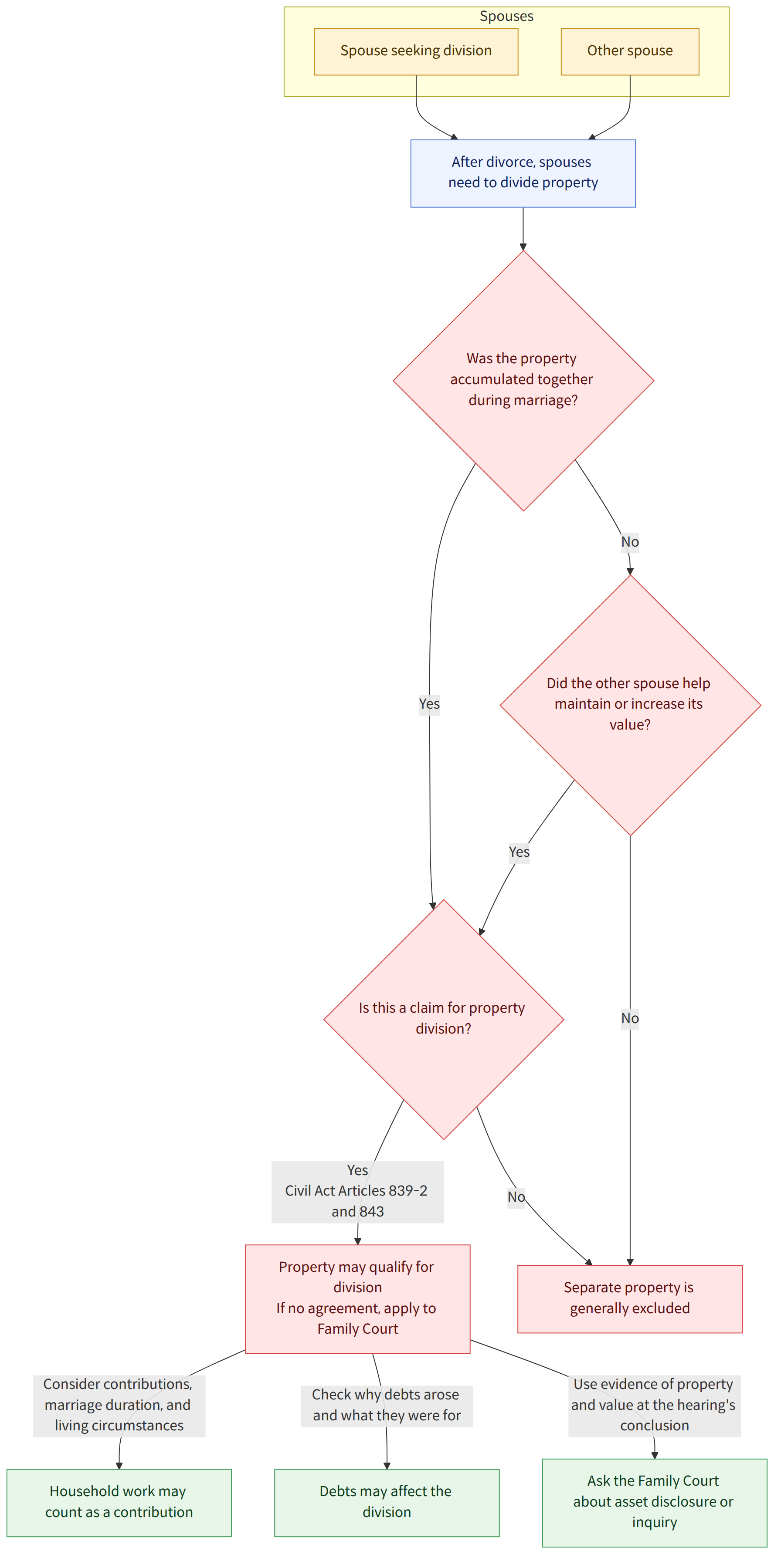
Division of property upon divorce is a process for liquidating the couple’s jointly accumulated property in substance; whether property is divided is not determined solely by whose name it is in. Various circumstances are considered, including each spouse’s contribution to the formation of the property, the nature of any debts, and the duration of the marriage. If the parties cannot reach an agreement, a claim may be filed with the Family Court.
At a glance
Key points
- A claim for division of property is separate from a claim for consolation money, and even a spouse responsible for the breakdown of the marriage may claim division of jointly owned property (Civil Act, Articles 839-2 and 843 (민법 제839조의2, 제843조); Case 5).
- Property accumulated together during the marriage may be subject to division regardless of whose name it is in or who manages it. Property acquired before marriage, or by inheritance or gift, is generally excluded; however, it may be subject to division if the other spouse contributed to its maintenance, preventing its depreciation, or increasing its value (Cases 5, 10, 19, and 23).
- Household work may be considered a contribution to the acquisition, maintenance, or increase in value of property. The method and amount of division are determined by considering various circumstances together, including the extent of each spouse’s contribution to the formation of the property, the duration of the marriage, and the parties’ living circumstances (Cases 5 and 23).
- Debts incurred to form jointly owned property or support the family’s economic life may be considered in the division of property. However, the cases discussed here include both a decision that a claim will not be granted if no assets remain after debts are deducted and a decision that debts may be allocated even when only debts remain. The circumstances in which the debts arose and their nature must therefore be considered (Cases 3 and 18).
- A spouse’s claim to retirement benefits accrued through employment during the marriage may be subject to division if its economic value can be assessed when the hearing on the merits concludes. Public officials’ retirement pensions already being received may also be subject to division (Cases 8 and 15).
- For a judicial divorce, the property subject to division and its value are determined based on objective evidence as of the date the hearing on the merits concludes. Property acquired after separation may also be subject to division if it was based on resources the couple accumulated together before separation (Cases 13 and 19).
- An agreement on division of property made on the assumption that the parties will divorce by mutual agreement may not take effect if the parties do not complete an uncontested divorce and instead divorce through judicial proceedings. In that event, unless the parties reach a new agreement, they must claim a division of property from the Family Court (Case 6).
- If it is difficult to identify the other party’s assets, you may apply to the Family Court for an order to disclose assets or for an asset inquiry. In judicial proceedings for division of property, the court may investigate the property subject to division and is not limited to the parties’ assertions (Family Litigation Act, Articles 48-2 and 48-3 (가사소송법 제48조의2, 제48조의3); Cases 21 and 25).
Frequently asked questions
Q. Can I claim a division of property for a home titled in only one spouse’s name?
This may be possible. If the property is, in substance, jointly owned property accumulated by the couple, whose name appears on the title is not decisive. The court will consider how the property was acquired and each spouse’s contributions, among other factors.
Q. Can a home acquired by my spouse before marriage be subject to division of property?
As a rule, separate property is not subject to division. However, it may be subject to division if the other spouse helped maintain it, prevent its depreciation, or increase its value. The specific facts concerning that contribution must be considered.
Q. Is a homemaker’s household work recognized in the division of property?
Household work may be considered a contribution to the acquisition, maintenance, or increase in value of the couple’s property. The extent of each spouse’s contribution to the formation of the property is determined by considering various circumstances, including household work.
Q. Do we have to divide debts even if we have no assets as a couple?
Debts incurred in connection with the couple’s shared life or the formation of their property may be considered for allocation in the division of property. However, some cases have held that a claim will not be granted if no assets remain after debts subject to liquidation are deducted from the property. It is therefore important to consider why the debts arose and whether they were incurred for the couple’s shared life.
Q. Can we divide the severance pay of a spouse who has not yet retired?
Even if a spouse has not actually received severance pay at the time of divorce, it may be subject to division if the economic value of the severance-benefit claim can be assessed when the hearing on the merits concludes. The cases describe the relevant amount as the severance benefits the spouse would be expected to receive if they retired at that time.
Q. If I signed a written waiver of property division in advance when we agreed to divorce, can I no longer make a claim?
A case discussed here holds that a waiver made in advance of a right to divide property that has not yet taken concrete form, before the marriage is dissolved, is not permitted. This should be distinguished from a case in which the parties actually reach a specific agreement on division of property after the divorce.
Q. Can I claim a division of property after the divorce?
You may claim a division of property after an uncontested divorce, but according to the cases, the right to claim division of property expires two years after the date of divorce. If the parties cannot reach an agreement, or an agreement is not possible, you may file a claim with the Family Court.
Q. What can I do if my spouse is hiding assets or I do not know where they are held?
You may ask the Family Court to issue an order requiring the other party to disclose their assets by submitting a list of property. If the court finds that the case cannot be resolved adequately based only on that list, you may also request an asset inquiry.
Q. Can I claim a division of property when a de facto marriage ends?
Even without a marriage registration, if the relationship is recognized as a de facto marriage—meaning the parties intended to marry and in fact lived together as a married couple—you may claim a division of property jointly acquired when the relationship ends. However, a case discussed here holds that if one de facto spouse dies, the surviving partner is not entitled to claim a division of property.
Relevant laws
- Civil Act, Article 830 (민법 제830조)
- Civil Act, Article 839-2 (민법 제839조의2)
- Civil Act, Article 843 (민법 제843조)
- Civil Act, Article 974 (민법 제974조)
- Civil Act, Article 975 (민법 제975조)
- Civil Act, Article 1057-2 (민법 제1057조의2)
- Family Litigation Act, Article 48-2 (가사소송법 제48조의2)
- Family Litigation Act, Article 48-3 (가사소송법 제48조의3)
- Family Litigation Act, Article 64(1) (가사소송법 제64조 제1항)
- Family Litigation Act, Article 67(1) (가사소송법 제67조 제1항)
- Family Litigation Act, Article 68(1)(1) (가사소송법 제68조 제1항 제1호)
- Act on Special Cases Concerning the Expedition, etc. of Legal Proceedings, Article 3 (소송촉진 등에 관한 특례법 제3조)
- Housing Lease Protection Act (주택임대차보호법)
- Commercial Building Lease Protection Act, Articles 2 and 3 (상가건물임대차보호법 제2조, 제3조)
- Public Officials Pension Act, Article 46-3 et seq. (공무원연금법 제46조의3 이하)
Watch out for
- According to the cases, the right to claim a division of property expires two years after the date of divorce. If you are considering making a claim after divorce, check the deadline.
- An agreement on division of property made on the assumption that the parties will divorce by mutual agreement may not take effect if the divorce instead occurs through judicial proceedings. A waiver signed before divorce may also be disallowed as an advance waiver of a right that has not yet taken concrete form.
- The mere fact that there are debts does not automatically require the other party to share them. You should determine whether the debts are related to the couple’s shared life or the formation of their jointly owned property; the outcome may vary by case.
- According to the cases, default interest on a property-division judgment ordering payment of money in connection with a divorce accrues from the day after the judgment becomes final, and the rate under the Act on Special Cases Concerning the Expedition, etc. of Legal Proceedings may not apply.
Related articles
Source cases
This guide was compiled by AI from the following Korea Legal Aid Corporation consultation cases (in Korean).
- 사실혼 파기로 인한 재산분할청구가 가능한지
- 재산분할로 소유권이전 될 경우 임차보증금반환채무 인수 형태
- 청산대상 채무액 공제 시 잔액이 없어도 재산분할청구 가능한지
- 이혼과 동시에 명한 재산분할채무의 이행기 및 적용이율
- 이혼 또는 혼인의 취소 시 재산분할청구
- 협의이혼을 전제한 재산분할약정의 재판상이혼 시 적용 여부
- 부부일방이 명의신탁한 부동산도 재산분할청구의 대상인지
- 향후 수령할 공무원 퇴직연금이 재산분할의 대상이 되는지
- 사실혼당사자의 사망과 재산분할청구권
- 부부일방의 고유재산이 재산분할청구대상에 포함되는지
- 이혼 및 위자료의 소송이 확정된 경우 위자료에 대한 이행명령
- 반소 인용 시 기각된 본소에 병합된 재산분할청구의 판단 여부
- 재판상 이혼을 전제로 한 재산분할에 있어 분할대상 재산과 액수산정의 기준시기
- 이혼 시 재산분할에 있어, 성년인 자녀들에 대한 부양의무를 지는 경우 이러한 사정 참작 여부
- 회사퇴직금도 재산분할청구의 대상이 될 수 있는지
- 단기간 혼인생활 파탄 시 일방이 혼인생활을 위해 지출한 비용의 반환 가부
- 재산분할합의가 해제된 경우 재산분할청구의 적법 여부
- 이혼 시 양 당사자가 채무만이 존재할 경우 채무도 재산분할이 되는지 여부
- 부부의 일방이 별거 후에 취득한 재산이 재산분할의 대상이 되는지
- 재산 분할시 상대방의 직업 등 기타 참작할 만한 사유
- 법원이 재산분할대상을 직권으로 조사할 수 있는지
- 이혼 시 재산분할의 지연 손해금 산정
- 재산분할에 있어 가사노동에 대한 평가
- 재산분할 청구권을 이혼 전 미리 포기할 수 있는지
- 재산 명시 및 재산 조회 제도
This guide is general legal information about Korean law, not legal advice for your situation. For a specific case, consult a lawyer or the Korea Legal Aid Corporation (call 132 in Korea).