
Crimes of Embezzlement and Breach of Trust: Elements and Case Examples
Based on 88 consultation cases · Updated · Translated from the Korean original.
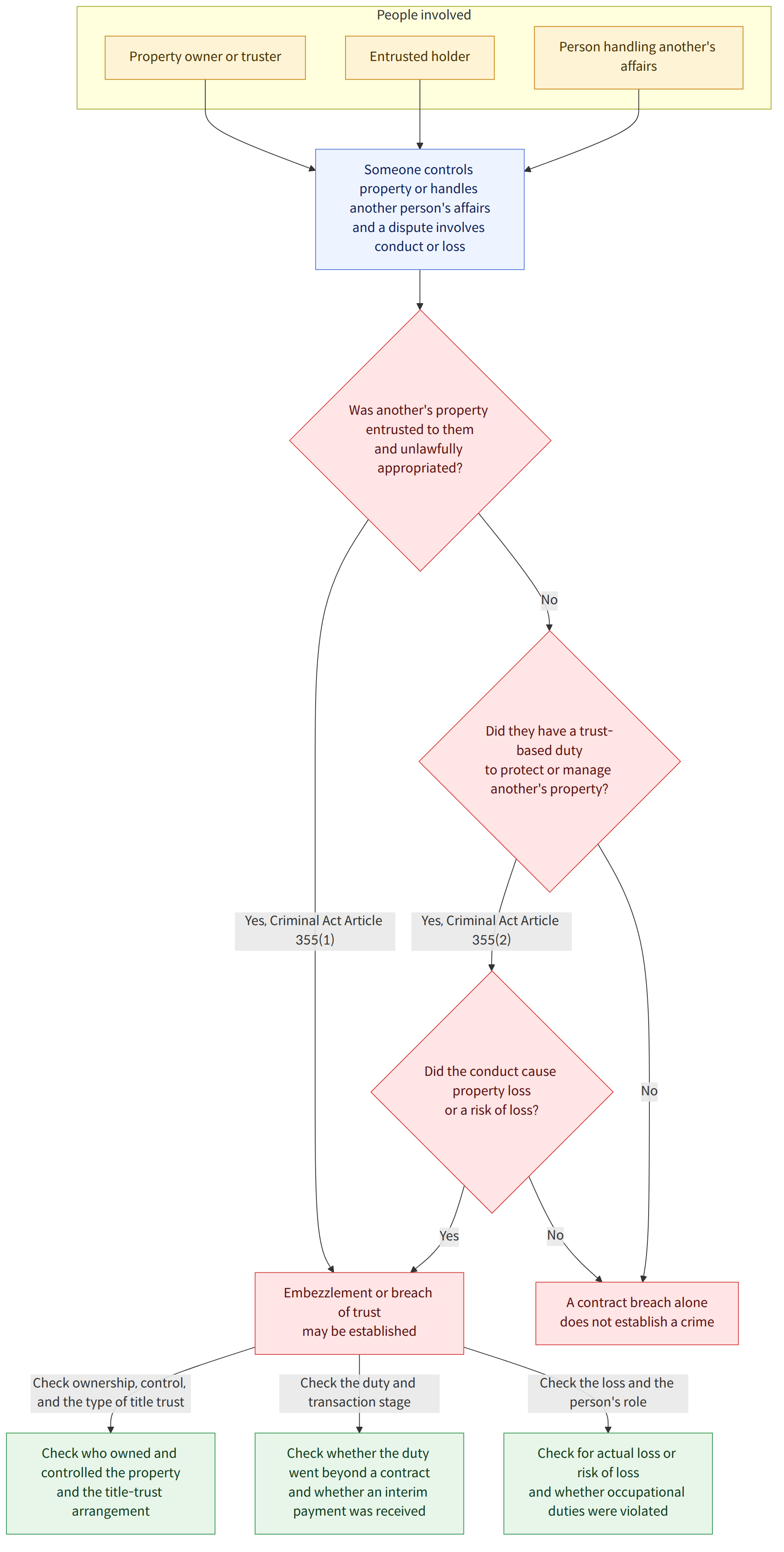
Embezzlement may arise when a person entrusted with another’s property disposes of it as if it were their own or refuses to return it. Breach of trust may arise when a person handling another’s affairs violates their duty, gains a property benefit, and causes loss to the other party. A breach of contract does not by itself constitute a crime; the relevant questions include who owns and holds the property, the nature of the entrusted duties, and whether loss or a risk of loss occurred.
At a glance
Key points
- Embezzlement requires a person to be entrusted with another’s property and to have the intent to unlawfully appropriate it. Custody means actual or legal control over the property (Criminal Act, Article 355(1); Cases 14 and 23).
- “Another’s affairs” for purposes of breach of trust are distinct from ordinary contractual obligations. What matters is whether the essence of the relationship is based on trust and involves protecting or managing another’s property (Criminal Act, Article 355(2); Cases 10, 18, 20 and 22).
- Loss for purposes of breach of trust may include not only actual loss but also a risk of property loss. The fact that a debt is later repaid or the loss is made good does not, by itself, erase a crime that has already been established (Cases 4, 8 and 24).
- Whether embezzlement is established in a real-estate title-trust arrangement depends on the type of arrangement. In a title-trust arrangement made through a contract or one involving an omitted intermediate registration, the trustee may not be regarded as a person entrusted with the truster’s property. However, a disposition may constitute embezzlement in cases involving clan-owned real estate or certain existing title-trust arrangements (Cases 1, 2, 12 and 13).
- A seller’s double sale of real estate after receiving only the earnest money may be judged differently from a double sale after receiving an interim payment. After receiving an interim payment, the seller may be found to have a duty to cooperate in registering the transfer of ownership (Case 11).
- There are cases in which a transferee holding a security interest by way of transfer does not commit breach of trust by disposing of or failing to settle the secured property, because the relevant duty concerns their own affairs. By contrast, breach of trust may be at issue if the security provider wrongfully diminishes the collateral’s value or makes it difficult for the security holder to exercise their rights (Cases 3, 7, 15 and 16).
- For occupational embezzlement or breach of trust, the key issue is whether the person held an occupational position and violated the duties of that position. An accomplice who does not hold such a position may be punished for ordinary breach of trust rather than occupational breach of trust (Criminal Act, Article 356 and proviso to Article 33; Cases 8, 9 and 21).
- The amount of gain or loss in an embezzlement case cannot always be determined by the nominal amount alone. Real estate subject to security interests may need to be valued with regard to its actual exchange value (Cases 5, 8 and 25).
Frequently asked questions
Q. Does a trustee always commit embezzlement by selling real estate held in a title-trust arrangement?
Not always. In a title-trust arrangement made through a contract, the person who entrusted the title may not acquire ownership of the real estate, so embezzlement may not be established. Embezzlement was also rejected in a case involving a title-trust arrangement with an omitted intermediate registration. By contrast, a disposition may be found to constitute embezzlement in cases involving clan-owned real estate or an existing title-trust building. The type of title trust and the circumstances therefore need to be examined.
Q. Does a seller who has received only the earnest money commit breach of trust by double-selling real estate after entering into a sale contract?
The case guidance explains that if the seller has received only the earnest money, the seller may terminate the contract by returning twice the amount of the earnest money, making it difficult to regard the seller as “a person handling another’s affairs” for purposes of breach of trust. By contrast, if the seller double-sells the property after receiving an interim payment, the seller may be found to have a duty to cooperate in registering the transfer of ownership.
Q. Does breach of trust arise if someone violates a contract and causes the other party a loss?
A breach of contract does not by itself immediately establish breach of trust. It is necessary to examine whether the relationship goes beyond an ordinary creditor-debtor relationship and is a fiduciary relationship in which one party protects or manages another’s property, and whether the person was in a position to handle another’s affairs.
Q. Can someone be punished for breach of trust even if no actual loss resulted?
Property loss may include not only loss that has actually occurred but also the risk that loss will occur. Accordingly, breach of trust may be at issue where someone creates a risk that collateral will lose its value as security or that a company will incur guarantee obligations, even if the debt is later repaid or the loss is made good.
Q. Does breach of trust arise if someone sells property held as security by way of transfer at an undervalue or fails to return the settlement amount?
According to the case guidance, a transferee holding a security interest by way of transfer is generally handling their own affairs when disposing of or settling the secured property to enforce that interest. Accordingly, selling it at an undervalue or failing to perform a duty to settle does not, by itself, establish breach of trust. However, separate conduct—such as the security provider wrongfully diminishing the value of the collateral—may raise an issue of breach of trust.
Q. Do a vehicle owner operating under a company’s registration or a vehicle custodian commit embezzlement by disposing of a vehicle without the company’s consent?
According to the case guidance, a person who receives and holds a vehicle owned by another may commit embezzlement by effectively disposing of it. This principle may apply to a disposition by a vehicle owner operating under a company’s registration or by someone entrusted with safekeeping the vehicle by that owner, even if the person is not the registered owner or was not directly entrusted with the vehicle.
Q. Is it not occupational embezzlement if someone transfers company money to a personal account and later returns it?
The mere fact that someone intended to return or compensate for the property afterward does not negate the intent to unlawfully appropriate it. The relevant questions include whether a person entrusted with company property in the course of their duties disposed of it as though it were their own money, and whether special circumstances existed, such as offsetting and settling a separate claim before the act.
Q. Does receiving a reward for an improper solicitation after retirement mean that the crime of receiving a bribe in breach of trust is not established?
Even if property is received after retirement, the crime of receiving a bribe in breach of trust may be established if the person received an improper solicitation while handling another’s affairs during their employment and the property was received in connection with that solicitation. It is not necessarily required that the person was actually in charge of the relevant duties when they received the property.
Q. When calculating the amount of gain from embezzling real estate provided as collateral, is the calculation based on its market value or the maximum secured amount of the mortgage?
The case guidance explains that the amount of gain should be calculated based not only on the market value of the real estate but on its actual exchange value, taking account of encumbrances such as a maximum-amount mortgage. The facts, including the scope of the security interest and the value of the real estate, must be examined to determine the amount in a particular case.
Relevant laws
- Criminal Act, Article 33 (형법 제33조)
- Criminal Act, Article 355(1) and (2) (형법 제355조 제1항·제2항)
- Criminal Act, Article 356 (형법 제356조)
- Criminal Act, Article 357(1) (형법 제357조 제1항)
- Civil Act, Article 265 (민법 제265조)
- Civil Act, Article 565 (민법 제565조)
- Act on the Registration of Real Estate under Actual Titleholder’s Name, Articles 3, 4, 8, 11 and 12 (부동산 실권리자명의 등기에 관한 법률 제3조·제4조·제8조·제11조·제12조)
- Provisional Registration Security Act, Articles 3 and 4 (가등기담보 등에 관한 법률 제3조·제4조)
- Unfair Competition Prevention and Trade Secret Protection Act, Article 2(2) and Article 18(2) (부정경쟁방지 및 영업비밀보호에 관한 법률 제2조 제2호·제18조 제2항)
- Passenger Transport Service Act, Article 21(1) and Article 24 (여객자동차 운수사업법 제21조 제1항·제24조)
- Act on the Aggravated Punishment, etc. of Specific Economic Crimes, Article 3(1) (특정경제범죄 가중처벌 등에 관한 법률 제3조 제1항)
Watch out for
- Whether embezzlement has occurred in relation to real estate held in a title-trust arrangement may depend on the specific facts, including the type of arrangement, when it was agreed, and what the seller knew.
- In assessing breach of trust, consider not only whether a contract was breached, but also whether the person was entrusted with “another’s affairs,” whether they breached their duty, and whether property loss or a risk of loss resulted.
- In cases involving the disposition of collateral, the value of the real estate at the time of disposition, any prior-ranking rights, and whether the collateral’s value was diminished may be important.
- The legal principles and conclusions presented in the cases are based on the facts of each case. In an actual matter, the contract terms and the ownership and custody of the property should be examined separately.
Source cases
This guide was compiled by AI from the following Korea Legal Aid Corporation consultation cases (in Korean).
- 계약명의신탁에서 수탁자가 목적물을 처분한 경우 횡령죄 여부
- 수탁자가 명의신탁부동산을 임의처분 한 경우 횡령죄의 성립 여부
- 양도담보 목적물을 부당하게 염가로 처분한 경우 배임죄 성부
- 전세권설정계약 후 타에 근저당권설정등기를 경료해 준 경우
- 회사영업비밀을 사외 유출한 경우 그 죄책과 손해액 산정방법
- 명의신탁은 종중토지를 담보로 근저당설정 및 매도까지 한 경우 횡령죄 여부
- 이중으로 동산양도담보권을 설정해준 경우 형사책임
- 비신분자가 신분자와 업무상배임죄를 범한 경우의 처벌
- 택시회사 소속 택시기사가 운송수입금 일부를 식대 등으로 사용한 경우
- 임대인이 임차인에게 소유권 취득 사실을 알리겠다는 약정을 어긴 경우
- 부동산 매도인이 계약금을 받고 이중매도한 경우 배임죄 여부
- 종중부동산의 명의수탁자가 이를 임의처분한 경우 횡령죄 여부
- 중간생략형 명의신탁에서 수탁자가 목적물을 처분한 경우 횡령죄 여부
- 지입차주가 지입회사의 승낙 없이 차량을 처분한 경우 횡령죄 여부
- 양도담보설정계약 후 기존 근저당권자에게 지상권등기해 준 경우
- 저당권이 설정된 자동차를 매도하는 경우 배임죄 여부
- 과반수 지분권에 기한 건물 사용·수익에 대한 결정에 따라 건물 임대수익을 분배하면서 일부 공유자를 제외한 경우 횡령죄의 성부
- 이중으로 임차권 양도계약을 한 경우 배임죄 성립 여부
- 배임수재죄의 성립요건
- 투자금반환채무 담보조로 임대차계약과 판매대금 입금을 투자자 명의로 한 상태에서 제3자에게 의류매장의 지위를 양도한 경우 배임죄...
- 허위임대차계약을 체결하고 회사 자금에서 임차보증금을 빼낸 경우 업무상횡령죄 여부
- 계불입금을 징수하지 않은 상태에서 잠적한 낙찰계주의 배임죄 성립여부
- 지입회사의 승낙없이 대표이사가 사실상 차량을 처분한 경우 횡령죄 여부
- 이사회 승인이나 다른 주주들의 동의 없이 대표이사가 다른 회사의 연대보증을 서게 하는 등 회사에 재산상 손해발생의 위험을 초래...
- 타인의 부동산을 관리하는 사람이 해당 부동산에 근저당권설정등기를 마친 경우, 횡령 이득액 산정 기준
This guide is general legal information about Korean law, not legal advice for your situation. For a specific case, consult a lawyer or the Korea Legal Aid Corporation (call 132 in Korea).