
Employment Contracts, Resignation, and Wages: An Essential Guide to Employment Contracts
Based on 18 consultation cases · Updated · Translated from the Korean original.
An employment contract may be formed orally, but it is important to put it in writing to confirm key terms and conditions of employment, such as wages and working hours, and to prevent disputes. If the contract terms are less favorable to the employee than statutory standards, such as the minimum wage, the statutory standards may apply. Resignation, repayment of training costs, and contract renewal must be assessed based on the agreement’s terms and the actual circumstances.
At a glance
Key points
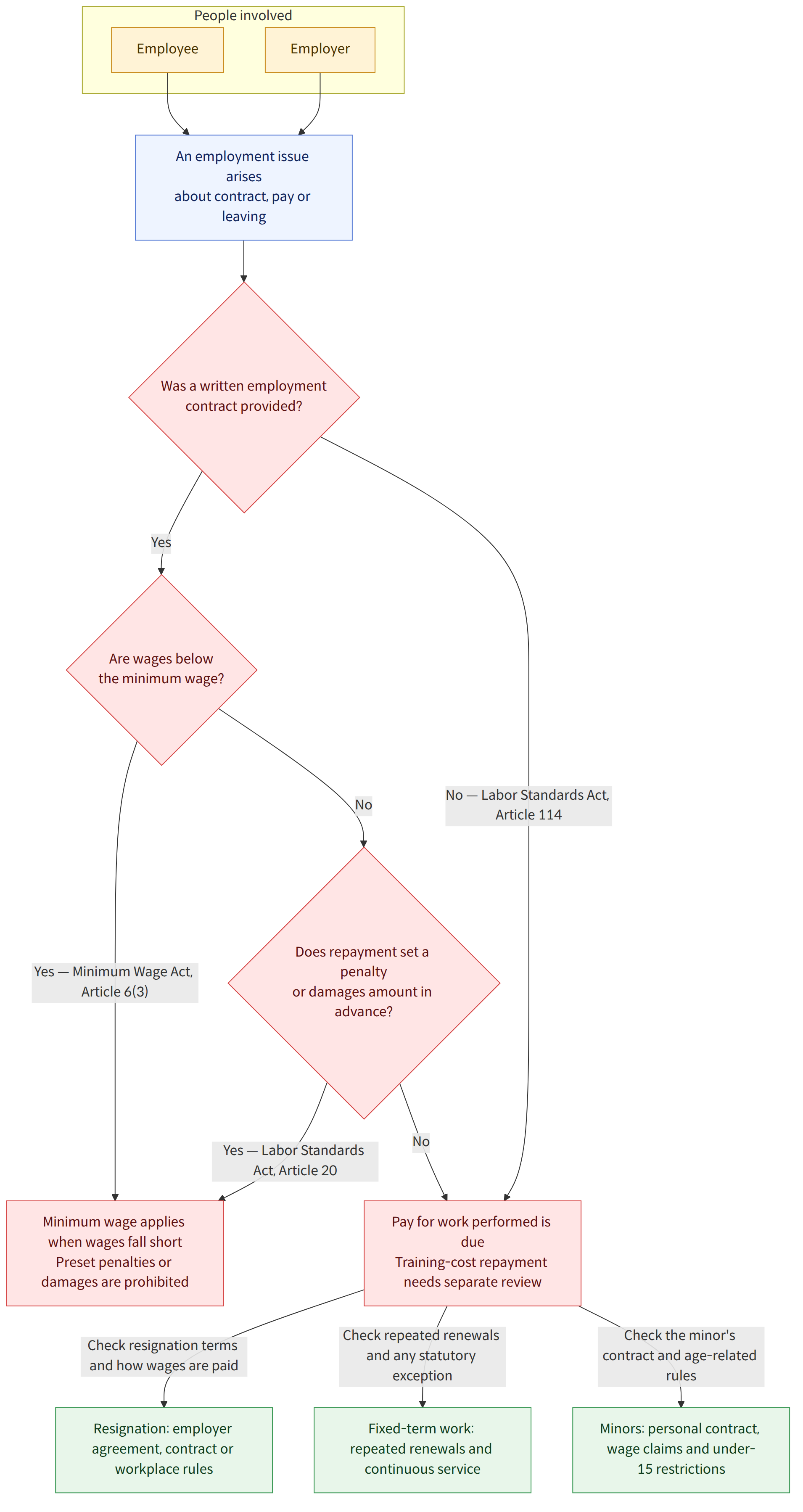
- When entering into an employment contract, an employer must specify the terms and conditions of employment, including wages, scheduled working hours, holidays, and annual paid leave, and must provide certain terms in writing (Labor Standards Act, Article 17 (근로기준법 제17조)).
- Wages must be paid for work actually performed even if no written employment contract was prepared. Failure to provide a written employment contract may be subject to a report (Labor Standards Act, Article 114 (근로기준법 제114조)).
- Any portion of wages set below the minimum wage is invalid, and the employee is deemed to have been promised the minimum wage. The employee may claim the difference (Minimum Wage Act, Article 6(3) (최저임금법 제6조 제3항)).
- If the parties agree to pay overtime pay exceeding the standards under the Labor Standards Act, the employer must pay it as agreed. An agreement setting various allowances at a fixed amount may be valid if it does not disadvantage the employee and is justified.
- An agreement that sets in advance a penalty or amount of damages for breach of an employment contract is prohibited. However, an agreement to repay actual training costs must be assessed separately from an agreement to repay wages or a separate penalty agreement (Labor Standards Act, Article 20 (근로기준법 제20조)).
- An employee may give notice of their intention to resign, but if the employer does not agree, the employee should check the resignation provisions in the employment contract or rules of employment. If there are no such provisions, the effective date may depend on factors such as the method of wage payment (Civil Act, Article 660 (민법 제660조)).
- If repeated renewals of fixed-term employment contracts result in a total period of continuous employment exceeding two years, the employee may be deemed to have an employment contract with no fixed term, unless a statutory exception applies (Act on the Protection, etc. of Fixed-Term and Part-Time Employees, Article 4 (기간제 및 단시간근로자 보호 등에 관한 법률 제4조)).
- As a rule, a minor must enter into an employment contract personally and may claim wages independently. Separate age-related rules, including restrictions on employing children under 15, should also be checked (Labor Standards Act, Articles 64, 67, and 68 (근로기준법 제64조, 제67조, 제68조)).
Frequently asked questions
Q. Is an employment contract formed even if I did not sign a written employment contract?
The cases indicate that a report may be filed if an employer fails to provide a written employment contract, and explain that wages must be paid for the days actually worked even if no contract was signed. To confirm the terms and conditions of employment and prevent disputes, it is advisable to put the contract terms in writing.
Q. Can I resign before the end of my contract term?
According to the cases, an employee may give notice of their intention to resign. If the employer agrees to the resignation, the employee may leave on the agreed date. If the employer does not agree, the employee should check the resignation provisions in the employment contract or rules of employment. If there are no such provisions, the effective date may depend on factors such as the method of wage payment.
Q. Do I have to repay training costs no matter what if I do not complete the required service period?
An agreement requiring an employee to repay the actual cost of employer-funded commissioned training if they fail to complete the required service period may be valid. However, one case held invalid an agreement requiring repayment of wages paid during the training period, on the grounds that it constituted a penalty or a predetermined amount of damages. What matters is not the name of the agreement but what it actually requires the employee to repay.
Q. If I resign, do I have to pay back both the scholarship and additional damages?
One case distinguished between a provision treating a scholarship as a loan that need not be repaid if the employee worked for a specified period, and a provision requiring the employee to pay an additional amount of damages calculated as a percentage of the scholarship if they left early. The former may give rise to an obligation to repay, while an agreement that sets an additional damages amount in advance may be invalid under the Labor Standards Act. The actual terms and nature of the agreement must be examined.
Q. If my contracted wage is below the minimum wage, can I still claim the difference even though I signed the contract?
Any portion of an employee’s wages set below the minimum wage is invalid, and the employee is deemed to have been promised the minimum wage. If the amount actually paid is below the minimum wage, the employee may claim the difference or file a report with the local labor office.
Q. If the agreed overtime pay is higher than the statutory amount, can I receive the agreed amount?
The cases explain that if the parties have agreed to pay overtime pay exceeding the standards set by the Labor Standards Act, the employer must comply with that agreement. When overtime, night-work, or holiday-work allowances are set at a fixed monthly amount, it must be considered whether the arrangement disadvantages the employee and whether it is justified in light of all the circumstances.
Q. Can I be dismissed due to the expiration of my contract if I have worked for more than two years through repeated one-year renewals?
According to the cases, if a fixed-term employee is employed for more than two years without a statutory exception applying, the employee is deemed to have an employment contract with no fixed term. In that case, refusing to renew the contract on the ground that its term has expired may be regarded as a dismissal, for which a justifiable reason may be required.
Q. Can a parent enter into an employment contract on behalf of a minor?
The cases explain that a person with parental authority or a guardian cannot enter into an employment contract on behalf of a minor; as a rule, the minor must enter into the contract personally. A minor may also claim wages independently, and restrictions on employment may apply depending on the minor’s age.
Q. Do I have to pay an employee who worked for only two days before quitting?
According to the cases, wages must be paid for the period actually worked. If an employee’s unauthorized departure causes actual damage to the workplace, the employer may separately claim damages; however, wages must still be paid if no damage was caused.
Relevant laws
- Labor Standards Act, Article 7 (근로기준법 제7조)
- Labor Standards Act, Article 16 (근로기준법 제16조)
- Labor Standards Act, Article 17 (근로기준법 제17조)
- Labor Standards Act, Article 20 (근로기준법 제20조)
- Labor Standards Act, Article 23 (근로기준법 제23조)
- Labor Standards Act, Article 43 (근로기준법 제43조)
- Labor Standards Act, Article 55 (근로기준법 제55조)
- Labor Standards Act, Article 60 (근로기준법 제60조)
- Labor Standards Act, Article 64 (근로기준법 제64조)
- Labor Standards Act, Articles 66 through 70 (근로기준법 제66조부터 제70조까지)
- Labor Standards Act, Article 114 (근로기준법 제114조)
- Civil Act, Article 398 (민법 제398조)
- Civil Act, Article 660 (민법 제660조)
- Act on the Protection, etc. of Fixed-Term and Part-Time Employees, Article 4 (기간제 및 단시간근로자 보호 등에 관한 법률 제4조)
- Minimum Wage Act, Article 6(3) (최저임금법 제6조 제3항)
Watch out for
- When reviewing an agreement to repay training costs, distinguish among the actual training costs, wages paid during training, and any additional damages for leaving early.
- Giving notice of an intention to resign does not always end the contract immediately. First check the relevant provisions in the employment contract and rules of employment.
- Statutory exceptions may apply when a fixed-term employee is employed for more than two years, so do not determine the employee’s status solely by counting the number of renewals.
- Even if an employee has signed an employment contract, terms that fall below statutory standards, such as the minimum wage, do not thereby become valid.
Source cases
This guide was compiled by AI from the following Korea Legal Aid Corporation consultation cases (in Korean).
- 해외연수교육 후 의무근무기간 경과 전 퇴직 시 교육비 반환의무
- 사용자와 근로자 사이에 약정한 위약금예정의 효력
- 근로 계약 기간 중 이직의 방법
- 미성년자의 근로계약
- 노동쟁의 면책약정의 효력
- 구두근로계약도 효력이 있는지
- 근로계약상 근로기간을 다 채워야 하는지
- 수습기간 중 근로계약서 작성의 필요성
- 2년 이상 근로계약을 갱신한 기간제 근로자의 지위
- 근로계약 갱신 거절
- 근로기준법이 정한 기준을 초과하는 시간외근로수당의 지급약정 효력
- 비정규직 근로자의 의미와 정규직 전환 시점
- 각종 수당을 매월 제수당으로 지급하기로 하는 계약의 효력
- 계약기간 내에 이직시 퇴직금 수령 가능성
- 최저임금을 위반한 근로계약의 효력
- 비정규직 근로계약서 작성 양식
- 최저임금 상승으로 인한 차액 청구
- 이틀 일한 직원의 급여
This guide is general legal information about Korean law, not legal advice for your situation. For a specific case, consult a lawyer or the Korea Legal Aid Corporation (call 132 in Korea).