
Guide to Damages and the Return of Engagement Gifts When an Engagement Is Ended
Based on 14 consultation cases · Updated · Translated from the Korean original.
An engagement is formed by an agreement between parties who intend to marry, and that agreement may also be implied. An engagement can be ended, but doing so without just cause or where the breakdown is attributable to a party may give rise to a claim for damages. Engagement gifts and items purchased in preparation for marriage are dealt with according to responsibility and ownership.
At a glance
Key points
- An engagement is formed by an agreement between parties who intend to marry in the future. It may arise not only from an express promise but also implicitly through conduct during the relationship (Case 13).
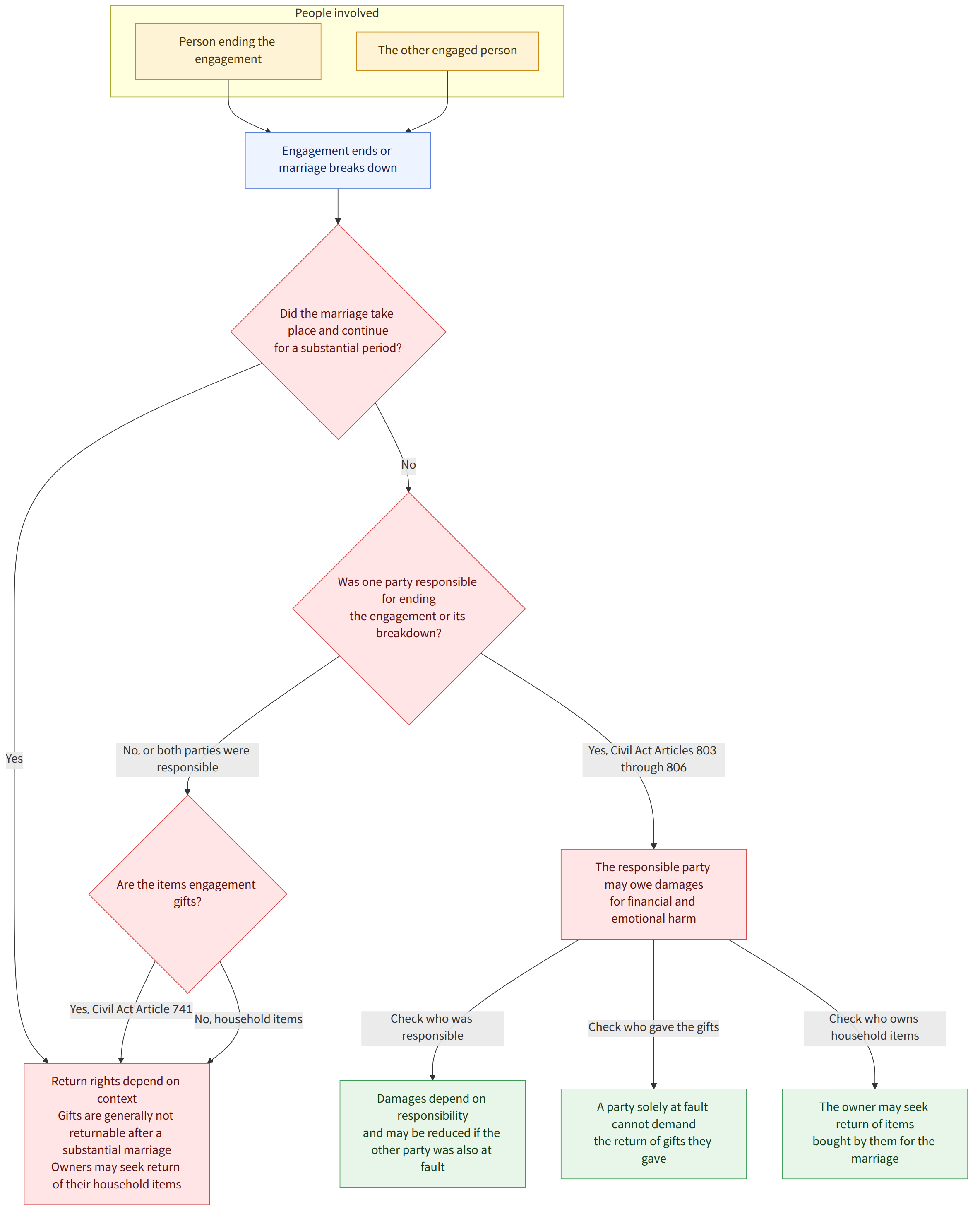
- An engagement may be ended by communicating one’s intention to the other party, but a party who is at fault in ending it may have to compensate the other party for damages (Civil Act, Articles 803 through 806 (민법 제803조 내지 제806조); Case 7).
- A serious misrepresentation after engagement, having sexual relations with another person, or refusing to marry or delaying the marriage without just cause may be grounds for ending an engagement (Civil Act, Article 804 (민법 제804조); Cases 2, 3, 10, and 14).
- A party responsible for ending an engagement may have to compensate the other party for financial and emotional harm. Even if the wedding and honeymoon have taken place but the parties have not begun living together as spouses, a claim for consolation money may be allowed for the breakdown attributable to the responsible party (Civil Act, Article 806 (민법 제806조); Cases 5 and 6).
- Engagement gifts are similar in nature to gifts made on the understanding that they will be returned if the marriage does not take place. A party may seek their return if neither party was at fault or both parties were at fault. If only one party was at fault, that party cannot demand the return of the gifts they gave (Civil Act, Article 741 (민법 제741조); Cases 1 and 11).
- If the marriage took place and continued for a substantial period, a party generally cannot demand the return of engagement gifts if the marriage later ends, absent special circumstances (Cases 1 and 11).
- Household items purchased by one party in preparation for marriage may belong to that party. If the other party possesses them, the owner may seek their return based on ownership rather than claim damages (Case 9).
Frequently asked questions
Q. Can an engagement exist even if we never explicitly said we would marry?
An agreement to become engaged may be made expressly or impliedly. An engagement may be found to exist if conduct during the relationship and continued sexual relations, among other things, are recognized as expressing an intention to marry and giving the other person reason to trust that marriage would take place.
Q. Must there be grounds specified by law to end an engagement?
According to the cases, either party may end an engagement by communicating their intention to the other party, regardless of whether grounds for ending the engagement exist. However, if a party ends the engagement without just cause and is found to be at fault, they may be liable to compensate the other party for damages.
Q. If my fiancé lied about their education or occupation, can I end the engagement and claim consolation money?
Misrepresenting a matter that has a significant bearing on the decision to marry, such as education, career history, or occupation, may be recognized as a serious ground that destroys trust. If the engagement ends as a result and the other party suffers emotional distress, they may claim consolation money. However, if the other party is also found at fault for failing to make reasonable inquiries, the amount of compensation may be reduced.
Q. Can I break off the engagement if my fiancé keeps putting off the wedding without a particular reason?
Refusing to marry or postponing the marriage without just cause may be grounds for ending an engagement. Whether there is just cause must be determined based on the circumstances of each case.
Q. Can my fiancé break off the engagement because I have a visual impairment?
The judgment discussed in the case materials found that poor eyesight that did not significantly interfere with daily life did not amount to an incurable illness that justified ending the engagement. Accordingly, the fact that a person has a visual impairment does not always constitute just cause to end an engagement.
Q. Can I claim damages if my fiancé was unfaithful with someone else?
Having sexual relations with another person after becoming engaged may be grounds for ending the engagement, and the party at fault may be asked to compensate the other party for financial and emotional harm. Whether damages are payable for ending the engagement depends on whether the other party was at fault.
Q. Can I claim consolation money if the relationship breaks down after the wedding and honeymoon?
Even if the wedding and honeymoon have taken place, a de facto marital relationship cannot be considered fully established if the parties have not begun living together as spouses. However, if the relationship breaks down at that stage for a reason attributable to one party, the other may claim compensation for emotional harm, on the same basis as for the wrongful breakdown of a de facto marital relationship.
Q. Do engagement gifts always have to be returned if the engagement is broken off?
The return of engagement gifts depends on who was responsible for ending the engagement and whether the marriage actually took place and continued. If only one party was responsible for ending the engagement, that party cannot affirmatively demand the return of the gifts they gave. If the marriage continued for a substantial period, a party generally cannot demand the return of the gifts absent special circumstances.
Q. Can I recover the cost of furniture and electronics as damages when an engagement is broken off?
Household items purchased in preparation for marriage may remain the property of the person who paid for them. If the other party possesses those items, the owner may seek their return. One case found that the purchase price itself could not be claimed as damages if the items remained the claimant’s property.
Q. If infidelity before the engagement is discovered later, can I divorce solely on that ground?
The judgment discussed in the case materials found that infidelity during the engagement period before marriage, by itself, does not constitute a ground for judicial divorce based on a spouse’s infidelity. The matter may be assessed differently, however, if the circumstances also constitute a separate ground for divorce.
Relevant laws
- Civil Act, Article 741 (민법 제741조)
- Civil Act, Article 803 (민법 제803조)
- Civil Act, Article 804 (민법 제804조)
- Civil Act, Article 806 (민법 제806조)
- Civil Act, Article 840 (민법 제840조)
Watch out for
- Whether an engagement was formed and whether there was just cause to end it may depend on the specific agreement and the parties’ conduct.
- The right to end an engagement and the absence of liability for damages are separate issues. Whether the party was at fault in ending it must be considered.
- The return of engagement gifts must be distinguished from claims for damages. For items purchased in preparation for marriage, do not confuse a claim for their return based on ownership with a claim for damages.
- If a marriage was formed and continued for a substantial period before ending, the rules on returning engagement gifts may differ from those that apply when an engagement is ended.
Source cases
This guide was compiled by AI from the following Korea Legal Aid Corporation consultation cases (in Korean).
- 약혼예물수수(授受)의 법적성질 및 그 소유권의 귀속관계
- 약혼 시 학력 등을 속인 당사자의 책임
- 약혼자가 학력·직장경력을 속인 경우 약혼해제사유인지
- 약혼의 해제사유2
- 약혼의 파탄에 대한 책임
- 약혼 부당파기에 따른 위자료 청구 가부
- 약혼자가 사기죄로 징역형을 선고받은 경우 약혼해제사유인지
- 약혼해제사유에 해당하는지 여부
- 약혼해제 시, 가재도구 구입비용을 상대방에게 손해배상으로 청구할 수 있는지 여부
- 약혼의 해제사유1
- 파혼에 따른 손해배상 및 약혼예물 등의 반환
- 약혼 단계에서의 부정과 이혼
- 묵시적 합의에 의한 약혼 성립 인정여부
- 약혼해제에 따른 위자료 청구 가부
This guide is general legal information about Korean law, not legal advice for your situation. For a specific case, consult a lawyer or the Korea Legal Aid Corporation (call 132 in Korea).