
Guide to Compensation for Damage Caused by Pollution
Based on 17 consultation cases · Updated · Translated from the Korean original.
The mere fact that pollution or noise occurred does not establish liability for compensation. The matter is assessed by considering the extent of the damage, causation, and other factors as a whole. However, a party responsible for environmental pollution may be held strictly liable, and the burden of proving causation may also be relaxed in pollution cases.
At a glance
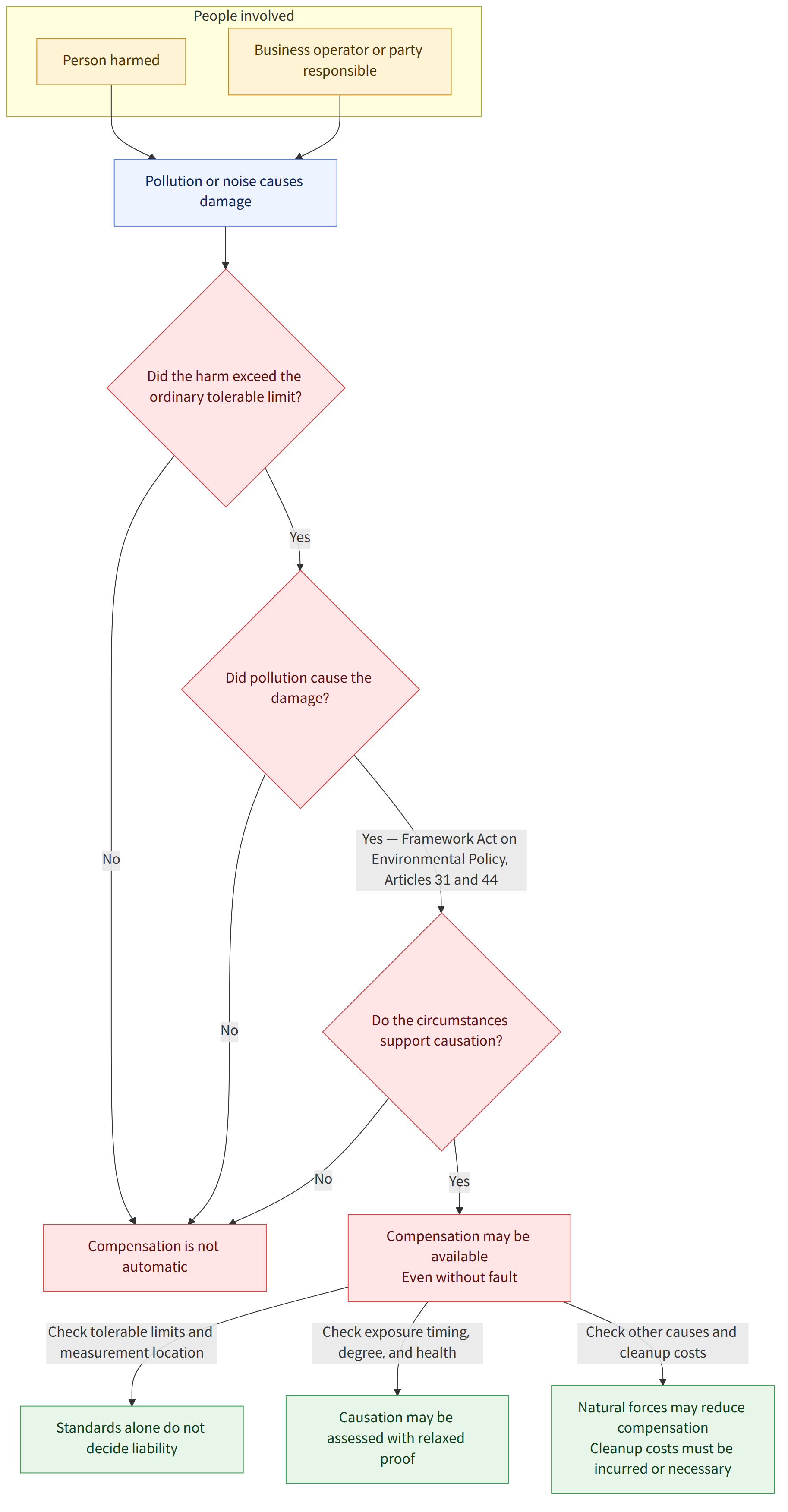
Key points
- Even if a facility is lawfully installed and operated, its use may separately be found unlawful if it causes harm from hazardous substances, noise, or vibration that exceeds the ordinary tolerable limit (Case 2).
- If environmental pollution causes damage, a business operator or the party responsible may be liable for compensation even without fault. The specific scope of application and whether liability exists are assessed based on the circumstances of the case (Framework Act on Environmental Policy, Articles 31 and 44; Cases 4).
- In pollution litigation, the burden of proof may be relaxed in light of the difficulty of requiring victims to establish every causal link with strict scientific certainty (Case 11).
- For nonspecific illnesses with multiple possible causes, such as asthma, causation may not be established merely by showing exposure to pollution and the onset of the illness. Additional circumstances, including the timing and degree of exposure and the person’s health, are important (Case 1).
- Exceeding noise standards does not automatically establish civil liability for compensation. The assessment also considers whether the disturbance exceeded the tolerable limit and whether the measurement location was appropriate (Case 10).
- Even if pollutant emissions are within statutory permitted limits, liability for compensation may be established if the harmful effects exceed the tolerable limit and the emissions caused the damage (Case 17).
- Even where a natural disaster and pollution jointly cause damage, liability may be established if pollution was one of the causes; however, the contribution of natural forces may be taken into account in limiting the amount of compensation (Case 16).
- If land with contaminated soil or illegally buried waste has been transferred, the former party responsible may be liable to compensate for the costs of cleanup or treatment once those costs have actually been incurred or the circumstances make it necessary to incur them (Case 3).
Frequently asked questions
Q. Can I obtain compensation for pollution damage even if the business operator was not at fault?
According to case law, when environmental pollution causes damage, a business operator or the party responsible may be liable for compensation even without fault. Noise and vibration may also constitute environmental pollution if they cause harm to human health, property, or the environment.
Q. Can I automatically obtain compensation if road noise exceeds environmental standards?
Not necessarily. Exceeding the applicable standard is important when determining whether the interference exceeded the tolerable limit, but that fact alone does not automatically establish unlawful interference and civil liability. For multi-unit housing, relevant considerations may include noise measurements taken in the living room, where residents mainly carry out their daily activities.
Q. Who has to prove the causal link between pollution and an illness?
In general, the victim bears the burden of proving causation in a damages claim. However, in pollution litigation, the burden of proof may be relaxed in light of the difficulty of scientifically establishing every causal link. The matter is assessed based on the specific circumstances.
Q. Can I obtain compensation if I develop asthma after exposure to vehicle exhaust?
It is difficult to conclude that exposure and the onset of asthma are causally linked based only on the fact that both occurred. Other factors must also be considered, such as the incidence of disease in the exposed group, the timing and degree of an individual’s exposure, when the illness began, and the individual’s health and lifestyle before the illness began.
Q. Can liability for compensation arise even if pollutant emissions were within the permitted limits?
Yes. Liability is not excused merely because emissions were within the permitted limits. Compensation may be awarded if the harmful effects exceeded the ordinary tolerable limit and the emissions caused the damage.
Q. Can I obtain compensation if a natural disaster was the main cause and pollution also had some effect?
Liability may be established if pollution was one of the causes of the damage. However, if natural forces also contributed to the damage, their contribution may be taken into account to limit the amount of compensation, having regard to the fair allocation of the loss.
Q. If I bought contaminated land, can I claim cleanup costs from the seller?
An unlawful act may be established if the former owner caused the contamination, illegally buried waste without treating it, and transferred the land in that condition. It is important, however, that the damage has materialized—for example, because you have incurred or become obliged to incur cleanup or treatment costs.
Q. Can someone who moved into an area after a pollution facility was built there obtain compensation?
Moving into the area does not automatically eliminate liability for compensation. However, if you moved there after it was known to be a pollution-affected area, or if the circumstances were such that you could have been aware of the risk, this may be considered a factor in reducing the amount of damages.
Q. Can I also claim solatium if I suffered emotional distress due to oil pollution?
According to case law, there is no reason to limit oil-pollution damage to property damage alone, so you may claim solatium. However, you must prove that you suffered non-pecuniary harm.
Relevant laws
- Constitution, Article 35(1) (헌법 제35조 제1항)
- Framework Act on Environmental Policy, Article 3, subparagraphs 1, 3, and 4 (환경정책기본법 제3조 제1호·제3호·제4호)
- Framework Act on Environmental Policy, Article 31 (환경정책기본법 제31조)
- Framework Act on Environmental Policy, Article 44(1) (환경정책기본법 제44조 제1항)
- Civil Act, Article 750 (민법 제750조)
- Civil Act, Article 751 (민법 제751조)
- Civil Act, Article 752 (민법 제752조)
- Civil Act, Article 766(1) (민법 제766조 제1항)
- Former Soil Environment Conservation Act (구 토양환경보전법)
- Former Waste Management Act (구 폐기물관리법)
- Oil Pollution Damage Compensation Guarantee Act (유류오염손해배상보장법)
- Act on Special Cases Concerning the Acquisition of Public Land and Compensation for Loss, Article 8(1) (공공용지의취득및손실보상에관한특례법 제8조 제1항)
- Environmental Conservation Act (환경보전법)
Watch out for
- Liability is not automatically established merely because environmental standards were exceeded or exposure to pollution occurred. The specific circumstances must be considered, including the connection between the cause and the damage and the extent of the damage.
- For illnesses with multiple possible causes, such as asthma, an epidemiological association at the group level alone may not prove the cause of an individual’s illness.
- As a general rule, the limitation period for a claim for damages caused by obstruction of sunlight may begin when the building is completed or its exterior structural work is finished. You should therefore check when the claim is being made and the circumstances of the harm (Case 8).
- The sunlight-duration figures cited as standards for multi-unit housing reflect the determination in that particular case. They should not be assumed to apply unchanged to every case (Case 15).
Source cases
This guide was compiled by AI from the following Korea Legal Aid Corporation consultation cases (in Korean).
- 자동차배출가스로 인한 대기의 오염과 천식과 같은 비특이성 질환의 발병 사이에 인과관계가 인정되는지
- 고속도로의 소음·진동 증가로 양돈업자의 폐업 시 도로공사의 책임
- 오염토양이 포함된 토지를 거래에 제공한 경우 손해배상책임 인정 여부와 그 책임의 범위
- 환경정책기본법상의 책임의 성질
- 공해를 발생시키는 국가시설이 설치된 이후에 그 지역으로 이주한 사람도 손해배상을 받을 수 있는지 여부
- 유류오염손해배상보장법에 규정된 유류오염손해에 정신적 손해도 포함되는지 여부
- 공공사업시행지구 밖에서 영업을 하다가 공공사업 시행으로 인하여 간접적인 영향을 받아 영업을 폐지하게 되어 손실보상을 받은 자가...
- 위법한 건축행위로 일조방해가 발생한 경우 손해배상청구권의 소멸시효 기산점
- 조망이익이 법적인 보호의 대상이 되기 위한 요건
- 도로소음의 손해배상책임 판단 기준
- 공해 소송에 있어서 인과관계의 입증책임
- 아파트 공사로 인한 일조 침해의 경우, 불법행위의 성립 시기 및 소유물에 대한 불법행위를 이유로 취득한 손해배상청구권이 소유권...
- 건축공사 수급인의 일조방해에 대한 손해배상책임여부
- 소음으로 인한 손해배상청구에 있어서의 피해 발생 입증 정도
- 공동주택에서 사회통념상 허용되는 일조 침해의 수인한도 기준
- 주된 원인은 자연재해이나 공해도 그 원인이 된 경우 손해배상책임 인정여부
- 오염물질의 배출량이 환경보전법에 의하여 허용된 기준치 이내인 경우에도 배출행위로 인한 손해배상책임이 인정될 수 있는지 여부
This guide is general legal information about Korean law, not legal advice for your situation. For a specific case, consult a lawyer or the Korea Legal Aid Corporation (call 132 in Korea).