
Requirements for the Crime of False Accusation and Whether It Is Punishable
Based on 23 consultation cases · Updated · Translated from the Korean original.
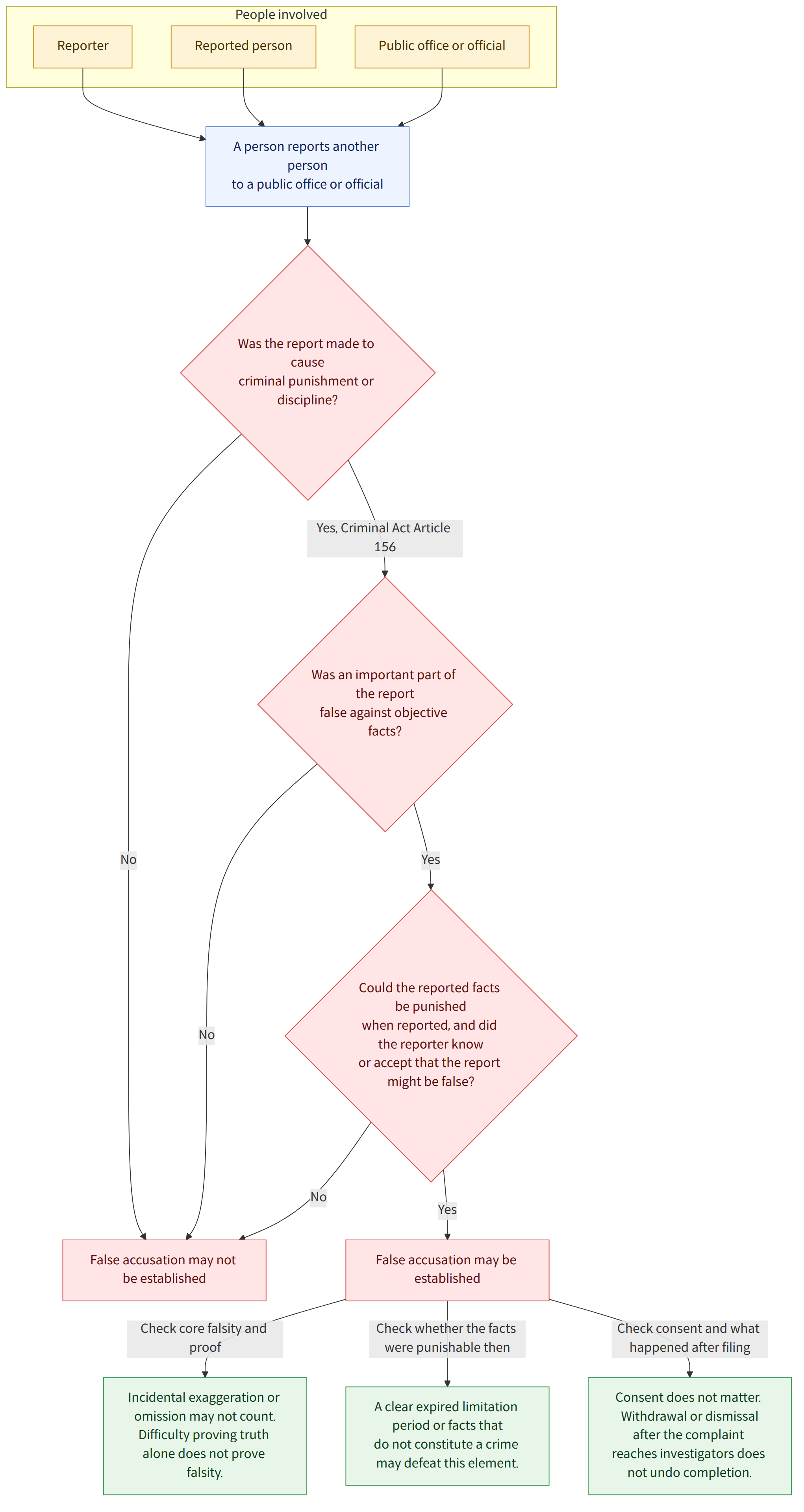
The crime of false accusation may be established when a person reports information contrary to objective facts to a public office or public official with the purpose of causing another person to face criminal punishment or disciplinary action. The circumstances must be examined closely, including whether a core part of the report was false, whether the reported facts could have been subject to criminal punishment when reported, and whether the person making the report knew it was false.
At a glance
Key points
- The crime of false accusation is committed by reporting false information to a public office or public official for the purpose of causing another person to face criminal punishment or disciplinary action (Criminal Act, Article 156 (형법 제156조)).
- Whether the reported information is false is determined by reference to objective truth, not the reporter’s belief. The inquiry focuses on whether a core or important part relevant to the elements of the crime is false (Supreme Court Decision 91Do1950, Oct. 11, 1991).
- The falsity of the report must be affirmatively proved. The fact that it is difficult to establish that the report is true does not, by itself, establish that it is false (Supreme Court Decision 2011Do15767, Feb. 13, 2014).
- The reporter need not be certain that the information is false. Conditional intent may also be found where a person reports facts without being convinced that they are true (Supreme Court Decision 96Do2417, Mar. 28, 1997).
- The crime of false accusation may not be established if the false information is an exaggeration or omission of an incidental fact that does not materially affect whether a crime is established. Whether core information was fabricated must be assessed separately (Supreme Court Decision 2002Do5939, Jan. 24, 2003, and others).
- When the report is made, the reported facts themselves must be capable of being subject to criminal punishment. The crime of false accusation may not be established if it is clear from the report alone that the statute of limitations for prosecution has already expired, or if the reported facts do not themselves constitute a crime (Supreme Court Decision 93Do3445, Feb. 8, 1994, and others).
- The other person’s consent does not affect whether the crime of false accusation is established. By contrast, falsely accusing oneself does not satisfy the elements of that crime, but liability for instigating or aiding and abetting may be at issue if another person is made to file a false report against oneself (Supreme Court Decision 2005Do2712, Sept. 30, 2005; Supreme Court Decision 2008Do4852, Oct. 23, 2008).
- The crime of false accusation is complete once a false complaint reaches an investigative agency. Subsequently getting the complaint back or having the complaint case dismissed does not affect whether the crime was established (Supreme Court Decision 84Do2215, Feb. 8, 1985).
Frequently asked questions
Q. Does making a report that differs from the facts always constitute the crime of false accusation?
Not necessarily. Whether a statement is false is determined based on objective facts, with particular attention to whether a core or important part of the report relevant to establishing a crime is false. Some exaggeration based on facts or the omission of incidental details alone may not constitute the crime of false accusation.
Q. Can I be punished for false accusation if there is no evidence that my report is true?
The fact that it is difficult to establish that the report is true does not, by itself, mean that it is false. There must be affirmative proof that the reported facts are contrary to objective truth.
Q. Can the crime of false accusation be established even if I did not want the other person to be punished?
You do not have to actually desire the other person’s punishment. The required purpose may be found if you knew that the false report could result in criminal punishment or disciplinary action against the other person. Accordingly, the crime of false accusation may be established even if you claim that you made the report to find someone or for another purpose.
Q. Can I be punished for making a false accusation with the other person’s consent?
It can. The principal legal interest protected by the crime of false accusation is the proper exercise of the state’s criminal justice or disciplinary authority. Therefore, even if the other person agreed to the false accusation, that does not affect whether the crime is established.
Q. Does falsely reporting that I am the offender constitute the crime of false accusation?
The act of falsely accusing yourself does not satisfy the elements of the crime of false accusation under the Criminal Act. However, if you make a false confession to obstruct the arrest or discovery of the actual offender, the crime of harboring a criminal may be at issue. If you have a third party make a false report against you, liability for instigating or aiding and abetting may be at issue.
Q. Does the crime of false accusation not apply if I file a complaint and then immediately get it back?
The crime of false accusation may be complete once the false report reaches an investigative agency, including through the filing of a false complaint. Returning the complaint after it has been submitted, or the dismissal of the complaint case, does not undo a crime of false accusation that has already been established.
Q. Does reporting facts for which the statute of limitations has expired, or which are not a crime, constitute false accusation?
The reported facts must themselves be capable of being subject to criminal punishment. Accordingly, the crime of false accusation may not be established if it is clear from the report alone that the statute of limitations for prosecution has already expired, or if the reported facts do not themselves constitute a crime. However, if the facts were punishable when reported and case law changed afterward, that change does not affect an already-established crime of false accusation, absent special circumstances.
Q. Does it constitute false accusation if I state false information that was not in my original complaint while answering questions from an investigative agency?
Merely answering questions from an investigative agency may not constitute the crime of false accusation because it is not a voluntary report. However, if during the investigation you voluntarily state additional facts or indicate that you intend to file a complaint based on those facts, the report may be considered voluntary.
Q. Can a false petition made to someone other than the police or prosecution constitute the crime of false accusation?
The recipient of a report is not limited to an investigative agency. The crime of false accusation may also be established if a false petition is submitted to the President, who is in a position to prompt the exercise of official authority for criminal punishment. However, in the case discussed, disciplinary action by a school foundation against a teacher at a private school was held not to constitute a “disciplinary action” for purposes of the crime of false accusation.
Relevant laws
- Criminal Act, Article 156 (형법 제156조)
- Criminal Act, Article 9 (형법 제9조)
- Criminal Act, Article 231 (형법 제231조)
- Criminal Procedure Act, Article 249(1)(4) (형사소송법 제249조 제1항 제4호)
- Criminal Procedure Act, Article 252(1) (형사소송법 제252조 제1항)
- Minor Offenses Punishment Act, Article 1(5) (경범죄처벌법 제1조 제5호)
- Private School Act, Article 53 (사립학교법 제53조)
- Private School Act, Article 53-2 (사립학교법 제53조의2)
- Private School Act, Article 54 (사립학교법 제54조)
- former Attorney-at-Law Act, Article 92 (구 변호사법 제92조)
- former Attorney-at-Law Act, Article 95 (구 변호사법 제95조)
- former Attorney-at-Law Act, Article 96 (구 변호사법 제96조)
- former Attorney-at-Law Act, Article 100 (구 변호사법 제100조)
Watch out for
- Whether a report is false is not determined solely by whether the person making it knew the facts to be different. Both the objective facts and the substance of the report must be considered.
- Some examples concerning the statute of limitations for prosecution or the period for filing a complaint are based on former laws. In particular, the explanation concerning rape as an offense prosecutable only upon complaint is based on the law before its amendment and should not be applied as-is to current cases.
- Whether the reported facts themselves constitute a crime and whether they could have been subject to punishment when reported may affect whether the crime of false accusation is established. Even if the law or case law changes later, the situation at the time of the report must be considered.
- Whether a matter qualifies as a “disciplinary action” for purposes of the crime of false accusation may be at issue, as with disciplinary action by a school foundation against a teacher at a private school. The recipient of the report and the nature of the authority to impose the action must therefore be distinguished.
Source cases
This guide was compiled by AI from the following Korea Legal Aid Corporation consultation cases (in Korean).
- 무고죄에서 ‘징계처분’의 의미
- 허위사실을 진정한 경우 무고죄가 성립되는지
- 공소시효가 명백히 완성된 허위사실을 고소한 경우 무고죄 여부
- 허위사실로 자기를 무고한 경우도 처벌되는지
- 무고죄에서의 형사처벌을 받게 할 목적
- 고소기간이 지난 허위의 사실로 무고한 경우 처벌되는지
- 피무고자의 승낙이 있는 고소의 경우 무고죄의 성립여부
- 무고죄에서의 ‘신고’의 의미
- 무고죄의 ‘허위신고’의 의미
- 사실의 일부를 숨긴 경우 무고죄의 성립여부
- 무고죄의 허위성 판단기준
- 타인 명의의 고소장을 작성·제출 시 무고죄의 주체
- 무고죄의 공동정범의 성립여부
- 판례의 변경에 의한 무고죄의 성립여부
- 무고죄에 있어서 입증의 정도
- 고소사실이 범죄를 구성하지 않는 경우, 무고죄의 성립여부
- 일부과장신고의 경우 무고죄의 성립여부
- 과장신고에 대한 무고죄의 성립여부
- 자신의 공범가담 사실을 숨기고 한 경우 무고죄의 성립여부
- 고소장 제출과 무고죄의 성립시기
- 무고죄의 교사범 성립여부
- 법률의 변경에 의한 무고죄의 성립여부
- 대통령에게 신고한 경우 무고죄의 성립여부
This guide is general legal information about Korean law, not legal advice for your situation. For a specific case, consult a lawyer or the Korea Legal Aid Corporation (call 132 in Korea).