
Guide to Establishing a Surname and Family Origin and Changing a Name in the Family Relations Register
Based on 14 consultation cases · Updated · Translated from the Korean original.
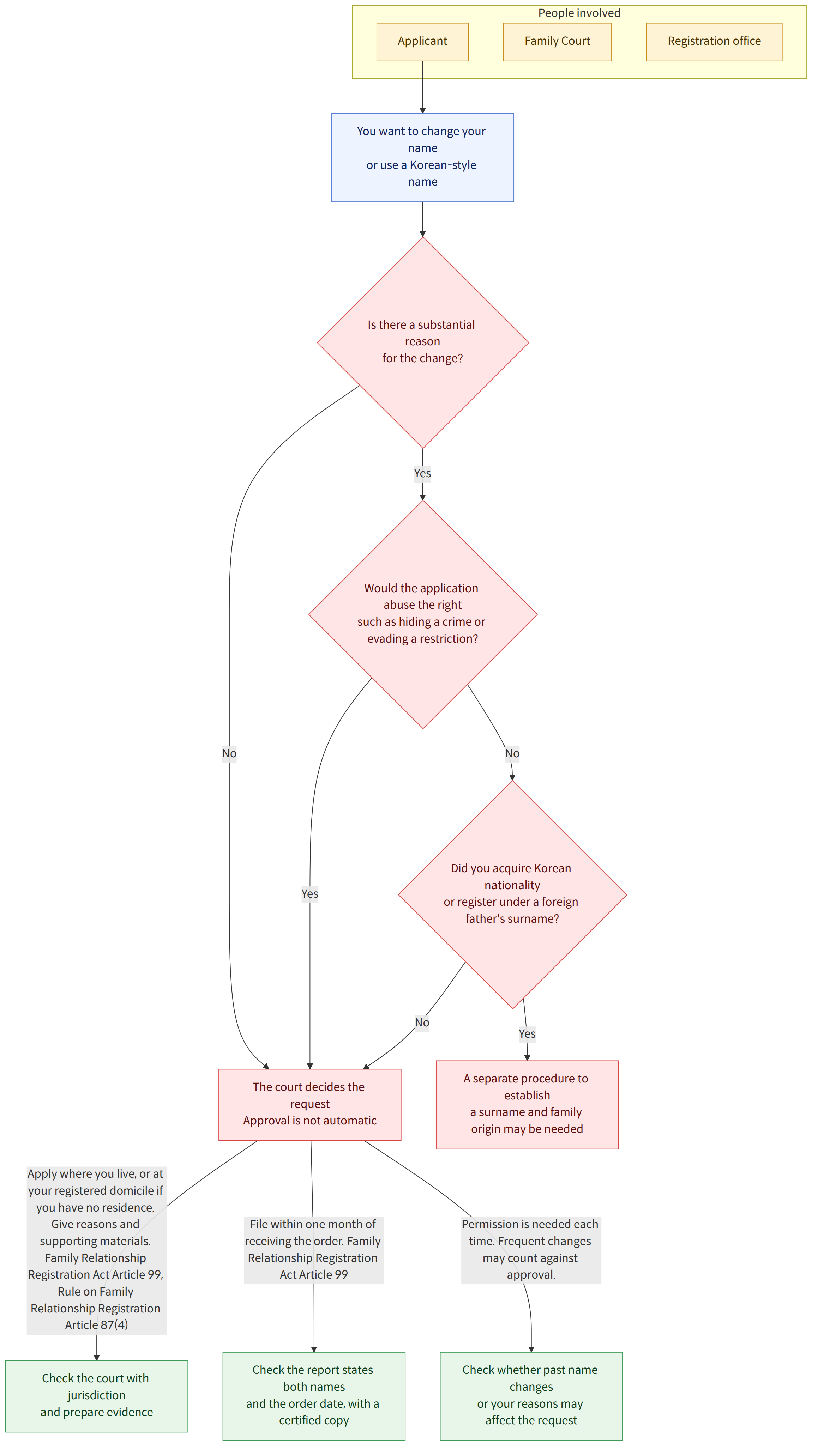
As a general rule, changing your name requires permission from the Family Court, and you must prepare reasons for the change and materials supporting them. A person who has acquired Korean nationality, or a person registered under a foreign father's surname, may need to complete a procedure to establish or create a surname and family origin in addition to changing their name in order to adopt a Korean-style surname and given name.
At a glance
Key points
- Apply to the Family Court with jurisdiction over your place of residence. If you have no place of residence, apply to the Family Court with jurisdiction over your registered domicile. Explain your reasons clearly in the application and attach supporting materials (Family Relationship Registration Act, Article 99 (가족관계의 등록 등에 관한 법률 제99조); Rule on Family Relationship Registration, Article 87(4) (가족관계의 등록 등에 관한 규칙 제87조 제4항)).
- The cited case-law standard is that permission is generally appropriate if there is a substantial reason to allow the name change and the application does not constitute abuse of the right to apply, such as to conceal a crime or evade a legal restriction (Supreme Court Order, November 16, 2005, 2005Seu26, and others (대법원 2005. 11. 16.자 2005스26 결정 등)).
- After the court grants permission to change your name, you must file a name-change report within one month from the day you receive the order. State your former and new names and the date of the order in the report, and attach a certified copy of the order (Family Relationship Registration Act, Article 99 (가족관계의 등록 등에 관한 법률 제99조)).
- There is no legal basis for limiting the number of name changes, but you must obtain permission each time you apply. Frequent name changes or reasons that are difficult to accept as reasonable may weigh against granting permission (Examples 5 and 14).
- The name-change procedure is also required to add Chinese characters to a Korean-script name, change a name recorded in both Korean script and Chinese characters to a Korean-script-only name, or change the Chinese characters in a name. You must also follow the name-change procedure if you want the name in the resident registration record to be reflected in the register when the two names differ (Examples 10–13).
- A person who has acquired Korean nationality and wishes to use a Korean-style surname and given name may need to obtain separate permission to establish a surname and family origin and to change their name (Example 8). A person registered under a foreign father's surname and a foreign-style name who wishes to take their Korean mother's surname and use a Korean-style name must complete the surname-creation procedure and the name-change procedure (Example 9).
- The guidance states that wanting to change a surname in the register to an English-style spelling, by itself, is unlikely to qualify as a reason to correct the register or as a substantial reason to change one's name (Family Relationship Registration Act, Article 18(1) (가족관계의 등록 등에 관한 법률 제18조 제1항); Example 4).
- A child's name must use Korean script or Chinese characters in ordinary use. Even though parents' freedom to choose a name is protected, a birth report may not be accepted if the name is obscure or difficult to pronounce and may seriously disrupt the child's social life (Family Relationship Registration Act, Article 44(3) (가족관계의 등록 등에 관한 법률 제44조 제3항)).
Frequently asked questions
Q. Where do I apply to change my name, and what documents must I submit?
State the requested relief and reasons in the application for permission to change your name, and submit it to the Family Court with jurisdiction over your place of residence. If you have no place of residence, apply to the Family Court with jurisdiction over your registered domicile. Attach supporting materials, such as certificates of registered matters and a copy of your resident registration record.
Q. Can I be permitted to change my name if I am teased or suffer severe distress because of it?
Under the standards set out in the cited case law, permission is generally appropriate if there is a substantial reason to allow the name change and no circumstances suggesting abuse of the right to apply. Distress caused by a name may be a reason for applying, and it is advisable to submit materials supporting those circumstances.
Q. Can I change my name after receiving bankruptcy relief or a discharge?
A cited case states that the fact that an applicant gave bankruptcy and discharge as reasons for changing their name does not, by itself, establish that they abused their right to apply. However, the court decides whether to grant permission based on the reasons for the application and whether it amounts to abuse.
Q. When and how must I report a name change after receiving permission?
You must file a name-change report within one month from the day you receive the order granting permission. The report must state your former name, new name, and the date of the order. Attach a certified copy of the order and submit the report to the head of the city, county, town, or township office for your registered domicile, the reporting person's address, or the place where they are currently located.
Q. Can I change my name only once?
There is no legal basis for limiting the number of times a person may change their name, so you may apply again after changing it once. However, permission is not guaranteed, and there have been cases in which an application to change a name again just a few months later was denied.
Q. How can I change to a Korean-style surname and given name after acquiring Korean nationality?
The cited example explains that a person who has acquired Korean nationality and wishes to use a Korean-style surname and given name must obtain permission to establish a surname and family origin (seongbon) and also obtain separate permission to change their name. A person registered under a foreign father's surname and a foreign-style name who wishes to take their Korean mother's surname and use a Korean-style name must also complete the surname-creation procedure and the name-change procedure. These requirements cannot be replaced by a supplementary report or correction of the register.
Q. Do I need to apply for a name change to add Chinese characters to my name in the register or to change the characters?
If you wish to add Chinese characters to a name that was registered in Korean script only at birth, you must follow the name-change procedure rather than file a supplementary report. The name-change procedure is also required to change a name recorded in both Korean script and Chinese characters to a Korean-script-only name, or to change the Chinese characters while keeping the same pronunciation.
Q. Can I change the name in the family relations register to match the name in my resident registration record?
The guidance states that if the name in the resident registration record differs from the name in the family relations register, you must follow the court's name-change procedure to have the name shown in the resident registration record entered in the register. This cannot be handled simply by correcting the register.
Q. Can I change my surname to match an English-style spelling or give my child an unusual name?
The guidance states that changing a surname solely because you want an English-style spelling does not qualify as a reason to correct the register or as a substantial reason to change your name. Parents may choose their child's name freely, but a birth report may not be accepted if the name is not ordinarily used and is difficult to pronounce, creating a risk of serious disruption to the child's social life.
Relevant laws
- Family Relationship Registration Act, Article 99 (가족관계의 등록 등에 관한 법률 제99조)
- Family Relationship Registration Act, Article 44(3) (가족관계의 등록 등에 관한 법률 제44조 제3항)
- Family Relationship Registration Act, Article 18(1) (가족관계의 등록 등에 관한 법률 제18조 제1항)
- Rule on Family Relationship Registration, Article 87(4) (가족관계의 등록 등에 관한 규칙 제87조 제4항)
- Constitution of the Republic of Korea, Article 36(1) (헌법 제36조 제1항)
- Constitution of the Republic of Korea, Article 10 (헌법 제10조)
Watch out for
- Even after receiving permission to change your name, you must file a report. You must do so within one month from the day you receive the order granting permission.
- You must prepare reasons for changing your name and materials supporting them. Permission may be denied if circumstances suggest abuse of the right to apply, such as concealing a crime or evading a legal restriction.
- If you need to establish or create a surname and family origin, do not assume that a name change alone will change both your surname and given name. Confirm whether you must also complete the relevant procedure.
- The absence of a limit on the number of name changes does not mean that repeat applications are automatically granted. Frequent name changes or reasons that are difficult to justify may result in denial.
Source cases
This guide was compiled by AI from the following Korea Legal Aid Corporation consultation cases (in Korean).
This guide is general legal information about Korean law, not legal advice for your situation. For a specific case, consult a lawyer or the Korea Legal Aid Corporation (call 132 in Korea).