
Guide to the Procedure and Application for Establishing a Family Relations Register
Based on 13 consultation cases · Updated · Translated from the Korean original.
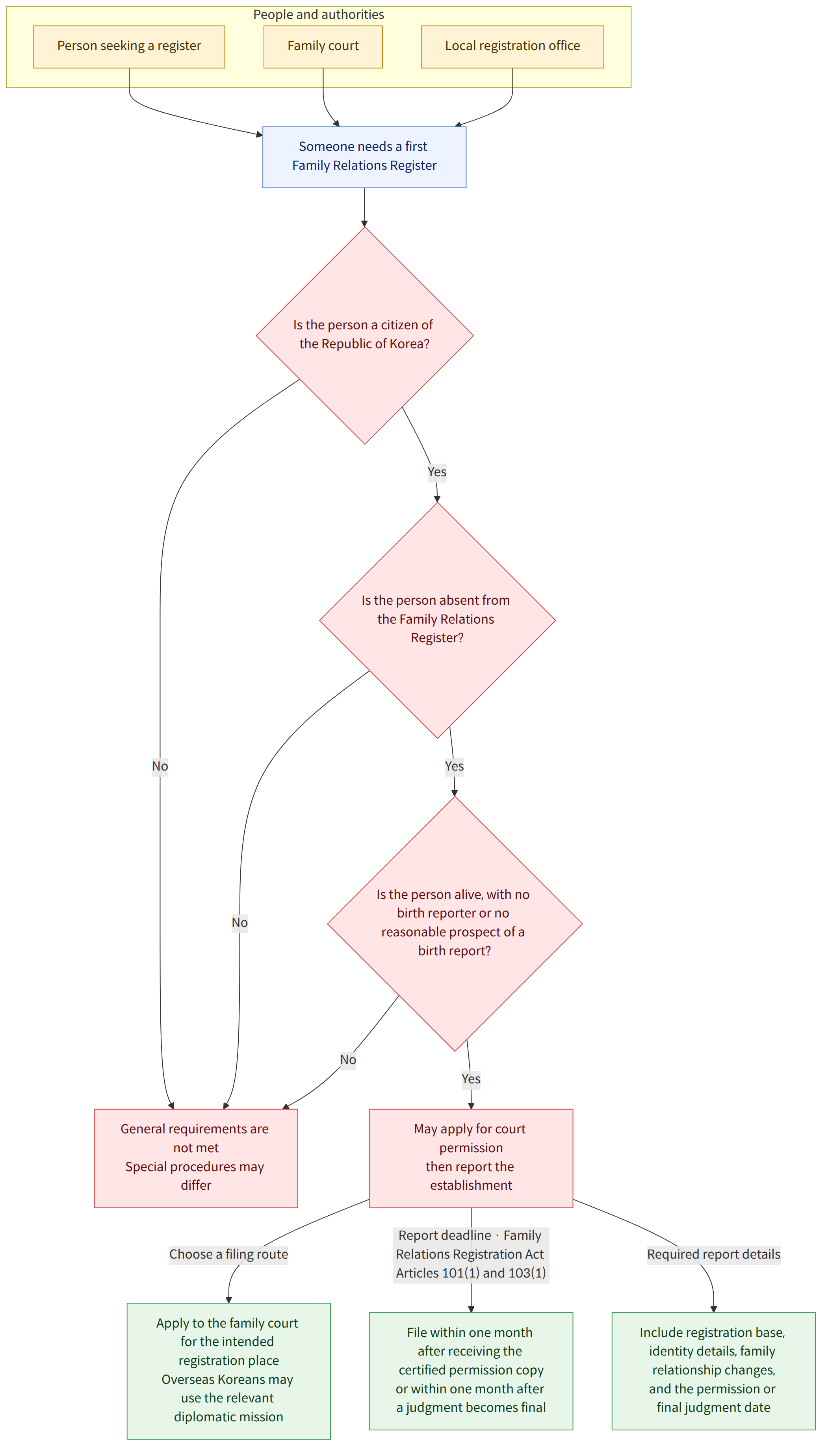
If you are a citizen of the Republic of Korea, have no Family Relations Register, and cannot reasonably expect your birth to be reported, you may apply to establish a Family Relations Register with permission from the family court. After permission is granted, you must report the establishment within the prescribed period. Different procedures may apply depending on the circumstances, including cases involving abandoned children, overseas Koreans, or a closed register.
At a glance
Key points
- Establishing a Family Relations Register is the procedure by which a citizen of the Republic of Korea who has no Family Relations Register obtains one for the first time, after receiving court permission and filing a report with the head of a Si, Gu, Eup, or Myeon.
- The requirements are that the person is a citizen of the Republic of Korea, is not recorded in the Family Relations Register, has no person obligated to report their birth or cannot reasonably be expected to have their birth reported, and is alive.
- As a general rule, the application must be filed with the family court having jurisdiction over the place where the person intends to register. The report may be filed at the person’s registration base or at the reporting person’s address or current location.
- If the family court grants permission, the report must be filed within one month from the date the certified copy of the permission is received. Establishment based on a final judgment must be reported within one month from the date the judgment becomes final (Family Relations Registration Act, Article 101(1) and Article 103(1) (가족관계의 등록 등에 관한 법률 제101조 제1항, 제103조 제1항)).
- The report to establish a Family Relations Register must state the registration base; the person’s name, family origin, sex, date of birth, and resident registration number; the occurrence and changes of family relationships; and the date permission was granted or the date the judgment became final (Family Relations Registration Act, Article 101(2) and Article 9(2) (가족관계의 등록 등에 관한 법률 제101조 제2항, 제9조 제2항)).
- For an abandoned child whose parents are unknown, the discovery must be reported to the head of a Si, Gu, Eup, or Myeon. The child’s register may then be created after obtaining court permission to establish the child’s family origin and surname. A separate adoption procedure is required if the child is to be adopted afterward.
- If an existing register has been closed following a judgment on parentage and a birth report cannot reasonably be expected, an application for permission to establish a register may be made with a certificate showing the registration details in the closed register, the judgment, and a certificate confirming that the judgment is final.
- An overseas Korean may, after deciding on a registration base, submit the application to the head of the overseas diplomatic mission with jurisdiction. The application may also be submitted directly to the family court or the head of the relevant Si, Gu, Eup, or Myeon having jurisdiction over the registration base chosen for convenience.
Frequently asked questions
Q. Who may apply to have a Family Relations Register established?
The requirements described in the example are that the person is a citizen of the Republic of Korea, is not recorded in the Family Relations Register, has no person obligated to report their birth or cannot reasonably be expected to have their birth reported, and is alive. The procedure is for the person without a Family Relations Register to apply personally; establishment of a register for a person who has already died is not permitted.
Q. Where should I apply to have a Family Relations Register established, and where should I file the report?
As a general rule, the application for permission must be filed with the family court having jurisdiction over the place where the person intends to register. The report may be filed at the person’s registration base or at the reporting person’s address or current location. Reports concerning overseas Koreans may also be filed at the Family Relations Registration Office for Overseas Koreans.
Q. After receiving permission, how soon must I report the establishment of a Family Relations Register?
If the family court grants permission, the report must be filed within one month from the date the certified copy of the permission is received. If a final judgment establishing the register is issued, the report must be filed within one month from the date the judgment becomes final (Family Relations Registration Act, Article 101(1) and Article 103(1) (가족관계의 등록 등에 관한 법률 제101조 제1항, 제103조 제1항)).
Q. What information must be included in an application to establish a Family Relations Register?
The report must state the registration base; the person’s name, family origin, sex, date of birth, and resident registration number; the occurrence and changes of family relationships, such as birth, marriage, and death; and the date permission to establish the register was granted or the date the judgment became final. If a foreign national is recorded as a family member, their name, sex, date of birth, nationality, and alien registration number must also be stated (Family Relations Registration Act, Article 101(2) and Article 9(2) (가족관계의 등록 등에 관한 법률 제101조 제2항, 제9조 제2항)).
Q. How do I register a child whose parents are unknown if I have found and am raising the child?
For an abandoned child, the person who finds the child or the police officer notified of the discovery must notify the head of the relevant Si, Gu, Eup, or Myeon within 24 hours. The procedure described is then to obtain court permission to establish the child’s family origin and surname, and create a Family Relations Register. A separate adoption procedure is required if the child is to be adopted after the register is created.
Q. Can a Family Relations Register be established even if an existing register was closed following a judgment on parentage?
If a Family Relations Register has been closed as a result of a judgment on parentage and a birth report cannot reasonably be expected, an application may be made for permission to establish a Family Relations Register. In the example, the required attachments are a certificate showing the registration details in the closed register, the judgment on parentage, and a certificate confirming that the judgment is final.
Q. How can an overseas Korean apply to have a Family Relations Register established?
After deciding on a registration base, you may submit the application to the head of the overseas diplomatic mission with jurisdiction over your address. You may also submit it directly to the family court or the head of the relevant Si, Gu, Eup, or Myeon having jurisdiction over the registration base you chose for your convenience.
Q. Can a missing child receive permission to have a Family Relations Register established?
The guidance states that a child who qualifies as a missing child and whose guardian has been identified is not eligible for permission to establish a register. This is because it is likely that the child’s birth was reported and a Family Relations Register was created.
Q. Can a Family Relations Register be established for a family member who died without one?
A Family Relations Register may not be established for an unregistered person who has already died. The example describes the procedure for reporting the death based on a death certificate, a post-mortem examination certificate, or another written document proving the death, or for reporting a declaration of disappearance.
Relevant laws
- Family Relations Registration Act, Article 9(2) (가족관계의 등록 등에 관한 법률 제9조 제2항)
- Family Relations Registration Act, Article 20 (가족관계의 등록 등에 관한 법률 제20조)
- Family Relations Registration Act, Article 84 (가족관계의 등록 등에 관한 법률 제84조)
- Family Relations Registration Act, Article 85 (가족관계의 등록 등에 관한 법률 제85조)
- Family Relations Registration Act, Article 101(1)–(2) (가족관계의 등록 등에 관한 법률 제101조 제1항·제2항)
- Family Relations Registration Act, Article 103(1) (가족관계의 등록 등에 관한 법률 제103조 제1항)
- Family Relations Registration Rules, Article 69(1) (가족관계등록 등에 관한 규칙 제69조 제1항)
- Special Act on the Establishment of Family Relations Registers, Correction of Family Relations Registers, and Reorganization of Family Relations Registers for Overseas Koreans, Article 3(1) (재외국민의 가족관계등록 창설, 가족관계등록부 정정 및 가족관계등록부 정리에 관한 특례법 제3조 제1항)
- Special Act on the Establishment of Family Relations Registers, Correction of Family Relations Registers, and Reorganization of Family Relations Registers for Overseas Koreans, Article 4(1) (재외국민의 가족관계등록 창설, 가족관계등록부 정정 및 가족관계등록부 정리에 관한 특례법 제4조 제1항)
- Family Relations Registration Directive No. 413, Articles 1–5 (가족관계등록예규 제413호 제1조부터 제5조)
- Former Family Register Act, repealed, Article 57 (폐지된 구 호적법 제57조)
Watch out for
- Even if permission to establish a register is granted, a report must still be filed. Be sure not to miss the one-month deadline, which runs from the date you receive the certified copy of the permission or from the date the judgment becomes final.
- An unregistered person who has already died is not eligible to have a Family Relations Register established. Check the applicable procedure, such as reporting the death or reporting a declaration of disappearance.
- A child who qualifies as a missing child and whose guardian has been identified may not be eligible for permission to establish a register.
- The procedure for entering an abandoned child in the Family Relations Register is different from adopting the child as the caregiver’s child. After creating a register for the child, you must complete a separate adoption procedure.
Source cases
This guide was compiled by AI from the following Korea Legal Aid Corporation consultation cases (in Korean).
- 기아를 취학연령까지 양육한 경우 가족관계등록방법
- 이미 사망한 자에 대하여 가족관계등록창설이 허용되는지 여부
- 친자관계의 판결에 의한 가족관계등록창설
- 어려서 사망한 자매의 호적(또는 가족관계등록부)으로 출생 후 현재까지 사회생활을 영위해 온 사람이 자신의 가족관계등록부를 가질...
- 재외국민의 경우 가족관계등록창설 절차
- 가족관계등록 창설신고 신청서의 작성사항
- 신청취지에 적을 사항
- 가족관계등록창설신고의 기한
- 가족관계등록창설의 허가장소 및 신고장소
- 실종아동의 경우
- 재외국민의 경우 가족관계등록창설 신청시 제출 서류
- 가족관계등록창설의 허가요건
- 가족관계등록창설의 의의
This guide is general legal information about Korean law, not legal advice for your situation. For a specific case, consult a lawyer or the Korea Legal Aid Corporation (call 132 in Korea).