
Guide to the Duty of Support Among Relatives and Claims for Support Payments
Based on 15 consultation cases · Updated · Translated from the Korean original.
Who has a duty to provide support, and the conditions under which that duty is recognized, depend on the relationship and the parties' living circumstances. This guide examines the standards for issues such as support for adult children, claims for past support, and apportionment among multiple persons with a duty to provide support, as well as when a change may be requested from the court.
At a glance
Key points
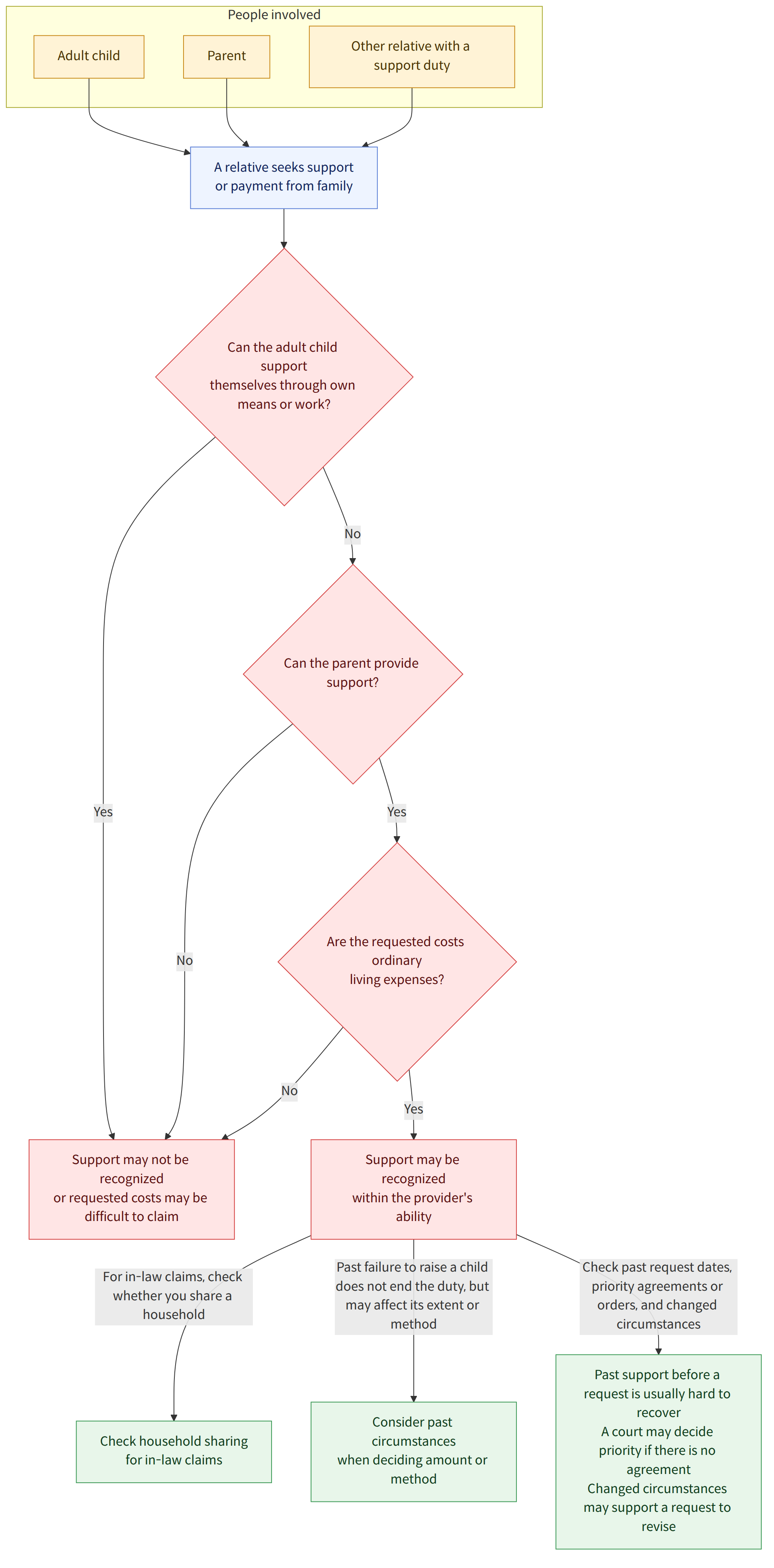
- Mutual support between spouses is a primary duty of support and an essential obligation of the marital relationship. A parent's duty to support an adult child is a secondary duty of support that may arise when, for example, the child cannot maintain a livelihood through their own means or work (Civil Act, Article 826(1), Article 974, subparagraph 1, and Article 975 (민법 제826조 제1항, 제974조 제1호, 제975조)).
- The support payments an adult child may claim from a parent are based on ordinary living expenses, within the parent's ability to provide support. Unless there are special circumstances, the cost of studying abroad is difficult to regard as an ordinary living expense.
- Even if a parent did not properly raise a child in the past, the duty of support between lineal relatives does not automatically cease to exist. Past circumstances may be taken into account in deciding the extent or method of support.
- If multiple persons have a duty to provide support and there is no agreement on priority, a determination of priority may be requested from the court, which may also designate multiple persons to provide support (Civil Act, Article 976 (민법 제976조)).
- If circumstances change after an agreement or court determination has set the priority or method of support, a request may be made to the court for revocation or modification (Civil Act, Article 978 (민법 제978조)).
- One case indicates that it is difficult to seek reimbursement for past support from other persons with a duty to provide support when support was provided without an agreement or court determination on priority. Unless there are special circumstances, it is also difficult to claim past support payments for a period before performance of the duty to provide support was requested.
- If support agreed upon as a condition of a gift subject to an obligation is not provided, the gift may be rescinded; rescission of such a gift may give rise to a question of restoration to the original state (Civil Act, Articles 561 and 548 (민법 제561조, 제548조)).
Frequently asked questions
Q. Can an adult child claim the cost of studying abroad from their parents as support?
Unless there are special circumstances, the costs of studying abroad are difficult to regard as ordinary living expenses, so it is difficult to claim them as support payments. Whether an adult child is entitled to support is determined by considering whether the child is in financial hardship and unable to support themselves through their own means or work, whether the parents have the ability to provide support, and other relevant factors.
Q. Do my parents have a duty to support me even if they did not raise me in the past?
The precedent cited in the case states that the duty to provide support does not itself change depending on whether the parents fulfilled their duty to raise the child in the past. However, past circumstances may be taken into account in deciding the extent or manner of support.
Q. Do I have to support my in-laws or stepparents if they live separately from me after my spouse dies?
According to the precedent in the case, the relationship by affinity may continue even if a spouse does not remarry after their spouse dies, but a duty of support among relatives is recognized only when they share a household. In the case, the parties lived separately and did not share a household, so no duty of support was recognized.
Q. Are educational expenses included in support payments for a minor child?
It may be included. Costs necessary for a child's education, taking into account the child's age, talents, status, and position, may also qualify as support payments. The specific scope is determined by considering the child's standard of living and the support provider's financial means, among other factors.
Q. Can I recover past support payments that arose before I requested support?
Between spouses, past support payments may generally be claimed for the period after support was requested but the other party failed to provide it and thus fell into default, unless there are special circumstances. The precedent discussed in the case takes the position that expenses incurred before a request for performance of the duty to provide support are, in principle, difficult to claim.
Q. How should support for parents be divided if there are several siblings?
If there is no agreement on the order of priority for providing support, a determination of priority may be requested from the court, and the court may designate multiple persons with a duty to provide support. By contrast, one case indicates that it is difficult to seek reimbursement for past support from other persons with a duty to provide support when support was provided without an agreement or court determination on priority or method.
Q. Can we renegotiate the method of providing support if circumstances change after it has been decided?
The parties may discuss the matter again and agree to a change. If they cannot reach agreement and circumstances have changed with respect to the priority, extent, or method of support, or who must provide or receive it, they may ask the court to revoke or modify the existing agreement or judgment.
Q. What happens if I received a house after agreeing to take care of and support my parents, but fail to keep that promise?
A precedent discussed in the case states that, where a gift is subject to the condition that the recipient faithfully support the parents, the donor may rescind the contract if the agreed support is not provided. If the contract is rescinded, restoration to the original state may require cancellation of the registration transferring ownership of the real estate.
Q. Can a child who has a duty to support a parent tell them to leave the child's home?
In a case where a child demanded that a parent leave the home without taking any other measures, even though the parent was elderly, had a chronic illness, and had no suitable place to live, the court found that the demand amounted to an abuse of rights. However, the same conclusion cannot be assumed in cases with different facts.
Relevant laws
- Civil Act, Article 775(2) (민법 제775조 제2항)
- Civil Act, Article 826(1) (민법 제826조 제1항)
- Civil Act, Article 833 (민법 제833조)
- Civil Act, Article 974, subparagraphs 1 and 3 (민법 제974조 제1호·제3호)
- Civil Act, Article 975 (민법 제975조)
- Civil Act, Article 976 (민법 제976조)
- Civil Act, Article 978 (민법 제978조)
- Civil Act, Article 556(1), subparagraph 2 (민법 제556조 제1항 제2호)
- Civil Act, Article 558 (민법 제558조)
- Civil Act, Article 561 (민법 제561조)
- Civil Act, Article 548 (민법 제548조)
- Civil Act, Article 913 (민법 제913조)
- Family Litigation Act, Article 2 (가사소송법 제2조)
- Family Litigation Act, Article 50 (가사소송법 제50조)
Watch out for
- Whether the relationship is one that gives rise to a duty of support must be considered separately from the actual scope of support payments. The specific circumstances, including the need for support, the support provider's financial means, and the parties' standard of living, are taken into account.
- The standards for support of adult children, the care and education of minor children, and support between spouses differ, so care should be taken not to assess them using the same standard.
- The outcome of a claim for past support payments, a reimbursement claim against other persons with a duty to provide support, or a request to modify an existing agreement may depend on when the claim is made and whether there was an agreement or court determination.
Source cases
This guide was compiled by AI from the following Korea Legal Aid Corporation consultation cases (in Korean).
- 계모가 별거하는 전처소생에게 부양료를 청구할 수 있는지
- 성년의 자녀가 부모를 상대로 유학비용 상당의 부양료를 청구할 수 있는지
- ‘충실한 부양’을 조건으로 한 부담부 증여에서의 부양의 정도
- 수인의 부양의무자가 그 순위를 정하지 아니한 경우 부양료 구상청구가 가능한지
- 아들이 사망한 경우 별거하는 며느리에게 부양의무가 있는지
- 부양의무에 관한 협의가 있은 후 이를 변경할 수 있는지
- 부양의무자가 부양권리자에게 자기 소유의 주택에서 퇴거 및 인도청구를 할 수 있는지
- 혼외자를 인지하지 않은 생부에 대하여 부양료구상청구가 가능한지
- 부부간 부양의무는 부모의 성년자 부양의무에 우선판단
- 양육을 내팽개친 채 수년 간 외도한 부모에 대하여 부양의무가 있는지
- 통상의 교육비가 미성년 자녀의 부양료에 포함되는지
- 과거부양료 청구
- 장인ㆍ장모 또는 시부모에게 부양의무가 있는지
- 자녀의 혼인비용을 부모에게 청구할 수 있는지
- 부양의무자가 여러 명인 경우
This guide is general legal information about Korean law, not legal advice for your situation. For a specific case, consult a lawyer or the Korea Legal Aid Corporation (call 132 in Korea).