
Fraud and Extortion: Elements and Examples
Based on 48 consultation cases · Updated · Translated from the Korean original.
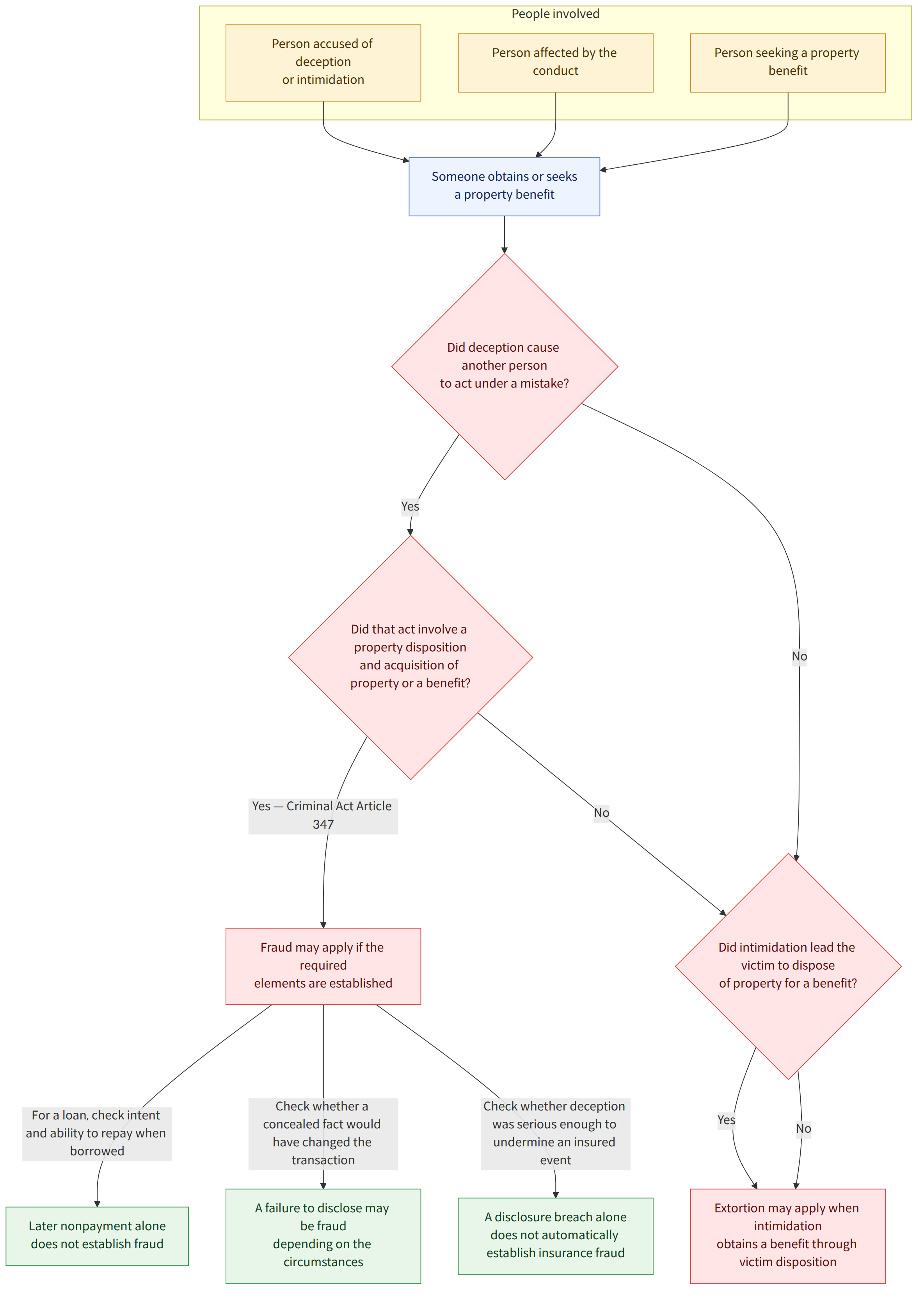
The key issue in fraud is whether deception caused another person to act under a mistake, leading to the acquisition of property or a property benefit; merely being unable to repay money does not immediately establish fraud. Extortion involves obtaining a property benefit by frightening someone through intimidation, and requires consideration of whether the victim took an act of disposition.
At a glance
Key points
- Fraud requires consideration of the connection between deception, mistake, an act of disposition involving property, and the acquisition of property or a property benefit (Criminal Act, Article 347 (형법 제347조)).
- For fraud involving a loan, the key issue is whether the borrower intended and was able to repay when borrowing the money; subsequent nonpayment alone does not establish fraud.
- If someone knowingly fails to disclose a fact that would have prevented the other party from entering into the transaction, the conduct may, depending on the circumstances, constitute fraud by breach of a duty to disclose.
- Even when someone is induced to sign or affix their seal without properly understanding the meaning of a dispositive document, the act of disposition required for fraud by procuring a signature may be established.
- Insurance fraud does not automatically arise from a breach of the duty of disclosure; it must be considered whether there was intentional deception serious enough to undermine the fortuity of the insured event.
- Fraud may be at issue if exaggeration or falsehood in product advertising goes beyond what is socially acceptable and misrepresents a fact material to the transaction.
- Intimidation for extortion may include not only explicit words but also conduct or a show of authority that causes someone to perceive a threat of harm; however, the victim must have taken an act of disposition to provide a property benefit.
Frequently asked questions
Q. Does failing to repay borrowed money amount to fraud?
If the borrower intended and was able to repay when taking out the loan, but later became unable to repay because circumstances worsened, nonpayment alone does not establish fraud. Intent to defraud is assessed by considering the borrower’s financial circumstances when taking out the loan, the purpose of the loan, the repayment plan, and the circumstances of the transaction as a whole.
Q. Is it fraud to lease a home without disclosing that it is in foreclosure?
If it is clear that the tenant would not have entered into the lease had they known that foreclosure proceedings were underway, the landlord may have a duty to disclose this. Case law has been cited holding that the conclusion does not change merely because the tenant could have checked the property register.
Q. Is it fraud to conceal that a real estate sale contract has already been made with someone else?
The mere failure to disclose that another sale contract had already been entered into does not necessarily establish fraud. However, fraud may be at issue if the fact was used to defraud a new buyer of the purchase price, or if circumstances that would obstruct the buyer’s ability to secure their rights or perform the contract were concealed.
Q. What happens if someone claims to have been hospitalized to receive insurance benefits when they did not actually receive inpatient treatment?
Whether inpatient treatment was genuinely provided is assessed by considering the patient’s symptoms and treatment, their stay at the hospital, and their conduct. Fraud may be at issue if someone obtained a hospital admission certificate and claimed insurance benefits even though outpatient treatment would have been sufficient. A doctor who knowingly issued the certificate to facilitate the claim may be liable for aiding and abetting fraud.
Q. When does failing to disclose a past medical condition when taking out insurance amount to fraud?
A breach of the duty of disclosure does not automatically constitute criminal fraud. It must be considered whether the conduct amounted to deception serious enough to undermine the fortuity of the insured event, such as concealing that the insured event had already occurred or that its occurrence was highly likely.
Q. Is it fraud to obtain someone’s signature or seal by misrepresenting the contents of a document?
Even if the person who signed did not properly understand the document’s meaning or consequences, an act of disposition may be found if they were deceived into signing or affixing their seal under a mistake, thereby causing property loss. The case concerns obtaining a signature and seal on a mortgage agreement by falsely claiming that the document was an application for permission to trade land.
Q. Is it extortion to obtain a property benefit by making threats or throwing one’s weight around?
Even without an express threat of harm, conduct or a person’s position or show of authority may amount to intimidation for extortion if it causes the other person to anticipate an unfair disadvantage. However, extortion may not be established if the victim cannot be said to have taken an act of disposition transferring a property benefit—for example, where someone flees after assaulting another person without paying a fare.
Q. Is it litigation fraud to make false statements or submit false evidence in a lawsuit?
A person does not commit litigation fraud merely by being mistaken about the facts or the law and believing and asserting that they have a right. The issue should be assessed cautiously, and only where the elements of a crime are clear, such as when someone knowingly makes an obviously false claim or fabricates evidence. In the case described, withdrawing a false claim is explained as an attempt.
Q. Are the losses combined if someone commits fraud against multiple victims using the same method?
According to the case law cited in the examples, even where there is a single criminal intent and the same method is used, the legal interests of multiple victims are independent, and a separate count of fraud may be established for each victim. Accordingly, the gains obtained from multiple victims cannot automatically be aggregated to apply the Act on the Aggravated Punishment, etc. of Specific Economic Crimes.
Relevant laws
- Criminal Act, Article 347 (형법 제347조)
- Criminal Act, Article 347-2 (형법 제347조의2)
- Criminal Act, Article 350 (형법 제350조)
- Criminal Act, Article 360 (형법 제360조)
- Credit Finance Business Act, Article 70(1)3 (여신전문금융업법 제70조 제1항 제3호)
- Commercial Act, Article 651 (상법 제651조)
- Civil Act, Article 103 (민법 제103조)
- Act on the Aggravated Punishment, etc. of Specific Economic Crimes, Article 3(1) (특정경제범죄 가중처벌 등에 관한 법률 제3조 제1항)
- Punishment of Minor Offenses Act, Article 1(11) (경범죄처벌법 제1조 제11호)
- Pharmaceutical Affairs Act, Article 68 (약사법 제68조)
- Medical Service Act, Article 56(3) (의료법 제56조 제3항)
Watch out for
- Intent to commit fraud must be assessed at the time of the transaction; it should not be determined solely from the fact that the contract was not performed.
- For fraud by omission, the specific circumstances of the transaction must be considered, including whether the other party was mistaken and whether there was a duty to disclose.
- An act that frightens someone may not, by itself, be sufficient for extortion; it must also be determined whether the victim thereby provided or disposed of a property benefit.
Source cases
This guide was compiled by AI from the following Korea Legal Aid Corporation consultation cases (in Korean).
- 이른바 서명사취도 사기죄에 해당하는지
- 거스름돈을 초과 수령한 후 반환하지 않은 경우 처벌 여부
- 훔친 신용카드로 자동인출기에서 현금을 인출한 경우
- 신용카드를 임의로 가져 가 현금인출 후 곧 반환한 경우
- 아들 낳는 시술 후 효과가 없었던 경우 사기죄 여부
- 입원치료를 받을 필요가 없는 자가 보험금 수령을 위해 입원한 경우
- 부동산에 대한 매매계약을 체결하였는데 매도인이 다른 사람과 이미 매매계약을 체결하고 중도금까지 받은 경우 사기죄 여부
- 보험계약자가 상법상고지의무를 위반하여 보험사기죄가 성립하기 위한 요건
- 간접사실들을 근거로 보험금 부정취득 목적으로 다수의 보험계약을 체결하여 보험사기가 성립한다고 판단할 수 있는지 여부
- 어음할인에 의한 사기의 경우 편취금액의 기준은 무엇인지
- 월급도 받지 못하고 별다른 재산도 없는 상가 관리소장이 재력있는 사람을 연대보증인으로 세우면서 돈을 차용한 경우 사기죄 여부
- 빌려준 돈을 갚지 않을 경우 사기죄가 성립되는지
- 기자가 불매운동을 이유로 광고를 따낸 경우에도 공갈죄가 성립하는지
- 타인명의를 모용하여 발급받은 신용카드로 현금대출 등을 받은 경우
- 과대광고로 침대를 판매한 경우 사기죄 성립 여부
- 대주가 차주의 신용 상태를 인식하고 변제불능의 위험을 예상할 수 있는 경우 사기죄 성립 여부
- 소송에서의 허위의 주장 및 증거제출이 사기죄가 되는지 여부
- 미신을 이유로 협박하여 돈을 받은 경우에도 공갈죄가 성립하는지
- 투자설명대로 일정기간 내에 원금을 반환할 수 없음에도 있는 것처럼 권유하는 투자했다가 원금도 돌려받지 못한 경우 사기죄 여부
- 임대차계약체결 시 경매 중인 사실을 알리지 않은 경우
- 폭력조직과 잘 알고 있다고 위세를 보이는 것도 공갈죄의 해악의 고지에 해당하는지
- 택시요금 지급을 면탈하기 위해 택시기사를 폭행하고 도주한 것이 공갈죄에 해당하는지
- 부녀를 기망하여 성행위 대가를 면한 경우 사기죄 여부
- 타인의 현금카드로 권한범위를 초과하여 현금을 인출한 경우
- 수인에 대하여 단일한 범의 아래 동일한 범행방법으로 사기범행한 경우 가중처벌 여부
This guide is general legal information about Korean law, not legal advice for your situation. For a specific case, consult a lawyer or the Korea Legal Aid Corporation (call 132 in Korea).