
When Are Crimes Concerning Gambling and Lottery Tickets Punishable?
Based on 13 consultation cases · Updated · Translated from the Korean original.
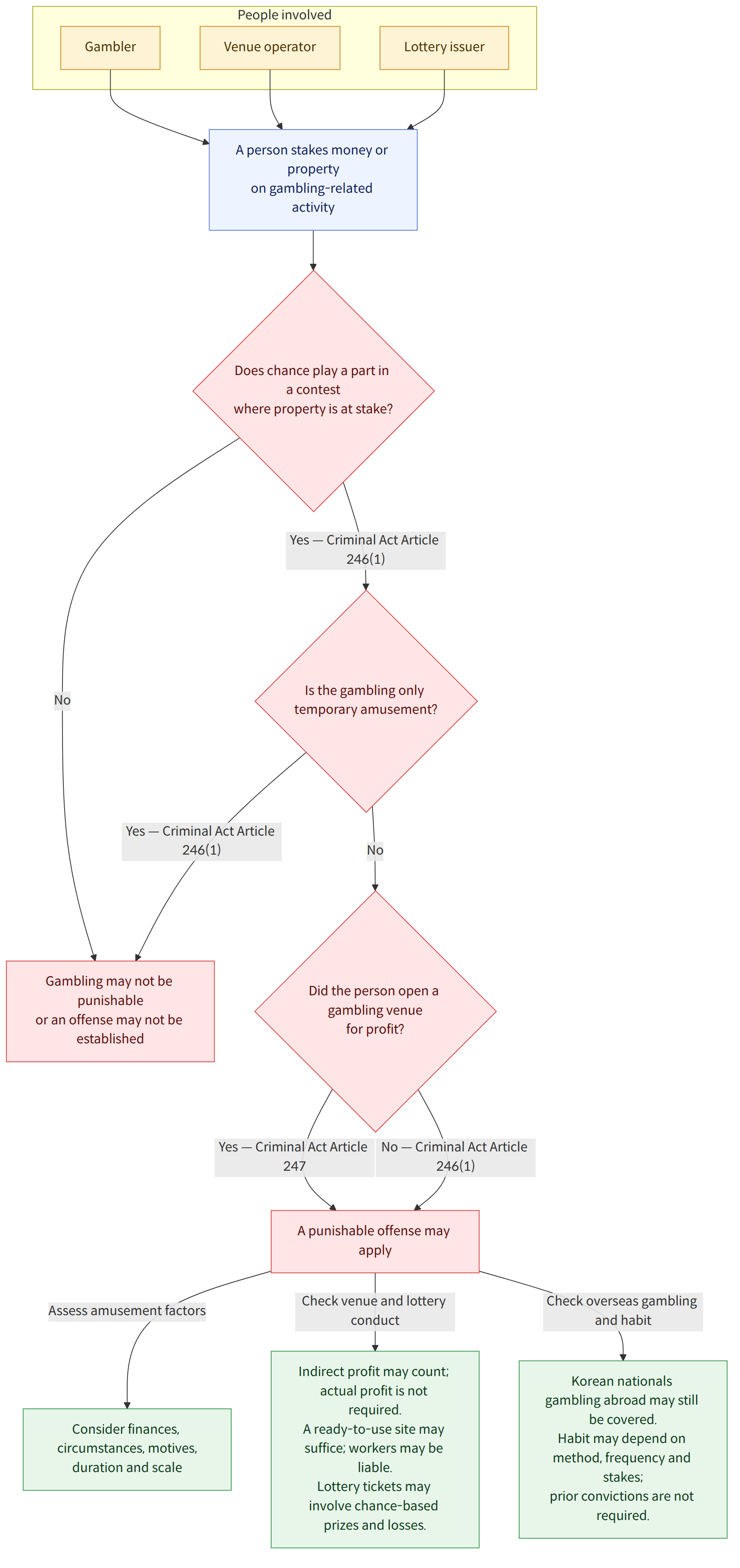
If a person stakes money or other property benefits on a contest whose outcome cannot be predicted with certainty or controlled, the offense of gambling may be established even if athletic skill affects the result. Whether the conduct amounts only to temporary amusement, whether the person arranged or opened a place for gambling, and whether the person acted habitually are assessed based on the specific circumstances.
At a glance
Key points
- Gambling is an act of staking property and contesting the gain or loss of property through a chance-based contest. Even if skill or ability affects the outcome, the offense of gambling may be established if chance plays even some part (Criminal Act, Article 246(1) (형법 제246조 제1항); Supreme Court, Judgment of October 23, 2008, Case No. 2006Do736).
- Even a small-stakes wager between friends may constitute gambling, but it may not be punishable if it amounts only to temporary amusement. This is assessed by considering the participants' occupations and financial circumstances, the circumstances and motives that led to the gambling, and its duration and scale, among other factors (Criminal Act, Article 246(1) (형법 제246조 제1항); Supreme Court, Judgment of February 9, 1990, Case No. 89Do1992).
- The Criminal Act may apply to Korean nationals who gamble at a casino abroad, and the fact that entry to the casino is permitted does not by itself exempt them from punishment. However, gambling at a casino where entry is permitted under applicable laws may be treated separately, and whether it amounts only to temporary amusement is also considered (Criminal Act, Article 3 (형법 제3조); Supreme Court, Judgment of April 23, 2004, Case No. 2002Do2518).
- The offense of opening a place for gambling may be established if a person opens a place or venue for gambling for profit. An intent to obtain indirect benefits may be found even if the person did not obtain profits directly, and it is not necessary for the person to have actually obtained a benefit (Criminal Act, Article 247 (형법 제247조); Supreme Court, Judgment of April 12, 2002, Case No. 2001Do5802).
- A part-time worker who knowingly takes part in work connected with opening a place for gambling may also be liable. Depending on the extent of the worker's involvement, liability as a co-principal or an aider or abettor may be at issue, and being a part-time worker does not by itself provide an exemption from liability. However, the extent of involvement and any profits may be considered in mitigation (Case 1).
- Once a gambling site is in a condition where property can pass between users, the offense of opening a place for gambling may be consummated regardless of whether users actually accessed the site and gambled (Criminal Act, Article 247 (형법 제247조); Supreme Court, Judgment of December 10, 2009, Case No. 2008Do5282).
- A lottery ticket involves issuing specific tickets to collect money or other valuables from many people, then giving some of them a benefit by a chance-based method such as a drawing, while causing the other participants to incur a loss. Its nature may remain unchanged even if it also serves an advertising function or another business bears the losses (Criminal Act, Article 248 (형법 제248조); Supreme Court, Judgment of December 26, 2003, Case No. 2003Do5433).
- Habituality is a characteristic of the offender: a propensity to gamble repeatedly. It may be found based on the method and frequency of gambling and the amount staked, even without prior gambling convictions. A person with a gambling habit may also commit the offense of aiding and abetting habitual gambling by aiding another person's gambling on a single occasion (Criminal Act, Article 246(2) (형법 제246조 제2항); Supreme Court, Judgment of July 11, 1995, Case No. 95Do955; Supreme Court, Judgment of April 24, 1984, Case No. 84Do195).
Frequently asked questions
Q. Can betting on golf or badminton, where skill matters, also constitute the offense of gambling?
It can. Even if a player's skill affects the outcome, the offense of gambling may be established if the result of each game cannot be predicted with certainty or freely controlled and chance plays a part.
Q. Can I be punished for playing Go-Stop for small stakes with friends?
If money was wagered, it may constitute gambling, but it may not be punishable if it amounts only to temporary amusement. The outcome is not determined solely by whether the participants are friends; it is assessed based on the amount and frequency, duration, circumstances that led to the gambling, and the participants' individual circumstances, considered together.
Q. Can I be punished for gambling at a casino abroad that I can legally enter?
That is possible. The fact that a person may enter a casino abroad, or that gambling is not punishable in that country, does not by itself make the conduct lawful under Korea's Criminal Act. Gambling at a casino where entry is permitted under applicable laws and whether the gambling amounts only to temporary amusement are considered separately.
Q. Can I be punished even if I only worked part-time at a gambling site?
If you knowingly took part in work connected with operating a gambling site, you may not be exempt from liability merely because you were working part-time. Depending on your specific role, liability as a co-principal or an aider or abettor may be at issue. The extent of your involvement and the wages you received may be considered in mitigation.
Q. If I created a gambling site but no users actually played games, does that mean the offense of opening a place for gambling was not established?
If a site was set up so that property could pass between users, the offense of opening a place for gambling may be consummated regardless of whether any user actually gambled. However, the stage of merely intending to create a site must be distinguished from a site that is actually in a condition where gambling is possible.
Q. Can a fishing pond or an adults-only PC café also be considered a place for gambling?
If, for profit, customers are given gift certificates or other property benefits based on a chance outcome, or a business provides online gambling and the topping up or exchange of game credits in return for a fee, the offense of opening a place for gambling may be at issue. The specific business model is examined, including the nature of any fees or prizes and how they were provided.
Q. Can someone who was deceived by rigged gambling and lost money also be punished for gambling?
In some cases, courts have held that the victim of rigged gambling did not commit the offense of gambling because the means of fraud controlled the outcome, leaving no element of chance. Those who took part in rigged gambling may be punished for fraud rather than gambling.
Q. Can the offense of habitual gambling be established even if I have no prior gambling convictions?
It can. A prior conviction or the number of times a person gambled is only one factor considered; a gambling habit may be found based on various circumstances, including the nature and method of the gambling, the size of the stakes, and the person's manner of participation.
Q. Can I face liability relating to criminal proceeds even if I did not personally keep money obtained through gambling?
If you received money through an account in another person's name while knowing that it was criminal proceeds, you may face liability for the actual receipt even if you did not personally keep any of the proceeds. The case explains that the actual recipient's liability does not disappear merely because the conduct was related to the employer's business.
Relevant laws
- Criminal Act, Article 3 (형법 제3조)
- Criminal Act, Article 246(1) and (2) (형법 제246조 제1항 및 제2항)
- Criminal Act, Article 247 (형법 제247조)
- Criminal Act, Article 248 (형법 제248조)
- Act on Regulation and Punishment of Criminal Proceeds Concealment, Article 4 (범죄수익은닉의 규제 및 처벌 등에 관한 법률 제4조)
Watch out for
- The fact that money was wagered does not lead to the same outcome in every case. Whether the gambling amounted only to temporary amusement is assessed by considering the duration and scale of the gambling and the participants' various circumstances.
- The offense of gambling is not ruled out merely because athletic skill affects the outcome. What matters is whether the result can be predicted with certainty or controlled, and whether chance plays a part.
- For the offense of opening a gambling site, the issue may be whether the site reached a condition in which property could pass between users, rather than whether users actually played games.
- Liability cannot be determined solely by whether someone was a part-time worker, had prior gambling convictions, or personally received profits. The person's involvement and the specific facts must be examined.
Source cases
This guide was compiled by AI from the following Korea Legal Aid Corporation consultation cases (in Korean).
- 아르바이트 학생의 도박개장죄 등 처벌 여부
- 도박죄에서의 ‘우연성’의 의미
- 배드민턴경기를 하면서 내기를 하는 경우 도박죄가 성립하는지 여부
- 해외여행 중 외국의 카지노에서 도박한 경우, 도박죄의 성립여부
- 친구들과 심심풀이 고스톱을 한 경우 도박죄가 성립하는지 여부
- 광고복권이 복표발매죄에 해당하는지 여부
- 친구들끼리 화투를 친 경우 도박죄가 성립하는지 여부
- 유료낚시터가 도박개장죄의 장소가 되는지 여부
- 사기도박의 피해자에게도 도박죄가 성립하는지 여부
- 성인피시방이 도박개장죄의 장소가 되는지 여부
- 도박전과가 없는 사람에게도 상습도박죄가 성립하는지 여부
- 도박개장죄의 기수 시기
- 상습도박방조죄의 상습의 의미
This guide is general legal information about Korean law, not legal advice for your situation. For a specific case, consult a lawyer or the Korea Legal Aid Corporation (call 132 in Korea).