
Guide to Applying to Change the Scope of Claims Exempt from Attachment
Based on 35 consultation cases · Updated · Translated from the Korean original.
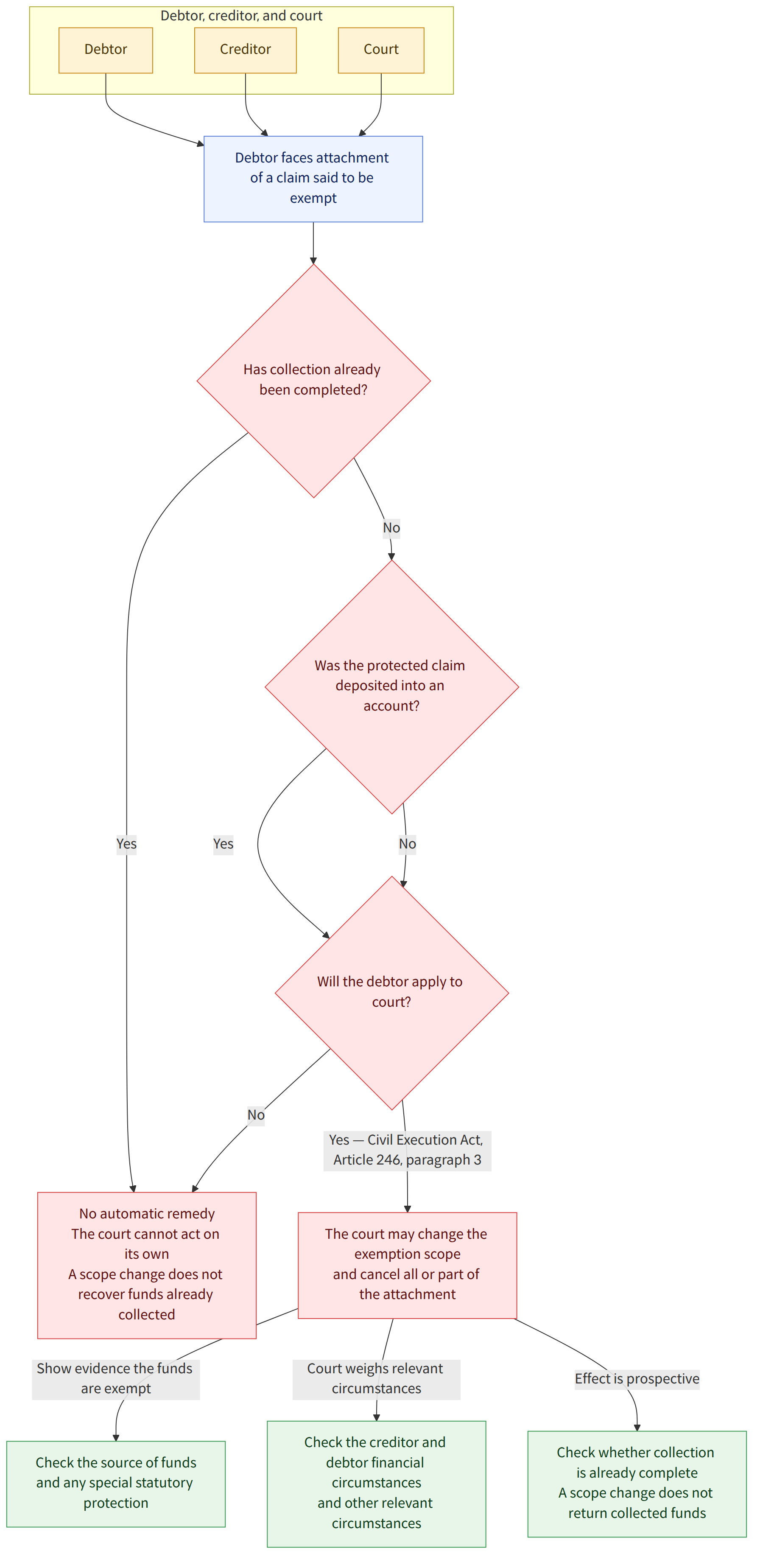
As a rule, when a claim exempt from attachment is deposited into an account, the exemption from attachment does not automatically extend to the deposit claim itself. However, a debtor may apply to the court to change the scope of the claims exempt from attachment and seek cancellation of all or part of the attachment order, taking into account factors such as the debtor’s financial circumstances and the nature of the deposited funds.
At a glance
Key points
- Claims exempt from attachment may include not only claims under the Civil Execution Act but also claims whose attachment is restricted by special statutes and claims that cannot be assigned.
- As a rule, when a claim exempt from attachment is deposited into an account, the original claim and the deposit claim lose their identity, and the exemption from attachment does not automatically extend to the deposit claim (Supreme Court Order of October 6, 1999, Case No. 99Ma4857).
- A debtor who has received an attachment order may apply to the court to change the scope of the claims exempt from attachment and seek cancellation of all or part of the attachment order (Civil Execution Act, Article 246, paragraph (3) (민사집행법 제246조 제3항)).
- The court rules upon an application by a party, taking into account the financial circumstances of the creditor and debtor and other relevant circumstances; it cannot change the scope of the exemption on its own initiative.
- There are cases in which a debtor may apply to change the scope of the exemption and seek cancellation of the attachment as to the relevant amount, even where funds protected under special statutes—such as the basic pension, disability allowance, or benefits under the National Basic Living Security Act—have been deposited into an account.
- In one case, the court held that the right to receive benefits under a retirement pension plan was entirely exempt from attachment under the prohibition on assignment in the Employee Retirement Benefit Security Act (Supreme Court Decision of January 23, 2014, Case No. 2013Da71180).
- A decision changing the scope of the exemption removes the effect of the attachment order prospectively. It therefore does not affect collection actions already completed or permit a claim for repayment of the collected funds (Supreme Court Decision of July 10, 2014, Case No. 2013Da25552).
- There are cases holding that even if an application is titled “immediate appeal” or “objection,” the enforcement court should treat it as an application to change the scope of the exemption if its substance seeks cancellation of the attachment order (Supreme Court Order of December 12, 2008, Case No. 2008Ma1774).
Frequently asked questions
Q. Is attachment-prohibited wages automatically protected once deposited into a bank account?
As a rule, no. Once a claim exempt from attachment is deposited into an account, it becomes a deposit claim and loses its identity as the original claim. The debtor may therefore need to apply to the court to change the scope of the exemption and seek cancellation of the attachment.
Q. How can I withdraw a basic pension or disability allowance from an attached account?
You may apply to the enforcement court to change the scope of the claims exempt from attachment, providing documents or other evidence showing that the wages are exempt from attachment. If the court cancels the attachment order to the extent that it covers those wages, you may request withdrawal in accordance with that decision.
Q. Who may apply to change the scope of claims exempt from attachment?
A debtor may apply to have an attachment order cancelled, and a creditor may apply for an attachment order against a claim that the law makes exempt from attachment. A creditor seeking a provisional attachment may also apply. The generally accepted view is that a person merely requesting distribution and a third-party debtor, among others, have no right to apply.
Q. What happens if I mistakenly title my application as an immediate appeal or an objection?
The substance matters more than the document’s title. There are cases holding that, if the document seeks cancellation of all or part of an attachment order, the enforcement court should treat it as an application to change the scope of the exemption and rule on it, absent special circumstances.
Q. If I apply to change the scope of the exemption, can I get back money the creditor has already withdrawn?
According to the cases, a decision changing the scope of the exemption removes the effect of the attachment order only prospectively. Amounts already collected are not subject to return solely by virtue of that decision, and the court has also held that the debtor cannot claim restitution of unjust enrichment from the creditor.
Q. Can an account be attached after a retirement pension has been deposited into it?
In one case, the court held that the statutory prohibition on assignment under the Employee Retirement Benefit Security Act takes precedence over the restrictions on attachment of wage claims under the Civil Execution Act, making the entire claim to retirement pension benefits exempt from attachment. If a retirement pension is attached after being deposited into an account, the debtor may apply to change the scope of the exemption and seek cancellation of the attachment of that deposit.
Q. How much of a bank deposit is exempt from attachment as living expenses?
The Enforcement Decree of the Civil Execution Act cited in the case treats up to KRW 1.5 million of each individual’s deposit balance as exempt from attachment. However, if there is cash that cannot be attached, that amount is deducted from the limit set for deposits, so cash and deposits must be considered together.
Q. Can I challenge a decision changing the scope of claims exempt from attachment?
An immediate appeal may be filed against a decision granting an application to change the scope of the exemption. The case explains that the notice of appeal must be filed with the court of first instance within the non-extendable period of one week from the date the decision is served. The case notes that views differ on how to challenge a decision denying the application.
Q. Can attachment be cancelled if a traffic accident settlement payment is deposited into my account?
A case held that damages or a settlement payment received directly by a victim from the wrongdoer is not exempt from attachment, unlike a direct claim against an insurance company. Accordingly, attachment cannot be cancelled through an application to change the scope of the exemption merely because the funds are a settlement payment.
Relevant laws
- Civil Execution Act, Article 15 (민사집행법 제15조)
- Civil Execution Act, Article 16, paragraph (2) (민사집행법 제16조 제2항)
- Civil Execution Act, Article 195 (민사집행법 제195조)
- Civil Execution Act, Article 196 (민사집행법 제196조)
- Civil Execution Act, Article 223 (민사집행법 제223조)
- Civil Execution Act, Article 246, paragraphs (1) through (4) (민사집행법 제246조 제1항부터 제4항까지)
- Civil Execution Act, Article 291 (민사집행법 제291조)
- Enforcement Decree of the Civil Execution Act, Article 6 (민사집행법 시행령 제6조)
- Enforcement Decree of the Civil Execution Act, Article 7 (민사집행법 시행령 제7조)
- Employee Retirement Benefit Security Act, Article 7 (근로자퇴직급여 보장법 제7조)
- Basic Pension Act, Article 21 (기초연금법 제21조)
- Welfare of Persons with Disabilities Act, Article 82 (장애인복지법 제82조)
- National Basic Living Security Act, Article 35 (국민기초생활 보장법 제35조)
- Guarantee of Automobile Accident Compensation Act, Articles 10 and 40 (자동차손해배상 보장법 제10조 및 제40조)
- Housing Lease Protection Act, Article 8 (주택임대차보호법 제8조)
Watch out for
- The fact that funds exempt from attachment have been deposited into an account does not, by itself, mean that the deposit claim is automatically exempt from attachment.
- The application may require evidence confirming the source and nature of the funds. The court will consider the specific circumstances, including the financial circumstances of the creditor and debtor.
- If the funds have already been collected before the decision changing the scope of the exemption is issued, that decision alone will not allow you to recover money already paid.
- An immediate appeal against a decision granting the application must, according to the case, be filed within the non-extendable period of one week from the date the decision is served. Be careful not to miss the deadline.
Source cases
This guide was compiled by AI from the following Korea Legal Aid Corporation consultation cases (in Korean).
- 압류가 금지되는 채권
- 압류금지채권의 목적물이 예금계좌에 입금된 경우
- 압류금지채권의 범위변경 신청이 가능한 경우
- 의료인이 치료비 청구권을 보전하기 위해 환자의 국가배상청구권을 대위행사할 수 있는지
- 퇴직연금채권에 대해 압류금지 효력이 미치는 범위
- 압류금지 채권이 계좌로 이체된 경우, 그 예금채권에 대한 압류도 금지되는지
- 압류될 적격이 없는 채권에 대한 압류의 경우, 그 지급을 거절할 수 있는지
- 즉시항고의 제목으로 압류명령의 전부 또는 일부의 취소를 신청하는 경우에 그 관할법원
- 퇴직연금제도에 기한 퇴직연금채권이 이체된 계좌 압류의 유효성
- 건설업자가 지급받은 공사대금에 압류금지채권인 임금이 혼재되어 있는 경우
- 교통사고 피해자가 가해자의 의무보험에 기하여 지급받은 보험금이 압류된 경우
- 민사집행법 제246조 제2항에 따라 압류명령이 취소된 경우, 집행을 완료한 채권자에게 부당이득반환의무가 있는지
- 압류금지채권 범위변경의 장래효
- 보이스피싱으로 편취당한 금액에 대해서도 압류금지채권의 범위변경이 가능한지
- 유체동산에 대한 강제집행에서 압류금지물건을 정하는 재판
- 압류금지채권의 범위변경에서 신청권자와 그에 따른 신청의 대상
- 압류명령에 대하여 채무자가 집행법원에 이의신청을 한 경우, 이 이의신청의 성격
- 민사집행법 제246조 제1항 제8호에 규정된 압류금지 예금 등의 범위
- 기초연금을 지급받은 계좌가 압류된 경우
- 교통사고 피해자가 가해자로부터 지급받은 합의금이 압류된 경우
- 장애수당을 지급받은 계좌가 압류된 경우
- 학교법인에 대한 집행권원으로 교비회계에 속하는 재산에 대해서 강제집행을 할 수 있는지
- 기초생활수급자의 수급급여를 지급받은 계좌가 압류된 경우
- 압류금지채권의 범위변경 결정에 대한 불복방법
- 피압류채권의 적격
This guide is general legal information about Korean law, not legal advice for your situation. For a specific case, consult a lawyer or the Korea Legal Aid Corporation (call 132 in Korea).