
General Damages: Key Issues in Claims and Assessment
Based on 222 consultation cases · Updated · Translated from the Korean original.
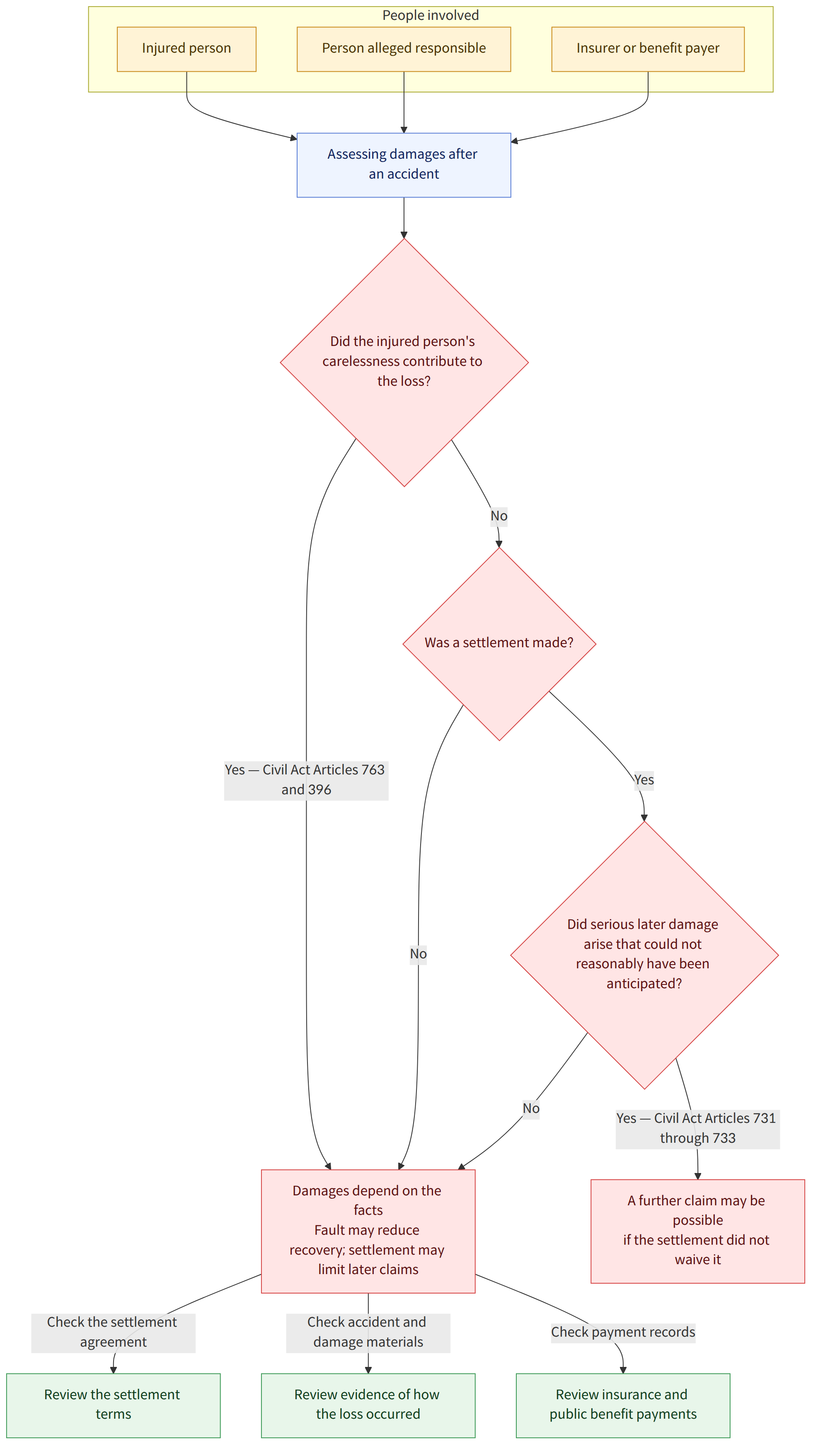
Damages are calculated by considering the type of loss and how it occurred, the injured party’s negligence, the terms of any settlement, and whether insurance benefits or other payments have been received. Some issues require case-specific assessment, such as whether an additional claim may be made after a settlement or whether the limitation period has been interrupted. The settlement agreement, payment records, and materials related to the accident should therefore be reviewed together.
At a glance
Key points
- When assessing damages for a tort, comparative negligence may be considered if the injured party’s carelessness contributed to the occurrence or aggravation of the loss. The proportion of fault is determined based on the specific circumstances (Civil Act, Article 763 and Article 396 (민법 제763조, 제396조); Case 14).
- When future lost earnings are calculated as a lump sum, deduction of interim interest becomes an issue. The court may determine which calculation method to apply, the Hoffmann method or the Leibniz method (Supreme Court Decision 83Da191, June 28, 1983; Case 1).
- As a general rule, a settlement may limit additional claims later on. However, an additional claim may be possible for serious subsequent damage that could not reasonably have been anticipated at the time of settlement (Civil Act, Articles 731 through 733 (민법 제731조부터 제733조); Cases 4 and 5).
- If an accident’s aftereffects cause new damage or make the damage greater than expected, the limitation period for that part of the damage may begin when the injured party becomes aware of the new damage (Civil Act, Article 766 (민법 제766조); Case 4).
- Even if the injured party continues working for their former employer after the accident or does not actually retire, pecuniary loss resulting from loss of earning capacity or lost retirement benefits may be recognized (Case 12).
- Whether insurance proceeds or public benefits are deducted from damages depends on the nature of the benefits and the applicable laws. For personal accident insurance proceeds or an industrial accident disability compensation pension, the deduction may be based not only on the amount actually paid but also on an amount converted into a lump sum (Commercial Act, Article 729 (상법 제729조); Industrial Accident Compensation Insurance Act, Article 80 (산업재해보상보험법 제80조); Cases 15 and 25).
- A joint tortfeasor may be liable for the entire loss as against the injured party, but the proportion of comparative negligence or the amount of damages may differ in separate proceedings depending on the evidence submitted and other factors (Civil Act, Article 760 (민법 제760조); Case 21).
- A person who applies for an improper provisional attachment or a stay of auction proceedings may be held liable for resulting damage. Whether a direct claim may be brought against the surety insurer, however, depends on factors such as the nature of the guarantee and whether there is an enforceable title (Cases 16, 17, and 24).
Frequently asked questions
Q. I signed a settlement agreement for damages. Can I still make an additional claim later?
As a general rule, the settlement terms must be followed, so an additional claim may be restricted. However, if serious subsequent damage could not reasonably have been anticipated at the time of settlement, an additional claim may be possible where the agreement cannot be construed as waiving the right to claim for that damage.
Q. If an insurance company pays medical expenses and proposes a settlement, does that interrupt the limitation period?
If the insurance company pays medical expenses or offers a settlement amount on the assumption that it is liable for damages on behalf of its insured, this may in some cases be regarded as an acknowledgment of the debt for damages. The result may depend on the company’s authority to act as agent and the specific circumstances of the payment or settlement, so the relevant materials should be reviewed.
Q. If the injured party was partly at fault, will they be unable to recover all of their medical expenses?
The injured party’s fault may be considered when determining the amount of damages. Even if an automobile insurance policy sets out standards for payment of medical expenses, litigation raises the issue of the loss recognized by the court and the result of comparative negligence. Payments under the policy should therefore be distinguished from the court’s determination.
Q. Can I receive damages if my earning capacity has been reduced by aftereffects of an accident, even though I am still working?
The fact that you continue to work or earn the same income does not, by itself, establish that there is no pecuniary loss. Lost earnings or lost retirement benefits may be recognized based on the degree of loss of earning capacity and the specific circumstances, including your occupation and work history.
Q. If I received an advance on an industrial accident disability compensation pension, is only that advance deducted from the damages?
The cited case explains that, where a person elects to receive a disability compensation pension and receives an advance covering a portion of the pension period, the deduction is not limited to the advance payment. Rather, the amount of future pension benefits converted into a disability compensation lump sum is deducted. When applying this rule, the relevant laws and benefit details in effect at the time of the accident should be checked.
Q. Can I claim from the automobile insurer the money I paid the injured party as a criminal settlement?
Unless there are special circumstances, a criminal settlement payment may be regarded as having been made as part of civil damages, and there may be grounds to claim it from the insurer. However, it is necessary to check whether the policy requires prior notice or consent and the purpose for which the settlement payment was made.
Q. Will damages be reduced if a natural force, such as a landslide, also contributed to the accident?
If a natural force contributed to the occurrence of the loss, its contribution may be taken into account in determining the scope of damages. However, if the risk could have been anticipated in advance and the accident could have been prevented through appropriate safety measures, but those measures were neglected, the scope of damages may not be reduced on the basis of the natural force’s contribution.
Q. Can I claim damages if a provisional attachment is found to have been improper in the main action?
If the person who obtained the provisional attachment is finally unsuccessful in the main action, intent or negligence may be presumed in the absence of special evidence to the contrary, and liability for damages may be recognized. If the provisional attachment was lifted by depositing security, losses relating to the use of the deposited funds may be at issue, but the amount of loss is determined based on the specific circumstances.
Q. Can the comparative-negligence percentage differ if separate lawsuits are brought against each joint tortfeasor?
Yes. If separate lawsuits are brought against joint tortfeasors, the evidence submitted and the circumstances of the accident found in each proceeding may differ, so the comparative-negligence percentage and the amount of damages may also be determined differently.
Relevant laws
- Civil Act, Article 396 (민법 제396조)
- Civil Act, Article 398 (민법 제398조)
- Civil Act, Article 507 (민법 제507조)
- Civil Act, Article 731 (민법 제731조)
- Civil Act, Article 732 (민법 제732조)
- Civil Act, Article 733 (민법 제733조)
- Civil Act, Article 760 (민법 제760조)
- Civil Act, Article 763 (민법 제763조)
- Civil Act, Article 766 (민법 제766조)
- Civil Act, Article 178 (민법 제178조)
- Guarantee of Automobile Accident Compensation Act, Article 3 (자동차손해배상 보장법 제3조)
- Commercial Act, Article 682 (상법 제682조)
- Commercial Act, Article 724(2) (상법 제724조 제2항)
- Commercial Act, Article 729 (상법 제729조)
- State Compensation Act, Article 2 (국가배상법 제2조)
Watch out for
- Even if the settlement agreement contains a clause waiving additional claims, consider both the scope of that clause and whether the damage could have been anticipated at the time of settlement.
- The date from which the limitation period for a damages claim runs may vary depending on the type of claim and when the claimant became aware of the damage. The effect of an insurance company’s payment of medical expenses or settlement offer on the limitation period should also be examined in light of the specific circumstances.
- The proportion of fault, lost income, retirement age for work, permanent impairment, and amount of damages are not determined by applying fixed figures uniformly; they may vary depending on the circumstances of the accident and the injured party’s specific situation.
- Some insurance policy or statutory language and interest rates cited in the cases may reflect the rules in effect when the case summaries were prepared. Check the current law and policy terms before applying them to a present case.
Source cases
This guide was compiled by AI from the following Korea Legal Aid Corporation consultation cases (in Korean).
- 호프만식계산법 중 240이 넘는 단리연금현가율 적용가능 여부
- 과실상계된 손해배상액보다 치료비가 더 많은 경우 그 청구 여부
- 교통사고의 공동불법행위자 사이 구상금채권의 소멸시효기간
- 식물인간상태에서 손해배상합의 후 여명기간 연장된 때 추가청구 여부
- 불법행위로 인한 손해배상에 합의한 후 추가청구가 가능한지
- 자기 소유 토지에 토양오염을 유발한 자의 불법행위 책임
- 특수자연조건에 의한 사고라도 가해자의 배상범위가 감소되지 않는 경우
- 증권회사 직원만 믿고 방치하여 손실을 본 고객의 과실 인정 여부
- 공무원의 국가배상청구 시 공무원연금법상 장해보상금 공제 여부
- 가해자가 피해자에게 지급한 형사합의금을 보험회사에 청구할 수 있는지
- 불법행위로 사망한 농민의 노동능력가동연한은 얼마인지
- 신체장해 피해자가 종전직장에 계속 근무할 경우 일실퇴직금의 산정방법
- 보험회사가 손해배상 합의를 시도한 경우 소멸시효가 중단되는지
- 불법행위로 인한 손해배상청구 시 일실소득의 산정기준
- 해외여행보험금이 손익상계로서 공제하여야 할 이익인지
- 본안소송에서 패소한 가압류권자에 대하여 손해배상청구 가능한지
- 가압류공탁금의 보증보험회사에 대하여 직접 손해배상청구 가능한지
- 공동불법행위자 일방에게 손해배상감액사유 있는 경우 구상관계
- 주인차량의 사고로 동승한 종업원의 보험금 산정 시 주인과실 참작되는지
- 계약서에 기재한 손해배상 예정액 약정이 불명확한 경우 해석 방법
- 공동불법행위자에 대한 별소(別訴)에서 과실상계비율이 다를 수 있는지
- 외국인에 대한 위자료액 산정 시 본국에서의 소득수준을 참작하는지
- 형의 운전부주의로 동생사망 시 상속인인 부모의 보험회사에 대한 손해배상청구권
- 경매절차의 부당한 정지로 경매채권자가 입은 손해의 범위
- 장해보상연금 일부를 선급신청한 경우 일실수입 산정 시 공제할 금액
This guide is general legal information about Korean law, not legal advice for your situation. For a specific case, consult a lawyer or the Korea Legal Aid Corporation (call 132 in Korea).