
When Does a Housing Lease Become Effective Against Third Parties, and How Is That Protection Maintained?
Based on 214 consultation cases · Updated · Translated from the Korean original.
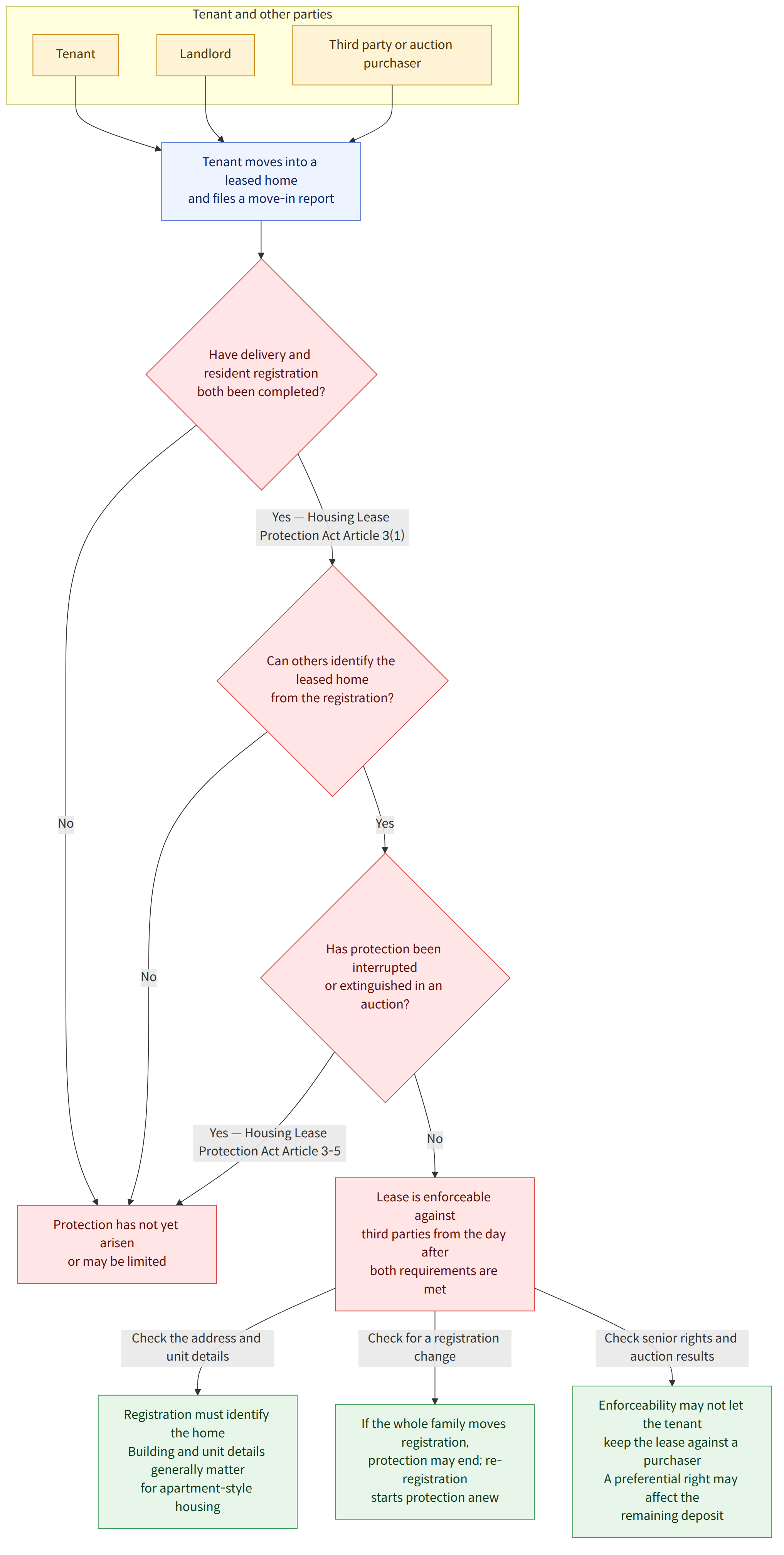
A housing tenant may assert the lease against third parties starting the day after taking delivery of the home and completing resident registration. However, the registered address must identify the leased home, and the scope of protection may vary if the requirements for enforceability are interrupted or if senior rights or other interests are extinguished in an auction.
At a glance
Key points
- Enforceability against third parties arises on the day after both delivery of the home and resident registration have been completed. Resident registration is deemed complete when the move-in report is filed (Housing Lease Protection Act, Article 3(1) (주택임대차보호법 제3조 제1항), Cases 1 and 6).
- Resident registration must serve as a means of public notice by which third parties can identify the leased home and the existence of the leasehold right. For multi-unit buildings and other apartment-style housing, the building and unit numbers must generally be stated accurately (Enforcement Decree of the Resident Registration Act, Article 9 (주민등록법 시행령 제9조), Cases 18 and 19).
- For a detached house used as a multi-household dwelling, resident registration may be valid even without a unit number if the lot number is stated accurately. The determination may vary depending on the type of building and the circumstances shown in the building register, land register, and other records (Cases 4 and 6).
- If the entire family transfers its resident registration to another address, existing enforceability may be extinguished. Even if they register again at the leased home, enforceability arises anew only from the date of the new registration (Case 21).
- If the tenant subleases the home with the landlord’s consent and the subtenant takes delivery of the home and completes resident registration, the requirements for enforceability may remain satisfied through the tenant’s indirect possession, even if the tenant does not live there personally. Even without consent, the matter may be viewed differently if special circumstances show that the sublease did not constitute an act of betrayal toward the landlord (Cases 9 and 15).
- Foreign registration or a report of change of place of stay, or a domestic residence report or report of change of domestic residence by an overseas Korean, may have the same legal effect as resident registration if the statutory requirements described in the cases are met. A report made by a cohabiting family member, rather than the tenant, may also be at issue (Immigration Control Act, Article 88-2 (출입국관리법 제88조의2); Act on the Immigration and Legal Status of Overseas Koreans, Article 10 (재외동포법 제10조); Cases 13 and 14).
- In an auction, enforceability alone does not always allow the tenant to assert the lease against the purchaser. The leasehold right may be extinguished depending on senior rights and the auction outcome. A tenant with both enforceability and a preferential right to payment may, in some cases, assert the lease against the purchaser for the remaining deposit after deducting the amount the tenant could have received from the distribution (Housing Lease Protection Act, Article 3-5 (주택임대차보호법 제3조의5), Cases 1, 3, and 11).
Frequently asked questions
Q. When does enforceability against third parties arise if I have filed a move-in report and moved in?
You may assert the lease against third parties starting the day after taking delivery of the home and completing resident registration. Resident registration is deemed complete when the move-in report is filed (Housing Lease Protection Act, Article 3(1) (주택임대차보호법 제3조 제1항)).
Q. Will I lose enforceability if I leave out the building or unit number when filing a move-in report for a multi-unit building?
Under the rule described in the cases, the building and unit numbers must be specified for a multi-unit building or other apartment-style housing. Resident registration stating only the lot number may not allow third parties to identify the tenant of a particular unit. However, it is necessary to examine the specific circumstances to determine whether the leased home can be identified by considering the building description and resident registration together (Cases 17 and 18).
Q. Can I still be protected if I enter the wrong unit number when filing a move-in report for a multi-household dwelling?
For a detached house used as a multi-household dwelling that is not separately registered by unit, resident registration may be valid if the lot number is accurate, even if the floor or unit number commonly used for convenience is incorrect. The determination may vary depending on whether the building is a multi-household dwelling or apartment-style housing and on how it is recorded in the separate registration and building register (Cases 4 and 6).
Q. If I temporarily transfer my resident registration elsewhere and then register again at the home, does my existing enforceability continue?
If the entire family transfers its resident registration elsewhere, existing enforceability may be extinguished at the time of the transfer. The cases explain that registering again does not retroactively restore the former enforceability; instead, new enforceability arises from the date of the new registration (Case 21).
Q. Is enforceability maintained if the tenant moves out and a subtenant lives in the home?
If the tenant lawfully subleases the home with the landlord’s consent and the subtenant takes delivery of the home and completes resident registration, the requirements for enforceability may be satisfied even where the tenant retains indirect possession. If the landlord did not consent, the issue may be whether special circumstances show that the sublease did not constitute an act of betrayal toward the landlord (Cases 9 and 15).
Q. Can I assert the lease against an auction purchaser if the lease agreement has no fixed date?
If the requirements for enforceability have been met and there is no right that takes priority and remains in effect, the tenant may in some cases assert enforceability even without a fixed date. However, without a fixed date, the tenant cannot claim the preferential right to payment that depends on having one. Whether the leasehold right remains in effect after an auction must also be considered in light of senior rights, the distribution of proceeds, and other matters (Cases 1 and 11).
Q. If I receive only part of my deposit through the auction distribution, can I claim the rest from the purchaser?
According to the precedent described in the cases, when a tenant with both enforceability and a preferential right to payment does not receive the full deposit through the distribution, the tenant may assert the lease against the purchaser for the balance after deducting the amount the tenant could have received under the correct order of priority. If the actual distribution was calculated incorrectly, the relevant amount may be the amount payable under the correct priority order, rather than the amount actually received (Cases 1, 3, and 24).
Q. Can foreign nationals and overseas Koreans also obtain enforceability for a housing lease?
Foreign registration or a report of change of place of stay under the Immigration Control Act, and a domestic residence report or report of change of domestic residence under the Act on the Immigration and Legal Status of Overseas Koreans, may have the same legal effect as resident registration, as described in the cases. Whether a report made by a cohabiting family member of a Korean national residing abroad who is the tenant satisfies the requirements for enforceability must be determined by examining the applicable laws described in the cases, the family relationship, and the specific circumstances (Cases 13 and 14).
Relevant laws
- Housing Lease Protection Act, Article 3(1) (주택임대차보호법 제3조 제1항)
- Housing Lease Protection Act, Article 3(2), (3), and (4) (주택임대차보호법 제3조 제2항·제3항·제4항)
- Housing Lease Protection Act, Article 3-2 (주택임대차보호법 제3조의2)
- Housing Lease Protection Act, Article 3-3 (주택임대차보호법 제3조의3)
- Housing Lease Protection Act, Article 3-5 (주택임대차보호법 제3조의5)
- Housing Lease Protection Act, Article 4(2) (주택임대차보호법 제4조 제2항)
- Housing Lease Protection Act, Article 8 (주택임대차보호법 제8조)
- Housing Lease Protection Act, Article 12 (주택임대차보호법 제12조)
- Enforcement Decree of the Resident Registration Act, Article 9 (주민등록법 시행령 제9조)
- Immigration Control Act, Articles 31, 32, 36, and 88-2 (출입국관리법 제31조·제32조·제36조·제88조의2)
- Act on the Immigration and Legal Status of Overseas Koreans, Article 10 (재외동포의 출입국과 법적 지위에 관한 법률 제10조)
- Civil Act, Articles 365, 366, 575, 578, and 629 (민법 제365조·제366조·제575조·제578조·제629조)
- Civil Execution Act, Articles 88, 91, 127, and 135 (민사집행법 제88조·제91조·제127조·제135조)
- Act on the Registration of Real Estate under Actual Titleholder’s Name, Articles 4 and 8 (부동산 실권리자명의 등기에 관한 법률 제4조·제8조)
- Act on Security for Provisional Registration, etc., Articles 2, 3, 4, 5, and 12 (가등기담보 등에 관한 법률 제2조·제3조·제4조·제5조·제12조)
Watch out for
- Enforceability does not arise from moving in or resident registration alone; both requirements must be met, and enforceability arises starting the following day.
- If the address does not identify the leased home, or if resident registration is transferred elsewhere, enforceability may not be recognized or existing enforceability may be interrupted. Confirm the building and unit numbers and the actual address for apartment-style housing.
- Whether enforceability and the preferential right to payment remain in effect in an auction, and the amount of any remaining deposit, may depend on senior rights, distribution priority, filing a claim for distribution, and whether delivery of the home and resident registration have been maintained.
- The cases refer both to provisions as numbered before amendments and to current provisions. For an actual matter, check the laws applicable at the relevant time and the specific facts.
Related articles
Source cases
This guide was compiled by AI from the following Korea Legal Aid Corporation consultation cases (in Korean).
- 대항력과 우선변제권을 겸유하고 있는 주택임차권의 법률관계
- 매각대금 납부 후 주택임차권에 대항력 있음을 알게된 매수인의 구제
- 매수인에게 대항할 수 있는 배당받지 못한 보증금 잔액의 범위
- 단독주택이 다세대 구분건물로 변경된 경우 기존 전입신고의 효력
- 주택신축 중 토지에 근저당권이 설정된 경우 주택임차권 보호 여부
- 다가구주택 전입신고 시 동·호수를 잘못 기재한 경우의 대항력
- 주임법상 소액임차인의 우선변제권의 요건인 주택의 인도 및 주민등록의 존속기간의 종기는 언제까지인지 등
- 주택을 매도하면서 임차인으로 변경된 매도인의 대항력 취득시점
- 전차인이 주택을 인도받아 주민등록을 마침으로써 임차인의 대항요건이 유지, 존속하는 경우
- 가압류된 주택의 매수인으로부터 임차 후 가압류권자에 의해 경매될 경우 임차권 보호
- 주택 경매로 2층의 선순위 전세권 소멸 시 1층의 후순위 전세권 소멸 여부
- 근저당된 건물을 임차하여 대항력 갖춘 후 등기의 유용이 있는 경우
- 재외국민이 주택을 임대차계약을 체결하고 그 동거가족인 외국인 또는 외국국적동포가 국내거소신고를 한 경우 대항력 취득 여부
- 외국국적동포의 국내거소신고가 주민등록과 동일한 법적 효과가 인정되는지 여부
- 간접점유의 경우에도 주택임대차보호법상 대항요건이 인정되는지
- 임대차의 대항력을 부정하는 근저당권자의 주장이 신의칙에 위배되는 경우
- 연립주택의 전입신고를 함에 있어 부동산등기부상 ‘동’의 기재와 다르게 신고하였음에도 임대차의 공시방법으로 유효한 경우
- 다세대주택의 전입신고 시 동·호수를 기재하지 않은 경우의 대항력
- 공무원의 실수로 주민등록이 잘못 기재된 경우 대항력 있는지
- 전입신고 후 토지 분할로 건물소재지 지번이 변경된 경우 대항력
- 임차인이 주민등록을 일시 옮겼다가 재전입한 경우 대항력
- 담보가등기 된 후 대항력을 갖춘 주택임차인의 청산금에 대한 권리
- 명의수탁자로부터 주택을 임차한 자의 명의신탁자에 대한 대항력
- 배당이의소송에서 패소한 임차인의 매수인에 대한 대항력
- 공동저당된 대지와 주택이 재건축된 후 일괄매각 시 임차인의 대항력
This guide is general legal information about Korean law, not legal advice for your situation. For a specific case, consult a lawyer or the Korea Legal Aid Corporation (call 132 in Korea).