
Essential Guide to Other Residential Lease Issues
Based on 68 consultation cases · Updated · Translated from the Korean original.
In residential leases, changes in the landlord’s status or the assignment or subletting of a leasehold right may affect opposability and the return of the deposit. Since the scope of rights and liability varies depending on the circumstances, such as a fire, foreclosure, or remaining in possession after the contract ends, check the requirements and precautions applicable to each situation.
At a glance
Key points
- A lease of jointly owned housing is a matter concerning the management of jointly owned property and may be decided by a majority of the shares (Civil Act, Articles 263 through 265 (민법 제263조부터 제265조까지)).
- If a leased home for which the requirements for opposability have been met is transferred, the transferee generally succeeds to the landlord’s status, and the obligation to return the deposit is also transferred to the transferee (Housing Lease Protection Act, Article 3 (주택임대차보호법 제3조)).
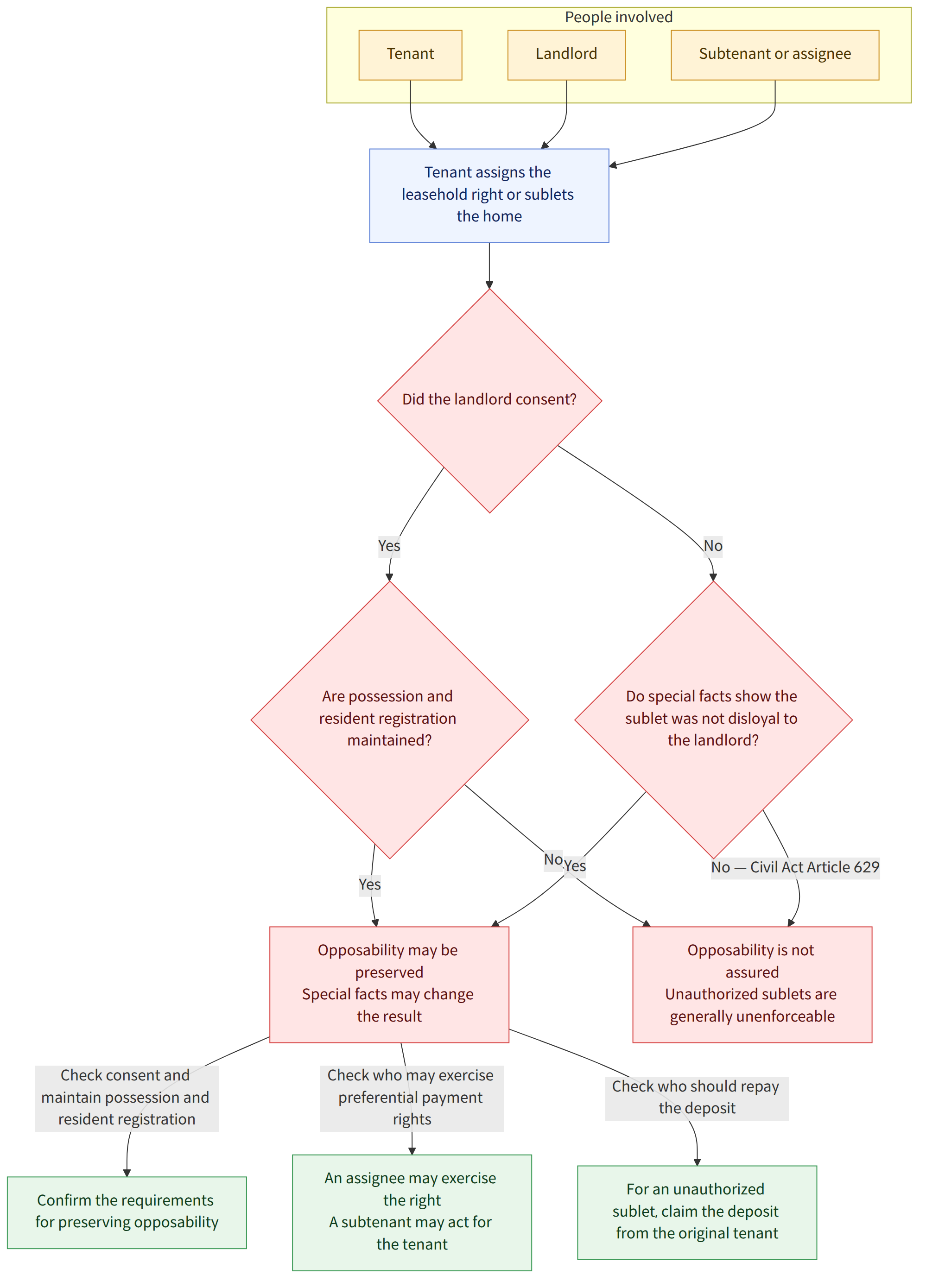
- If the leasehold right is assigned or the home is sublet with the landlord’s consent, and possession and resident registration are maintained, the original tenant’s opposability may be preserved; the right to preferential payment may also be exercised or exercised on the tenant’s behalf.
- A sublease made without the landlord’s consent generally cannot be asserted against the landlord, but it may be assessed differently if special circumstances show that it was not a disloyal act toward the landlord (Civil Act, Article 629 (민법 제629조)).
- Even if the tenant remains in possession of the property after the contract ends without having received the deposit, no obligation to make restitution for unjust enrichment may arise if the tenant did not actually use and enjoy the property and obtain a benefit.
- If leased property is destroyed by a fire of unknown cause, the tenant may avoid liability for damages only by proving that they fulfilled the duty of care expected of a prudent manager.
- To receive preferential payment in foreclosure proceedings, a request for distribution may need to be submitted by the applicable deadline. It is difficult to challenge a decision to permit the sale solely because the tenant did not receive notice of the foreclosure before reporting their rights.
- If a landlord enters into a lease without disclosing that the rental home is subject to foreclosure, the landlord may face civil liability for damages or a fraud charge.
Frequently asked questions
Q. When renting a jointly owned home, must I obtain the consent of all co-owners?
Matters concerning the management of jointly owned property may be decided by a majority of the co-owners’ shares. Accordingly, if co-owners holding a majority share decide to lease the property, the lease may be valid even if a co-owner with a minority share did not participate in the contract.
Q. If a rental home is sold, from whom can I recover my deposit?
If a leased home for which the requirements for opposability have been met is transferred, the transferee succeeds to the landlord’s status, and the obligation to return the deposit is also, in principle, transferred to the transferee. However, in some cases, if the tenant objects within a reasonable period after learning of the transfer, the tenant may refuse the succession to the landlord’s status and seek repayment from the former landlord.
Q. Can I claim my deposit if I change my resident registration after the landlord changes?
If the rental home has been transferred and the transferee has succeeded to the landlord’s status, the fact that the tenant later changes their resident registration does not, by itself, extinguish the already-incurred obligation to return the deposit. However, the tenant may be unable to assert their rights against someone who subsequently acquires the home or a mortgagee, so care is required.
Q. If I assign my leasehold right or sublet the home with the landlord’s consent, is the original opposability preserved?
If the landlord consents, and the transferee or subtenant takes possession of the home and maintains their resident registration there, the original tenant’s opposability may be preserved. A transferee of the leasehold right who meets these requirements may exercise the original tenant’s right to preferential payment, and a subtenant may exercise that right on the original tenant’s behalf.
Q. Do I have to leave a home that was sublet to me without the landlord’s consent?
A sublease made without the landlord’s consent generally cannot be asserted against the landlord, who may terminate the lease on that basis. However, the outcome may differ if special circumstances show that the sublease was not a disloyal act toward the landlord. In principle, the deposit should be claimed from the sublessor, who is the original tenant.
Q. If I have not received my deposit after the contract ends, do I have to keep paying rent if I do not hand over the keys?
If the landlord has not returned the deposit and the tenant remains in possession while exercising the defense of simultaneous performance, that possession is not, by itself, unlawful. However, if the tenant actually used and enjoyed the property for the purpose specified in the contract and thereby obtained a benefit, the tenant may have an obligation to make restitution for unjust enrichment. The landlord must assert and prove that rent or a damages claim arose and may be deducted.
Q. If a fire of unknown cause occurs in a rented home, must the tenant pay for the damage?
Even if the cause of a fire is unknown, a tenant may avoid liability for damages only by proving that they exercised the care expected of a prudent manager in preserving the building. However, the tenant may not be held liable if the fire was caused by a circumstance for which the landlord is responsible for repair and maintenance, such as a defect in electrical wiring that forms part of the building’s structure.
Q. Can I hold a landlord responsible for entering into a lease without disclosing that foreclosure proceedings were underway?
If the landlord did not disclose at the time of contracting that the leased home was subject to foreclosure, the landlord may be liable for civil damages. The court decision discussed in the example held that the landlord’s failure to disclose could constitute fraud even if the tenant could have checked the property register. Whether the tenant can receive a distribution in the foreclosure proceedings must be separately confirmed, including whether a request for distribution may be made and the applicable deadline.
Q. If I could not request a distribution because I did not receive notice of the auction, can I appeal the decision to permit the sale?
The fact that a tenant did not receive notice before reporting their rights to the auction court is unlikely, by itself, to be grounds for challenging the decision to permit the sale. A tenant can become an interested party in the auction proceedings only by proving and reporting their rights. To receive preferential payment, the tenant must check the deadline for requesting a distribution and submit the request by that deadline.
Q. If the landlord goes bankrupt, can a tenant with opposability receive preferential payment of the deposit?
The example explains that a tenant who meets the requirements for opposability may receive preferential payment of the deposit from the proceeds of the liquidation of a home and its land belonging to the bankruptcy estate. The requirements for preferential payment to a tenant with a fixed date and for preferential payment of a small deposit may differ, so the applicable requirements should be checked.
Relevant laws
- Civil Act, Article 191 (민법 제191조)
- Civil Act, Article 263 (민법 제263조)
- Civil Act, Article 264 (민법 제264조)
- Civil Act, Article 265 (민법 제265조)
- Civil Act, Article 392 (민법 제392조)
- Civil Act, Article 507 (민법 제507조)
- Civil Act, Article 623 (민법 제623조)
- Civil Act, Article 629 (민법 제629조)
- Civil Act, Article 758 (민법 제758조)
- Housing Lease Protection Act, Article 3 (주택임대차보호법 제3조)
- Housing Lease Protection Act, Article 3-2 (주택임대차보호법 제3조의2)
- Housing Lease Protection Act, Article 8 (주택임대차보호법 제8조)
- Civil Execution Act, Article 41 (민사집행법 제41조)
- Civil Execution Act, Article 84 (민사집행법 제84조)
- Civil Execution Act, Article 90 (민사집행법 제90조)
Watch out for
- To receive a distribution in foreclosure proceedings, you may need to apply by the deadline for requesting a distribution. Do not wait for notice of the foreclosure; check the procedures and deadlines.
- To object to the transfer of a rental home and refuse to accept the transferee’s succession to the landlord’s status, you must object within a reasonable period from when you learned of the transfer.
- After changing your resident registration, you may be unable to assert your rights against a subsequent purchaser of the home or a mortgagee. Take care when changing your address before your deposit is returned.
- The fact that the cause of a fire is unknown does not, by itself, exempt the tenant from liability; the tenant may need to prove that they exercised the required duty of care.
Source cases
This guide was compiled by AI from the following Korea Legal Aid Corporation consultation cases (in Korean).
- 공유주택 임차 시 공유자 전원의 동의를 받아야 하는지
- 반대의무 이행 없이 임차주택 소유권이전등기청구권 압류 가능한지
- 주택소유자의 임차인에 대한 공작물소유자로서의 책임
- 경매통지 없었음을 이유로 임차주택의 매각허가결정에 항고 가능한지
- 임차주택에서 원인불명의 화재가 발생한 경우 임차인의 책임
- 임대인이 파산선고를 받은 경우 임차인에게 별제권이 인정되는지
- 주택임대차보호법상 대항력을 갖춘 임차인의 임대차보증금반환채권이 가압류된 상태에서 임대주택이 양도된 경우, 양수인이 채권가압류의...
- 임대주택 분양제한기간 만료 후 임대인의 임대차계약 해지권 있는지
- 동시이행항변권으로 임차건물 계속 점유 시 부당이득 성립범위
- 임대주택법에 위반하여 체결된 임대차계약의 효력
- 주택 경매절차의 매수인이 매각물건명세서에 기재되어 공시된 내용을 기초로 매수가격을 정하여 낙찰을 받아 주택에 관한 소유권을 취...
- 임대차계약 체결 시 임대인이 경매사실을 알리지 않은 경우
- 임대인의 동의 없는 주택전대차계약의 효력
- 대항력 있는 주택임차인이 임대인의 동의 하에 임차권 양도한 경우
- 임차건물에 도둑이 든 경우 임대인에게 손해배상책임이 있는지
- 신탁법에 따라 신탁된 임차주택 수탁자의 임대인 지위승계 여부
- 대항력 있는 주택임차인이 임대인의 동의 받아 전대차한 경우의 효력
- 임차인이 임대인의 동의하에 임차권 양도하고, 전차인이 주택인도받아 주민등록을 마친 경우 임차인이 대항력을 취득하는지 여부
- 임차인이 임차주택을 매수한 경우 임차권의 소멸 여부
- 임대인의 동의를 얻어 주택을 양도 또는 전대 받은 경우 임차권의 양수인 내지 전차인이 원래 임차인이 가지는 우선변제권을 행사할...
- 임차보증금에 대한 전부명령 송달 후 연체된 월세의 공제 여부
- 주민등록이 공시방법으로 인정되기 위한 요건
- 임차주택이 양도된 경우 양도인의 주택임차보증금채무가 소멸되는지
- 임차인의 이행지체 중 그 과실 없이 임차건물반환이 불가능해진 경우
- 임차주택이 양도된 후 임차인의 주소를 이전할 경우 양수인에 대한 대항력
This guide is general legal information about Korean law, not legal advice for your situation. For a specific case, consult a lawyer or the Korea Legal Aid Corporation (call 132 in Korea).