
Guide to Applying for an Order for Registration of a Residential Leasehold Right and Its Effects
Based on 29 consultation cases · Updated · Translated from the Korean original.
If your lease has ended but your deposit has not been returned, you may apply for an order for registration of a leasehold right and move out after the registration is completed. Any opposability against third parties and preferential right to payment that you had already acquired before registration remain in effect. However, timing matters: you may lose your rights if you move out before the leasehold registration is complete.
At a glance
Key points
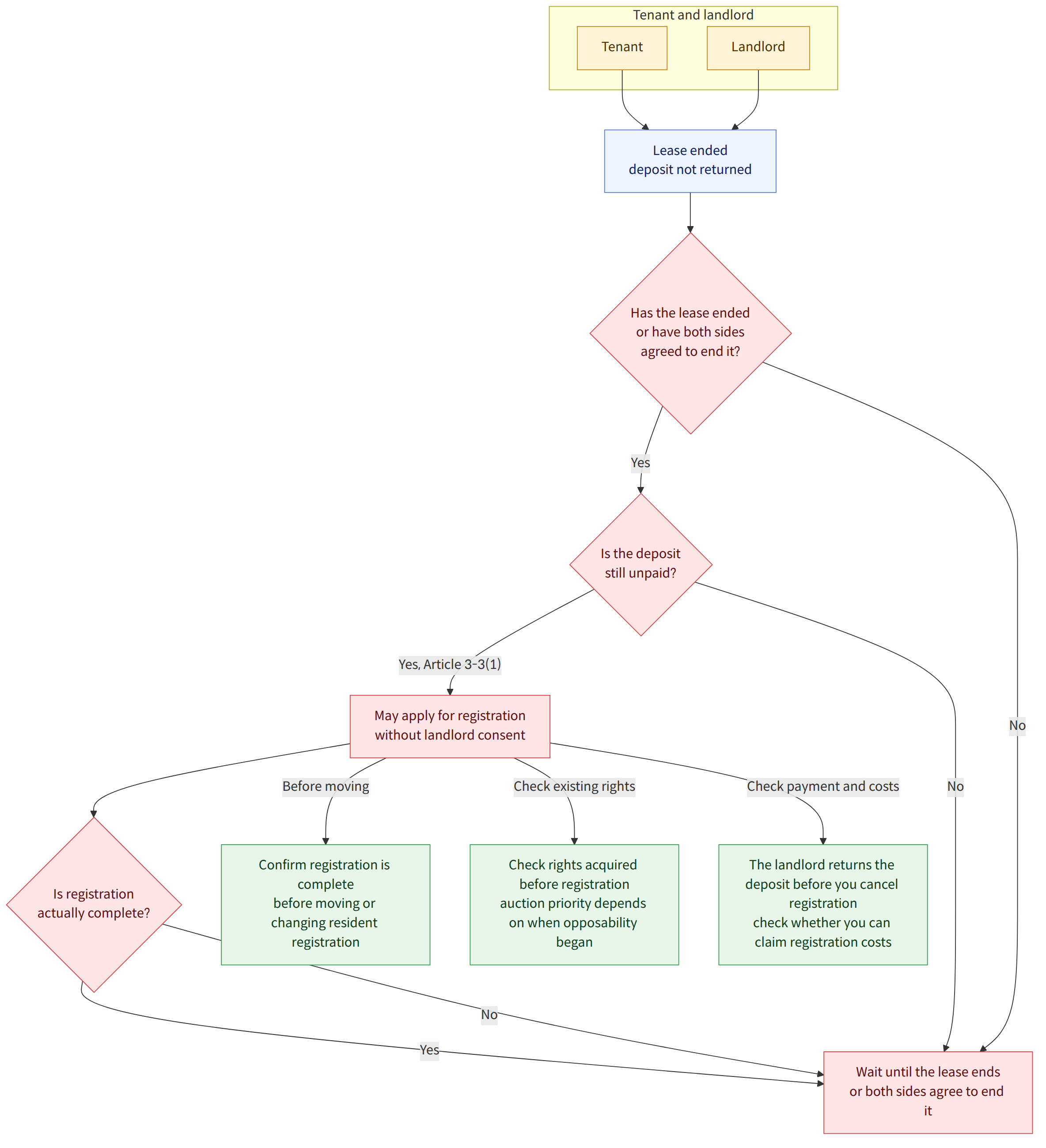
- A tenant whose lease has ended but whose deposit has not been returned may apply for an order for registration of a leasehold right without the landlord's consent or cooperation (Housing Lease Protection Act, Article 3-3(1) (주택임대차보호법 제3조의3 제1항), Examples 6 and 9).
- Once registration of the leasehold right is complete, the tenant acquires opposability against third parties and a preferential right to payment, and rights acquired before registration remain in effect. After registration, the tenant may preserve rights already acquired without continuing to meet the requirements of possession or resident registration (Housing Lease Protection Act, Article 3-3(5) (주택임대차보호법 제3조의3 제5항), Examples 3 and 6).
- It is safer to move out or change your resident registration only after confirming that registration of the leasehold right has actually been completed. Applying for the order does not itself complete the registration (Example 3).
- If the tenant had acquired opposability against third parties before registration, whether the tenant can assert that right against the purchaser at an auction is determined by when the tenant originally acquired opposability, not by the date of the leasehold registration. If the tenant had not acquired opposability before registration, the registration alone does not give the tenant priority over earlier-ranking rights (Examples 5, 17, and 22).
- The landlord's obligation to return the deposit must be performed before the tenant's obligation to cancel the leasehold registration. The tenant may cancel the registration after receiving the deposit (Supreme Court Decision 2005Da4529, June 9, 2005, Examples 2 and 14).
- If registration of the leasehold right was completed before the first registration of a decision to commence auction proceedings, the tenant may qualify as a creditor entitled to receive a distribution without filing a separate request for one (Supreme Court Decision 2005Da33039, September 15, 2005, Examples 7 and 20).
- A person who leases a home after a leasehold right has been registered is not entitled to the highest-priority preferential payment available to small-amount tenants. However, if that person has a fixed date, they may exercise a preferential right to payment according to their priority ranking (Housing Lease Protection Act, Article 3-3(6) (주택임대차보호법 제3조의3 제6항), Examples 4 and 8).
- You may claim from the landlord the costs of applying for an order for registration of a leasehold right and completing the resulting registration (Housing Lease Protection Act, Article 3-3(8) (주택임대차보호법 제3조의3 제8항), Example 25).
Frequently asked questions
Q. Can I apply for an order for registration of a leasehold right before the lease term ends if I have not received my deposit?
As a general rule, you may apply after the lease has ended. You cannot unilaterally terminate the lease during its term solely because of your personal circumstances. However, if you and the landlord agree to end the lease and the deposit is not returned, you may apply.
Q. Can I move out immediately after applying for an order for registration of a leasehold right?
Be careful not to move out immediately after applying. You should move only after confirming that the registration of the leasehold right has actually been completed, so that you can preserve your existing opposability against third parties and preferential right to payment.
Q. Once registration of the leasehold right is complete, will my existing rights remain in effect if I change my resident registration?
If you acquired opposability against third parties or a preferential right to payment before the leasehold right was registered, those rights remain in effect after registration. Once registration is complete, you may preserve rights already acquired without continuing to meet the requirements of possession and resident registration.
Q. If the landlord asks me to cancel the leasehold registration at the same time as returning the deposit, do I have to cancel it first?
You do not need to cancel the registration first. The landlord's obligation to return the deposit must be performed before your obligation to cancel the leasehold registration, so you may cancel the registration after receiving the deposit.
Q. If I registered my leasehold right, do I also have to file a separate request for a distribution in an auction?
If registration of the leasehold right was completed before the first registration of a decision to commence auction proceedings, you may qualify as a creditor entitled to receive a distribution without filing a separate distribution request. The court decision cited in the example holds that the tenant has a preferential right to payment in this situation.
Q. Can a small-amount tenant who moves into a home after a leasehold right has been registered receive the highest-priority preferential payment?
A person who leases the home after registration of the leasehold right has been completed cannot receive the preferential payment right available to small-amount tenants. If that person has a fixed date, they may exercise a preferential right to payment according to their priority ranking.
Q. If I did not acquire opposability against third parties before registering my leasehold right, can the registration alone give me priority over an earlier maximum-amount mortgage?
No. The example explains that a tenant who did not acquire opposability against third parties because they did not file a move-in report cannot secure repayment of the deposit ahead of an already-established maximum-amount mortgage merely by registering a leasehold right later.
Q. Can I claim from the landlord the costs of applying for an order for registration of a leasehold right and completing the registration?
You may claim from the landlord the costs incurred in applying for an order for registration of a leasehold right under the Housing Lease Protection Act and in completing the resulting registration. The example distinguishes registration of a lease under the Civil Act, for which it is difficult to claim the related costs unilaterally.
Relevant laws
- Housing Lease Protection Act, Article 3(1) and (2) (주택임대차보호법 제3조 제1항·제2항)
- Housing Lease Protection Act, Article 3-2(2) (주택임대차보호법 제3조의2 제2항)
- Housing Lease Protection Act, Article 3-3(1), (2), (3), (4), (5), (6), (8), and (9) (주택임대차보호법 제3조의3 제1항·제2항·제3항·제4항·제5항·제6항·제8항·제9항)
- Housing Lease Protection Act, Article 3-4(1) and (2) (주택임대차보호법 제3조의4 제1항·제2항)
- Housing Lease Protection Act, Article 3-5 (주택임대차보호법 제3조의5)
- Housing Lease Protection Act, Article 8 (주택임대차보호법 제8조)
- Civil Act, Article 621 (민법 제621조)
- Civil Execution Act, Article 90 (민사집행법 제90조)
- Civil Execution Act, Article 148(4) (민사집행법 제148조 제4호)
- Civil Execution Act, Article 283 (민사집행법 제283조)
- Civil Execution Act, Article 286(1) (민사집행법 제286조 제1항)
- Civil Execution Act, Article 288(1) (민사집행법 제288조 제1항)
- Rules on Proceedings for Orders for Registration of Leasehold Rights, Article 2(2), Article 4, and Article 5 (임차권등기명령절차에 관한 규칙 제2조 제2항·제4조·제5조)
Watch out for
- As a general rule, you cannot apply for an order for registration of a leasehold right before the lease ends. A tenant cannot unilaterally terminate a lease during its term solely because of the tenant's circumstances.
- Do not move out merely because you have applied for an order for registration of a leasehold right. Confirm that the registration has actually been completed.
- If you did not acquire opposability against third parties before the leasehold right was registered, the registration does not give you priority over existing rights such as a maximum-amount mortgage.
Source cases
This guide was compiled by AI from the following Korea Legal Aid Corporation consultation cases (in Korean).
- 주택임차권등기와 민법 제621조에 의한 임대차등기의 효력
- 임차보증금 반환의무와 임차권등기 말소의무가 동시이행 관계인지
- 주택임차권등기명령에 의한 임차권등기 시 그 효력
- 임차권등기명령에 의한 주택임차권등기 후 다시 임대하는 방법
- 담당 공무원의 실수로 말소된 주택임차권등기의 효력
- 임차기간 만료 후 보증금을 못 받고 이사갈 경우 대항력 유지방법
- 임차권등기 후 배당요구를 하지 않는 임차인에 대한 배당이의 가부
- ‘주택임차권등기’가 된 집을 임차한 소액임차인의 보호 여부
- 임차기간 만료 전 임차권등기명령으로 주택임차권등기 가능한지
- 임차권 등기가 부당하게 말소된 경우 구제방법
- 허위의 임대차계약에 기한 임차권등기명령의 효력
- 경매법원의 실수로 임차권 등기가 말소된 경우
- 임차권등기명령의 대항력 기준시점
- 임차권등기말소와 보증금반환의무가 동시이행인가?
- 임차권등기를 받은 임차권자가 강제경매절차의 이해관계인인지
- 임차권등기명령에 대한 임대인의 이의신청 가부
- 전입신고 없이 살다가 임차권등기한 경우
- 공부상 비주택에 대한 임대차등기명령신청
- 임차권등기명령을 신청할 때 소요된 비용
- 경매절차에서 배당요구를 해야 하는지 여부
- 민법상 임차권등기와 주임법상 임차권등기
- 임차권등기명령에 의한 등기를 한 경우 대항력의 기준시
- 임차권등기된 주택에 소액임차인이 입주한 때
- 임차권등기 개관
- 임차권등기명령에 소요된 비용
This guide is general legal information about Korean law, not legal advice for your situation. For a specific case, consult a lawyer or the Korea Legal Aid Corporation (call 132 in Korea).