
Guide to Changes in Housing Lease Deposits and Rent
Based on 12 consultation cases · Updated · Translated from the Korean original.
To increase or reduce a deposit or rent during a housing lease, you must consider the statutory requirements, including changed circumstances, and the limit on increases. The rules on increases may differ depending on whether the lease was renewed by implication or a new lease was made after the previous lease ended. Amounts paid above the applicable limit may be claimed back.
At a glance
Key points
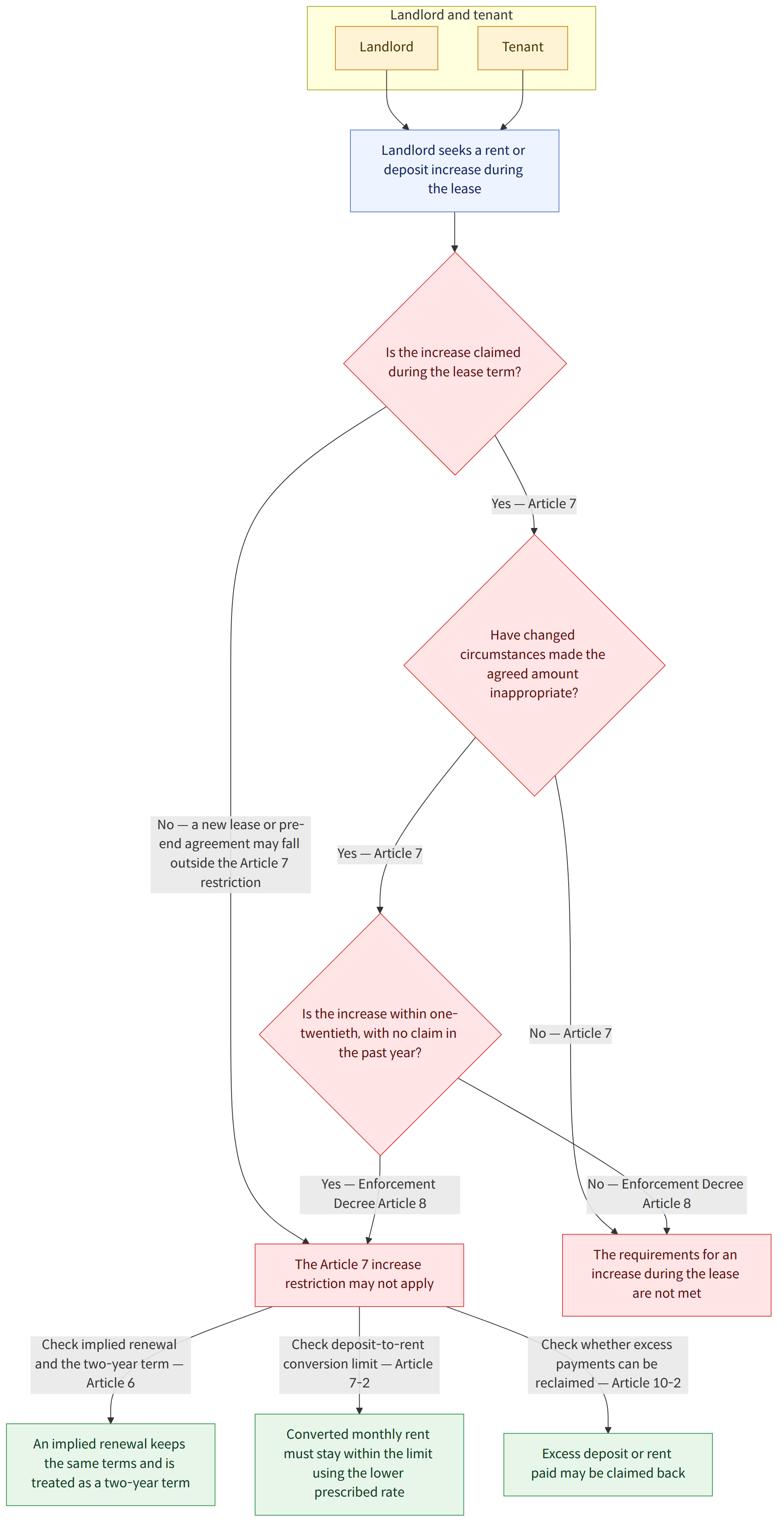
- If changes in the burden of taxes, public charges, or other expenses relating to the leased home, or changes in economic circumstances, make the agreed deposit or rent inappropriate, either party may claim an increase or reduction going forward (Housing Lease Protection Act, Article 7 (주택임대차보호법 제7조)).
- A claim for an increase during the term of the lease may not exceed one-twentieth of the agreed rent or deposit, and no further claim may be made within one year after the agreement was made or the previous increase took effect (Enforcement Decree of the Housing Lease Protection Act, Article 8, Paragraphs 1 and 2 (주택임대차보호법 시행령 제8조 제1항·제2항)).
- If no notice of refusal to renew or change of terms is given between six months and one month before the end of the lease term, the lease is implicitly renewed on the same terms as before, and the term is treated as two years (Housing Lease Protection Act, Article 6 (주택임대차보호법 제6조)).
- The example discusses court decisions holding that the increase restriction in Article 7 does not apply when the parties enter into a new lease after the previous lease ends, or agree to increase the deposit or rent before the lease ends (Supreme Court Decision 93Da30532, December 7, 1993, etc.).
- When all or part of a deposit is converted into monthly rent, the monthly rent may not exceed the limit calculated using the lower of the two rates prescribed by law (Housing Lease Protection Act, Article 7-2 (주택임대차보호법 제7조의2)).
- A claim may be made for the return of any deposit or rent paid in excess of the statutory increase rate or monthly rent calculation rate (Housing Lease Protection Act, Article 10-2 (주택임대차보호법 제10조의2)).
- A tenant may also request a reduction in the deposit due to changed circumstances. However, separate requirements may apply to increases or reductions in the deposit when the contract terms are changed, including through a new lease.
- The example discusses a court decision holding that, if a deposit is validly reduced so that the tenant qualifies as a small-amount tenant, the tenant may be protected as such unless special circumstances, such as a sham agreement, exist (Supreme Court Decision 2007Da23203, May 15, 2008).
Frequently asked questions
Q. If my landlord asks me to increase the deposit or monthly rent because local market rents have gone up, do I have to agree?
A claim for an increase during the term of the lease may be made if the agreed amount has become inappropriate because of changes in the burden of taxes, public charges, or other expenses, or changes in economic circumstances. The increase may not exceed one-twentieth of the agreed amount, so a landlord’s statement that local market rents have risen does not mean that the request must always be accepted.
Q. Can the landlord ask for another increase shortly after the deposit was raised?
Under the provisions cited in the example, a further claim for an increase may not be made within one year after the lease agreement was made or the agreed rent or deposit was increased. You should therefore check when the previous agreement was made or when the last increase took effect.
Q. My lease was renewed by implication. Can the landlord raise the rent?
An implied renewal takes place on the same terms as before and is treated as having a term of two years. However, even during the term of the lease, a claim for an increase going forward may be made if the statutory requirements concerning changed circumstances are met. The increase limit and one-year restriction must also be considered.
Q. Does the limit on deposit increases also apply when we enter into a new lease after the lease term ends?
The case law discussed in the example holds that the increase restriction in Article 7 of the Housing Lease Protection Act does not apply when the parties enter into a new lease after the previous lease has ended. It is necessary to distinguish between a claim for an increase during the term of a lease and a new agreement reached after the lease has ended.
Q. How is the monthly rent limited if part of the deposit is converted into rent?
When all or part of a deposit is converted into monthly rent, the monthly rent may not exceed the limit calculated using the lower of the two rates prescribed under Article 7-2 of the Housing Lease Protection Act. The examples explain the rates used in the calculation by reference to factors such as the base interest rate, so you should check which rates apply at the time of conversion.
Q. Can I get back a deposit or rent that I paid above the statutory limit?
Article 10-2 of the Housing Lease Protection Act, as cited in the example, allows a claim for the return of amounts paid in excess of the statutory increase rate or monthly rent calculation rate. The amount that may be recovered depends on the amount actually paid and the applicable limit.
Q. Can a tenant request a reduction in the deposit during the lease term?
A tenant may also request a reduction if the agreed deposit has become inappropriate because of changes in the burden of taxes, public charges, or other expenses, or changes in economic circumstances. However, where the parties dispute an increase or reduction in the deposit in connection with a new lease or similar arrangement, the nature of the contract change and the requirements concerning changed circumstances may be at issue.
Q. Can I receive protection if lowering the deposit makes me a small-amount tenant?
The example discusses a court decision holding that, if the deposit was reduced under a valid new agreement and the main purpose of the lease is to use and enjoy the home, the tenant may be protected as a small-amount tenant unless special circumstances, such as a sham agreement, exist.
Q. If a family member other than the tenant lives in the home and registers their move-in, can the lease be asserted against the new owner?
Based on the circumstances that the tenant’s younger sibling continued to live in the property and registered their move-in, the example concludes that the tenant’s indirect possession and opposability requirements were maintained, and that the new owner succeeded to the landlord’s position. It also explains, however, that an occupant who is not a party to the direct lease agreement must exercise their rights through the tenant.
Relevant laws
- Housing Lease Protection Act, Article 4 (주택임대차보호법 제4조)
- Housing Lease Protection Act, Article 6 (주택임대차보호법 제6조)
- Housing Lease Protection Act, Article 7 (주택임대차보호법 제7조)
- Housing Lease Protection Act, Article 7-2 (주택임대차보호법 제7조의2)
- Housing Lease Protection Act, Article 10-2 (주택임대차보호법 제10조의2)
- Enforcement Decree of the Housing Lease Protection Act, Article 8, Paragraph 1 (주택임대차보호법 시행령 제8조 제1항)
- Enforcement Decree of the Housing Lease Protection Act, Article 8, Paragraph 2 (주택임대차보호법 시행령 제8조 제2항)
- Enforcement Decree of the Housing Lease Protection Act, Article 9, Paragraph 1 (주택임대차보호법 시행령 제9조 제1항)
- Enforcement Decree of the Housing Lease Protection Act, Article 9, Paragraph 2 (주택임대차보호법 시행령 제9조 제2항)
Watch out for
- The increase limit must be checked in light of when the claim for an increase was made and when the agreement was made or the previous increase took effect.
- An implied renewal and a new lease made after the previous lease ends may be treated differently for purposes of the increase restriction, so they must be distinguished.
- The interest rates and calculation results in the monthly rent conversion example relate to a particular point in time and should not be applied unchanged at a different time.
- The legal treatment may differ between a case where the parties agree to reduce or convert the deposit and a case where one party claims an increase or reduction during the term of the lease.
Source cases
This guide was compiled by AI from the following Korea Legal Aid Corporation consultation cases (in Korean).
- 언니 대신 동생이 임대차 목적물에 주소를 두고 사는 경우 대항력 유지 여부, 연속된 묵시의 갱신에 있어서 임대차기간 계산, 임...
- 묵시적 갱신된 임대차기간 중 임대인 일방의 차임 증액 요구가 유효하기 위한 요건과 유효한 증액 범위
- 재계약시에도 주택임대차보증금의 증액제한규정이 적용되는지
- 1년의 임대차기간이 끝나갈 무렵 임대인의 보증금 증액요구
- 월세로 전환된 금액이 과다한 경우 이를 돌려받을 수 있는지
- 재계약한 경우 차임의 증액 청구권
- 임대차보증금이 감액된 경우
- 보증금의 월 차임 전환
- 초과 차임 등의 반환 청구 가능 여부
- 보증금 증액 청구
- 보증금의 감액 청구
- 보증금의 증액 청구
This guide is general legal information about Korean law, not legal advice for your situation. For a specific case, consult a lawyer or the Korea Legal Aid Corporation (call 132 in Korea).