
Guide to Housing Lease Terms and Implicit Renewal
Based on 32 consultation cases · Updated · Translated from the Korean original.
Even if a housing lease term is set at less than two years, the tenant may assert the shorter agreed term, while an implicitly renewed lease generally continues for two years. After implicit renewal, the tenant may give notice of termination, but termination takes effect only three months after the landlord receives the notice.
At a glance
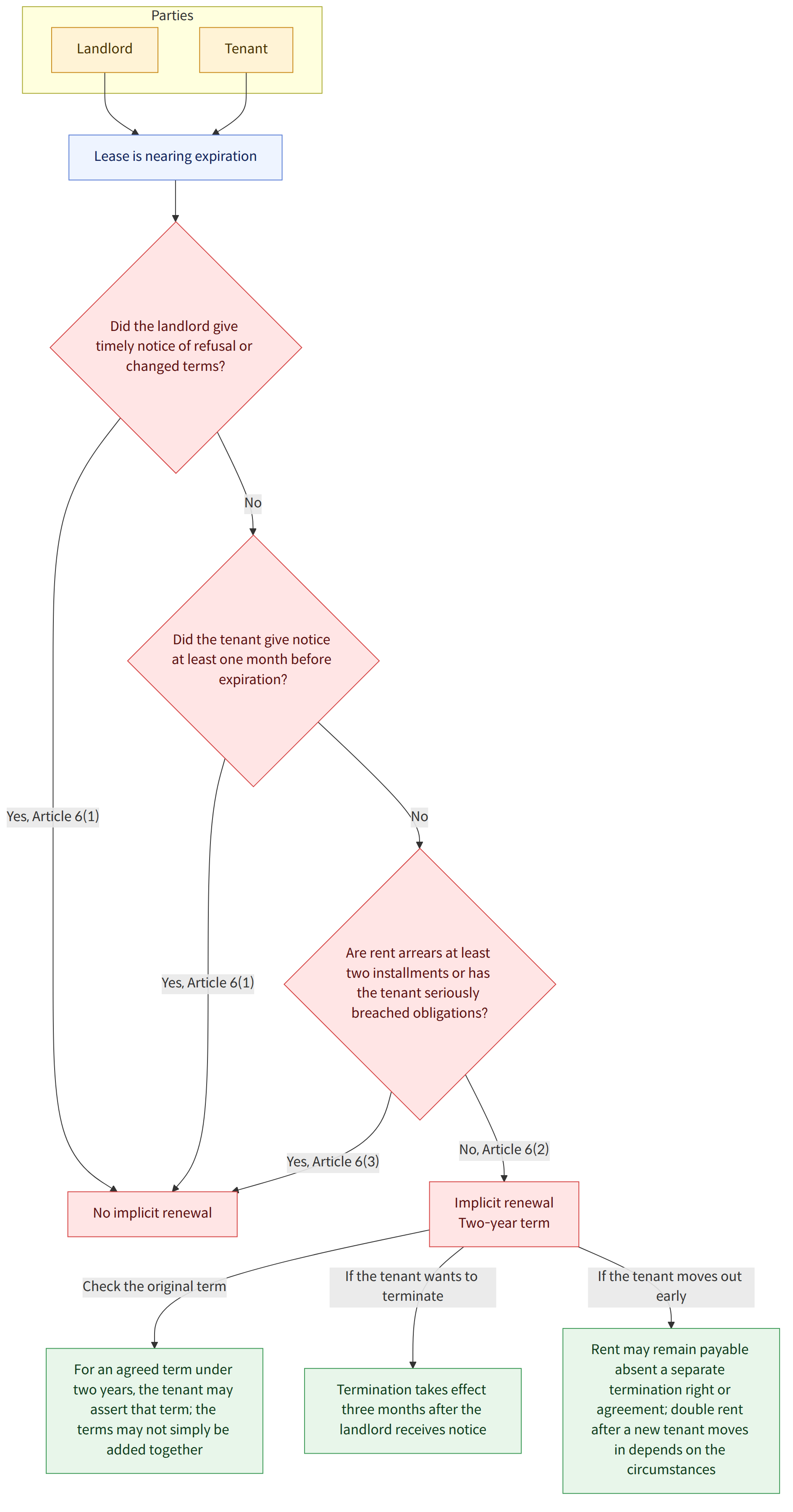
Key points
- A lease with no specified term or a term of less than two years is generally deemed to have a term of two years, but the tenant may assert that an agreed term of less than two years is valid (Housing Lease Protection Act, Article 4(1) (주택임대차보호법 제4조 제1항)).
- The landlord must notify the tenant of a refusal to renew or an intention to change the terms between six months and one month before the term expires. The lease may also be implicitly renewed if the tenant does not give notice at least one month before expiration (Housing Lease Protection Act, Article 6(1) (주택임대차보호법 제6조 제1항)).
- The term of an implicitly renewed lease is deemed to be two years (Housing Lease Protection Act, Article 6(2) (주택임대차보호법 제6조 제2항)).
- After implicit renewal, the tenant may give notice of termination at any time, but termination takes effect only three months after the landlord receives the notice (Housing Lease Protection Act, Article 6-2 (주택임대차보호법 제6조의2)).
- Implicit renewal may not apply if the total amount of rent in arrears, calculated cumulatively, reaches two rental installments, or if the tenant has seriously breached their obligations (Housing Lease Protection Act, Article 6(3) (주택임대차보호법 제6조 제3항)).
- Even if the tenant moves out unilaterally for personal reasons before the term expires, rent may remain payable for the rest of the term unless the tenant has a separate right to terminate or the parties have agreed otherwise. However, whether rent may be collected twice for a period after a new tenant moves in may be decided differently depending on the circumstances of the case.
- Where an implicitly renewed lease follows the expiration of an agreed term of less than two years, there are cases in which the agreed term and the renewal term cannot simply be added together to assert the total term (Supreme Court Decision 96Da5551, 5568, April 26, 1996, etc.).
Frequently asked questions
Q. I signed a one-year lease. Do I have to live there for two years?
No. A lease term of less than two years is generally deemed to be two years, but the tenant may assert that the agreed one-year term is valid. If you wish to claim that the lease has ended because the agreed term has expired, you should also check the deadline for giving notice of refusal to renew.
Q. What happens to the lease term if neither party says anything before the contract expires?
The lease may be implicitly renewed if the landlord does not give notice of refusal to renew or of a change in the terms within the period prescribed by law, and the tenant also does not give notice at least one month before the term expires. The renewed lease is deemed to have a term of two years.
Q. After an implicit renewal, can the tenant move out at any time?
The tenant may give the landlord notice of termination at any time. However, termination takes effect three months after the landlord receives the notice, so the tenant cannot necessarily get the deposit back immediately after giving notice.
Q. Can the landlord give notice of refusal to renew just before the lease expires?
The landlord must give notice of refusal to renew between six months and one month before the lease term expires. In one case, the court found that the landlord’s notice, given less than one month before the term expired, was ineffective and that the lease had therefore been implicitly renewed.
Q. Will implicit renewal be prevented if I fall two months behind on rent?
Implicit renewal may not apply if the total amount of rent in arrears reaches two rental installments. The arrears do not necessarily have to be for two consecutive months, and there is also a case finding that the landlord may terminate the lease under the Civil Act during the lease term.
Q. If I move out early while time remains on the lease, do I still have to pay rent for the remaining term?
If the right to terminate was not agreed upon when the contract was made, it may be difficult for the tenant to unilaterally end the contract for personal reasons alone, and the tenant may have to pay rent for the remaining term or reach an agreement with the landlord. However, one case found that if the landlord accepts a new tenant and re-rents the property, the landlord cannot collect rent twice for the subsequent period.
Q. Can I end the lease if the landlord changes, even though time remains on the lease?
As a general rule, a person who acquires ownership of a house succeeds to the landlord’s position. However, one case found that a tenant who does not wish to be bound by this succession may object within a reasonable time after learning that the house has been transferred and thereby escape the binding effect of the lease relationship.
Q. The lease term has expired, but I have not received my deposit back. Can I claim it from the new landlord?
One case explains that, where a tenant has opposability, the lease relationship is deemed to continue while the deposit remains unpaid, and that a person who buys the house during that period succeeds to the landlord’s position. In that situation, the tenant may claim return of the deposit from the new owner and assert that delivery of the house and return of the deposit must take place concurrently.
Q. Do I need to obtain a new fixed-date certification after an implicit renewal?
One case advises that an existing fixed-date certification remains effective even after implicit renewal, so there is no need to obtain a new one. It explains that obtaining a new fixed-date certification could instead disadvantage the tenant.
Relevant laws
- Housing Lease Protection Act, Article 3(1) (주택임대차보호법 제3조 제1항)
- Housing Lease Protection Act, Article 3(3) and (4) (주택임대차보호법 제3조 제3항 및 제4항)
- Housing Lease Protection Act, Article 3-3 (주택임대차보호법 제3조의3)
- Housing Lease Protection Act, Article 3-5 (주택임대차보호법 제3조의5)
- Housing Lease Protection Act, Article 4(1) and (2) (주택임대차보호법 제4조 제1항 및 제2항)
- Housing Lease Protection Act, Article 6(1) through (3) (주택임대차보호법 제6조 제1항부터 제3항까지)
- Housing Lease Protection Act, Article 6-2 (주택임대차보호법 제6조의2)
- Housing Lease Protection Act, Article 7 (주택임대차보호법 제7조)
- Housing Lease Protection Act, Article 10 (주택임대차보호법 제10조)
- Civil Act, Article 543 (민법 제543조)
- Civil Act, Article 618 (민법 제618조)
- Civil Act, Article 635 (민법 제635조)
- Civil Act, Article 639 (민법 제639조)
- Civil Act, Article 640 (민법 제640조)
Watch out for
- In addition to the notice deadline, it is important to confirm that the notice actually reached the landlord and to have evidence proving that it did. A notice sent by certified mail that was not delivered, or an oral notice that is difficult to prove, may lead to a dispute.
- Even after giving notice of termination following implicit renewal, the lease may remain in effect for three months from the date the landlord receives the notice. You should therefore consider the moving date and the timing of the deposit refund in advance.
- In some cases, where an implicit renewal follows the expiration of an agreed term of less than two years, the original agreed term and the renewal term cannot simply be added together to assert the total duration of the lease. The specific circumstances of the renewal should therefore be examined.
Source cases
This guide was compiled by AI from the following Korea Legal Aid Corporation consultation cases (in Korean).
- 기간만료 6개월 전 계약해지 통지가 기간만료 시의 갱신거절인지
- 부당한 보증금 증액 통지를 임차인이 거부한 경우 이를 임대차계약 갱신거절 의사 통지로 해석할 수 있는지
- 임차주택 양도를 이유로 주택임대차계약을 해지할 수 있는지
- 1년의 약정기간 만료 후 묵시적 갱신의 경우 주택임대차기간
- 기간을 1년으로 한 임대차계약의 임차인이 10개월 후 한 계약갱신거절 통지의 효력
- 집기파손, 관리비 미납을 이유로 갱신된 임대차계약기간의 중도에 임대차계약을 해지할 수 있지
- 주택임차인이 2년 미만으로 약정한 임차기간을 주장할 수 있는지
- 2기 이상의 차임을 연체한 경우에 해당하는지 여부, 임대차기간 중 임대차계약 해지할 수 있는 법적근거가 무엇인지
- 임대인이 임대차기간이 끝나기 1개월 이내 해지통지를 한 경우 묵시적 갱신이 되는지
- 임대차기간 종료 직전에 한 해지통지의 효력 발생시점
- 묵시적으로 갱신된 경우의 주택임대차기간
- 임대차기간 종료 후에 매매계약을 한 양수인이 보증금을 받지 못한 임차인에게 임대차 목적물의 인도를 청구할 수 있는지
- 임대인의 계약 갱신거절의 통지
- 주택임대차보호법 제4조 제1항의 해석
- 기간만료 전 이사한 임차인이 만료시까지의 월세를 지급해야 하는지
- 임차인의 주택인도의무가 선이행 의무인지
- 주택임대차보호법상 묵시적 갱신시 임대차 존속기간
- 2년 미만의 약정기간 만료 후 묵시적 갱신된 경우
- 임의경매절차에서 2년 미만의 약정 임대차기간의 주장 가능성
- 차임 연체와 묵시적 갱신
- 임대차계약의 묵시적 갱신과 임차인의 해지 통보
- 임대목적물 매매를 이유로 한 임차인의 임대차계약 해지
- 기간을 2년 미만으로 정한 임차인의 우선변제권 주장
- 임대차계약의 묵시적 갱신과 확정일자
- 임대차보증금반환청구권을 양도한 경우 임대차계약기간의 연장 가능성
This guide is general legal information about Korean law, not legal advice for your situation. For a specific case, consult a lawyer or the Korea Legal Aid Corporation (call 132 in Korea).