
Division of an Estate: A Key Guide to Agreements and Court Decisions
Based on 17 consultation cases · Updated · Translated from the Korean original.
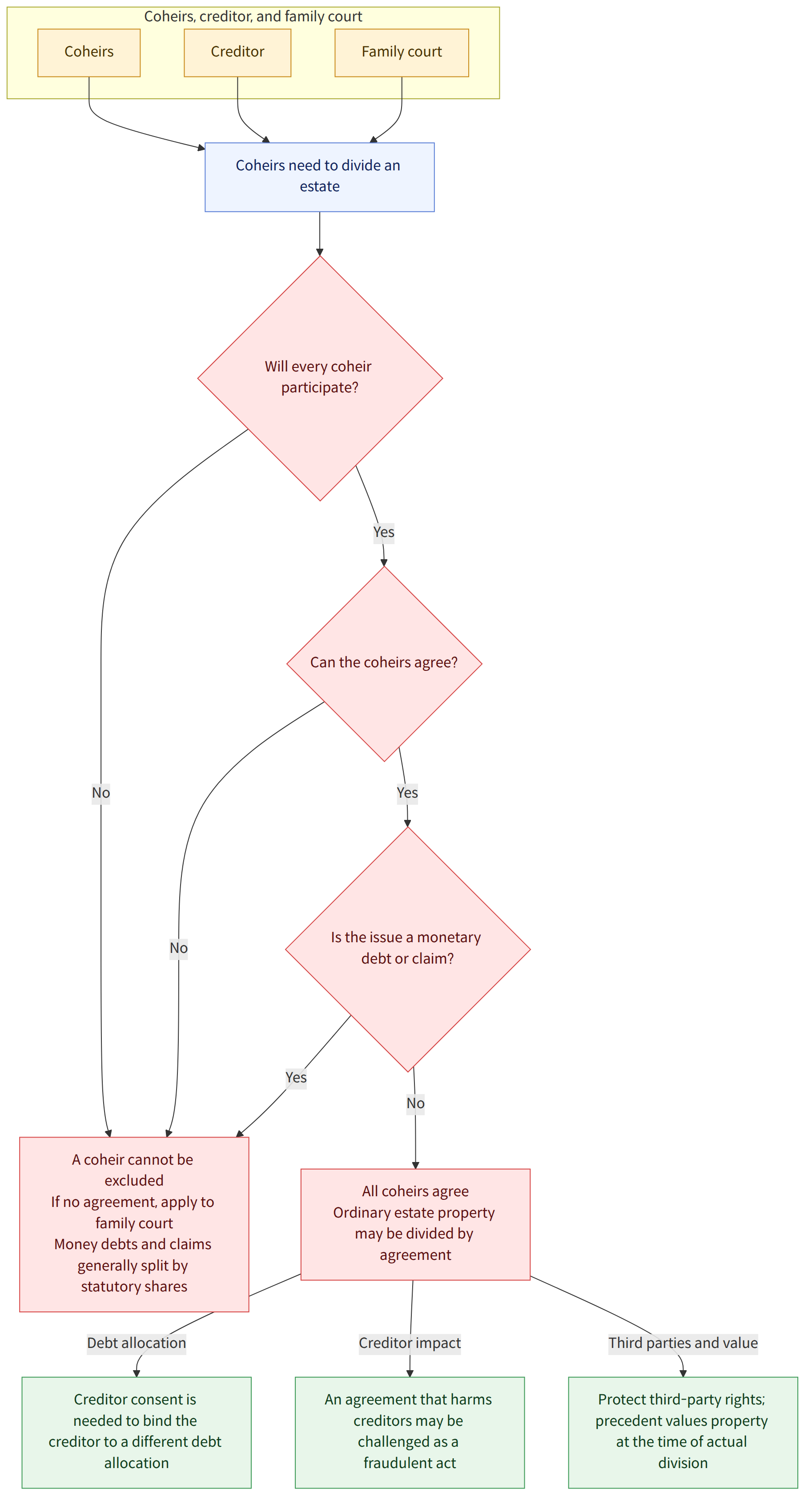
To divide an estate by agreement, all coheirs must participate. If no agreement is reached, or an agreement cannot be made, an application for a judicial decision on the division of the estate may be filed with the family court. However, divisible rights and obligations, such as monetary debts and monetary claims, are generally divided according to the statutory shares when the inheritance opens, and are treated differently from estate property subject to ordinary division.
At a glance
Key points
- All coheirs must participate in an agreed division of the estate. They do not have to meet in person; the proposed division may be approved in turn, or some heirs may give their consent in writing (Cases 1 and 17).
- If the address of one of the coheirs is unknown, the heirs cannot agree on a division while excluding that person. The case explains that an agreed division is difficult if no declaration of disappearance has been obtained for an heir whose whereabouts are unknown (Case 1).
- If no agreement is reached, or an agreement cannot be made, an application for a judicial decision on the division of the estate may be filed with the family court. A lawsuit for partition of jointly owned property cannot be brought with respect to an individual property that forms part of the estate (Cases 7 and 16).
- As a general rule, monetary debts and monetary claims are divided according to the statutory shares as soon as the inheritance opens, and are not subject to an agreement on the division of the estate. Even if the heirs agree among themselves to allocate the debt differently, they cannot rely on that agreement against the creditor without the creditor’s consent (Cases 2, 9, and 12; Civil Act, Article 454 (민법 제454조)).
- According to the case, if one heir acquires more property than that heir’s statutory share through an agreement on the division of the estate, the excess is not treated as a gift from another heir (Case 10).
- If an heir whose liabilities exceed their assets agrees to receive significantly less than their rightful inheritance share, or the agreement otherwise harms creditors, the division agreement may be subject to the exercise of a creditor’s right to revoke a fraudulent act (Cases 3 and 13).
- The coheirs may rescind an agreement on division by mutual consent and make a new agreement, but they must take care not to prejudice the rights of third parties in the process (Case 6; Civil Act, Article 548(1), proviso (민법 제548조 제1항 단서)).
- The position of the precedent described in the case is that it is reasonable to value the property to be divided as of the time of the actual division, rather than as of the time the inheritance opened (Case 14).
Frequently asked questions
Q. Must all the heirs meet in person for an agreement on the division of the estate to be valid?
No. All coheirs must participate, but they do not have to meet in person. It is also possible for one person to prepare a proposed division and have the others approve it in turn, or for some heirs to give their consent in writing.
Q. If we do not know the address of one coheir, can the other heirs divide the estate among themselves first?
According to the case, an agreed division in which only some of the coheirs participate is invalid, so the heirs cannot agree on a division while excluding an heir whose address is unknown. However, one option described is for some heirs to apply to register the inheritance in the names of all coheirs according to their statutory shares.
Q. If we cannot agree on how to divide real property in the estate, can we file a lawsuit for partition of jointly owned property?
According to the case, it is not permissible to bring a lawsuit for partition of jointly owned property with respect to an individual property that forms part of the estate. If no agreement is reached, or an agreement cannot be made, an application for a judicial decision on the division of the estate must be filed with the family court.
Q. If we agree that one heir will assume all the monetary debts inherited, is that agreement effective against the creditor too?
As a general rule, monetary debts are divided among the heirs according to their statutory shares as soon as the inheritance opens. An agreement under which one heir assumes another heir’s share in substance constitutes an assumption of debt that releases the other heir; the creditor’s consent is therefore required for that other heir to be released from liability to the creditor.
Q. Must inherited monetary claims also be divided by an agreement on the division of the estate?
According to the case, divisible claims such as monetary claims are divided according to the statutory shares as soon as the inheritance opens, and are therefore not subject to an agreement on the division of the estate. It explains that if one heir is to acquire a claim exceeding that heir’s statutory share, this is treated as an assignment of the claim, and notice to the debtor is required.
Q. Will gift tax be imposed if I receive more than my share through an agreement on the division of the estate?
According to the position taken in the precedent cited in the case, even if an heir acquires property exceeding that heir’s share through an agreed division, the property is deemed to have been inherited from the decedent when the inheritance opened. It therefore explains that the excess is not treated as a gift from another coheir.
Q. I inherited property together with my minor child. Can I represent my child in the division agreement?
The case explains that where a parent with parental authority and a minor child are coheirs, their interests conflict, and an agreement on division made by the parent directly representing the child is invalid. The parties must obtain the court’s appointment of a special representative for the child and proceed with the agreement through that representative.
Q. Can we later cancel an agreement on the division of the estate and decide on a new division?
If all coheirs agree, they may rescind all or part of an existing agreement and make a new agreement on the division. However, the case explains that care must be taken with respect to third-party rights because the proviso to Article 548(1) of the Civil Act applies.
Q. Is someone who bought an inheritance share from an heir before the agreement on the division of the estate protected?
According to the case, despite the retroactive effect of the division, the third parties protected are specific successors who have met the requirements for asserting their rights, such as registration. It explains that a person who purchased an inheritance share but did not register the transfer of ownership is not a protected third party.
Relevant laws
- Civil Act, Article 22 (민법 제22조)
- Civil Act, Article 268 (민법 제268조)
- Civil Act, Article 454 (민법 제454조)
- Civil Act, Article 548(1) (민법 제548조 제1항)
- Civil Act, Article 921 (민법 제921조)
- Civil Act, Article 1013 (민법 제1013조)
- Civil Act, Article 1015 (민법 제1015조)
- Civil Act, Article 1017 (민법 제1017조)
- Civil Act, Article 1019 (민법 제1019조)
- Civil Act, Article 1026(1) (민법 제1026조 제1항)
- Real Estate Registration Act, Article 48(1) (부동산등기법 제48조 제1항)
- Real Estate Registration Act, Article 48(2) (부동산등기법 제48조 제2항)
Watch out for
- All coheirs must participate in an agreed division. Take care not to proceed with registration of real property based on an agreement that excludes some heirs.
- An agreement among heirs about how to allocate divisible debts does not, by itself, change their liability to the creditor. Check whether the creditor’s consent is required to release another heir from a debt.
- An agreement on the division of the estate may be subject to revocation as a fraudulent act if it reduces the debtor’s assets and harms creditors.
- The cases address, respectively, the valuation of property at the time of division, the rights of third parties when an agreement is rescinded, and the participation of an heir whose whereabouts are unknown. When following specific registration or court procedures, the relevant circumstances should therefore be considered together.
Source cases
This guide was compiled by AI from the following Korea Legal Aid Corporation consultation cases (in Korean).
This guide is general legal information about Korean law, not legal advice for your situation. For a specific case, consult a lawyer or the Korea Legal Aid Corporation (call 132 in Korea).