
Standards and Calculation Methods for Claims to a Reserved Portion of an Estate
Based on 14 consultation cases · Updated · Translated from the Korean original.
A reserved portion is a legally guaranteed minimum share that allows a statutory heir to recover a minimum part of an inheritance when the heir receives little or none of it because of a bequest or gift. Whether a claim can be made and its amount depend on the relationship between the heirs, the timing and recipient of gifts, property already received, and inheritance debts.
At a glance
Key points
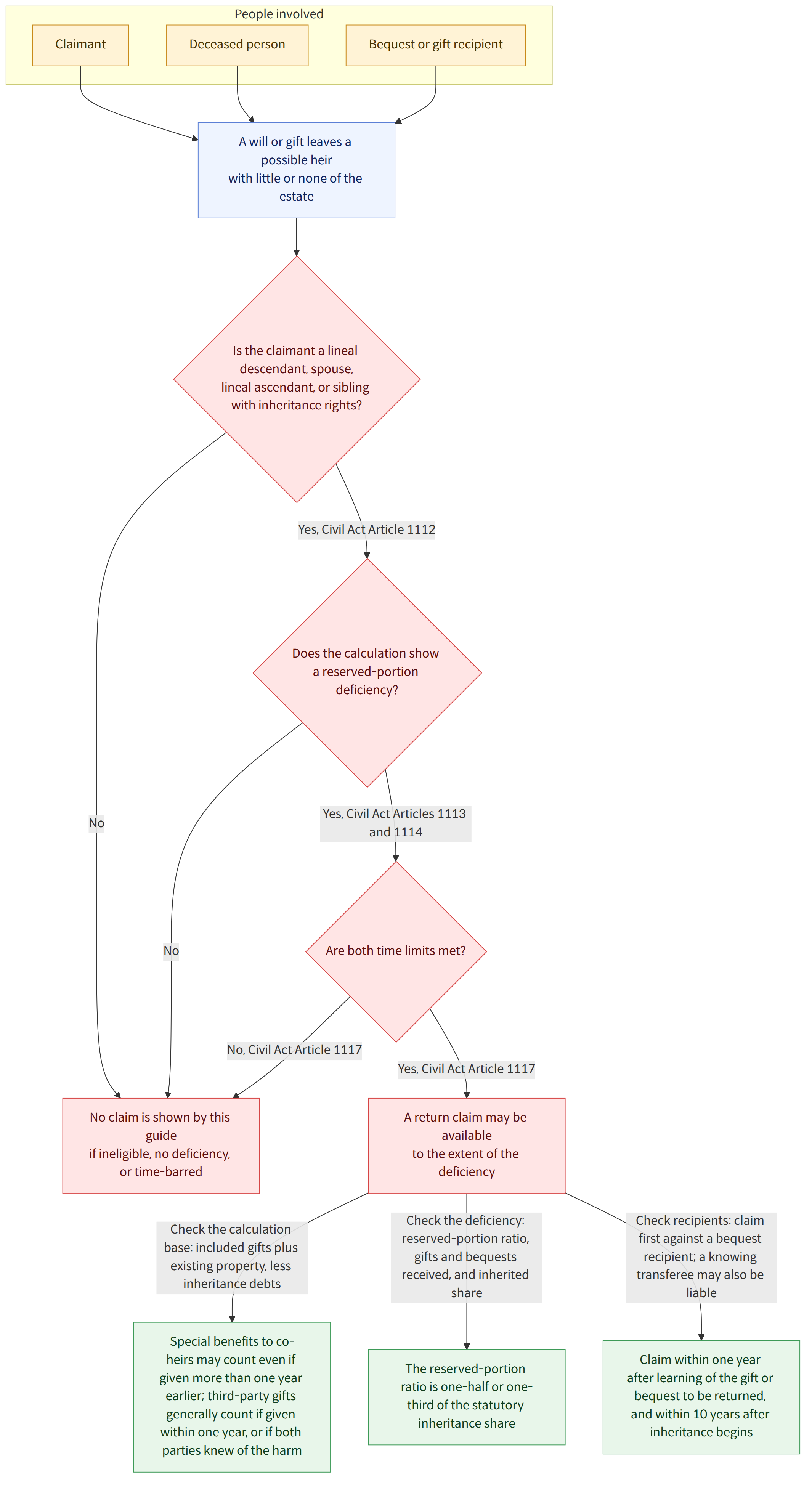
- A reserved portion may be held by lineal descendants, a spouse, lineal ascendants, or siblings who have inheritance rights under the order of succession. Its ratio is one-half or one-third of the statutory inheritance share (Civil Act, Article 1112 (민법 제1112조)).
- The reserved portion is calculated by adding gifts subject to inclusion to the property existing at the commencement of inheritance and deducting inheritance debts (Civil Act, Articles 1113 and 1114 (민법 제1113조, 제1114조)).
- A special benefit received by a co-heir may be included in the estate used as the calculation base for the reserved portion even if the gift was made more than one year before the commencement of inheritance.
- A deficiency in the reserved portion is calculated by multiplying the estate used as the calculation base by the reserved-portion ratio, then taking into account gifts and bequests received by the claimant and the claimant’s share of the inherited property, among other things.
- If a bequest and a gift together infringe a reserved portion, a claim for return must first be made against the person who received the bequest (Civil Act, Article 1116 (민법 제1116조)).
- Even if gifted property has been transferred to a third party, a claim for return may be made if the transferee knew, at the time of the transfer, that it would harm a person entitled to a reserved portion.
- The time limits applicable to a claim for return of a reserved portion are one year from when the claimant learns of the gift or bequest that must be returned, and 10 years from the commencement of inheritance (Civil Act, Article 1117 (민법 제1117조)).
Frequently asked questions
Q. If a will gives all the property to another person or organization, can the heirs receive nothing?
If a bequest under a will leaves a reserved portion deficient, a person entitled to a reserved portion may claim its return to the extent of the deficiency. However, you must first determine whether the person has inheritance rights under the order of succession and what each person’s reserved portion is.
Q. Is property received by an heir during the decedent’s lifetime included in the calculation of the reserved portion?
If a co-heir received a special benefit from the decedent, a gift made more than one year before the commencement of inheritance may still be included in the estate used as the calculation base. By contrast, gifts to third parties are generally included if made within one year before the commencement of inheritance. A gift made more than one year earlier may also be included if both parties knew that it would harm a person entitled to a reserved portion.
Q. How is a deficiency in the reserved portion calculated?
The calculation method shown in the example is to multiply the estate used as the calculation base by the reserved-portion ratio, then take into account the claimant’s special benefits and net inheritance share. The estate used as the calculation base is determined by adding gifts subject to inclusion to the property existing at the commencement of inheritance, then deducting inheritance debts. You should therefore check all property, gifts, and debts.
Q. If both a bequest and a gift are involved, against whom should a claim for return be made first?
If both a bequest and a gift infringe a reserved portion, a claim for return must first be made against the person who received the bequest. Whether a deficiency remains after the return, and the extent to which each recipient must return property, depend on the specific property relationships.
Q. Can I make a claim against someone after gifted property has been transferred to them?
If the transferee knew, when receiving the property, that the transfer would harm a person entitled to a reserved portion, a claim for return of the property may also be made against the transferee. If there are no such circumstances, it is difficult to conclude that a claim can be made against a third party.
Q. By when must a claim for return of a reserved portion be made?
Under the standard cited in the example, the claim must be exercised within one year from when the claimant learns that there is a gift or bequest that must be returned. A further issue arises if 10 years have passed since the commencement of inheritance. Do not assume that the time limit for a claim for return of a reserved portion has been met merely because another lawsuit challenging the validity of a gift was filed. Check whether the intention to seek return was expressed with respect to the particular gift or bequest.
Q. Are funeral expenses and inheritance tax deducted like inheritance debts when calculating the reserved portion?
According to the decision in the example, funeral expenses and inheritance tax are costs incurred after the decedent’s death and cannot be treated as inheritance debts deductible from the property existing at the commencement of inheritance. Accordingly, it is difficult to conclude that they should automatically be deducted from the estate used as the calculation base.
Q. Can a creditor of a person entitled to a reserved portion claim its return on that person’s behalf?
The right to claim return of a reserved portion is a right whose exercise is left to the claimant’s free decision. A creditor will therefore have difficulty exercising it on the claimant’s behalf unless the claimant is recognized as having made a definite decision to exercise the right. The fact that the debtor has insufficient assets does not, by itself, make a claim by subrogation immediately available.
Relevant laws
- Civil Act, Article 1001 (민법 제1001조)
- Civil Act, Article 1008 (민법 제1008조)
- Civil Act, Article 1009 (민법 제1009조)
- Civil Act, Article 1010 (민법 제1010조)
- Civil Act, Article 1112 (민법 제1112조)
- Civil Act, Article 1113 (민법 제1113조)
- Civil Act, Article 1114 (민법 제1114조)
- Civil Act, Article 1115 (민법 제1115조)
- Civil Act, Article 1116 (민법 제1116조)
- Civil Act, Article 1117 (민법 제1117조)
- Civil Act, Article 1118 (민법 제1118조)
Watch out for
- The one-year period relates not only to knowledge of the commencement of inheritance but also to knowledge that there is a gift or bequest that must be returned. You should establish when the claimant became aware of these facts and the circumstances in which that occurred.
- After 10 years have passed from the commencement of inheritance, the right to claim may be extinguished even if registration of the transfer of ownership pursuant to a gift has not yet been completed.
- The mere fact that a gift was made does not mean that it is included in the estate used as the calculation base. You must consider whether the recipient is a co-heir, whether the gift was a special benefit, when it was made, and whether the parties knew it would infringe a reserved portion.
- The estate used as the calculation base and the amount of any deficiency vary depending on the value of the inherited property, gifts and bequests, debts, and amounts already received by the claimant. Do not apply the calculation in an example as-is to a different inheritance situation.
Source cases
This guide was compiled by AI from the following Korea Legal Aid Corporation consultation cases (in Korean).
This guide is general legal information about Korean law, not legal advice for your situation. For a specific case, consult a lawyer or the Korea Legal Aid Corporation (call 132 in Korea).