
Understanding the Order of Inheritance and Who Inherits
Based on 11 consultation cases · Updated · Translated from the Korean original.
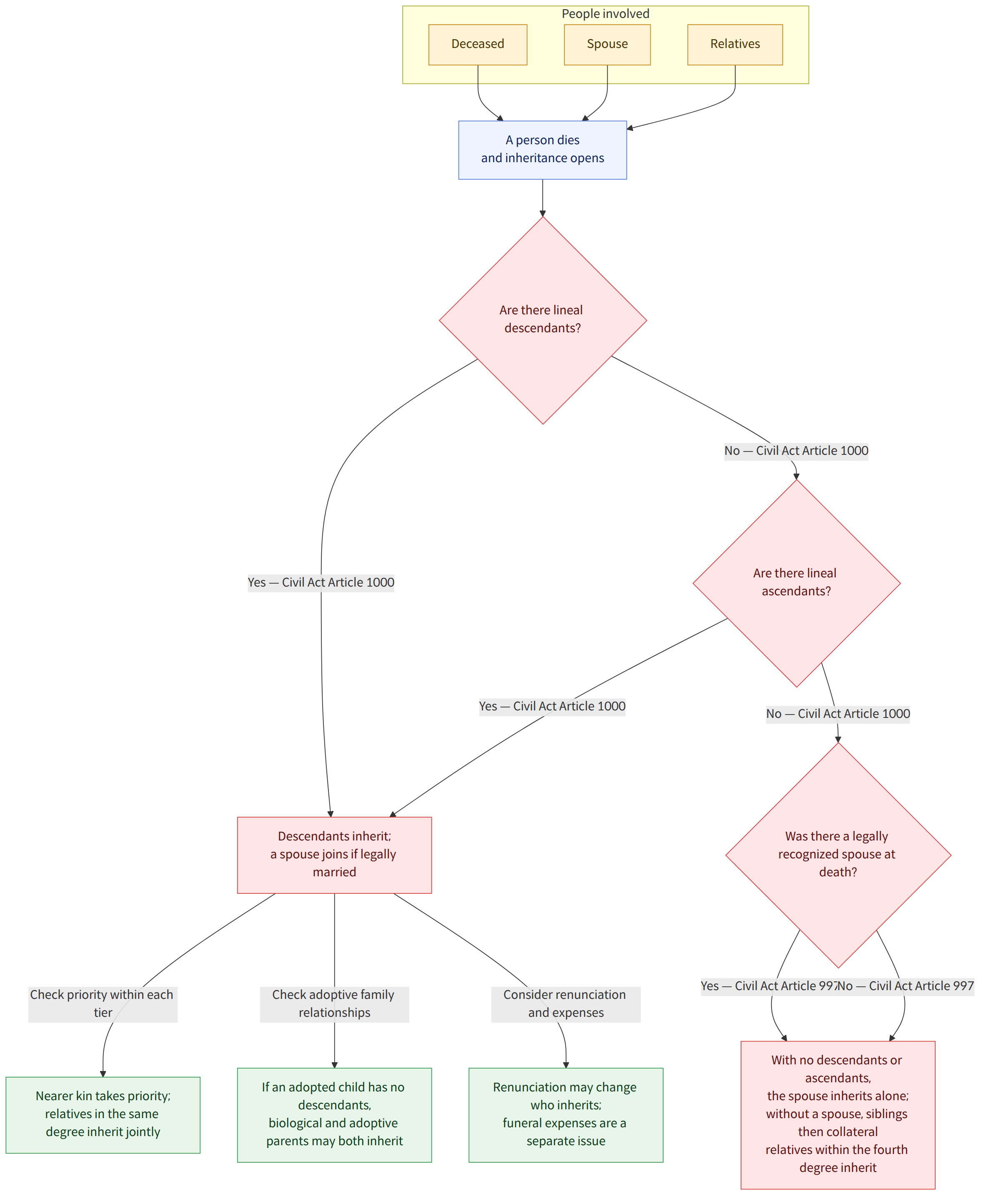
Inheritance passes in the following order: lineal descendants, lineal ascendants, siblings, and collateral relatives within the fourth degree. If there is an heir in a higher-priority tier, heirs in lower-priority tiers do not inherit. A spouse inherits in the same tier as lineal descendants or lineal ascendants, and inherits alone if neither group exists.
At a glance
Key points
- The statutory order of inheritance is the deceased’s lineal descendants, lineal ascendants, siblings, and collateral relatives within the fourth degree (Civil Act, Article 1000 (민법 제1000조)).
- Within the same tier, a relative in the nearer degree of kinship takes priority. If there are multiple relatives in the same degree, they inherit jointly (Civil Act, Article 1000 (민법 제1000조)).
- A spouse inherits jointly with lineal descendants or lineal ascendants and inherits alone if there are neither lineal descendants nor lineal ascendants (Civil Act, Article 1003 (민법 제1003조)).
- If the deceased had a spouse and children, the parents and other lineal ascendants are lower-priority heirs and do not inherit (Cases 1, 5, and 10).
- If an adopted child dies without lineal descendants, both the biological parents and the adoptive parents may inherit as lineal ascendants (Supreme Court Decision 94Ma535, January 20, 1995; Case 7).
- If both the spouse and children, who are first-priority heirs, renounce the inheritance, the grandchildren may become heirs, so any decision to renounce an inheritance should be considered carefully (Supreme Court Judgment 95Da27769, September 26, 1995; Case 9).
- Inheritance opens upon death. Therefore, a person may inherit if they were still legally married to the deceased at the time of death, even if divorce proceedings were underway (Civil Act, Article 997 (민법 제997조); Case 11).
- Liability for funeral expenses is treated as a separate issue from inheritance. Even if the inheritance is renounced, the highest-priority heirs may be liable for those expenses in the absence of special circumstances (Case 4).
Frequently asked questions
Q. If the deceased had children and a spouse, do the deceased’s parents also inherit?
No. Children are lineal descendants and first-priority heirs, and the spouse inherits in the same order as the children. The parents, as lineal ascendants, are lower-priority heirs and therefore do not inherit.
Q. When does a spouse inherit alone?
If there are no lineal descendants or lineal ascendants, the spouse inherits alone. If there are lineal descendants or lineal ascendants, the spouse inherits jointly with those heirs.
Q. Can a spouse inherit if the other spouse dies while divorce proceedings are underway?
A person may be an heir if the legally recognized marriage still existed at the time of death. There is a case holding that the fact that divorce proceedings were underway does not, by itself, change the person’s status as an heir at the time of death.
Q. Can the biological parents inherit when an adopted child dies?
If an adopted child has no lineal descendants and inheritance passes to the lineal-ascendant tier, both the biological parents and the adoptive parents may be heirs. If the adopted child has a wife, the lineal ascendants and the spouse may inherit jointly.
Q. If all the children renounce the inheritance, do the grandchildren inherit?
If both the spouse and children, who are first-priority heirs, renounce the inheritance, the grandchildren may become heirs as lineal descendants. It is important to distinguish between a situation in which only the children renounce the inheritance and one in which the spouse also renounces it.
Q. Does renouncing an inheritance also mean that I do not have to pay funeral expenses?
In the case, the court considered liability for funeral expenses to arise from the family relationship with the deceased, not from the inheritance itself. Accordingly, even if the inheritance is renounced, the highest-priority heirs may be liable for those expenses in the absence of special circumstances.
Q. Do all of the deceased’s siblings inherit in the same order?
The precedent cited in the case interpreted the siblings referred to in Article 1000(1)(3) of the Civil Act as the deceased’s paternal collateral blood relatives, and held that siblings who share only the same mother but have different fathers are not included. This issue should be considered in light of both the specific family relationships in the case and the purpose of the precedent.
Q. What happens to the estate if there are no heirs?
The case explains that, if there are no heirs, the estate ultimately vests in the State after certain procedures are followed. However, an inheritance that opened in the past may be governed by the law and transitional provisions in force at that time, so the date on which the inheritance opened should be confirmed.
Relevant laws
- Civil Act, Article 752 (민법 제752조)
- Civil Act, Article 997 (민법 제997조)
- Civil Act, Article 1000 (민법 제1000조)
- Civil Act, Article 1003 (민법 제1003조)
- Civil Act, Article 1009(2) (민법 제1009조 제2항)
- Civil Act, Article 1058(1) (민법 제1058조 제1항)
- Addenda to the Civil Act, Article 25(2) (민법 부칙 제25조 제2항)
Watch out for
- Depending on whether an inheritance is renounced, a person in the next tier of inheritance, such as a grandchild, may become an heir. Confirm both who is renouncing and the family relationships involved.
- A case indicates that renouncing an inheritance does not, by itself, remove liability for funeral expenses; consider this issue separately from matters concerning the estate.
- For cases involving a death in the past or a declaration of disappearance, the order of inheritance may depend on when the inheritance opened and which law applies.
Source cases
This guide was compiled by AI from the following Korea Legal Aid Corporation consultation cases (in Korean).
- 재산상속에 있어서 법정상속인의 상속순위
- 구민법 시행 당시 호주가 상속할 남자 없이 사망함으로써 호주 및 유산상속을 한 망 호주의 장남의 처가 신민법 시행 후 사망한 ...
- 실종기간만료와 실종선고가 신민법시행 전후로 나뉜 경우 상속순위
- 장례비용과 상속 순위
- 직계비속과 직계존속의 상속순위
- 재산상속에 있어서 법정상속인의 상속순위
- 양자의 경우 직계존속의 상속순위
- 민법 제1000조 제1항 제3호 소정의 "피상속인의 형제자매"의 범위
- 채무자인 피상속인의 제1순위 상속인인 자 전원이 상속을 포기한 경우, 차순위인 손들의 상속
- 자녀가 있는 경우 직계존속의 상속순위
- 이혼 소송 중인 배우자의 상속가능 여부
This guide is general legal information about Korean law, not legal advice for your situation. For a specific case, consult a lawyer or the Korea Legal Aid Corporation (call 132 in Korea).