
Limited Acceptance and Renunciation of Inheritance: Deadlines and Effects
Based on 41 consultation cases · Updated · Translated from the Korean original.
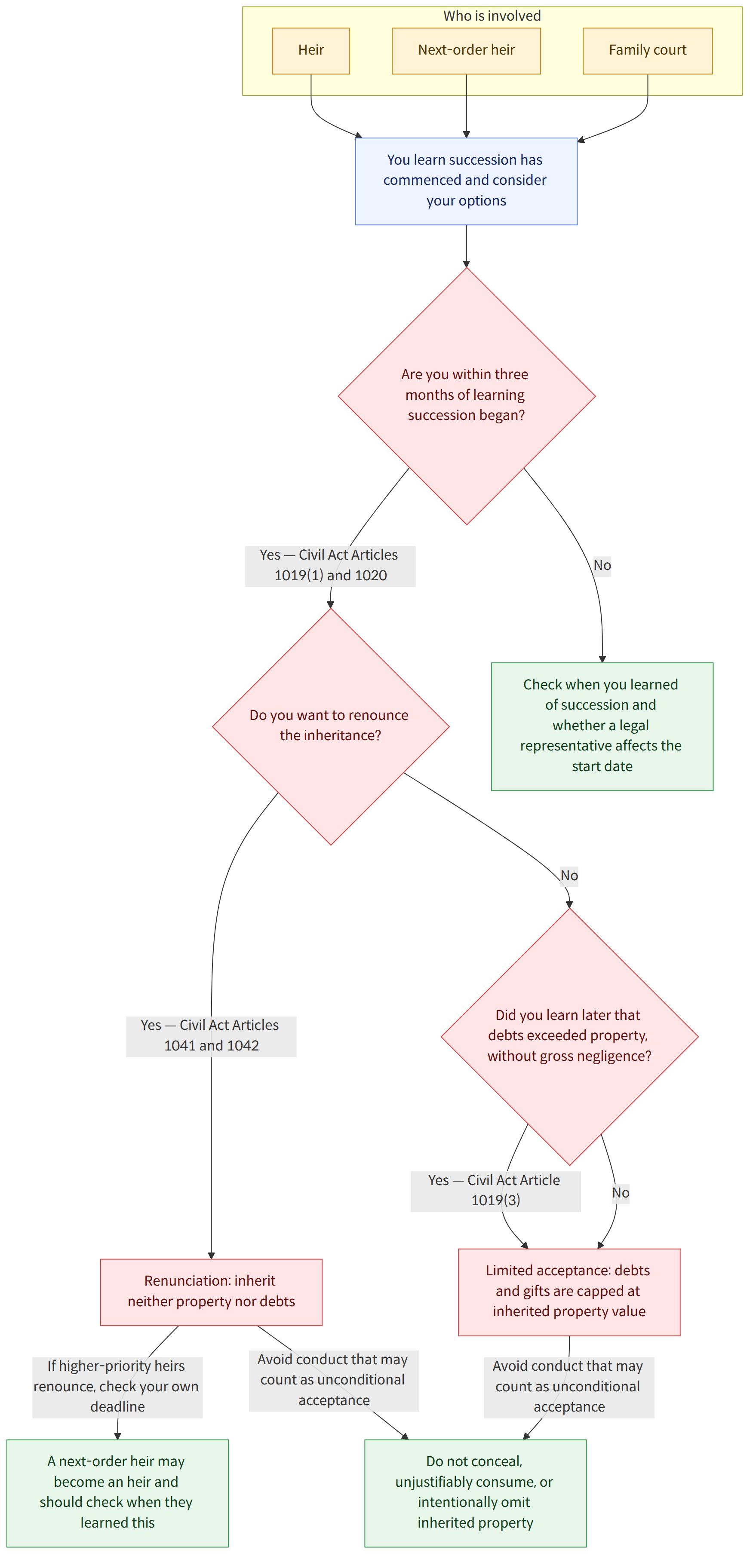
Renunciation of inheritance means that you do not inherit either property or debts, while limited acceptance means that you pay debts only up to the value of the property inherited. As a general rule, you must file with the family court within three months from the date you learn that succession has commenced; after an inheritance is renounced, a person in the next order may become an heir.
At a glance
Key points
- Renunciation of inheritance must be filed with the family court within three months from the date you learn that succession has commenced. Once renounced, the heir is treated as if they had never been an heir (Civil Act, Articles 1019(1) and 1042 (민법 제1019조 제1항, 제1042조)).
- Limited acceptance means paying the decedent’s debts and testamentary gifts only up to the value of the property acquired through inheritance (Civil Act, Articles 1028 and 1030 (민법 제1028조, 제1030조)).
- If, without gross negligence, you did not learn within three months that the inherited debts exceeded the inherited property, you may make a special limited acceptance within three months from the date you learned that fact (Civil Act, Article 1019(3) (민법 제1019조 제3항)).
- If all higher-priority heirs renounce the inheritance, a person in the next order may become an heir. A lower-priority heir should therefore check the applicable deadline from the date they learn that they have become an heir (Civil Act, Article 1000 (민법 제1000조), Cases 1 and 14).
- Monetary debts are divided according to the statutory shares of inheritance when succession commences. To assert an agreement among co-heirs on how to divide the debt against the creditor, the creditor’s consent is required (Civil Act, Article 454 (민법 제454조), Cases 4 and 16).
- After limited acceptance or renunciation of inheritance, concealing inherited property, consuming it without justifiable reason, or intentionally omitting it from the inventory may result in the inheritance being deemed unconditionally accepted (Civil Act, Article 1026(3) (민법 제1026조 제3호)).
- Renunciation of inheritance may also apply to property omitted from the inventory, and an agreement to renounce made before succession commences has no effect as a renunciation of inheritance under the statutory procedure (Civil Act, Articles 1041 and 1042 (민법 제1041조·제1042조), Cases 10 and 15).
Frequently asked questions
Q. What is the difference between renunciation of inheritance and limited acceptance?
Renunciation of inheritance means that the heir succeeds to neither the inherited property nor the debts; upon renunciation, the heir is treated as if they had never been an heir. Limited acceptance means that debts are paid only up to the value of the property acquired through inheritance (Civil Act, Articles 1028 and 1042 (민법 제1028조, 제1042조)).
Q. By when must I renounce an inheritance or make a limited acceptance?
As a general rule, a declaration must be filed with the family court within three months from the date the person learns that succession has commenced. For minors and other persons lacking legal capacity, the period may be calculated from the date their legal representative learns that succession has commenced, so you should also check who the legal representative and holder of parental authority is (Civil Act, Articles 1019(1) and 1020 (민법 제1019조 제1항, 제1020조)).
Q. What should I do if I later learn that the inherited debts exceed the inherited property?
If, without gross negligence, you did not learn within the original three-month period that the inherited debts exceeded the inherited property, you may make a limited acceptance within three months from the date you learned that fact. This is a peremptory period, so you cannot later cure a late filing merely on the grounds that circumstances beyond your control prevented you from meeting the deadline (Civil Act, Article 1019(3) (민법 제1019조 제3항), Case 17).
Q. If a parent renounces an inheritance, must the grandchildren also renounce it?
If a higher-priority heir renounces the inheritance, a person in the next order may become an heir; if the children and spouse renounce, the grandchildren may become heirs. A lower-priority heir should consider renouncing the inheritance or making a limited acceptance within three months from the date they learn that they have become an heir (Civil Act, Article 1000 (민법 제1000조), Cases 1 and 14).
Q. If co-heirs agree that one person will take on all the debt, are the other heirs free of liability?
As a general rule, monetary debts are divided according to the statutory shares of inheritance when succession commences, and therefore are not subject to division of inherited property. Even if the co-heirs agree among themselves that one person will bear a larger share of the debt, the creditor must consent for the agreement to be asserted against the creditor (Civil Act, Article 454 (민법 제454조), Case 4).
Q. Is property omitted from the inventory in a renunciation filing excluded from the renunciation?
Renunciation of inheritance is, as a general rule, a comprehensive and unconditional expression of intent, and may therefore also apply to property omitted from the inventory of property attached to the renunciation filing. Omitting property from the inventory does not, by itself, mean that only that property is inherited separately (Civil Act, Article 1042 (민법 제1042조), Case 15).
Q. If I did not assert renunciation of inheritance or limited acceptance in a lawsuit, can I prevent enforcement later?
There is a case holding that, even if limited acceptance was not asserted in the lawsuit, the heir may assert the limitation on the scope of liability in an action to oppose enforcement of the claim after the judgment becomes final. By contrast, a case held that, because renunciation of inheritance concerns the existence of the debt itself, it is difficult to obtain relief through an action to oppose enforcement of the claim after failing to assert the renunciation in the lawsuit and the judgment has become final.
Q. Can I receive life insurance proceeds for a deceased person even if I renounce the inheritance?
Case law has held that an heir’s right to insurance proceeds, where the heir is designated as the beneficiary, is the beneficiary’s own property rather than inherited property. Accordingly, the heir may in some cases claim the insurance proceeds even after renouncing the inheritance (Case 9).
Q. Can I rescind a renunciation filing if I change my mind afterward?
As a general rule, renunciation of inheritance cannot be withdrawn after the filing, even if some of the three-month period remains. An exception may apply where there is a ground for rescission under the General Provisions of the Civil Act, such as fraud or duress; you should also check the time limit for exercising the right to rescind (Civil Act, Article 1024 (민법 제1024조)).
Relevant laws
- Civil Act, Article 27 (민법 제27조)
- Civil Act, Article 28 (민법 제28조)
- Civil Act, Article 454 (민법 제454조)
- Civil Act, Article 909(3) (민법 제909조 제3항)
- Civil Act, Article 911 (민법 제911조)
- Civil Act, Article 997 (민법 제997조)
- Civil Act, Article 1000 (민법 제1000조)
- Civil Act, Article 1005 (민법 제1005조)
- Civil Act, Article 1006 (민법 제1006조)
- Civil Act, Article 1013 (민법 제1013조)
- Civil Act, Article 1015 (민법 제1015조)
- Civil Act, Article 1017 (민법 제1017조)
- Civil Act, Articles 1019(1) and (3) (민법 제1019조 제1항·제3항)
- Civil Act, Article 1020 (민법 제1020조)
- Civil Act, Article 1024 (민법 제1024조)
Watch out for
- The general deadline for renunciation of inheritance and limited acceptance is three months from the date you learn that succession has commenced. Check when the period begins based on who became an heir and when.
- Special limited acceptance is available only if you learned belatedly, without gross negligence, that the inherited debts exceeded the inherited property. Take care not to miss the three-month period from the date you learned that fact.
- Concealing inherited property, consuming it without justifiable reason, or intentionally omitting it from the inventory may result in the inheritance being deemed unconditionally accepted.
- As a general rule, renunciation of inheritance cannot be withdrawn, and an agreement to renounce made before succession commences does not constitute a legal renunciation of inheritance.
Source cases
This guide was compiled by AI from the following Korea Legal Aid Corporation consultation cases (in Korean).
- 제1순위 상속인이 상속을 포기한 경우 상속순위
- 한정승인시, 상속채권자가 상속재산에 관해 우선변제권이 있는지
- 미성년자의 상속포기 또는 한정승인권 행사기간
- 사망한 부모의 빚을 공동상속인들이 분할하여 부담할 수 있는지
- 사망한 부모의 빚을 물려받지 않을 수 있는지
- 공동상속인 중 1인의 행방불명 시 소유권이전등기 방법
- 상속포기가 사해행위취소의 대상인지
- 상속포기의 항변과 기판력
- 사망자의 생명보험금이 상속포기의 대상이 되는지 여부
- 상속개시 전 상속포기의 효력
- 한정승인의 항변과 기판력
- 부정소비와 법정단순승인
- 상속포기 및 청구이의의 소
- 특별한정승인
- 상속포기서 목록에 상속재산이 누락된 경우 상속포기의 효력
- 공동상속인 일부의 한정승인
- 특별한정승인 기간의 추후보완
- 상속의 한정승인
- 상속재산분할과 특별한정승인
- 상속재산 은닉 및 부정소비와 법정단순승인
- 상속 승인·포기의 철회가 가능한지
- 한정승인과 상속재산분할청구
- 한정승인과 보증인의 책임
- 포기기간 경과 후의 상속포기 신고의 효력
- 상속재산분할과 법정단순승인
This guide is general legal information about Korean law, not legal advice for your situation. For a specific case, consult a lawyer or the Korea Legal Aid Corporation (call 132 in Korea).