
General Inheritance Guide: Basic Principles on Heirs and Inherited Property
Based on 92 consultation cases · Updated · Translated from the Korean original.
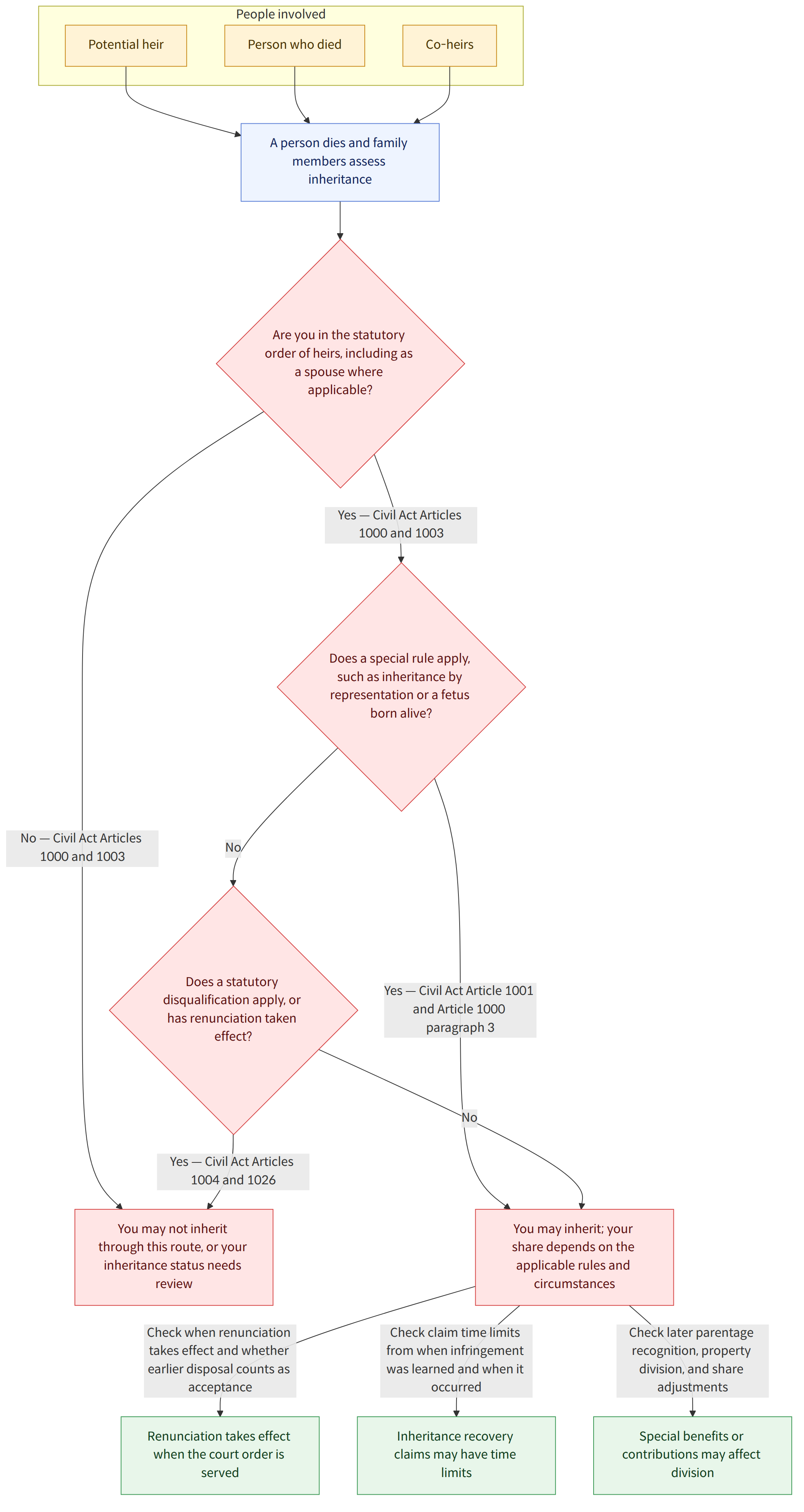
Heirs are determined by the statutory order of inheritance and family relationships, and the outcome may vary depending on specific circumstances, such as inheritance by representation, an unborn child, legal recognition of parentage, or adoption. The timing of legal effect and applicable time limits are important for renunciation of inheritance, disposition of inherited property, and claims for infringement of inheritance rights, so the circumstances of each case should be checked.
At a glance
Key points
- The order of inheritance is descendants in the direct line, ascendants in the direct line, siblings, and collateral relatives within the fourth degree. A spouse inherits jointly with descendants or ascendants in the direct line (Civil Act, Articles 1000 and 1003 (민법 제1000조, 제1003조)).
- If a descendant in the direct line or a sibling who would have been an heir dies or is disqualified before the succession commences, that person’s descendants, among others, may inherit in their place (Civil Act, Article 1001 (민법 제1001조)).
- A fetus is treated as already born for purposes of the order of inheritance, but inheritance rights are recognized only if the child is born alive (Civil Act, Article 1000, Paragraph 3 (민법 제1000조 제3항); Case 19).
- Even if a child born out of wedlock is legally recognized after the decedent’s death and becomes a co-heir, the child may, in certain circumstances, claim an amount equivalent to their share of the inheritance if the other heirs have already divided or disposed of the property (Civil Act, Article 1014 (민법 제1014조); Case 24).
- Disqualification from inheritance requires a statutory ground. Running away from home or adultery alone does not disqualify a person, but intentionally terminating the pregnancy of a fetus who is an heir in the same order may raise the issue of disqualification (Civil Act, Article 1004 (민법 제1004조); Cases 12 and 14).
- Filing a renunciation of inheritance does not by itself make the renunciation effective. Disposing of inherited property before the order granting the renunciation is served may be deemed simple acceptance (Civil Act, Article 1026 (민법 제1026조); Case 17).
- A claim challenging infringement of rights in inherited property may be treated as a claim for recovery of inheritance based on its substance rather than its form. The applicable time limits should be checked by reference to when the claimant learned of the infringement and when the infringing act occurred (Civil Act, Article 999 (민법 제999조); Cases 11 and 15).
- Divisible claims, such as monetary claims, are in principle divided according to the statutory shares of inheritance when the succession commences. However, they may be subject to division if necessary to adjust fairness among co-heirs due to special benefits, a share attributable to contribution, or other factors (Civil Act, Articles 1008 and 1008-2 (민법 제1008조, 제1008조의2); Case 21).
Frequently asked questions
Q. My father died before my grandfather. Can I, as his grandson, inherit my grandfather’s estate?
If a father dies before the commencement of his grandfather’s succession, the grandson may inherit by representation in the father’s place. The spouse of an heir by representation may also become a co-heir where provided by law.
Q. Can I exclude my spouse from inheritance because they committed adultery or ran away from home?
Running away from home or adultery alone does not constitute a ground for disqualification from inheritance under the Civil Act. A person may be deprived of inheritance rights only if a statutory ground for disqualification exists.
Q. Two family members died in the same accident. If it is unknown who died first, what happens to the inheritance?
If two people die in the same peril and it is impossible to determine who died first, they are presumed to have died simultaneously. Accordingly, neither is regarded as inheriting from the other, and sufficient and clear evidence is required to rebut the presumption.
Q. Can a fetus inherit if the heir is unborn?
A fetus is treated as already born for purposes of the order of inheritance, but inheritance rights are recognized only if the child is born alive. The case explanation states that no inheritance rights are recognized if the child dies before birth.
Q. What happens if I sell inherited property after filing a renunciation but before the court issues its order?
A renunciation of inheritance takes effect when the Family Court’s order granting it is served. Disposing of inherited property before then may be deemed simple acceptance, so you should not dispose of the property merely because you have filed the renunciation.
Q. I was legally recognized as a child after the decedent’s death, but the other heirs have already divided the estate. What should I do?
If the inherited estate has already been divided or disposed of, it may not be possible to challenge the validity of that division or disposition. However, a person whose parentage has been legally recognized may claim from the other co-heirs an amount equivalent to their share of the inheritance. A lower-priority heir may also lose their inheritance rights as a result of that recognition.
Q. My inheritance rights were infringed. Can I still bring a claim if more than 10 years have passed since the succession began?
The case explanation states that a claim for recovery of inheritance may be possible if fewer than 10 years have passed since the act infringing the inheritance rights and fewer than 3 years have passed since the claimant learned of the infringement. The date the succession commenced and the date of the infringing act may differ, so each date must be considered when bringing an actual claim.
Q. If I am adopted by a relative, will I be unable to inherit from my birth parents?
According to the case, a generally adopted child may inherit from both the adoptive parents and the birth parents. However, a full adoption ends the legal relationship with the birth parents and may therefore affect inheritance rights.
Q. Can a claim to a bank deposit be subject to division of the inherited estate?
Monetary claims are, in principle, divided according to the statutory shares of inheritance when the succession commences and are therefore not subject to division as part of the estate. However, they may exceptionally be subject to division if necessary to ensure fairness among the heirs due to special benefits or a share attributable to contribution.
Relevant laws
- Civil Act, Article 30 (민법 제30조)
- Civil Act, Article 860 (민법 제860조)
- Civil Act, Article 1000 (민법 제1000조)
- Civil Act, Article 1001 (민법 제1001조)
- Civil Act, Article 1003 (민법 제1003조)
- Civil Act, Article 1004 (민법 제1004조)
- Civil Act, Article 1008 (민법 제1008조)
- Civil Act, Article 1008-2 (민법 제1008조의2)
- Civil Act, Article 1008-3 (민법 제1008조의3)
- Civil Act, Article 1013 (민법 제1013조)
- Civil Act, Article 1014 (민법 제1014조)
- Civil Act, Article 1026 (민법 제1026조)
- Civil Act, Article 1041 (민법 제1041조)
- Civil Act, Article 1042 (민법 제1042조)
- Civil Act, Article 1045 (민법 제1045조)
Watch out for
- A renunciation of inheritance takes effect not on the date it is filed but when the order granting it is served. Disposing of inherited property before then may be deemed simple acceptance.
- The time limit for a claim for recovery of inheritance is assessed based on when the claimant learned of the infringement and when the infringing act occurred. Take care not to calculate the time limit based solely on the date the succession commenced.
- If a person becomes a co-heir after the other co-heirs have already divided or disposed of the property, the person may need to claim an amount equivalent to their share of the inheritance rather than seek return of the property itself.
- A fetus’s inheritance rights presuppose that the child is born alive. Whether deaths are presumed simultaneous or inheritance by representation applies may also depend on the order of death and the family relationships involved.
Source cases
This guide was compiled by AI from the following Korea Legal Aid Corporation consultation cases (in Korean).
- 상속개시 후 인지된 자의 상속재산의 과실(果實)
- 상속재산관리인 선임청구인에게 보수의 예납을 명할 수 있는지
- 조부의 재산을 사망한 부(父)를 대신하여 상속할 수 있는지
- 공동상속인 1인 명의로 소유권이전등기 된 부동산의 회복방법
- 피상속인의 재산과 상속인 재산의 분리
- 아들부부의 싸움 도중 며느리의 방화로 아들만 사망 시 상속권자
- 매도인이 사망한 때 바로 매수인에게 부동산소유권이전등기 가능한지
- 장인과 처가 동시에 사망한 경우 사위가 장인의 재산을 상속받을 수 있는지
- 이혼으로 인한 위자료청구권도 상속이 가능한지
- 남편과 아들이 동시에 사망한 경우 남편 재산의 상속인
- 제사용 재산의 승계와 상속회복청구권에 관한 제척기간의 적용
- 동순위의 상속인이 태아를 낙태한 경우 상속결격사유인지
- 제3자에 대한 상속회복청구권의 제척기간 기산일
- 불륜행위한 처가 남편의 유산을 상속할 수 있는지
- 상속개시 10년 후 상속권을 침해당한 경우 상속회복청구권
- 대습상속인이 될 배우자가 대습상속의 개시 전에 사망한 경우
- 상속포기신고를 수리하는 심판이 고지되기 전 상속재산을 처분한 경우 단순승인이 되는지
- 양자로 입양된 자가 생부모의 재산을 상속할 수 있는지
- 태아도 재산상속을 할 수 있는지
- 이북 지역에 남은 가족을 재산상속인에서 제외할 수 있는지
- 금전채권과 같은 가분채권이 상속분할의 대상이 되는 예외적인 경우
- 상속포기신고를 한 공동상속인이 다른 상속인에게 지분이전등기를 한 경우 단순승인으로 간주되는지
- 증여와 상속재산
- 피인지자의 상속문제
- 묘토인 농지
This guide is general legal information about Korean law, not legal advice for your situation. For a specific case, consult a lawyer or the Korea Legal Aid Corporation (call 132 in Korea).