
Guide to Calculating Inheritance Shares and Dividing an Estate
Based on 29 consultation cases · Updated · Translated from the Korean original.
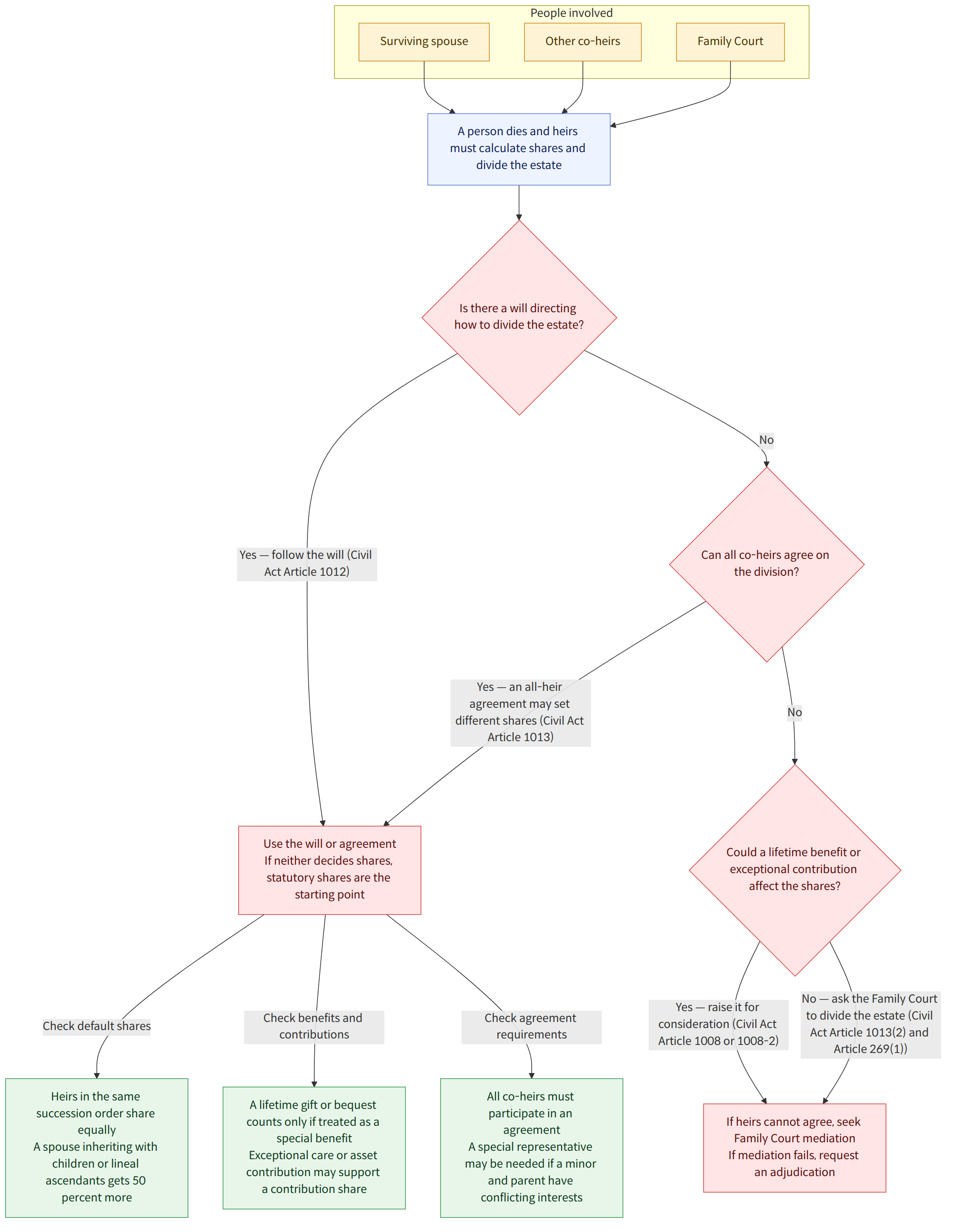
If there is no will, statutory inheritance shares apply as a starting point, but the actual distribution may differ depending on the surviving spouse’s increased share, gifts or bequests made during the deceased’s lifetime, and contribution shares. The estate may be divided as directed by a will, by agreement of all co-heirs, or through Family Court proceedings if the heirs cannot reach an agreement.
At a glance
Key points
- Heirs in the same order of succession inherit in equal shares as a rule. If the spouse inherits jointly with children or lineal ascendants, the spouse’s share is increased by 50% (Civil Act, Article 1009 (민법 제1009조)).
- If a co-heir received a lifetime gift or bequest, whether it can be regarded as an advance on that heir’s inheritance share is considered when calculating the specific inheritance shares. Whether it qualifies as a special benefit is assessed in light of the deceased’s assets, income, standard of living, family circumstances, and other factors (Civil Act, Article 1008 (민법 제1008조); Supreme Court Decision of December 8, 1998, 97Meu513, 520, 97Seu12).
- A co-heir who provided exceptional care for the deceased or made an exceptional contribution to maintaining or increasing the deceased’s assets may claim a contribution share. If the heirs cannot reach an agreement, or an agreement is not possible, they may ask the Family Court to determine the contribution share (Civil Act, Article 1008-2 (민법 제1008조의2)).
- The estate may be divided in the manner specified in a will, by agreement of all co-heirs, or through court proceedings. The share agreed upon in an estate-division agreement does not have to match the statutory inheritance share (Civil Act, Articles 1012 and 1013 (민법 제1012조, 제1013조)).
- All co-heirs must participate in an agreement to divide the estate. A special representative may be required for an agreement where a minor and their parent with parental authority have conflicting interests (Civil Act, Article 921 (민법 제921조)).
- If the heirs cannot reach an agreement, they may apply to the Family Court for mediation and, if mediation is unsuccessful, request an adjudication. Division in kind is the default method of court-ordered division, but the court may order a sale by auction depending on the circumstances (Civil Act, Article 1013(2) and Article 269(1) (민법 제1013조 제2항, 제269조 제1항)).
- One co-heir may apply to register the entire inheritance according to the statutory shares, including the other heirs’ shares, but the example does not recognize separately registering only some heirs’ shares (Registration Precedent No. 5-276, October 7, 1996; Supreme Court Order of February 22, 1995, 94Ma2116).
- If a child who would have inherited dies or is disqualified before the inheritance opens, the child’s lineal descendants and others may inherit by representation. Renunciation of inheritance, however, is not a ground for inheritance by representation. If all heirs renounce, the heirs in the next order of succession may become relevant (Civil Act, Articles 1001 and 1010 (민법 제1001조, 제1010조); Supreme Court Decision of March 9, 2001, 99Da13157; Supreme Court Decision of April 7, 1995, 94Da11835).
Frequently asked questions
Q. If there is no will, how are the inheritance shares of a spouse and children determined?
Children in the same order of succession inherit in equal shares as a rule, while the surviving spouse receives 50% more than each child. As in the example, if the spouse and three children inherit jointly, the shares are 3/9 for the spouse and 2/9 for each child.
Q. Are wedding funds or housing funds received during the deceased’s lifetime taken into account in the inheritance shares?
A gift or bequest made during the deceased’s lifetime does not automatically qualify as an advance on an inheritance. Whether it can be regarded as an advance on the recipient’s inheritance share is assessed in light of the deceased’s assets and standard of living, family circumstances, and other factors. If it qualifies as a special benefit, it is taken into account when calculating the recipient’s specific inheritance share.
Q. Can an heir who cared for a parent or helped build up the parent’s assets receive a larger share?
A co-heir may claim a contribution share if they provided exceptional care for the deceased or made an exceptional contribution to maintaining or increasing the deceased’s assets. The contribution must be exceptional and distinguishable from ordinary contributions. If the heirs cannot reach an agreement, they may ask the Family Court to determine the contribution share.
Q. What happens if one heir objects to dividing the estate?
An agreement to divide the estate requires the consent of all co-heirs, so some heirs cannot divide the entire estate by making an agreement among themselves. If they cannot reach an agreement, they may apply to the Family Court for mediation and, if mediation is unsuccessful, request an adjudication.
Q. Can the inheritance be registered even if someone refuses to cooperate with the registration?
According to the example, one co-heir may apply to register the inheritance of the entire estate according to the statutory shares, including the shares of the other heirs. However, the example does not recognize registering only some heirs’ shares separately.
Q. If a child dies before their parent, do the grandchildren inherit in the child’s place?
If a child dies or becomes disqualified from inheriting before the inheritance opens, the child’s lineal descendants may inherit in the child’s place by representation. As a rule, the represented heirs’ shares are determined based on the inheritance share of the person who died first or was disqualified.
Q. If the children renounce the inheritance, do the grandchildren inherit by representation?
Renunciation of inheritance is different from death or disqualification, which are grounds for inheritance by representation. The example explains that if the spouse and all the children renounce the inheritance, the grandchildren inherit as the heirs in the next order of succession.
Q. Can a parent agree to divide the estate on behalf of a minor child?
If an agreement to divide the estate could create a conflict of interest between a parent and a minor child, the parent cannot represent the child in the agreement. The example explains that a special representative must be appointed for each minor to participate in the agreement, and that an agreement made without following the required procedure may be invalid.
Q. Are the inheritance shares of a family member who died in the past calculated under today’s rules?
The example explains that inheritance shares are calculated under the rules in effect when the deceased died. In particular, the shares of eldest sons and daughters who had married and left the family home, among others, were determined differently in the past, so the date of death must be confirmed.
Relevant laws
- Civil Act, Article 265 (민법 제265조)
- Civil Act, Article 269(1) (민법 제269조 제1항)
- Civil Act, Article 921 (민법 제921조)
- Civil Act, Article 997 (민법 제997조)
- Civil Act, Article 1000 (민법 제1000조)
- Civil Act, Article 1001 (민법 제1001조)
- Civil Act, Article 1003 (민법 제1003조)
- Civil Act, Article 1006 (민법 제1006조)
- Civil Act, Article 1008 (민법 제1008조)
- Civil Act, Article 1008-2 (민법 제1008조의2)
- Civil Act, Article 1009 (민법 제1009조)
- Civil Act, Article 1010 (민법 제1010조)
- Civil Act, Article 1012 (민법 제1012조)
- Civil Act, Article 1013 (민법 제1013조)
- Civil Act, Article 1014 (민법 제1014조)
Watch out for
- Inheritance shares may vary depending on the rules in effect when the deceased died, so first confirm the date of death.
- All co-heirs must participate in an agreement to divide the estate. If the interests of a minor and their parent with parental authority conflict, a special representative may need to be appointed.
- Whether a lifetime gift qualifies as a special benefit and whether a contribution share is recognized depend on the specific circumstances. The outcome is not determined solely by the fact that someone received a gift or helped build up the deceased’s assets.
- Renunciation of inheritance and death before the inheritance opens are treated differently in inheritance matters. Renunciation must not be treated as the same thing as inheritance by representation.
Source cases
This guide was compiled by AI from the following Korea Legal Aid Corporation consultation cases (in Korean).
- 특별수익자의 상속분
- 상속재산의 분할방법
- 1990.1.13. 개정된 민법 시행 전 상속인의 법정상속분
- 공동상속인의 일부가 상속등기에 협력하지 않을 경우
- 본위상속과 대습상속의 계산 (1)
- 본위상속과 대습상속의 계산 (2)
- 본위상속과 대습상속의 계산 (3)
- 상속분 계산 (4)
- 상속분 계산 (3)
- 피상속인 재산의 증가에 기여한 상속인의 기여분
- 상속재산분할협의와 이해상반행위
- 특별연고자의 상속재산분여
- 상속재산분할협의 불성립 시 상속재산분할 방법
- 1990.1.13. 개정된 민법 시행 후 상속인의 법정상속분
- 특별수익자가 있는 경우의 상속문제
- 상속분 계산 (1)
- 상속분 계산 (2)
- 본위상속과 대습상속의 계산 (4)
- 상속인이 될 자녀 전원이 피상속인의 사망 이전에 사망한 경우 손자들의 상속분
- 기여분과 상속분
- 대습상속인의 상속분(2)
- 상속인이 될 자녀 전원이 피상속인의 사망 이전에 사망한 경우 손자들의 상속분
- 인지와 상속분
- 특별연고자의 상속재산분여
- 기여분(2)
This guide is general legal information about Korean law, not legal advice for your situation. For a specific case, consult a lawyer or the Korea Legal Aid Corporation (call 132 in Korea).