
Guide to the Forms and Legal Effect of Wills in Inheritance
Based on 27 consultation cases · Updated · Translated from the Korean original.
A will takes effect only if it satisfies the forms and requirements prescribed by law; even if it reflects the testator’s true intentions, it may be invalid if the required formalities are not met. Check in advance the requirements for making each type of will, the witness and probate procedures, and when revocation and legal effect occur.
At a glance
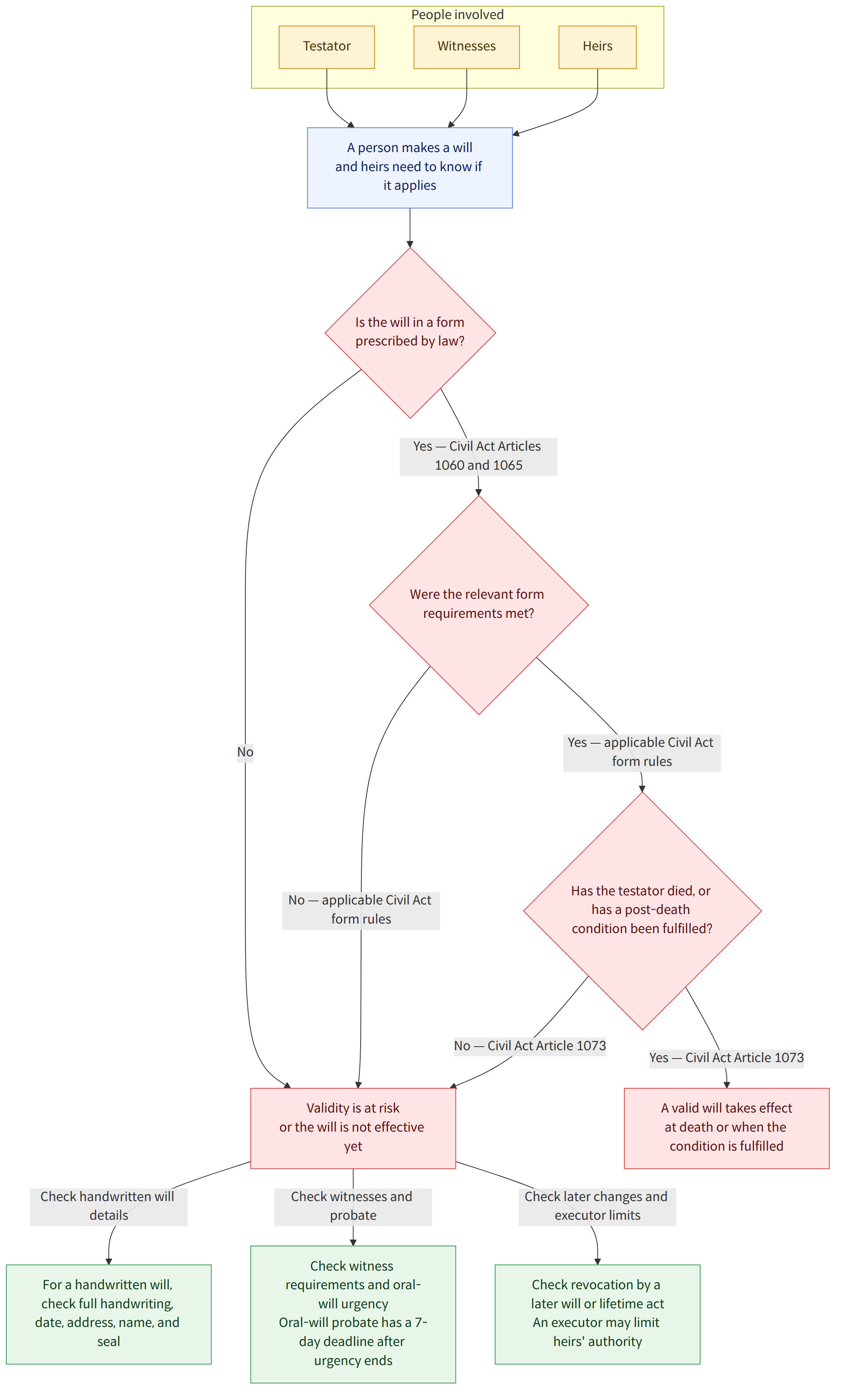
Key points
- A will takes effect only if it is made in one of the forms prescribed by law: a holographic document, recording, notarial instrument, sealed document, or oral will (Civil Act, Articles 1060 and 1065 (민법 제1060조, 제1065조)).
- A holographic will must be written entirely by the testator and include the full text, year, month, and day, address, and name, and it must bear the testator’s seal. A will that omits the address or seal may be invalid even if the testator’s intentions are clear (Civil Act, Article 1066 (민법 제1066조); Supreme Court Decision 2012Da71688, September 26, 2014; Supreme Court Decision 2006Da25103, September 8, 2006).
- The date on a holographic will must make the year, month, and day ascertainable; a will stating only the year and month, without the day, is invalid. A fingerprint may qualify as a seal, but one case held that a seal on a photocopy was not recognized as a holographic will (Supreme Court Decision 2009Da9768, May 14, 2009; Jeonju District Court Ruling 95Neu127, November 12, 1997; Jeju District Court Decision 2007Gadan22957, April 23, 2008).
- An oral will requires an urgent circumstance, such as illness, that prevents the testator from making a will in another form. It must also meet the statutory requirements, including the participation of at least two witnesses and oral communication of the substance of the will. Merely asking about contents written out in advance and having the testator nod or briefly affirm them is generally not considered oral communication (Civil Act, Article 1070 (민법 제1070조); Supreme Court Decision 98Da17800, September 3, 1999; Supreme Court Decision 2005Da57899, March 9, 2006).
- A notarial will requires the participation of two witnesses. Its validity may be in question if a person disqualified by law, such as a person who benefits under the will or a relative of the notary public, acts as a witness (Civil Act, Articles 1068 and 1072 (민법 제1068조, 제1072조); Notary Public Act, Article 33(3) (공증인법 제33조 제3항)).
- A lawfully made will does not become invalid solely because it did not go through the procedures for probate or opening. However, an application to probate an oral will must be filed within 7 days after the urgent circumstance has ended (Civil Act, Article 1070(2) and Articles 1091 and 1092 (민법 제1070조 제2항, 제1091조·제1092조); Supreme Court Decision 97Da38510, June 12, 1998).
- A testator may revoke all or part of a will by a later will or an act during the testator’s lifetime. If a later will or lifetime act conflicts with an earlier will, the conflicting part is deemed revoked. The mere fact that the testator disposed of some property or remarried does not revoke a will concerning other property (Civil Act, Articles 1108, 1109, and 1110 (민법 제1108조·제1109조·제1110조); Supreme Court Decision 97Da38503, May 29, 1998).
- A will generally takes effect when the testator dies; if it is subject to a suspensive condition that is fulfilled after the testator’s death, it takes effect when the condition is fulfilled. If an executor has been appointed, the heirs’ authority to dispose of property or standing to sue as plaintiffs may be limited to the extent necessary to carry out the will (Civil Act, Articles 1073 and 1101 (민법 제1073조·제1101조); Supreme Court Decision 2009Da20840, October 28, 2010).
Frequently asked questions
Q. If I say during my lifetime who should receive my property, without writing a will, does that have legal effect?
A statement made during the testator’s lifetime alone does not constitute a will made in a legally prescribed form. If the testator has not designated how the estate is to be divided in a will, the heirs are not bound by that statement.
Q. Is a holographic will valid if it omits the address, date, or seal?
A holographic will must be written entirely by hand and include the year, month, and day, the address, and the testator’s name, and it must bear the testator’s seal. If the date states only the year and month, or the address or seal is omitted, the will may be held invalid even if the testator’s intentions are clear.
Q. If I prepare a will on a computer and affix my fingerprint, will it be recognized as a holographic will?
A document prepared on a computer does not qualify as a holographic will. However, it may be recognized as a sealed will if it meets the requirements for that form, such as being securely sealed and bearing a seal, and being identified as a will in the presence of two witnesses.
Q. Is an oral will valid if the testator nods or gives a brief response?
For an oral will, communicating the substance of the will means conveying its contents orally. Asking the testator about contents written out in advance and having the testator affirm them by a gesture or brief response is generally not considered an oral communication, absent special circumstances.
Q. Can I make an oral will even when another form of will is available?
An oral will is permitted when an urgent circumstance, such as illness, prevents the testator from making a will by holographic document, recording, notarial instrument, or sealed document. If another form was objectively available, the oral will may be held invalid.
Q. Will my will be invalid if I do not have it probated by the court?
Probate is a procedure for verifying matters such as the form of a will and preventing forgery or alteration; it is not a procedure that directly determines whether the will is valid. Accordingly, a will does not become invalid solely because it was not submitted for probate or opened through the required procedure.
Q. Can I write a new will or destroy an existing will?
A testator may revoke all or part of a will by a later will or an act during the testator’s lifetime. If a later will or lifetime act conflicts with an earlier will, the conflicting part is deemed revoked. However, disposing of some property does not, by itself, revoke a will concerning other property.
Q. Can a person who receives property under a will act as a witness to a notarial will?
A person who receives a benefit under a will may be disqualified from acting as a witness. A notarial will requires two witnesses, so if a witness is disqualified, the will may fail to meet the statutory requirements and its validity may be in question.
Q. When do conditions or obligations imposed by the testator take effect?
A will generally takes effect when the testator dies. A will subject to a condition that must be fulfilled after the testator’s death takes effect when the condition is fulfilled. If an obligation attached to a testamentary gift is not performed, the heirs or executor may set a reasonable period for performance, demand that the obligation be performed within that period, and then petition the court to revoke the will.
Relevant laws
- Civil Act, Article 5 (민법 제5조)
- Civil Act, Article 10 (민법 제10조)
- Civil Act, Article 13 (민법 제13조)
- Civil Act, Article 18 (민법 제18조)
- Civil Act, Article 1000 (민법 제1000조)
- Civil Act, Article 1003 (민법 제1003조)
- Civil Act, Article 1009 (민법 제1009조)
- Civil Act, Article 1012 (민법 제1012조)
- Civil Act, Article 1060 (민법 제1060조)
- Civil Act, Article 1061 (민법 제1061조)
- Civil Act, Article 1062 (민법 제1062조)
- Civil Act, Article 1063 (민법 제1063조)
- Civil Act, Article 1065 (민법 제1065조)
- Civil Act, Article 1066 (민법 제1066조)
- Civil Act, Article 1067 (민법 제1067조)
Watch out for
- An application to probate an oral will must be filed with the Family Court within 7 days after the urgent circumstance has ended.
- A sealed will must be submitted to a notary public or court clerk within 5 days of the date written on the outside of the sealed document to obtain a fixed-date stamp.
- The fact that a will reflects the testator’s true intentions does not cure defects in the statutorily prescribed form.
- Although probate and opening procedures do not determine a will’s legal effect, the requirements for making each type of will and the qualifications of witnesses must be checked separately.
Source cases
This guide was compiled by AI from the following Korea Legal Aid Corporation consultation cases (in Korean).
- 자필증서에 의한 유언의 효력
- 구수증서에 의한 유언의 효력
- 유언의 효력과 관련한 구수(口授)의 의미
- 유언에 참여할 증인의 자격
- 구수증서에 의한 유언의 요건
- 유언집행자의 해임사유
- 자필증서에 의한 유언의 효력 (주소를 자서하지 않은 경우)
- 유언방식에 위배된 피상속인의 상속재산분할방법 지정행위의 효력
- 구수증서에 의한 유언의 효력
- 행위무능력자가 유언을 할 수 있는지 여부
- 검인·개봉절차를 거치지 아니한 유언증서의 효력
- 공정증서에 의한 유언의 효력(2)
- 유언집행자가 있는 경우, 상속인의 원고적격이 인정되는지
- 유언자의 진정한 의사에 합치하나, 요건·방식에 어긋나는 유언의 효력
- 부담부 유증
- 유언이 없는 경우 상속분
- 복사본에 날인된 자필증서의 효력
- 컴퓨터로 작성한 유언장의 효력
- 유언의 철회
- 공정증서에 의한 유언의 효력
- 비밀증서에 의한 유언
- 유언의 철회
- 유언의 방식
- 무인의 경우 자필증서에 의한 유언의 효력
- 조건부 유언의 효력발생시기
This guide is general legal information about Korean law, not legal advice for your situation. For a specific case, consult a lawyer or the Korea Legal Aid Corporation (call 132 in Korea).