
Consumer Guide to Installment Transactions, Door-to-Door Sales, and Credit Cards
Based on 42 consultation cases · Updated · Translated from the Korean original.
You may withdraw from installment and door-to-door sales contracts within specified periods, but restrictions may apply depending on the purpose of the transaction and the type or condition of the goods. Liability for unauthorized credit card use and refund obligations in prepaid installment transactions may also depend on such factors as whether the card was signed, the cardholder’s fault, and whether the business was transferred.
At a glance
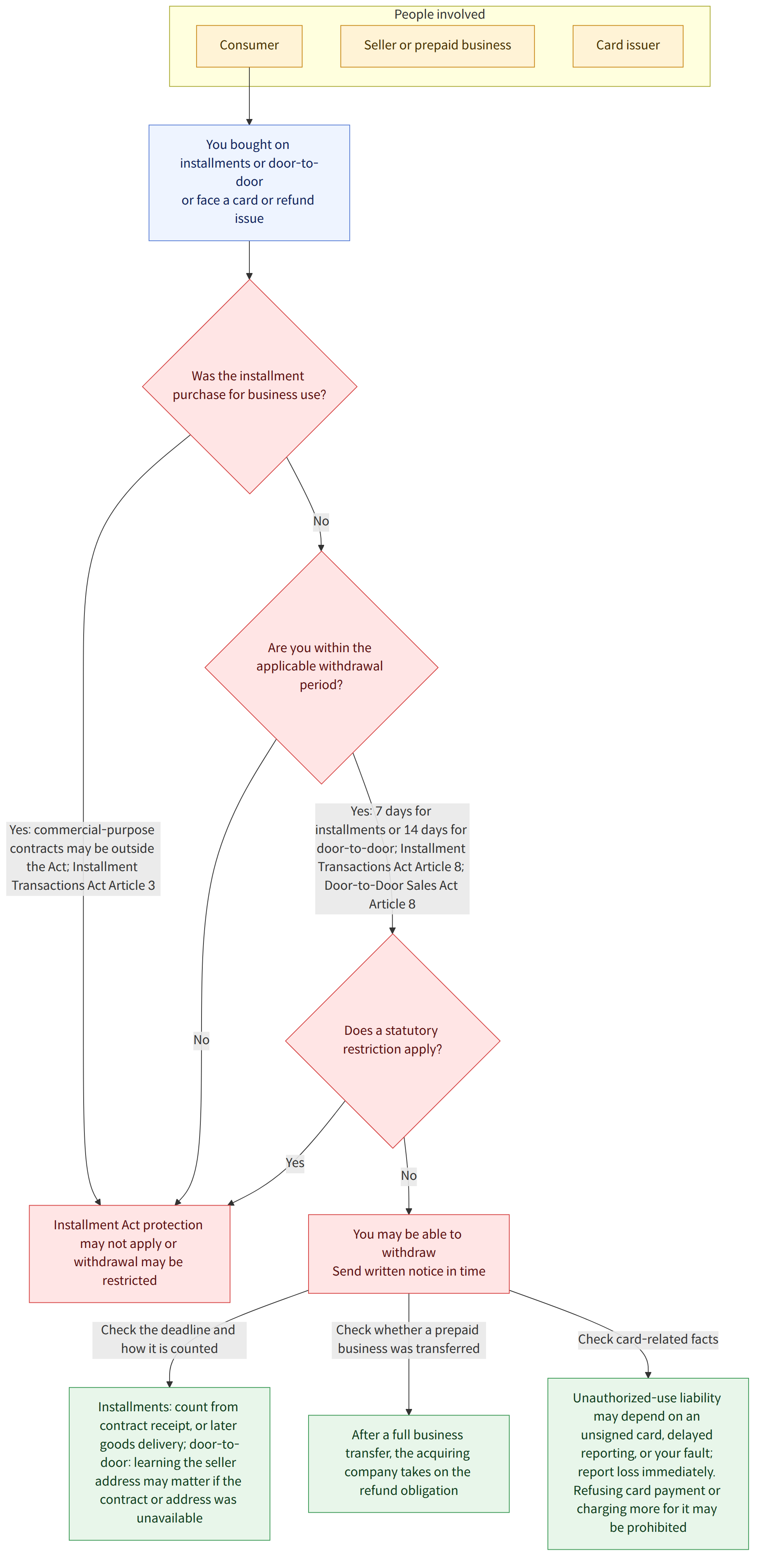
Key points
- As a rule, the period for withdrawing from an installment transaction is 7 days from the day you receive the contract. If the goods are supplied later, the period is counted from the day they are supplied (Installment Transactions Act, Article 8 (할부거래에 관한 법률 제8조)).
- As a rule, you may withdraw from a door-to-door sales contract within 14 days from the day you receive the contract. If the contract was not provided or the seller’s address was unknown, the period may be counted from the day you learned or could have learned the address (Act on Door-to-Door Sales, etc., Article 8 (방문판매 등에 관한 법률 제8조)).
- Withdrawal may be restricted if a statutory ground applies, such as damage to the goods caused by the consumer or a significant reduction in their value.
- The Installment Transactions Act may not apply to an installment contract made for commercial purposes, such as purchasing goods to operate a business (Installment Transactions Act, Article 3 (할부거래에 관한 법률 제3조)).
- If a prepaid installment transaction business transfers its entire business, the acquiring company succeeds to the contractual rights and obligations, including the obligation to pay refunds upon cancellation. An agreement excluding this succession is ineffective (Installment Transactions Act, Article 22(1) (할부거래에 관한 법률 제22조 제1항); Supreme Court, January 14, 2016, 2015Da50200).
- Compensation for unauthorized use following loss or theft of a card may depend on circumstances under the terms and conditions, such as whether the card was unsigned, whether the report was delayed, and whether the cardholder was at fault. Report the loss immediately, and if you dispute that you were at fault, check what evidence is available to establish this.
- Refusing a payment or offering a better price to cash-paying customers because a customer pays by credit card may be prohibited (Specialized Credit Finance Business Act, Article 19(1) (여신전문금융업법 제19조 제1항)).
Frequently asked questions
Q. How many days do I have to cancel a purchase made in installments?
According to the case, you may withdraw within 7 days from the day you receive the contract. If you receive the goods later, the period may be counted from the day they are supplied. However, withdrawal may be restricted if a statutory exception applies, such as damage to or use of the goods. You must send the seller written notice of your intention to withdraw within the applicable period.
Q. I want to return a book I bought through door-to-door sales, but I can’t contact the seller.
As a rule, you may withdraw from a door-to-door sales contract within 14 days from the day you receive the contract. If you did not receive the contract or could not withdraw because you did not know the seller’s address, the period may be counted from the day you learned or could have learned the address. The case explains that you may give notice of withdrawal in writing.
Q. I bought something in installments for use in my shop. Can I cancel if I change my mind?
The case explains that when a refrigerator needed to operate a restaurant is purchased, the transaction is considered an installment contract for commercial purposes and is unlikely to be protected under the Installment Transactions Act. Whether the Act applies may depend on whether the purchase is related to operating a business.
Q. The sales contract for the goods was canceled. Do I still have to keep paying the credit card installments?
Under an indirect installment contract, if there is a ground for invalidating, rescinding, or terminating the sales contract, you may rely on that ground to refuse to pay the installments to the credit provider. The case explains that you may assert this refusal only after notice of your intention to refuse payment has reached the credit provider.
Q. If a mutual aid company is transferred to another company, who pays the refund upon cancellation?
If a prepaid installment transaction business transfers its entire business, the acquiring company succeeds to the contractual rights and obligations, including the obligation to pay refunds upon cancellation. The case explains that even if the transfer agreement leaves responsibility for refunds with the former company, this cannot exclude succession as against consumers.
Q. Can I get compensation if my unsigned card was stolen and used fraudulently?
The case identifies an unsigned card as a circumstance that may exclude compensation under the standard terms, so compensation may be difficult to obtain. However, it also discusses a court decision holding that a contractual clause may be invalid if it places all liability on the cardholder despite the cardholder having no fault in the card’s theft or the disclosure of the PIN. The applicable terms and the specific circumstances of any fault must therefore be examined.
Q. My personal information was leaked and charges I don’t recognize were made on my card. Do I have to pay them?
According to the case, the credit card company is liable for use of card information obtained through unlawful means, such as hacking or an internal data leak. The outcome may differ if the cardholder acted intentionally or with gross negligence, so you should check the circumstances relating to how you handled your information and security measures.
Q. Can I offer a discount for cash payments and charge more for credit card payments?
The case explains that measures that disadvantage cardholders because they pay by credit card, or favor customers who pay in cash, may be prohibited. It also notes that violations may be subject to penalties.
Q. If a minor cancels a card-use agreement, must they also repay the cost of goods bought with the card?
According to the case, even if a card-use agreement is canceled, the separate sales contract with the merchant may remain valid. If the card issuer paid the merchant and the minor thereby obtained the benefit of being relieved of the obligation to pay the purchase price, the minor may be liable to return that benefit to the extent it still exists.
Relevant laws
- Installment Transactions Act, Article 2 (할부거래에 관한 법률 제2조)
- Installment Transactions Act, Article 3 (할부거래에 관한 법률 제3조)
- Installment Transactions Act, Article 8 (할부거래에 관한 법률 제8조)
- Installment Transactions Act, Article 12(2) (할부거래에 관한 법률 제12조 제2항)
- Installment Transactions Act, Article 22(1) (할부거래에 관한 법률 제22조 제1항)
- Installment Transactions Act, Article 25 (할부거래에 관한 법률 제25조)
- Act on Door-to-Door Sales, etc., Article 2(1) (방문판매 등에 관한 법률 제2조 제1호)
- Act on Door-to-Door Sales, etc., Article 7(2) (방문판매 등에 관한 법률 제7조 제2항)
- Act on Door-to-Door Sales, etc., Article 8 (방문판매 등에 관한 법률 제8조)
- Specialized Credit Finance Business Act, Article 14(4) (여신전문금융업법 제14조 제4항)
- Specialized Credit Finance Business Act, Article 14-2 (여신전문금융업법 제14조의2)
- Specialized Credit Finance Business Act, Article 14-4 (여신전문금융업법 제14조의4)
- Specialized Credit Finance Business Act, Article 14-5(3) (여신전문금융업법 제14조의5 제3항)
- Specialized Credit Finance Business Act, Article 16(5) (여신전문금융업법 제16조 제5항)
- Specialized Credit Finance Business Act, Article 17(1) (여신전문금융업법 제17조 제1항)
Watch out for
- The withdrawal period varies by type of transaction. As a rule, it is 7 days for installment transactions and 14 days for door-to-door sales; if the contract was not provided or delivery was delayed, for example, the date from which the period runs may differ.
- Withdrawal may be restricted if the goods have been used or damaged. Take care not to affect the packaging or condition of the goods when inspecting them.
- Compensation for unauthorized card use may depend on whether the card was signed, when the incident was reported, whether the cardholder acted intentionally or negligently, and the terms and conditions. If you learn that your card has been lost or stolen, report it to the card issuer immediately.
- This guide provides general information based on the explanations in the cited consultation cases. How the rules apply in a particular situation may depend on the contract and the facts.
Source cases
This guide was compiled by AI from the following Korea Legal Aid Corporation consultation cases (in Korean).
- 할부거래에 있어서 계약철회가 가능한 경우
- 출판사 영업사원이 방문판매한 책을 반품할 수 있는지
- 서명 없는 신용카드 도난 시 부정사용대금에 관한 책임
- 여신거래기본약관과 개별약정서상의 이율이 서로 다른 경우
- 신용카드가 아닌 현금 결제 우대의 위법성
- 선불식 할부거래인 상조계약의 상조회사의 영업양도의 경우 지위 승계
- 전자복권을 신용카드로 구입할수 있는지 여부
- 기업구매전용카드의 신용카드 여부
- 미성년자의 신용카드 이용시 법정대리인의 묵시적 동의 및 처분허락
- 선불식 할부거래 업체의 양도, 양수
- 항공 마일리지 제공 약관이 고액에게 불리하게 변경된 경우
- 명의도용신용카드의 경우 신용카드회원이 책임을 지는지
- 신용카드 소득공제액에 관하여
- 할부거래에 관한 법률이 적용되지 않는 경우
- 할부거래의 승계
- 미성년자의 신용카드 이용계약 취소시 신용카드 이용대금 지급 책임
- 해약환급금 지급 제한 무효
- 방문판매의 정의
- 할부거래에서의 지급거절통지
- 제3자 부정사용 신용카드에 있어 신용카드가맹점의 귀책사유 약정의 해석
- 신용카드 도난으로 인한 책임
- 방문판매한 책의 반품
- 서명않은 신용카드 도난 후 부정사용시 그 대금에 대한 책임
- 길거리에서 신용카드 회원을 모집하는게 위법한지
- 신용카드가맹점의 본인 확인의무
This guide is general legal information about Korean law, not legal advice for your situation. For a specific case, consult a lawyer or the Korea Legal Aid Corporation (call 132 in Korea).