
Guide to Responding to Intellectual Property Infringement and Damages Claims
Based on 50 consultation cases · Updated · Translated from the Korean original.
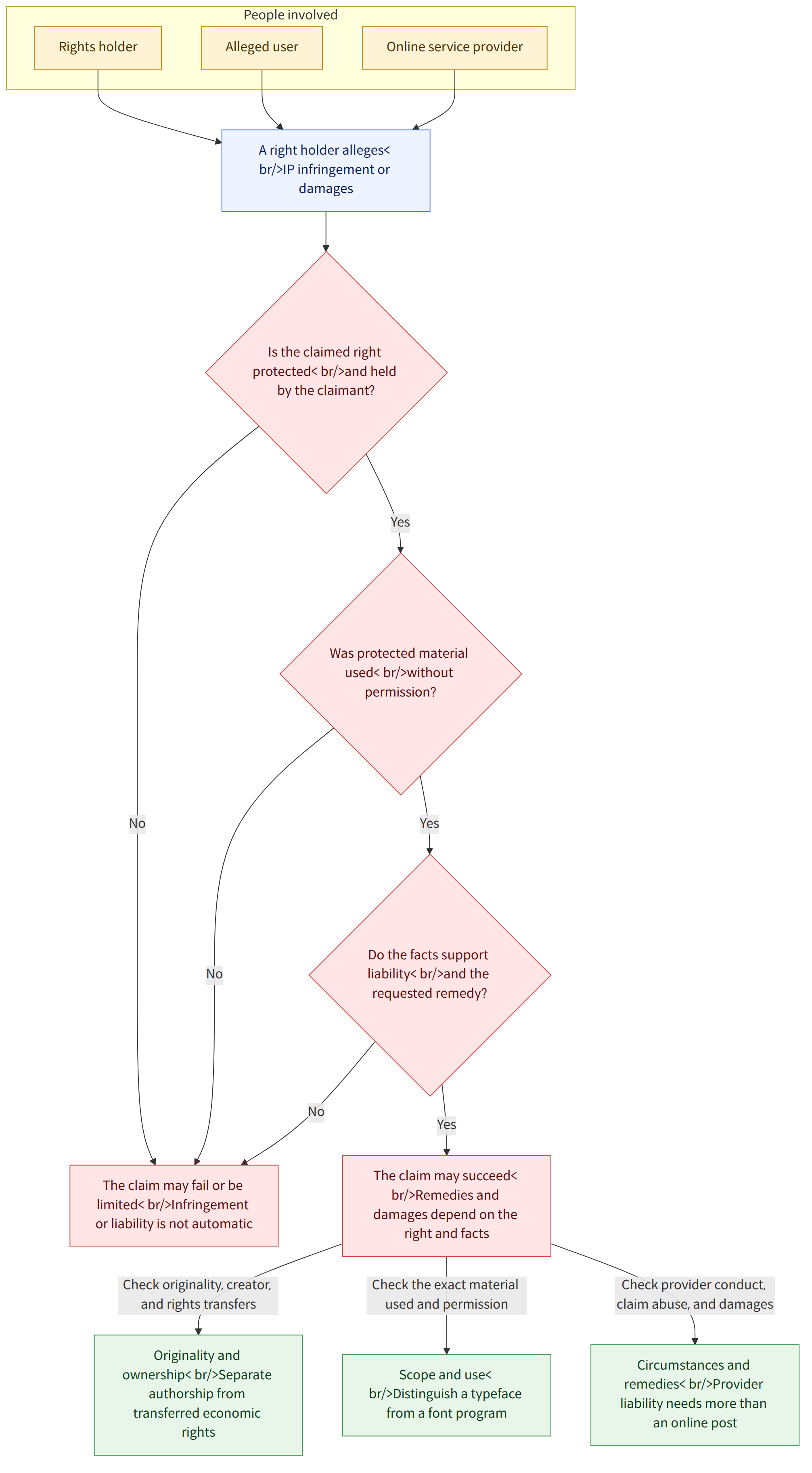
Whether copyright, trademark, or patent rights have been infringed depends on the type of right, its scope of protection, and how the right was actually used. When alleging or responding to infringement, you should confirm originality, ownership of the rights, the terms of any contract, and the circumstances of the infringement, and use the remedies provided by law.
At a glance
Key points
- Copyright protects expressions that contain original creative elements. A simple statement of facts or an expression that does not reflect creative individuality may not be protected (Copyright Act, Article 7(5) (저작권법 제7조 제5호)).
- For photographs, it is important whether the photographer’s creative individuality is expressed. A photograph that simply shows a product as it is may be judged differently from an advertising image photograph that arranges the background and other elements in an original way (Cases 4 and 15).
- When a work is created under a contract for work, the actual creator cannot be replaced as the author merely by contract. A transfer of economic rights must be distinguished from moral rights (Copyright Act, Article 9 (저작권법 제9조); Article 10(2) (저작권법 제10조 제2항); Article 14(1) (저작권법 제14조 제1항)).
- The mere existence of an online post does not make an online service provider liable. Liability for aiding infringement may be found if the infringement is obvious, the provider can manage and control it, and the provider fails to take necessary measures (Case 11).
- Even if a trademark is formally registered, a claim for an injunction against infringement or for damages may be disallowed as an abuse of rights when it is obvious that the registration is invalid (Case 6).
- A patent holder should use legal remedies to protect their rights. In circumstances where it is unclear whether infringement has occurred, pressuring someone to terminate a contract or remove products in exchange for withdrawing a criminal complaint may be unlawful (Case 7).
- The typeface itself must be distinguished from the font program used to render it. The mere fact that a typeface was made to resemble another does not constitute copyright infringement of the font program (Cases 21 and 23).
- Damages are calculated according to the type of right and the specific circumstances. In cases of trademark infringement, the amount of damages may be calculated based on factors such as the infringer’s profits (Case 19).
Frequently asked questions
Q. Is it copyright infringement to post product photos on an online shopping site without permission?
First, consider whether the photographer’s creative individuality is reflected in the photograph. Unlike a photograph that simply shows the product as it is, an advertising image photograph that arranges the product, background, and other elements in an original way may be protected as a work. Using it without permission may therefore infringe copyright.
Q. Can I freely use online reviews or photos as long as I cite the source?
Attribution alone does not necessarily make a use permissible. A post containing original creative expression may raise copyright issues. Even information that is not protected under the Copyright Act may give rise to civil liability for a tort if special circumstances exist, such as an improper purpose.
Q. If a copyright-infringing post is uploaded, is the portal site also liable for damages?
The mere fact that an infringing post appears in search results does not automatically establish the online service provider’s liability. Liability may be found if the infringement is obvious, the provider knew or could have known about it specifically, and the provider could manage it technically and economically but failed to take appropriate measures, such as deleting or blocking the material.
Q. Is it copyright infringement to create or use a typeface similar to another font?
The cases distinguish between typefaces themselves and font programs. Merely creating a typeface similar to another does not generally constitute copyright infringement of the font program. However, downloading and using a font program without the rights holder’s permission may raise infringement issues.
Q. Is the company named in the contract the author of a design created under an outsourcing arrangement?
According to the cases, a person who did not actually create a work cannot be designated as its author merely by contract. However, economic rights in a work may be transferred, so you should separately confirm who created the work and whether the economic rights were transferred.
Q. Do I have to pay remuneration for phonogram use if I play streamed music in my store?
According to the Supreme Court’s decision in the case, “use” of a commercial phonogram includes both playing the phonogram directly and playing it by streaming. Accordingly, playing streamed music in a store may also be subject to the rules on remuneration.
Q. Can a patent holder demand that products be removed in exchange for withdrawing a criminal complaint?
Even if it is unclear whether a patent has been infringed, repeatedly demanding termination of a contract or removal of installed products as a condition for withdrawing a criminal complaint—without pursuing legal remedies—may be found to exceed the proper exercise of rights. A patent holder may use legal procedures, such as seeking a preliminary injunction prohibiting the manufacture or sale of the product.
Q. Can I make copies of a university library book myself for the purpose of writing a thesis?
The cases distinguish between a library employee making a copy of materials held by the library and a patron making a copy directly. Even for a thesis or research purposes, copying materials yourself or reproducing them using a scanner available in the library may fall outside the scope permitted under the Copyright Act.
Q. Can a trademark holder claim damages while the validity of the registered trademark is being disputed?
Even before a decision invalidating the registration becomes final, a claim for an injunction against infringement or for damages may be disallowed as an abuse of rights if it is obvious that the trademark registration will be invalidated. A court hearing an infringement case may also examine whether the registration is invalid in order to decide an abuse-of-rights defense.
Relevant laws
- Copyright Act, Article 2(2) (저작권법 제2조 제2호)
- Copyright Act, Article 2(15) (저작권법 제2조 제15호)
- Copyright Act, Article 2(22) (저작권법 제2조 제22호)
- Copyright Act, Article 2(28) (저작권법 제2조 제28호)
- Copyright Act, Article 4(1)(7) (저작권법 제4조 제1항 제7호)
- Copyright Act, Article 4(1)(8) (저작권법 제4조 제1항 제8호)
- Copyright Act, Article 7(5) (저작권법 제7조 제5호)
- Copyright Act, Article 9 (저작권법 제9조)
- Copyright Act, Article 10(2) (저작권법 제10조 제2항)
- Copyright Act, Articles 11 through 22 (저작권법 제11조 내지 제22조)
- Copyright Act, Article 14(1) (저작권법 제14조 제1항)
- Copyright Act, Article 16 (저작권법 제16조)
- Copyright Act, Article 30 (저작권법 제30조)
- Copyright Act, Article 45(1) (저작권법 제45조 제1항)
- Copyright Act, Article 76-2(1) (저작권법 제76조의2 제1항)
Watch out for
- Whether a work is protected is not determined solely by its name or purpose of use. You should confirm the originality of the actual expression and ownership of the rights.
- Transfers of economic rights and moral rights are different. You should distinguish between the types and scope of rights when reviewing a contract.
- The cases cited set out separate time limits for remedies concerning patent applications filed by persons without rights and for procedures relating to patent rights. For a specific matter, you should confirm the applicable deadlines.
- Even if infringement is suspected, rather than pressuring the other party to terminate a contract or remove products, consider legal remedies such as the preliminary injunction mentioned in the cases.
Source cases
This guide was compiled by AI from the following Korea Legal Aid Corporation consultation cases (in Korean).
- 법인명의 저작물 도급에서의 저작자 결정과 동일성 유지권 침해
- 복제방지장치제거 기능을 이용한 DVD 불법복제에 대한 구제
- 응용미술저작물 침해에 대한 피해구제
- 광고용 카탈로그에 있는 제품 등의 사진이 저작권법상 보호되는 저작물인지
- 상표권 사용방법
- 상표권 등에 기초한 침해금지 또는 손해배상 등의 청구가 권리남용에 해당되는 경우
- 유사제품 제조자에 대한 특허권자의 권리행사 범위
- 선출원주의와 법정실시권
- 무권리자의 특허출원으로부터 구제방법
- 이용발명의 실시관계
- 인터넷 포털사이트를 운영하는 온라인서비스제공자가 제공한 인터넷 게시공간에 타인의 저작권을 침해하는 게시물이 게시된 경우, 온라...
- 국가고시나 전문자격시험의 수험서와 같은 실용적 저작물이 저작권법에 의하여 보호되는 창작물에 해당할 수 있는지 여부
- 식당이용후기를 출처기재 없이 무단으로 게재한 경우 저작권 침해 여부
- 뉴스 기사에 대한 저작권 인정 범위
- 광고사진 무단 사용행위가 저작권 침해행위에 해당되는지 여부
- 아파트평면도를 게시한 경우 저작권 침해 여부
- 저작권법 제76조의2 제1항, 제83조의2 제1항의 ‘사용’에 판매용 음반을 스트리밍 등의 방식을 통하여 재생하는 간접사용이 ...
- 특허권자가 특허의 출원·등록과정 등에서 특허발명과 대비대상이 되는 제품을 특허발명의 특허청구 범위에서 의식적으로 제외하였다고 ...
- 상표권 침해로 인한 손해배상 청구에 있어 침해자가 받은 이익액 및 상표권자의 손해액의 산출 방법
- 상표권에 관하여 사용권을 설정받은 자가 등록상표를 직접 사용하지 않고 사용권이 없는 제3자가 사용한 경우에 사용권자 또는 제3...
- 수급인이 타인의 폰트 프로그램을 불법 다운로드 받은 경우 도급인의 책임
- 특허 출원의 요건
- 타인의 폰트를 사용한 경우 디자인권 또는 저작권 침해에 따른 손해배상책임을 부담하는지 여부
- 음원서비스 제공 중 작곡자의 성명을 잘못 표시한 것이 작곡자의 성명표시권을 침해한 것인지 여부
- 대학생이 대학도서관에서 비치 대여하는 도서의 복제
This guide is general legal information about Korean law, not legal advice for your situation. For a specific case, consult a lawyer or the Korea Legal Aid Corporation (call 132 in Korea).