
Guide to Joint and Several Debts, Guarantee Obligations, and Rights of Contribution
Based on 89 consultation cases · Updated · Translated from the Korean original.
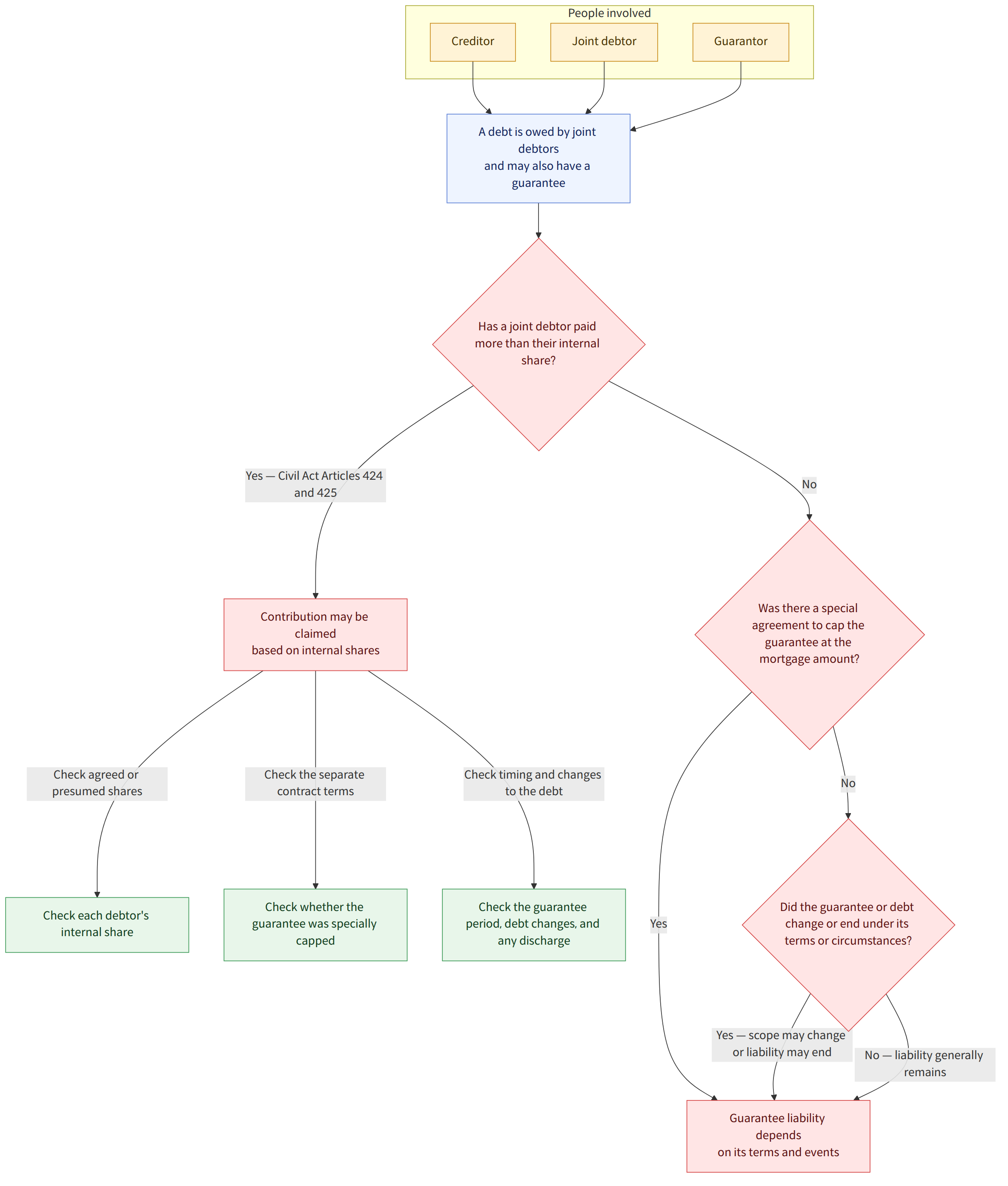
Joint and several debts and guarantee obligations require consideration not only of liability to the creditor but also of the debtors’ respective shares of liability and rights of contribution among themselves. The scope of a guarantee obligation may vary depending on the contract terms, the guarantee period, changes to the debt, the guarantor’s death, or the principal debtor’s discharge. The contract and the specific circumstances should therefore be reviewed together.
At a glance
Key points
- A joint and several debtor may seek contribution based on the parties’ internal shares of liability. A right to contribution may arise even after only partial payment, to the extent of another debtor’s share of liability (Civil Act, Articles 424 and 425 (민법 제424조·제425조); Case 25).
- A joint and several guarantee and a maximum-amount mortgage are separate contracts, so liability under the joint and several guarantee is not limited to the mortgage’s maximum secured amount. The issue is whether there were special circumstances showing that the parties intended to limit liability to that amount (Cases 5 and 13).
- The scope of liability under a continuing guarantee may depend on the contract term, the guarantee limit, the validity of an automatic-extension clause, and when notice of termination was given. Debts already fixed before the guarantee ended do not automatically disappear (Cases 7 and 10).
- A guarantee obligation generally remains in effect even if the maturity of a fixed debt is extended without the guarantor’s consent. However, a different agreement between the parties may govern (Case 16).
- If the purpose or form of the principal debt changes without the guarantor’s knowledge, the guarantee obligation may be extinguished if the debt no longer retains its substantive identity. If the guarantor’s burden decreases or increases, the scope of liability may vary depending on the change (Cases 20 and 24).
- The principal debtor’s discharge in bankruptcy generally does not affect the guarantor’s liability. One case holds that, under a continuing guarantee with no specified term or limit, debts newly incurred after the guarantor’s death do not pass to the heirs (Cases 14 and 23).
- Unlike an ordinary guarantee, an identity guarantee is subject to statutory provisions on matters such as its term and notice obligations. The contract ends when the guarantor dies, but liability that arose before the death may still raise inheritance issues (Act on Identity Guarantees, Articles 3, 4, and 7 (신원보증법 제3조·제4조·제7조); Cases 1 and 12).
- A waiver or release of a claim against one obligor with non-genuine joint and several liability generally does not affect the other debtors. However, an amount actually paid by one debtor is credited against the other debtor’s liability to that extent (Case 21).
Frequently asked questions
Q. Can a joint and several debtor seek contribution from the other debtors after paying only part of the debt?
A joint and several debtor does not have to pay more than their own share before seeking contribution. They may claim from the other debtors a portion of the amount by which the joint debt was discharged, based on the parties’ internal shares of liability. If no shares were agreed, they may be presumed equal (Case 25).
Q. If a maximum-amount mortgage has been created, is liability under the joint and several guarantee also limited to the maximum secured amount?
A maximum-amount mortgage and a joint and several guarantee are separate contracts, so the maximum secured amount under the mortgage does not, as a rule, cap the guarantor’s liability under the joint and several guarantee. It is necessary to consider whether there were special circumstances showing that the parties agreed to limit both liabilities to that amount (Case 13).
Q. If the principal debtor is discharged in bankruptcy, is the joint and several guarantor also released from liability?
The case explains that the principal debtor’s discharge in bankruptcy does not affect the guarantor’s obligation to pay. Accordingly, the guarantee obligation cannot be treated as extinguished solely because the principal debtor was discharged (Case 14).
Q. Does the guarantee obligation end if the loan term is extended without the guarantor’s consent?
A guarantee of a loan whose terms have already been fixed generally remains in effect even if its maturity is extended without the guarantor’s consent. However, if the parties made a separate agreement concerning an extension without the guarantor’s consent, that agreement governs (Case 16).
Q. Does a continuing guarantee automatically end when the principal debtor retires from the company?
Retirement alone does not automatically end the guarantee obligation, but the case explains that a continuing guarantee may be terminated in certain circumstances. However, if the transactions have ended or the principal debt has been fixed before termination, liability for debts that have already arisen may remain (Case 10).
Q. Is a guarantee extended even if I did not agree to an automatic-extension clause for the guarantee period?
A clause providing for the automatic extension, without notice, of a continuing transaction agreement and the guarantee period may be invalid if it risks placing an unfair disadvantage on the guarantor. The specific terms of the clause are important, including whether the guarantor had a way to end their status as guarantor when the contract expired (Case 7).
Q. If a guarantor dies, must the heir also guarantee continuing debts incurred afterward?
One case holds that, under a continuing guarantee with no specified term or guarantee limit, the heir does not assume guarantee liability for principal debts newly incurred after the guarantor’s death. However, the inheritance implications of guarantee obligations that had already arisen before the death must be considered separately (Case 23).
Q. If the principal debtor and creditor increase the damages amount without the guarantor’s knowledge, must the guarantor pay the increased amount too?
If an amount of damages is agreed upon after the guarantee contract was made, without the guarantor’s participation, and that amount exceeds the scope of liability for the existing breach, the guarantor may not be liable for the excess. If the principal debt is changed, the scope of liability may also depend on whether the debt retains its substantive identity and whether the guarantor’s burden has increased or decreased (Cases 20 and 24).
Q. If I settle with one joint tortfeasor and waive my claim, can I no longer claim anything from the company?
A waiver or release of a claim against one joint tortfeasor does not automatically apply to the other debtors. However, any amount actually paid may be taken into account against the other debtor’s liability to that extent, and it must also be considered whether the settlement was intended to include the other debtors (Case 21).
Relevant laws
- Civil Act, Article 2 (민법 제2조)
- Civil Act, Article 105 (민법 제105조)
- Civil Act, Article 110 (민법 제110조)
- Civil Act, Article 126 (민법 제126조)
- Civil Act, Article 424 (민법 제424조)
- Civil Act, Article 425 (민법 제425조)
- Civil Act, Article 428 (민법 제428조)
- Civil Act, Article 429 (민법 제429조)
- Civil Act, Article 430 (민법 제430조)
- Civil Act, Article 433 (민법 제433조)
- Civil Act, Article 445 (민법 제445조)
- Civil Act, Article 446 (민법 제446조)
- Civil Act, Article 448 (민법 제448조)
- Civil Act, Article 459 (민법 제459조)
- Civil Act, Article 1019 (민법 제1019조)
Watch out for
- Even if a joint and several guarantee and a maximum-amount mortgage were created together, do not assume that their liability limits are the same. Check the contract wording and the parties’ agreement.
- To end a continuing guarantee, consider when notice of termination was given and whether any debts had already arisen or been fixed before then.
- For an identity guarantee, statutory time limits and the employer’s duty to give notice may be relevant. Check the specific circumstances, including changes to the work and when the guarantor died.
- Debts incurred after the guarantor’s death may be treated differently from debts that had already arisen before the death. Heirs should also consider whether to accept the inheritance subject to limited liability or disclaim the inheritance.
Source cases
This guide was compiled by AI from the following Korea Legal Aid Corporation consultation cases (in Korean).
- 신원보증인의 책임한계는 어떻게 되는지
- 할부구입자동차가 양도된 경우 할부금에 대한 연대보증인의 책임
- 연대보증계약에서 주채무자가 바뀐 경우 연대보증인의 책임이 있는지
- 당사자 사이 사회질서에 반하지 않는 보증책임면책특약의 효력
- 근저당권설정계약서에 부동문자로 된 ‘연대보증’ 문구의 효력
- 신용보증서상 대출과목과 실제 대출과목이 다른 경우 보증책임이 면책되는지
- 계속적 보증에 있어서 보증기간 자동연장조항(약관)의 효력
- 회생절차개시 후 연대보증인이 대위변제한 경우 회생채권자가 되는지
- 법정이자 보다 높게 빌린 돈으로 공동면책한 경우 구상권의 범위
- 회사임직원 지위에서 계속적 보증계약을 한 후 퇴직 시 해지 가능한지
- 응급환자의 치료비에 대한 연대보증의 경우 보증책임범위를 감축할 수 있는지
- 신원보증인이 사망한 경우 상속인에게 그 보증책임이 있는지
- 동일 채무에 대하여 연대보증과 근저당권설정등기를 해준 경우 그 효력
- 개인파산으로 면책결정된 경우 면책된 채무에 대한 보증인의 책임
- 근보증계약서에 채무의 최고액이 특정되지 않아도 유효한 경우
- 확정채무에 관하여 보증인의 동의 없이 대출기간을 연장할 수 있는지
- 분할 또는 분할합병으로 인하여 설립되는 회사 또는 존속하는 회사’와 ‘분할 또는 분할합병 전의 회사’가 부담하는 연대책임의 법...
- 수탁보증에 있어 주채무자가 면책행위를 하고도 보증인에게 통지를 하지않고 있는 동안에 보증인이 사전 통지 없이 이중의 면책행위를...
- 주채무가 해제된 경우 보증채무에 기해 기지급한 금원이 부당이득으로 되는지
- 보증계약 후 채무자와 채권자간 손해배상액을 예정한 경우 보증인의 책임범위
- 부진정연대채무자 중 일방에 대한 청구포기 약정의 다른 채무자에 대한 효력
- 물상보증과 연대보증의 피담보채무 중첩된 때 근저당권말소의 효력
- 보증한도 정함 없는 계속적 보증계약의 보증인 사망한 경우 상속인의 보증승계여부
- 보증인 동의 없이 주채무의 목적이나 형태가 변경된 경우 보증채무의 범위
- 다수의 연대채무자 관계에서의 구상요건
This guide is general legal information about Korean law, not legal advice for your situation. For a specific case, consult a lawyer or the Korea Legal Aid Corporation (call 132 in Korea).