
Guide to Grounds and Procedures for Judicial Divorce
Based on 30 consultation cases · Updated · Translated from the Korean original.
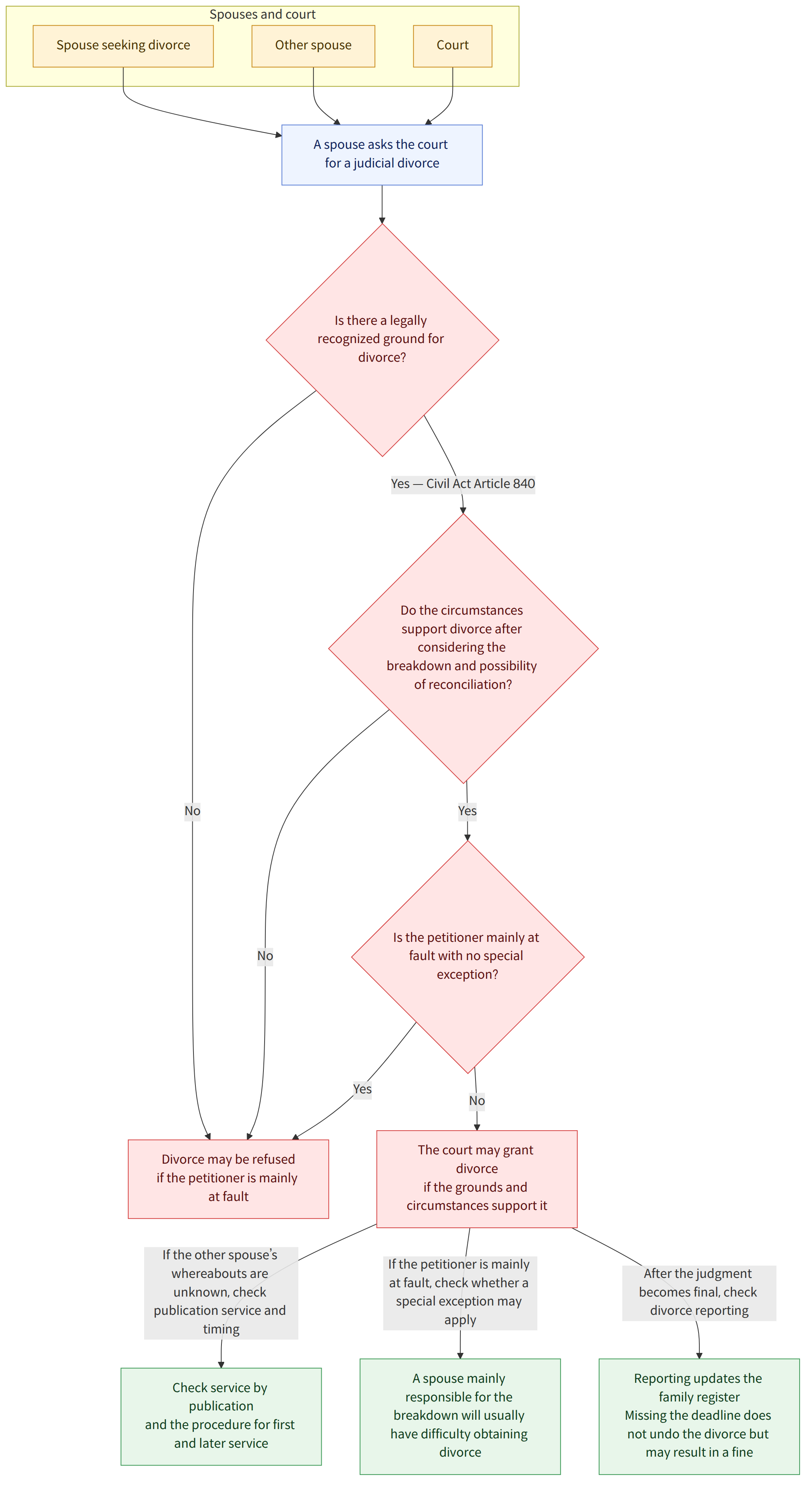
A judicial divorce requires grounds prescribed by law. The court considers the specific circumstances, including the causes and extent of the marital breakdown, the possibility of reconciliation, and each party’s responsibility. The issues to check include methods of service when a spouse’s whereabouts are unknown, claims by a spouse at fault, and reporting the divorce after the judgment becomes final.
At a glance
Key points
- A spouse’s unfaithful conduct is not limited to adultery. Even without sexual intercourse, living with someone other than one’s spouse may be found to constitute unfaithful conduct (Civil Act, Article 840(1) (민법 제840조 제1호); Supreme Court Decision 92Meu68, November 10, 1992).
- A judicial divorce may also be sought where a spouse abandons the other without providing care and without just cause, where a spouse has been subjected to extremely unfair treatment, or where there is a serious reason that makes it difficult to continue the marriage (Civil Act, Article 840(2), (3), and (6) (민법 제840조 제2호·제3호·제6호)).
- Refusing sexual relations without just cause, or circumstances that continuously prevent a normal sex life, may constitute a serious reason that makes it difficult to continue the marriage. However, sexual dysfunction that may be remedied with treatment and assistance may not be sufficient on its own (Civil Act, Article 840(6) (민법 제840조 제6호); Supreme Court Decision 2010Meu1140, July 15, 2010).
- Psychotic symptoms alone do not automatically entitle a spouse to a divorce. The court considers various circumstances, including the possibility of recovery, efforts to obtain treatment, and the sacrifices and suffering required of the family (Civil Act, Article 840(6) (민법 제840조 제6호); Supreme Court Decision 2004Meu740, September 13, 2004).
- Insufficient wedding gifts, inability to conceive, or a temporary agreement to divorce do not ordinarily constitute grounds for judicial divorce. Even if there was an agreement to divorce and a division of property, the court must consider whether the marital relationship was actually dissolved irretrievably (Civil Act, Article 840(6) (민법 제840조 제6호); Supreme Court Decision 96Meu226, April 26, 1996).
- As a rule, a spouse primarily responsible for the breakdown of the marriage will have difficulty obtaining a divorce. An exception may be made in special circumstances, such as where the other spouse also has no intention of continuing the marriage but refuses to agree to a divorce out of obstinacy or a desire for revenge (Supreme Court Decision 2009Meu844, December 9, 2010).
- If ordinary service is impossible because the other spouse’s address or place of work is unknown, an application for service by publication may be filed with the court with supporting documents. The time when the first service by publication takes effect differs from that for subsequent service, so the applicable procedure should be checked (Civil Procedure Act, Articles 194–196 (민사소송법 제194조·제195조·제196조)).
- A judicial divorce takes effect when the judgment becomes final, and reporting it is a procedure for updating the family relations register. Missing the reporting deadline does not nullify the divorce, but may result in a fine (Act on Registration of Family Relations, Articles 78, 58, 121, and 122 (가족관계의 등록 등에 관한 법률 제78조·제58조·제121조·제122조)).
Frequently asked questions
Q. Can I proceed with a divorce lawsuit if I do not know my spouse’s address?
If documents cannot be served by ordinary means, you may apply to the court for service by publication. One case describes submitting, along with the application, documents showing that the current address is unknown, such as a canceled resident registration certificate and a certificate of non-residence.
Q. Will I automatically be divorced after reporting my spouse as missing and waiting a certain period?
No. Reporting a spouse as missing does not, by itself, dissolve the marriage. However, leaving home without just cause and abandoning one’s duties as a spouse may, depending on the circumstances, constitute malicious desertion, a ground for judicial divorce.
Q. Can I obtain a judicial divorce if my spouse refuses to have sex?
Refusing sexual relations without just cause, or circumstances that make it difficult to satisfy the spouses’ sexual needs in a normal way, may constitute a serious reason that makes it difficult to continue the marriage. However, a temporary sexual dysfunction that may be remedied through treatment or assistance may not, by itself, constitute a ground for divorce.
Q. Can I divorce my spouse if they exhibit psychotic symptoms?
The mere fact that a spouse exhibits psychotic symptoms does not automatically entitle the other spouse to a divorce. The court considers specific circumstances, including the possibility of recovery, efforts to obtain treatment, and the sacrifices and suffering the illness requires of the family. There is a ruling that, if recovery is possible, efforts should be made to obtain treatment.
Q. Can a spouse responsible for the breakdown of the marriage file for divorce?
As a rule, a divorce claim by a spouse primarily responsible for the breakdown of the marriage is not allowed. However, an exception may be made in special circumstances—for example, where it is objectively clear that the other spouse also has no intention of continuing the marriage but refuses to agree to a divorce out of obstinacy or a desire for revenge.
Q. Can I divorce after a long separation, even if my spouse has another cohabiting relationship?
Although a divorce claim by a spouse at fault is generally restricted, the court may consider whether that spouse’s fault has diminished—for example, where the substance of the marriage has been completely dissolved by a lengthy separation—and assess the other spouse’s mental, social, and economic circumstances and whether their livelihood is secured. The length of separation alone does not automatically establish a right to divorce.
Q. If we agreed to divorce and exchanged alimony or property, does that constitute a ground for judicial divorce?
Agreement, payment of money, or division of property does not ordinarily, by itself, constitute a ground for judicial divorce. The court must consider special circumstances, including whether those events irretrievably broke down the marital relationship and whether the spouses actually lived apart after dissolving the substance of their marriage.
Q. Will my divorce become invalid if I miss the reporting deadline after the divorce judgment becomes final?
No. A judicial divorce takes effect when the judgment becomes final, so missing the deadline to report it does not invalidate the divorce. However, late reporting may result in a fine, and if the divorce has not yet been entered in the family relations register, the reporting procedure must be completed.
Q. Is a spouse’s infidelity with another person during divorce proceedings always a tort?
The precedent discussed in the case explains that the question is not decided solely by whether divorce proceedings are pending; rather, the court must consider whether the spouses’ shared life has already broken down irretrievably. If it has reached that point, a sexual relationship with a third party may not be considered a tortious act infringing the other spouse’s rights concerning their shared marital life.
Relevant laws
- Civil Act, Article 834 (민법 제834조)
- Civil Act, Article 826 (민법 제826조)
- Civil Act, Article 833 (민법 제833조)
- Civil Act, Article 840(1), (2), (3), and (6) (민법 제840조 제1호·제2호·제3호·제6호)
- Civil Act, Article 842 (민법 제842조)
- Civil Act, Article 909(4) (민법 제909조 제4항)
- Civil Act, Article 940 (민법 제940조)
- Civil Act, Article 947 (민법 제947조)
- Civil Act, Article 949 (민법 제949조)
- Civil Procedure Act, Article 174 (민사소송법 제174조)
- Civil Procedure Act, Article 194 (민사소송법 제194조)
- Civil Procedure Act, Article 195 (민사소송법 제195조)
- Civil Procedure Act, Article 196 (민사소송법 제196조)
- Civil Procedure Act, Article 220 (민사소송법 제220조)
- Rules of Civil Procedure, Article 54(1) (민사소송규칙 제54조 제1항)
Watch out for
- Whether a judicial divorce is warranted cannot usually be determined based on a single asserted ground. The court must also consider specific circumstances, including the length of the marriage, the causes of and responsibility for the breakdown, and the possibility of reconciliation.
- For service by publication, it is important to establish that the other party’s address or place of work is unknown and to provide supporting documents. The case explains that the first service by publication takes effect two weeks after the date of publication, while any subsequent service by publication on the same party takes effect the day after it is carried out.
- A judicial divorce must be reported within one month from the date the judgment becomes final. Missing the deadline does not affect the validity of the divorce, but may result in a fine.
- The rulings discussed in the cases make clear that the outcomes involving mental illness, sexual dysfunction, lengthy separation, or exceptional divorce claims by a spouse at fault may vary depending on the specific circumstances.
Source cases
This guide was compiled by AI from the following Korea Legal Aid Corporation consultation cases (in Korean).
- 공시송달에 의한 이혼
- 이혼사유의 존재가 계속되는 경우 이혼청구권의 제척기간 적용 여부
- 정당한 이유 없는 성교 거부가 재판상 이혼의 사유가 되는지
- 후견인이 의사무능력상태에 있는 자를 대리하여 그 배우자를 상대로 재판상 이혼을 청구할 수 있는지 여부
- 외국인 남성과 한국인 여성 사이의 재판상 이혼에 있어 우리나라법원에 관할이 존재하는지 여부
- 배우자가 정신병적인 증세를 보이는 경우, 재판상 이혼청구를 할 수 있는지 여부
- 남편이 가정을 돌보지 않고 아내를 유기한 경우
- 이혼판결 확정 후 그 신고기간 내 이혼신고를 하지 않은 경우
- 북한이탈주민이 북한지역의 잔존 배우자를 상대로 대한민국 법원에 이혼청구가 가능한지 여부
- 재판상 이혼청구 소송에 있어서 소취하합의의 효력
- 가출신고를 하면 이혼이 될 수 있는지
- 부부의 일방이 정신병적 증세를 보인다 하여 곧바로 이혼청구를 할 수 있는지 여부
- 재판상 이혼사건 진행 중 상대방의 부정행위가 불법행위를 구성하는지 여부
- 빈약한 혼수, 임신불능을 이유로 이혼을 청구할 수 있는지 여부
- 과도한 신앙생활로 인한 재판상 이혼의 가부
- 유책배우자의 이혼청구에 대해 상대방이 반소로 이혼을 구할 경우, 본소청구가 타당한지
- 장기간의 별거 중 유책배우자의 재판상 이혼청구 가부
- 이혼 합의사실의 존재가 재판상이혼사유에 해당되는지
- 유책배우자의 재판상 이혼청구가 가능한지
- 성적 불능 기타 부부 상호간의 성적 요구의 정상적인 충족을 저해하는 사실이 존재하는 경우 재판상 이혼 가부
- 배우자가 악의로 다른 일방을 유기한 경우에 해당하는지 여부(민법 제840조 제2호, 제3호, 제6호에 해당하는지 여부)
- 유책배우자의 이혼청구권이 인정되는 경우
- 이혼 합의사실의 존재가 재판상 이혼사유에 해당하는지 여부
- 심인성 음경발기부전증과 혼인파탄의 책임
- 민법 제840조 제1호 소정의 “부정한 행위”의 의미
This guide is general legal information about Korean law, not legal advice for your situation. For a specific case, consult a lawyer or the Korea Legal Aid Corporation (call 132 in Korea).