
A Guide to Procedures and Responses in Juvenile and Domestic Violence Cases
Based on 26 consultation cases · Updated · Translated from the Korean original.
Juvenile and domestic violence cases follow procedures that differ from ordinary criminal trials, and protective dispositions may be imposed instead of criminal penalties. The effects of protective dispositions, how to challenge them, applications for a court-appointed assistant, and interim measures in domestic violence cases depend on the type and stage of the case.
At a glance
Key points
- Under the Juvenile Act, a juvenile is a person under 19 years of age, and a protective disposition by the Juvenile Department is distinct from criminal punishment (Juvenile Act, Articles 2 and 32(6) (소년법 제2조, 제32조 제6항)).
- Protective dispositions for juveniles include entrusting them to a guardian for care, ordering attendance at educational programs, ordering community service, probation, entrustment to a facility or hospital, and commitment to a juvenile training school (Juvenile Act, Article 32 (소년법 제32조)).
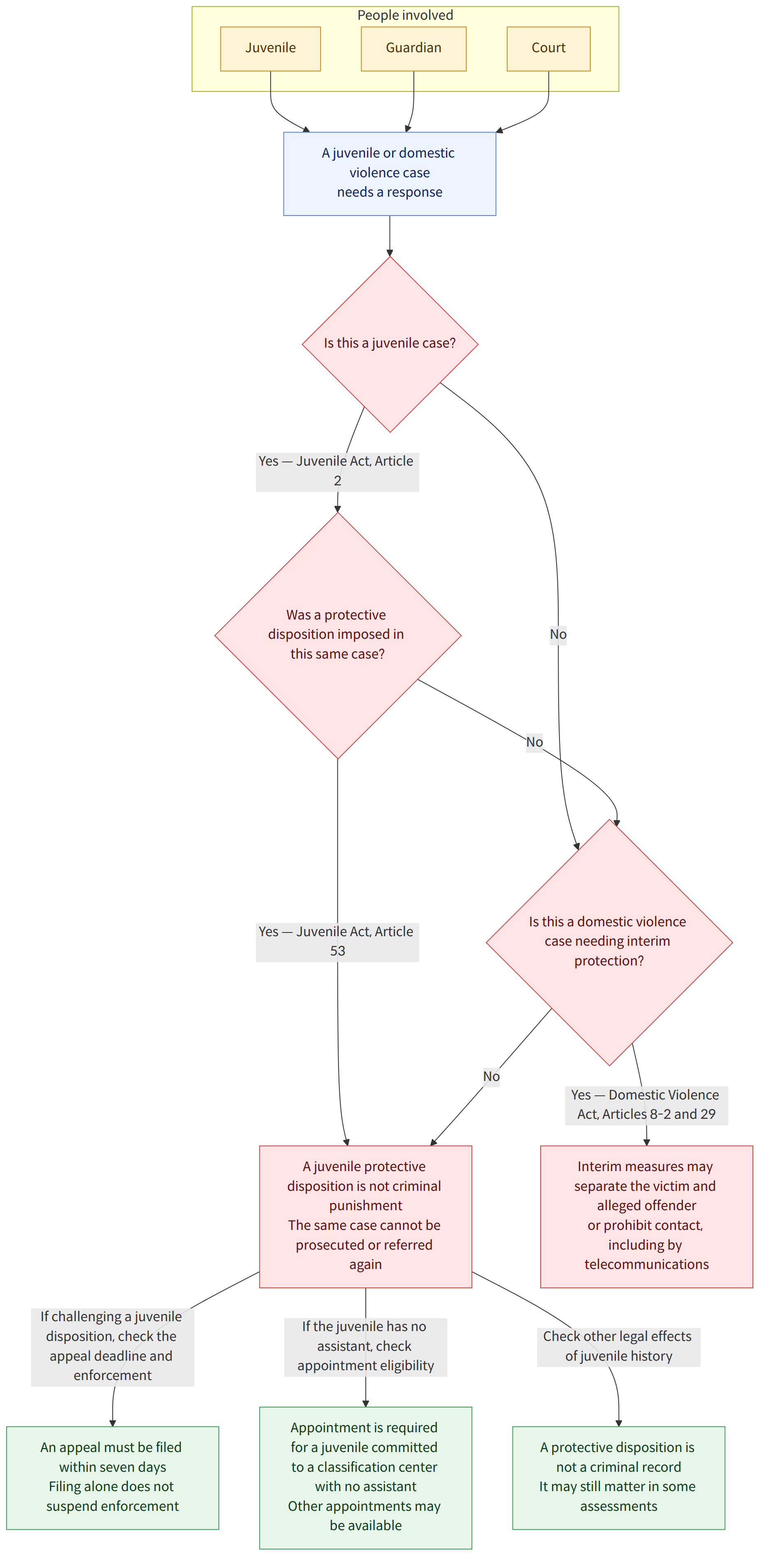
- If a juvenile committed to a Juvenile Classification and Examination Center has no assistant, the court must appoint a court-appointed assistant. In certain other circumstances, one may be appointed upon application or by the court on its own motion (Juvenile Act, Article 17-2 (소년법 제17조의2)).
- A case in which a juvenile protective disposition has been imposed may not be prosecuted again or referred to the Juvenile Department if it is the same case. By contrast, a decision not to impose a disposition in a domestic violence case does not automatically bar prosecution for the same criminal facts (Juvenile Act, Article 53 (소년법 제53조); Act on Special Cases Concerning the Punishment, etc. of Crimes of Domestic Violence, Article 17(1) (가정폭력처벌법 제17조 제1항); Examples 1 and 21).
- To challenge a juvenile protective disposition, an appeal must be filed; according to the examples, the filing period is seven days. Filing an appeal alone does not suspend enforcement of the disposition (Juvenile Act, Article 43 (소년법 제43조)).
- Mitigation of a sentence under the Juvenile Act is discretionary for the court, and whether a person is a juvenile is generally determined as of the time the judgment is pronounced by the court of fact-finding (Juvenile Act, Article 60(2) (소년법 제60조 제2항); Examples 5 and 13).
- In a domestic violence case, a court-ordered interim measure or other measure may be used to separate the victim and alleged offender or prohibit the alleged offender from approaching the victim, including by means of telecommunications (Act on Special Cases Concerning the Punishment, etc. of Crimes of Domestic Violence, Articles 8-2 and 29 (가정폭력처벌법 제8조의2, 제29조)).
- A juvenile protective disposition is distinct from a criminal record. However, according to the examples, a protective disposition or a sentence of imprisonment imposed during a person’s juvenile years may be considered in determining certain legally relevant prior history or habituality (Examples 4, 7, and 8).
Frequently asked questions
Q. What protective dispositions may be imposed on a juvenile?
The Juvenile Act provides for several types of protective dispositions, including entrusting a juvenile’s care to a guardian or facility, ordering attendance at educational programs or community service, placing the juvenile under probation, entrusting the juvenile to a hospital or other institution, and sending the juvenile to a juvenile training school. The disposition is determined in light of the circumstances of the case and the juvenile’s situation (Juvenile Act, Article 32 (소년법 제32조)).
Q. Can a juvenile get assistance in a juvenile case, like court-appointed defense counsel?
In juvenile cases, a court-appointed assistant may be available in place of a court-appointed defense counsel. If a juvenile has been committed to a Juvenile Classification and Examination Center and has no assistant, the court must appoint one. In certain other circumstances, the juvenile or the juvenile’s guardian may apply for an appointment (Juvenile Act, Article 17-2 (소년법 제17조의2)).
Q. Will a juvenile have a criminal record after receiving a protective disposition?
According to the examples, a juvenile protective disposition is different from criminal punishment and does not in itself give the juvenile a criminal record. However, this does not mean that a protective disposition has no significance in any legal assessment. The examples explain that it may be considered when determining whether a theft was habitual.
Q. Can a juvenile be prosecuted again for a case in which a protective disposition was imposed?
A case in which a protective disposition has been imposed under the Juvenile Act may not be prosecuted again or referred to the Juvenile Department if it is the same case. According to the examples, if a prosecution is brought for the same case, the court may dismiss the prosecution (Juvenile Act, Article 53 (소년법 제53조)).
Q. If a decision not to impose a disposition becomes final in a domestic violence case, can the person be prosecuted again for the same facts?
According to the examples, a decision not to impose a disposition under the Act on Special Cases Concerning the Punishment, etc. of Crimes of Domestic Violence does not have the same effect as a final criminal judgment. Therefore, the fact that such a decision has become final does not, by itself, bar prosecution for the same criminal facts. This differs from the restriction on reprosecution for the same case after a protective disposition under the Juvenile Act.
Q. How can a juvenile challenge a protective disposition?
A protective disposition may be challenged by filing an appeal if it is considered to violate laws or regulations, involve a serious error of fact, or be manifestly unfair. According to the examples, the appeal period is seven days, and filing an appeal does not automatically suspend enforcement of the disposition (Juvenile Act, Article 43 (소년법 제43조)).
Q. Can a person receive a reduced sentence under the Juvenile Act if they were a minor when they committed the offense?
Mitigation under the Juvenile Act is discretionary for the court, not mandatory. According to the examples, whether a person is a juvenile is generally determined as of the time the judgment is pronounced by the court of fact-finding. Accordingly, even if the person was a minor when the offense was committed, the person may not be eligible for mitigation under the Juvenile Act if they turn 19 before the judgment is pronounced.
Q. Is there a way to protect a victim before a domestic violence case is concluded?
According to the examples, even before a case is concluded, an emergency interim measure or a court-ordered interim measure may be used to separate the alleged offender from the home and prohibit them from approaching the victim or others, including by means of telecommunications. Court-ordered interim measures may also include entrusting the person to a medical institution or placing them in detention (Act on Special Cases Concerning the Punishment, etc. of Crimes of Domestic Violence, Articles 8-2 and 29 (가정폭력처벌법 제8조의2, 제29조)).
Relevant laws
- Constitution of the Republic of Korea, Article 13(1) (헌법 제13조 제1항)
- Juvenile Act, Article 2 (소년법 제2조)
- Juvenile Act, Article 4(1) and (3) (소년법 제4조 제1항·제3항)
- Juvenile Act, Article 5(2) (소년법 제5조 제2항)
- Juvenile Act, Article 7(2) (소년법 제7조 제2항)
- Juvenile Act, Article 17(소년법 제17조)
- Juvenile Act, Article 17-2 (소년법 제17조의2)
- Juvenile Act, Article 18(1), (2), and (6) (소년법 제18조 제1항·제2항·제6항)
- Juvenile Act, Article 24(2) (소년법 제24조 제2항)
- Juvenile Act, Article 25-3 (소년법 제25조의3)
- Juvenile Act, Article 30-2 (소년법 제30조의2)
- Juvenile Act, Article 32 (소년법 제32조)
- Juvenile Act, Article 43(1) (소년법 제43조 제1항)
- Juvenile Act, Article 49 (소년법 제49조)
- Juvenile Act, Article 50 (소년법 제50조)
Watch out for
- To challenge a juvenile protective disposition, you must file an appeal rather than an appeal from a judgment. Take care not to miss the seven-day period stated in the examples.
- Filing an appeal does not automatically suspend enforcement of a protective disposition.
- Although a juvenile protective disposition is distinct from a criminal record, do not assume that it will never be considered in any legal assessment.
- Whether someone is a juvenile and whether they may receive a reduced sentence under the Juvenile Act may not be determined solely by their age when the offense was committed; the date the judgment is pronounced should also be checked.
Source cases
This guide was compiled by AI from the following Korea Legal Aid Corporation consultation cases (in Korean).
- 가정폭력처벌법상의 불처분결정이 확정된 후 다시 같은 범죄사실에 대하여 공소를 제기할 수 있는지
- 소년법에서 정하고 있는 보호처분의 종류
- 소년 사건에도 국선변호인의 도움을 받을 수 있는지
- 소년사건의 보호처분도 전과에 해당되는지
- 판결선고 시 19세가 된 경우 소년법상의 감경을 받을 수 있는지
- 소년에 대해 무기징역을 선택한 후 작량감경하여 부정기의 징역형을 선고할 수 있는지
- 소년형으로서 처벌받은 징역형이 특정범죄가중처벌 등에 관한 법률 제5조의 4 제5항의 “징역형” 에 포함되는지 여부
- ‘성폭력범죄 2회 이상’에 소년보호처분 전력이 포함되는지
- 통고제도
- 소년보호절차상의 화해권고 제도
- 부정기형을 받은 소년범이 항소심판결 시 19세가 된 경우
- 소년 보호처분에 대한 불복절차
- 소년범 감경이 필요적 감경인지 여부
- 사회봉사명령에도 형벌불소급의 원칙이 적용되는지
- 소년부송치사건 중 보호자가 감독하는 위탁변경 신청방법
- 가정보호사건이 종결되기 전의 임시조치
- 가정폭력의 처벌 등에 관한 특례법의 처벌대상범죄
- 가정폭력의 처벌 등에 관한 특례법의 적용 범위
- 소년 보호사건의 기록을 열람·등사할 수 있는지
- 소년부 송치의 의미
- 소년법상 보호처분 받은 사건을 다시 공소 제기할 수 있는지
- 상호간 이혼의사가 있는 경우 보호처분 가부
- 소년부 심리 중 해당 소년에 대하여 보도가 이루어졌을 경우 대응방법에 대하여
- 가정보호사건의 조사
- 소년사건의 경우에도 국선변호인 선임이 가능한지
This guide is general legal information about Korean law, not legal advice for your situation. For a specific case, consult a lawyer or the Korea Legal Aid Corporation (call 132 in Korea).