
Acquisition and Loss of Nationality: Requirements and Procedures
Based on 25 consultation cases · Updated · Translated from the Korean original.
South Korean nationality may be acquired at birth, through naturalization, or with permission to restore nationality. Marriage alone does not automatically confer nationality. If you acquire foreign nationality or have dual nationality, you should check the procedures and deadlines relating to loss, retention, or choice of nationality.
At a glance
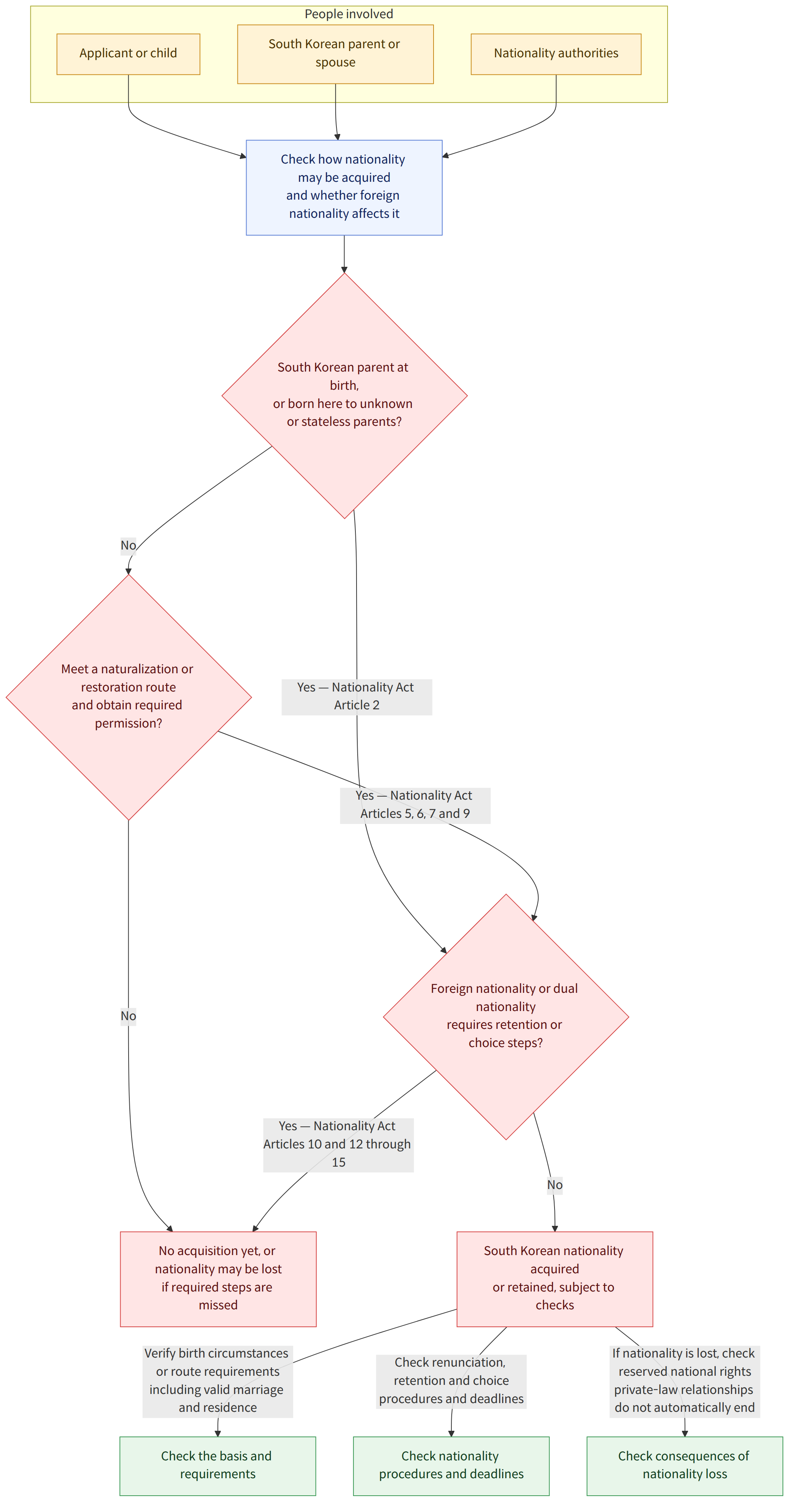
Key points
- If either parent is a South Korean national at the time of the child's birth, the child acquires South Korean nationality at birth. A person born in South Korea also acquires nationality if both parents are unknown or the person is stateless (Nationality Act, Article 2 (국적법 제2조)).
- A foreign national does not acquire South Korean nationality immediately upon marrying a South Korean national. The foreign national must meet the requirements for simplified naturalization, including having a legally valid marriage and satisfying the domestic residence period, and obtain permission for naturalization (Nationality Act, Article 6 (국적법 제6조)).
- General naturalization requires meeting residence requirements, including having had an address in South Korea for at least five years, as well as requirements concerning adulthood, conduct, ability to support oneself, and basic knowledge (Nationality Act, Article 5 (국적법 제5조)).
- Special naturalization may be sought in cases including having a parent who is a South Korean national, having rendered distinguished service to South Korea, or being recognized as likely to contribute to the national interest through outstanding ability in a particular field (Nationality Act, Article 7 (국적법 제7조)).
- A person who was formerly a South Korean national and lost that nationality may apply for permission to restore it. If permission is granted, the person acquires South Korean nationality at that time. There are also grounds on which permission may be restricted (Nationality Act, Article 9 (국적법 제9조)).
- As a general rule, a person who acquires South Korean nationality while holding foreign nationality must renounce the foreign nationality within one year of acquiring South Korean nationality. Failure to do so may result in loss of South Korean nationality (Nationality Act, Article 10 (국적법 제10조)).
- If a person acquires a spouse's foreign nationality through marriage to a foreign national, they may lose South Korean nationality if they do not notify the authorities of their intention to retain it. Dual nationals should check the procedures and deadlines for choosing a nationality or renouncing South Korean nationality (Nationality Act, Articles 12 through 15 (국적법 제12조부터 제15조까지)).
- Loss of South Korean nationality does not automatically extinguish private-law status, such as an existing parent-child relationship or property relationship. However, a person who has lost nationality cannot enjoy rights reserved for South Korean nationals (Nationality Act, Article 18 (국적법 제18조)).
Frequently asked questions
Q. Do I acquire South Korean nationality as soon as I marry a South Korean?
No. Marriage alone does not confer nationality. You must meet the requirements, including having a marriage that is legally valid and satisfying the domestic residence period, and obtain permission for simplified naturalization. Simply living together does not meet the requirements for simplified naturalization based on marriage.
Q. Will I lose the South Korean nationality I acquired if I divorce my South Korean spouse?
You do not lose South Korean nationality merely because you divorce your spouse or your spouse dies after you have naturalized based on marriage. However, the guide discusses separately, in its examples, cases where it is established that the marriage was entered into without the intention of establishing an actual marital relationship.
Q. Does a child acquire South Korean nationality at birth if one parent is South Korean?
If either parent is a South Korean national at the time of the child's birth, the child acquires South Korean nationality at birth. The example explains that the principle of nationality by descent from either parent took effect on June 14, 1998. The law and circumstances at the time of birth should therefore be checked separately for anyone born before that date.
Q. Can I continue to hold foreign nationality after acquiring South Korean nationality?
According to the example, a person with foreign nationality who acquires South Korean nationality must renounce their foreign nationality within one year of the date of acquisition. If the renunciation procedure is not completed within that period, the person may lose South Korean nationality, and must submit documents proving the renunciation or loss of nationality.
Q. I lost my South Korean nationality after acquiring foreign nationality. Can I restore it?
A person who was formerly a South Korean national may apply to the Minister of Justice for permission to restore nationality. The applicant must submit required materials, including documents proving the reason and date of loss of nationality. If permission is granted, the person reacquires South Korean nationality at that time.
Q. What happens to my South Korean nationality if I marry a foreign national and acquire my spouse's nationality?
According to the example, if you acquire your foreign spouse's nationality and do not notify the Minister of Justice within six months that you intend to retain South Korean nationality, you may be deemed to have lost South Korean nationality retroactively from the date you acquired the foreign nationality. It also explains that if the date on which the foreign nationality was acquired is unknown, the date the foreign passport was first issued may be used as a basis for estimation.
Q. By when must a dual national choose a nationality?
The example explains that a person who became a dual national before turning 20 must choose a nationality before turning 22, while a person who became a dual national after turning 20 must choose a nationality within two years of becoming a dual national. Separate deadlines may apply depending on circumstances related to military service, such as being entered onto the military service preliminary roster, so you should check whether any such circumstances apply to you.
Q. If I lose South Korean nationality, will my relationship with my parents or my inheritance rights also end?
Loss of nationality affects rights that only South Korean nationals may enjoy, but does not automatically extinguish private-law status, such as an existing parent-child relationship or property relationship. Accordingly, the example explains that a child who has lost nationality may still inherit from a parent who is a South Korean national.
Q. Can I apply to restore nationality even if there is no record of loss of nationality in the family relations register?
The example explains that an application to restore nationality should not be refused solely because there is no record of loss of nationality. If necessary, the record of loss of nationality may first be corrected ex officio, after which the register may be corrected in accordance with the notice granting permission to restore nationality.
Relevant laws
- Nationality Act, Article 2 (국적법 제2조)
- Nationality Act, Article 5 (국적법 제5조)
- Nationality Act, Article 6 (국적법 제6조)
- Nationality Act, Article 7 (국적법 제7조)
- Nationality Act, Article 8 (국적법 제8조)
- Nationality Act, Article 9 (국적법 제9조)
- Nationality Act, Article 10 (국적법 제10조)
- Nationality Act, Article 11 (국적법 제11조)
- Nationality Act, Articles 12 through 16 (국적법 제12조부터 제16조까지)
- Nationality Act, Article 18 (국적법 제18조)
- Act on Registration of Family Relations, Article 18 (가족관계의 등록 등에 관한 법률 제18조)
- Act on Registration of Family Relations, Article 38 (가족관계의 등록 등에 관한 법률 제38조)
- Act on Registration of Family Relations, Article 95 (가족관계의 등록 등에 관한 법률 제95조)
- Enforcement Rule of the Nationality Act, Article 6(2) (국적법 시행규칙 제6조 제2항)
Watch out for
- Simplified naturalization based on marriage requires a legally valid marriage; a de facto marriage or simply living together does not satisfy this requirement.
- Different deadlines, including one year, six months, and two years, apply to acquisition, loss, and choice of nationality. Check the deadline that applies to your particular circumstances and procedure.
- Even if a notification of loss of nationality or a record in the family relations register is missing, whether nationality was actually lost and whether it can be restored are not determined solely by that record.
- The examples include matters that vary depending on when a law took effect or on circumstances related to military service. Consider both your date of birth and the specific circumstances in which your nationality changed.
Source cases
This guide was compiled by AI from the following Korea Legal Aid Corporation consultation cases (in Korean).
- 외국인과의 혼인으로 상실하였던 대한민국국적 회복방법
- 대한민국국민과 혼인한 외국인의 대한민국국적 취득방법
- 소송으로 이혼한 경우 국적취득이 가능한지 여부
- 혼인으로 인한 외국국적 취득 시 대한민국국적의 상실 여부
- 국적판정
- 국적 회복 절차
- 국적법상 부모양계혈통주의
- 한국에 거주하는 외국인 부부의 이혼
- 우리나라에 거주하는 외국 국적의 혼인외 출생자에 대하여 대한민국 국적의 생모가 법정대리권을 행사할 수 있는지 여부
- 특별귀화에 의한 국적취득의 요건
- 대한민국 국적의 이탈
- 일반귀화에 의한 국적취득 요건
- 혼인 전 출생한 자녀도 한국 국적을 취득할 수 있는지 여부
- 대한민국 국적 취득자의 외국국적 포기 의무
- 상속인들이 일본 법원에 상속포기를 신청했다면 우리나라에 있는 부동산 등 재산에도 상속포기의 효력이 미치는지
- 북한이탈주민의 지위
- 국적상실과 상속관계
- 외국인이 대한민국에 상속받은 부동산이 있는 경우 이를 계속 보유할 수 있는지
- 혼인신고를 하지 않고 동거하는 관계도 귀화 신청이 가능한지 여부
- 국적취득의 방법·절차
- 피상속인이 유언으로 다른나라 법을 지정할 수 있는지
- 피상속인이 외국에서 사망한 경우 상속문제
- 복수국적자의 국적선택
- 국적법 제2조 제1호의 해석
- 출생에 의한 국적취득
This guide is general legal information about Korean law, not legal advice for your situation. For a specific case, consult a lawyer or the Korea Legal Aid Corporation (call 132 in Korea).