
Justifiable Grounds for Dismissal and Remedies in Employment
Based on 61 consultation cases · Updated · Translated from the Korean original.
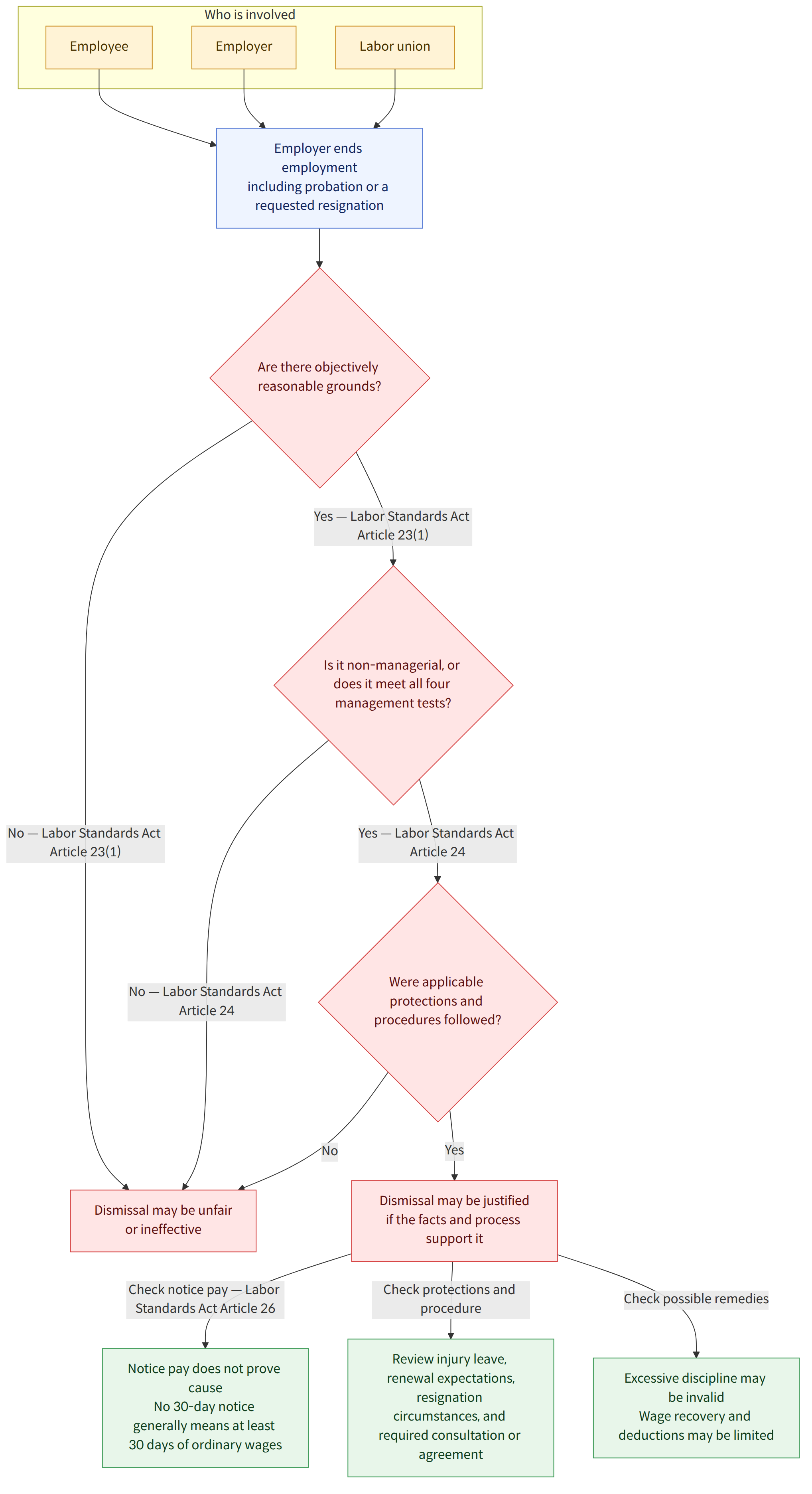
Dismissal must have justifiable grounds, and dismissals for managerial reasons or during a probationary period must each meet the applicable requirements. The fact that dismissal notice pay was received or a resignation letter was submitted does not, by itself, establish that the dismissal was justified; the substance of the dismissal and the procedures followed must both be examined.
At a glance
Key points
- Even during a probationary period, dismissal requires objectively reasonable grounds that can be considered reasonable in light of generally accepted social standards (Labor Standards Act, Article 23(1) (근로기준법 제23조 제1항), Case 1).
- The fact that treatment for an occupational injury or illness has ended, or that disability compensation has been received, does not by itself justify dismissal. As a rule, dismissal is restricted during leave for occupational medical treatment and for 30 days thereafter (Labor Standards Act, Article 23(2) (근로기준법 제23조 제2항), Case 2).
- A dismissal for managerial reasons is assessed comprehensively, taking into account an urgent managerial necessity, efforts to avoid dismissal, reasonable and fair selection of employees to be dismissed, and sincere consultations with the employees’ side. A request by some business partners or workplaces to reduce staff does not, by itself, satisfy these requirements (Labor Standards Act, Article 24 (근로기준법 제24조), Cases 5 and 8).
- Dismissal notice or dismissal notice pay does not replace a justifiable reason for dismissal. Even if a dismissal is justified, an employer who does not give 30 days’ notice must, as a rule, pay ordinary wages for at least 30 days (Labor Standards Act, Article 26 (근로기준법 제26조), Cases 9 and 23).
- Even if there are grounds for disciplinary action, an excessively severe disciplinary measure may be invalid as an abuse of disciplinary authority. In a claim for wages for a period during which a dismissal was invalid, income earned from another job may be deducted, although the cases also explain that deductions are limited to the extent of dismissal allowance (Labor Standards Act, Articles 23(1) and 46 (근로기준법 제23조 제1항·제46조); Civil Act, Article 538 (민법 제538조), Case 10).
- Even if the process took the form of submitting a resignation letter and being dismissed at the employee’s request, it may be treated as a dismissal where the employee had no intention to resign and the employer effectively ended the employment relationship unilaterally. The circumstances surrounding submission of the resignation letter, the employer’s request that the employee resign, and any anticipated disadvantages are considered together (Cases 11 and 14).
- If a fixed-term employee has a legitimate expectation that the contract will be renewed or that they will be converted to regular-employee status, a refusal to renew or convert without reasonable grounds may be ineffective, just like an unfair dismissal (Act on the Protection, etc. of Fixed-Term and Part-Time Employees, Article 4 (기간제 및 단시간근로자 보호 등에 관한 법률 제4조), Cases 13 and 18).
- The effect of a procedural violation may depend on whether the personnel procedure in the collective agreement requires “consultation,” meaning that the labor union’s views must be heard, or “agreement,” meaning prior consent or consensus is required (Case 6).
Frequently asked questions
Q. Can a company dismiss me without cause during a probationary period?
That is not necessarily the case. During a probationary period, an employer may refuse to formally hire an employee after assessing their suitability for the work, but there must be objectively reasonable grounds based on an evaluation of the employee’s work attitude or abilities. It must also be determined whether those grounds are considered reasonable in light of generally accepted social standards.
Q. Can I be dismissed after occupational injury treatment ends and I receive disability compensation?
The fact that you received disability compensation does not, by itself, constitute grounds for dismissal. As a rule, dismissal is restricted during a period of leave taken because of an occupational injury or illness and for 30 days thereafter. Whether you can continue working in your job after treatment depends on a comprehensive assessment of the degree of disability, the nature of the work, and other relevant factors.
Q. Is a dismissal justified if the company says it is having financial difficulties?
In assessing a dismissal for managerial reasons, the factors considered include not only an urgent managerial necessity, but also efforts to avoid dismissal, the reasonableness and fairness of selecting the employees to be dismissed, and sincere consultations with the employees’ side. It cannot be assumed that a request by the residents’ representative body of a particular apartment complex to reduce staff, or a temporary downturn in business, alone establishes that the dismissal was justified.
Q. If I receive dismissal notice pay, can I no longer challenge my dismissal as unfair?
The fact that you received dismissal notice pay does not, by itself, establish that you accepted the dismissal. Dismissal notice and payment of the allowance do not replace a justifiable reason for dismissal, so you may separately challenge whether the dismissal itself was justified.
Q. I submitted a resignation letter and was processed as having left the company. Can I claim that I was dismissed?
If you submitted your resignation letter voluntarily, the employment relationship may be regarded as having ended by mutual agreement. However, if you had no intention of resigning and effectively submitted the letter because of pressure from the employer or similar circumstances, whether the action was, in substance, a dismissal is determined by comprehensively examining how the letter was submitted and the circumstances at the time.
Q. Can an employer refuse to renew my fixed-term contract because it has expired?
As a rule, the employment relationship ends when the contract term expires. However, if the contract or rules of employment provide for renewal, or if a legitimate expectation that the contract would be renewed has arisen in light of various circumstances, an unjustified refusal to renew may be ineffective.
Q. Is the dismissal of a union member invalid if the employer does not consult with the labor union?
There have been cases holding that a dismissal remains effective despite noncompliance with the procedure where the collective agreement’s “consultation” provision merely gives the union an opportunity to present its views. By contrast, where the provision requires prior consent or agreement, a personnel action taken without following that procedure may, as a rule, be invalid.
Q. What remedies can I seek if I am unfairly dismissed?
The cases explain that you may apply to the competent labor relations commission for relief against unfair dismissal or file a lawsuit in court seeking confirmation that the dismissal is invalid. If the dismissal is invalid, you may also be able to claim wages for the period of dismissal.
Relevant laws
- Labor Standards Act, Article 23(1) and (2) (근로기준법 제23조 제1항·제2항)
- Labor Standards Act, Article 24 (근로기준법 제24조)
- Labor Standards Act, Article 26 (근로기준법 제26조)
- Labor Standards Act, Article 28 (근로기준법 제28조)
- Labor Standards Act, Article 35 (근로기준법 제35조)
- Labor Standards Act, Article 46 (근로기준법 제46조)
- Civil Act, Article 538 (민법 제538조)
- Civil Act, Article 660 (민법 제660조)
- Civil Act, Article 661 (민법 제661조)
- Act on the Protection, etc. of Fixed-Term and Part-Time Employees, Article 4 (기간제 및 단시간근로자 보호 등에 관한 법률 제4조)
Watch out for
- Giving dismissal notice or paying dismissal notice pay does not guarantee that the grounds for dismissal are justified.
- If you took leave because of an occupational injury or illness, a restricted period for dismissal may apply, so you should check the relationship between the end of treatment and the date of dismissal.
- The cases state that an application for relief to a labor relations commission must be filed within three months from the date of dismissal. In an actual case, you should confirm the applicable procedure and deadline.
- Do not assume that you cannot challenge a dismissal merely because you submitted a resignation letter or received severance pay or dismissal notice pay. Consider the circumstances at the time and whether you raised an objection.
Source cases
This guide was compiled by AI from the following Korea Legal Aid Corporation consultation cases (in Korean).
- 시용(試用)기간 중 부적격이라고 해고한 경우 부당해고 여부
- 산재치료를 종결하였으나 부당하게 해고된 경우 구제방법
- 근로자의 사정에 의한 근로계약 해지 시 해지의 효력발생시기
- 단체협약 규정의 해석 방법 등
- 회사의 경영악화를 이유로 해고한 경우 경영악화의 판단기준
- 노동조합과 협의 없이 한 조합원 해고의 효력
- 임용결격자가 공무원으로 임용되어 사실상 근무하여 온 경우
- 입주자대표회의의 감원요청으로 인한 정리해고가 정당한지 여부
- 해고의 예고와 해고예고수당
- 징계권 남용을 이유로 한 해고무효소송 및 임금지급청구 가능 여부
- 사직서 제출에 따른 사용자의 의원면직처분이 해고로 될 수 있는지
- 사용자의 직장폐쇄가 정당성을 상실하는 경우, 사용자가 그 기간 동안의 임금에 대해 지불의무를 면하는지 여부
- 기간제 근로자의 정규직 전환에 대한 기대권
- 기간제근로자에 대한 해고
- 업무상 재해 여부가 문제된 사건
- 근로자의 채용 조건으로 일정 수준 이상의 학위 소지자일 것을 요구하여 근로자가 학위 논문을 제출한 경우, 학위 논문에 표절 등...
- 백화점 파견 판매원의 근로기준법상의 근로자성
- 근로계약기간의 반복적 갱신 중 사용자의 해고가 정당한지 여부
- 해고수당을 수령하면 부당해고조치에 이의할 수 없는지
- 근로자가 업무상의 부상 또는 질병 등의 사정으로 사용할 해당 연도에 전혀 출근하지 못한 경우, 이미 부여받은 연차휴가를 사용하...
- 근로시간 면제 제도 사건
- 가족관계등록부상 생년월일 정정 허가결정 후 인사기록상 정년퇴직 예정일 변경 요청이 거부된 사건
- 고용된 지 5개월만에 해고된 경우 해고예고수당청구가 가능한지
- 연차휴가미사용수당 등 미지급 사건
- 근로자의 자살이 업무상 재해에 해당되기 위한 요건 등
This guide is general legal information about Korean law, not legal advice for your situation. For a specific case, consult a lawyer or the Korea Legal Aid Corporation (call 132 in Korea).