
Guide to Establishing Labor Unions, Collective Bargaining, and Industrial Action
Based on 31 consultation cases · Updated · Translated from the Korean original.
Labor unions must be established and operated with autonomy and independence, and collective bargaining and industrial action must comply with applicable laws and procedures. The legitimacy of changes to management structure, lockouts, and union activities may depend on their specific purpose and circumstances.
At a glance
Key points
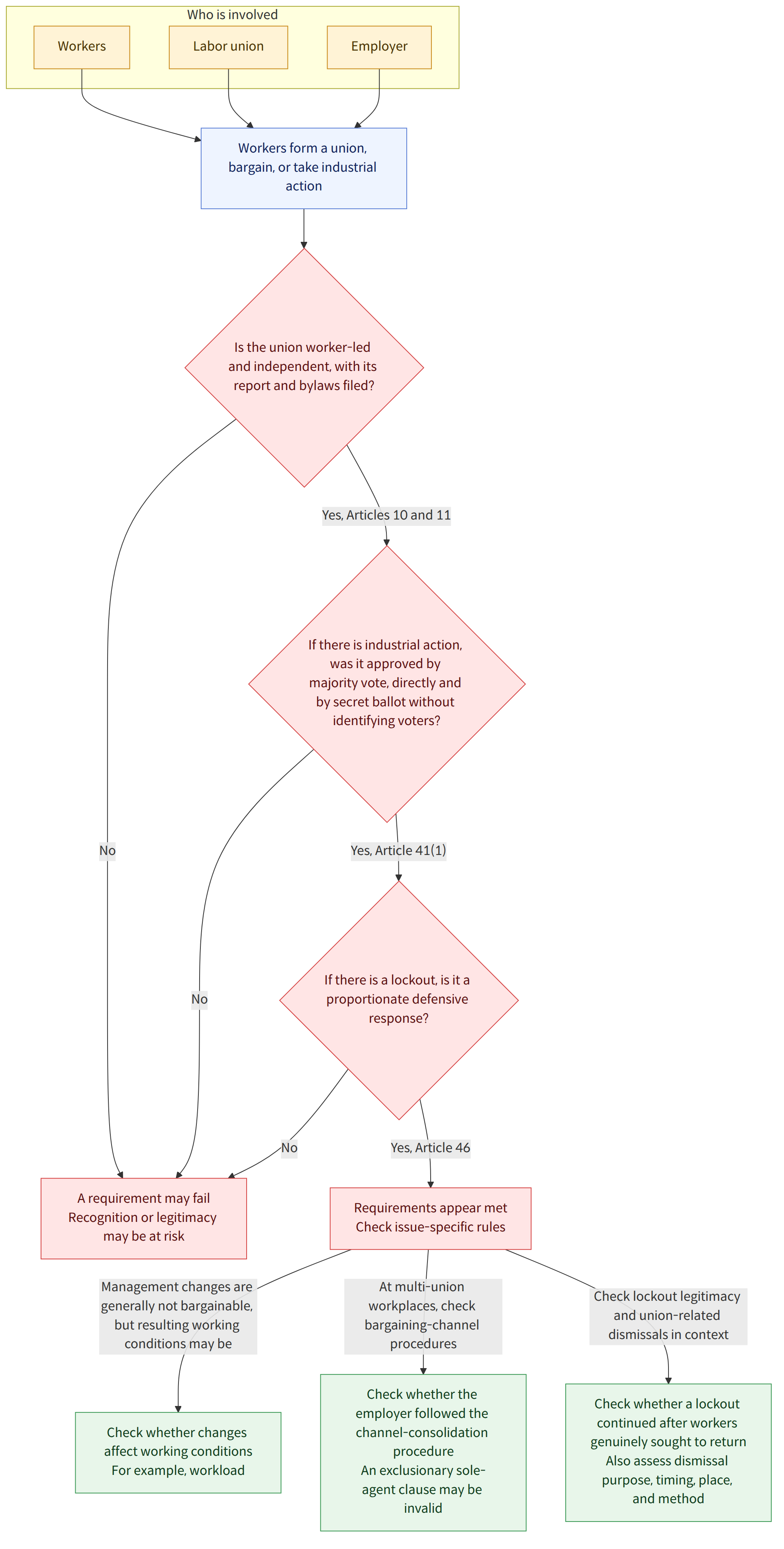
- A labor union must be independently organized by workers, and the establishment report and bylaws must be submitted when filing to establish it. The case explains that a union may be formed by two or more people (Trade Union and Labor Relations Adjustment Act, Articles 2(4), 10, and 11 (노동조합 및 노동관계조정법 제2조 제4호, 제10조, 제11조)).
- Where certain objective circumstances exist, the administrative agency may review whether the labor union meets the substantive requirements. An organization led by the company and lacking autonomy and independence may not be recognized as a labor union (Cases 20 and 25).
- A change to management structure or the abolition of a business division is generally unlikely, in itself, to be subject to collective bargaining. However, working conditions resulting from that change, such as workload, may be subject to bargaining (Case 1).
- Industrial action must have a legitimate actor, purpose, procedure, and method. As a general rule, it must be approved by a majority vote of the union members, conducted directly, by secret ballot, and without identifying voters (Trade Union and Labor Relations Adjustment Act, Article 41(1) (노동조합 및 노동관계조정법 제41조 제1항); Cases 2 and 9).
- A lockout must be a proportionate defensive measure in response to industrial action by a labor union. If employees genuinely seek to return to work but the employer continues the lockout, the lockout may lose its legitimacy for the subsequent period, giving rise to an obligation to pay wages (Article 46 (노동조합 및 노동관계조정법 제46조); Cases 5 and 22).
- Dismissal for engaging in legitimate labor union activities or participating in legitimate industrial action may constitute unfair dismissal. The purpose, timing, place, and method of the activities, as well as the legitimacy of the industrial action, should be considered together (Cases 6 and 9).
- At a workplace with multiple labor unions, an employer’s refusal or neglect to follow the procedure for consolidating bargaining channels may constitute an unfair labor practice. A sole bargaining agent clause that excludes another union’s right to bargain may be invalid (Trade Union and Labor Relations Adjustment Act, Articles 29-2 and 81(3) (노동조합 및 노동관계조정법 제29조의2, 제81조 제3호); Cases 11 and 16).
- Union members may inspect the union’s financial statements and operational status. According to the case, a lower court has held that making copies is also permitted to ensure meaningful access (Article 26 (노동조합 및 노동관계조정법 제26조); Case 23).
Frequently asked questions
Q. What procedure must be followed to establish a labor union?
According to the case, the general rule is to file a report with the competent administrative agency, attaching the union’s bylaws to the establishment report. After receiving the report, the agency issues a certificate of report if the statutory requirements are met, and may also review the substantive requirements where objective circumstances warrant it (Cases 3 and 20).
Q. Can employees demand collective bargaining if the company abolishes a business division or assigns them to a different workplace?
The abolition of a business division or the assignment of employees is, in itself, a matter of management prerogative and is generally unlikely to be subject to mandatory bargaining. However, if the action affects working conditions—for example, by increasing workloads—the parties may bargain over improvements to those conditions (Case 1).
Q. Can a strike be legitimate if it takes place without a vote of the union members?
As a general rule, industrial action must be approved by a majority vote of the union members, conducted directly, by secret ballot, and without identifying voters. The case explains that industrial action that does not follow this voting procedure loses its legitimacy unless objective circumstances are recognized that made it impossible to follow the procedure (Trade Union and Labor Relations Adjustment Act, Article 41(1) (노동조합 및 노동관계조정법 제41조 제1항); Case 2).
Q. What happens if an employer does not cooperate with the procedure for consolidating bargaining channels?
At a workplace with multiple labor unions, the procedure for consolidating bargaining channels is a prerequisite to collective bargaining. If an employer refuses or neglects to follow the procedure without justifiable cause, that conduct may constitute an unfair labor practice (Trade Union and Labor Relations Adjustment Act, Article 81(3) (노동조합 및 노동관계조정법 제81조 제3호); Case 11).
Q. Can I receive wages if I end the strike and try to return to work but the company continues the lockout?
Even if a lockout is justified when it begins, it may lose its legitimacy if the employer continues it after employees have stopped their industrial action and genuinely expressed their intention to return to work. The case explains that, for the period during which the lockout has lost its legitimacy, the employer cannot avoid the obligation to pay wages (Trade Union and Labor Relations Adjustment Act, Article 46 (노동조합 및 노동관계조정법 제46조); Cases 5 and 22).
Q. Can I be dismissed for engaging in labor union activities?
Dismissing an employee solely because they engaged in legitimate labor union activities may constitute unfair dismissal. The assessment considers, among other things, whether the activities were related to union business, were intended to improve working conditions, and were appropriate in their timing and manner (Case 6).
Q. Can a labor union refuse to readmit someone who left the union?
A labor union may not arbitrarily refuse membership to a worker who is eligible to join. In particular, where a union shop agreement is in place, refusing readmission may lead to dismissal. Restricting membership without special circumstances, such as grounds that would justify expulsion, may therefore be unlawful or improper (Case 13).
Q. Can a union member copy the labor union’s financial records?
The case discusses a lower court decision recognizing that the statutory right to inspect the union’s financial statements and operational status also includes the right to make copies of the materials. Accordingly, if a member requests access to materials but is refused copies, whether the member has that right may be considered in light of the specific materials and circumstances (Trade Union and Labor Relations Adjustment Act, Article 26 (노동조합 및 노동관계조정법 제26조); Case 23).
Relevant laws
- Trade Union and Labor Relations Adjustment Act, Article 2(4) (노동조합 및 노동관계조정법 제2조 제4호)
- Trade Union and Labor Relations Adjustment Act, Article 5 (노동조합 및 노동관계조정법 제5조)
- Trade Union and Labor Relations Adjustment Act, Article 10 (노동조합 및 노동관계조정법 제10조)
- Trade Union and Labor Relations Adjustment Act, Article 11 (노동조합 및 노동관계조정법 제11조)
- Trade Union and Labor Relations Adjustment Act, Article 12 (노동조합 및 노동관계조정법 제12조)
- Trade Union and Labor Relations Adjustment Act, Article 16 (노동조합 및 노동관계조정법 제16조)
- Trade Union and Labor Relations Adjustment Act, Article 17 (노동조합 및 노동관계조정법 제17조)
- Trade Union and Labor Relations Adjustment Act, Article 26 (노동조합 및 노동관계조정법 제26조)
- Trade Union and Labor Relations Adjustment Act, Article 27 (노동조합 및 노동관계조정법 제27조)
- Trade Union and Labor Relations Adjustment Act, Article 29(3) (노동조합 및 노동관계조정법 제29조 제3항)
- Trade Union and Labor Relations Adjustment Act, Article 29-2 (노동조합 및 노동관계조정법 제29조의2)
- Trade Union and Labor Relations Adjustment Act, Article 35 (노동조합 및 노동관계조정법 제35조)
- Trade Union and Labor Relations Adjustment Act, Article 41(1) (노동조합 및 노동관계조정법 제41조 제1항)
- Trade Union and Labor Relations Adjustment Act, Article 41(2) (노동조합 및 노동관계조정법 제41조 제2항)
- Trade Union and Labor Relations Adjustment Act, Article 46 (노동조합 및 노동관계조정법 제46조)
Watch out for
- As a general rule, industrial action must have a legitimate purpose and method and comply with statutory procedures, including a vote of the union members. Whether objective circumstances made it impossible to follow the procedures must be assessed on a case-by-case basis.
- Whether a lockout is legitimate may depend not only on whether it was justified when it began, but also on whether it continued after employees expressed their intention to return to work.
- Conclusions about union formation, membership, bargaining, and access to materials may vary depending on the bylaws, collective agreement, and circumstances at the workplace. Do not assume that the conclusions in a case apply in the same way to every situation.
Source cases
This guide was compiled by AI from the following Korea Legal Aid Corporation consultation cases (in Korean).
- 사업부 폐지와 같은 경영조직의 변경이 단체교섭사항인지
- 노조 조합원의 투표절차를 거치지 않은 쟁의행위도 정당한지
- 노동조합의 설립절차
- 노동조합의 설립절차
- 단체교섭과 임금
- 위법한 노동조합활동
- 노동조합의 서면교섭요구
- 노동조합 활동 중에 생긴 재해가 생긴 경우 산재보상을 받을 수 있는지 여부
- 위법한 쟁의행위(파업)
- 노조 조합원이 아님에도 단체협약을 적용받는 ‘동종 근로자’의 의미
- 교섭창구 단일화 절차에 협조하지 않는 사용자의 부당노동행위 해당여부
- 산업별·지역별 노동조합 지부·분회의 조직형태 변경
- 노동조합 가입·탈퇴의 자유
- 노동조합 총회와 대의원회의 관계
- 행정관청의 노동조합 지도
- 복수노조제 하에서 유일교섭단체 조항의 유효성
- 노동조합 총회 진행 중 임시의장 선출의 효력
- 노동조합의 임원 선거
- 단체교섭의 권한 위임
- 행정관청의 노동조합 신고에 대하여 실질적인 판단을 할 수 있는지 여부
- 주요방위산업체로 지정된 회사가 사업의 일부를 사내하도급 방식으로 다른 업체에 맡겨 방산물자를 생산하는 경우, 하수급업체에 소속...
- 사용자의 직장폐쇄의 개시 자체는 정당하지만 근로자가 쟁의행위를 중단하였음에도 사용자가 직장폐쇄를 계속 유지하면서 공격적 직장폐...
- 노동조합 운영상황의 공개
- 노동조합 조직형태 변경 관련 의결권의 행사방법
- 사측이 설립한 노동조합의 적법성
This guide is general legal information about Korean law, not legal advice for your situation. For a specific case, consult a lawyer or the Korea Legal Aid Corporation (call 132 in Korea).