
Labor: Guide to Top-Priority Payment of Wages and Retirement Benefits
Based on 28 consultation cases · Updated · Translated from the Korean original.
The right to top-priority payment is the right to receive payment of certain wage and retirement benefit claims, among others, from the employer's assets ahead of secured creditors and other creditors. However, you must check the scope of the covered claims, whether the assets belong to the employer, and the applicable deadlines for filing claims for distribution and providing supporting evidence in the auction proceeding.
At a glance
Key points
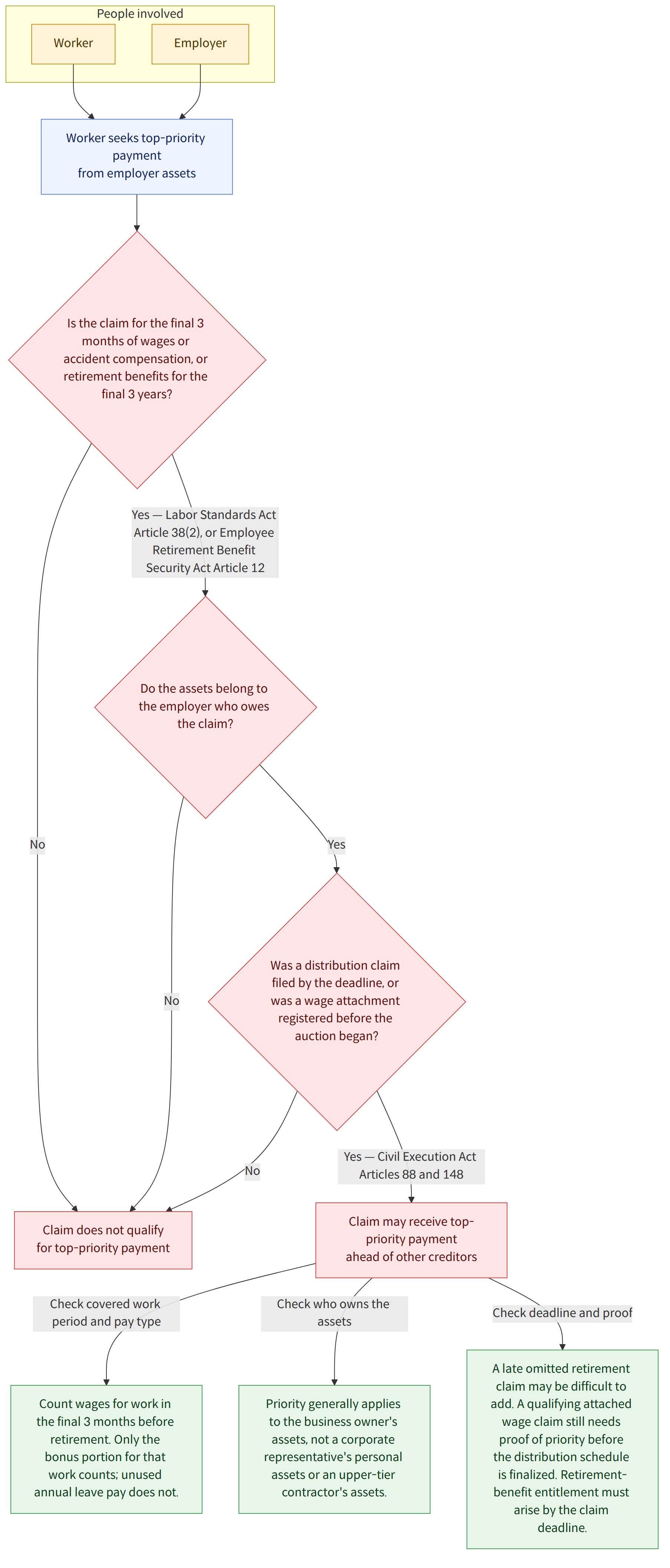
- The final three months of wages and accident compensation may be paid from the employer's total assets ahead of claims secured by pledges or mortgages, taxes and public charges, and other claims (Labor Standards Act, Article 38(2)).
- Retirement benefits for the final three years may also qualify for top-priority payment. The example explains that the event giving rise to entitlement to payment of the retirement benefits must occur by the deadline for filing claims for distribution (Employee Retirement Benefit Security Act, Article 12; Example 22).
- The final three months of wages means wages for work performed during the final three months before retirement, not wages determined by when the payment obligation arose. The relevant period is calculated backward from the retirement date (Examples 20 and 23).
- A bonus does not qualify for priority payment in full merely because it was paid during the final three months; only the portion that represents compensation for work during that period is covered. The example treats unused annual leave pay as excluded from the final three months of wages (Examples 23 and 24).
- As a rule, the “employer's total assets” are the assets of the business owner who owes the wages. The right to priority payment generally cannot be asserted against the personal assets of a corporate representative or an unlimited partner in a limited partnership, or against the assets of the immediate upper-tier contractor (Examples 1 and 15).
- To receive priority payment in an auction proceeding, a claim for distribution generally must be filed by the applicable deadline. After that deadline, it is difficult to add an omitted retirement benefit claim (Civil Execution Act, Article 88; Examples 7 and 16).
- A wage creditor who obtained a provisional attachment over real property before registration of the auction commencement decision may be entitled to a distribution without separately filing a claim for distribution. However, to receive priority distribution, the creditor must substantiate before the distribution schedule is finalized that the attached claim is a wage claim entitled to priority payment (Civil Execution Act, Article 148; Examples 8, 17, and 25).
Frequently asked questions
Q. Are the final three months of wages calculated from the date of retirement or the date the company became insolvent?
The example explains that the final three months are determined by reference to the date of retirement, not the date of insolvency. Wages for work actually performed during that period are covered. Even if the employee retired three months before the insolvency, unpaid wages for the final three months may still receive priority payment.
Q. Is the entire bonus paid during the final three months eligible for top-priority payment?
No. Coverage is not determined solely by when the bonus was paid. Only the portion of the bonus that represents compensation for work during the final three months is covered.
Q. Is unused annual leave pay included in the final three months of wages?
According to the example, unused annual leave pay arising from retirement is not compensation for work during the final three months. It is therefore not included in the final three months of wages eligible for top-priority payment.
Q. Can damages for delay on a wage claim be paid ahead of secured creditors?
The example explains that only the principal of claims such as wage claims is eligible for top-priority payment, and that the right to top-priority payment does not extend to damages for delay. Accordingly, damages for delay cannot be considered entitled to distribution ahead of other claims in the same order of priority as the principal.
Q. Must I first obtain a provisional attachment over real property to receive priority payment of a wage claim?
If real property owned by the employer is being auctioned, you may file a claim for distribution by the deadline for filing such claims without first obtaining a provisional attachment. However, if the employer's property may be transferred to a third party, you should consider whether steps are needed to preserve it.
Q. If I obtained a provisional attachment for a wage claim before the auction commenced, do I still need to file a claim for distribution?
The example explains that a provisional attachment creditor whose attachment was registered before the first registration of an auction commencement decision may receive a distribution without separately filing a claim for distribution. However, to receive priority payment on a wage claim, the creditor must substantiate, before the distribution schedule is finalized, that the claim secured by the provisional attachment is a wage claim entitled to priority payment.
Q. Can I add a retirement benefit claim after the deadline for filing claims for distribution has passed?
According to the example, it is difficult to add a retirement benefit claim after the deadline for filing claims for distribution if doing so would exceed the scope of the claims filed by that deadline. Check which claims were listed in the original claim for distribution and when the filing deadline was.
Q. Can the right to top-priority payment also be exercised against the assets of a company representative or an immediate upper-tier contractor?
As a rule, the “employer's total assets” against which the right to priority payment may be exercised are the assets of the business owner who owes the wages. The example explains that the right to priority payment of wage claims cannot be asserted against the personal assets of a corporate representative or an unlimited partner in a limited partnership, or against the assets of the immediate upper-tier contractor.
Q. If the deadline for filing claims for distribution passes before I retire from the company, will my retirement benefits still receive priority distribution?
The example explains that retirement benefits for the final three years must also be claimed for distribution in a procedurally proper manner by the deadline for filing claims, and that the event giving rise to entitlement to payment of the retirement benefits must occur before that deadline. If the employee retires after the deadline, it is difficult to obtain top-priority payment of those benefits in that auction proceeding.
Relevant laws
- Labor Standards Act, Article 38 (근로기준법 제38조)
- Labor Standards Act, Article 44 (근로기준법 제44조)
- Employee Retirement Benefit Security Act, Article 12 (근로자퇴직급여 보장법 제12조)
- Civil Execution Act, Article 88 (민사집행법 제88조)
- Civil Execution Act, Article 148 (민사집행법 제148조)
- Civil Execution Act, Article 268 (민사집행법 제268조)
- Civil Act, Article 160 (민법 제160조)
- Civil Act, Article 482 (민법 제482조)
- Commercial Act, Article 777 (상법 제777조)
- Framework Act on the Construction Industry, Article 88 (건설산업기본법 제88조)
Watch out for
- A creditor required to file a claim for distribution may receive no distribution in the relevant auction if the filing deadline is missed, even if the creditor has a right to priority payment.
- If the claim for distribution lists wages but not retirement benefits, it may be difficult to add the retirement benefits after the deadline.
- The right to top-priority payment applies to the employer's assets. As a rule, it cannot be exercised against property after that property has been transferred to a third party.
- Even where a provisional attachment creditor may omit filing a claim for distribution, the creditor may still need to substantiate the priority of the wage claim before the distribution schedule is finalized.
Source cases
This guide was compiled by AI from the following Korea Legal Aid Corporation consultation cases (in Korean).
- 직상수급인 재산에 대해 근로자 임금의 우선변제권 인정되는지
- 선박우선특권과 임금우선특권 사이의 배당순위
- 근로자가 임금채권을 우선변제 받으려면 가압류가 필요한지
- 선원의 임금을 지급받기 위하여 선박우선특권을 실행하는 방법
- 회사가 도산한 경우 임금 및 퇴직금 채권의 배당순위
- 수급인에게 고용된 근로자의 도급인에 대한 노임우선청구권 여부
- 배당요구하지 않은 임금채권자의 부당이득반환청구권
- 경매개시 전 가압류한 임금채권자의 배당기일에서의 우선배당권
- 최우선변제권이 인정되는 채권의 지연손해금도 최우선변제 되는지
- 우선변제권 있는 임금채권을 사용자를 대위하여 변제한 자의 지위
- 임금채권 우선변제권의 추급효 인정 여부
- 사용자의 재산이 이전 된 경우 퇴직금 등 우선변제권 인정 여부
- 사업자의 귀책사유에 따른 휴업수당과 임금의 최우선변제권
- 부도 3개월 이전에 퇴직한 자의 최종 3개월분 임금의 우선변제 여부
- 합자회사 무한책임사원의 재산도 사용자의 총재산에 포함되는지
- 배당요구 종기 후 퇴직금채권 추가 가부
- 우선변제권 있는 임금채권의 소명 시기
- 소액체당금 지급과 최우선변제권
- 담보권과 임금채권의 최우선변제권
- 최우선변제권이 인정되는 “최종 3개월분의 임금채권”의 계산방법
- 담보권과 임금채권의 최우선변제권
- ‘최종 3년간의 퇴직금’의 경우 배당요구 종기일 이전에 퇴직금 지급사유가 발생하여야 하는지 여부
- 최우선변제권 있는 임금채권의 범위와 상여금
- 연차유급휴가수당에 최우선변제권이 인정되는지 여부
- 최우선변제권 있는 임금채권의 배당요구 필요성
This guide is general legal information about Korean law, not legal advice for your situation. For a specific case, consult a lawyer or the Korea Legal Aid Corporation (call 132 in Korea).