
Working Hours: Overtime, Rest Periods, and Protections for Pregnant Employees
Based on 13 consultation cases · Updated · Translated from the Korean original.
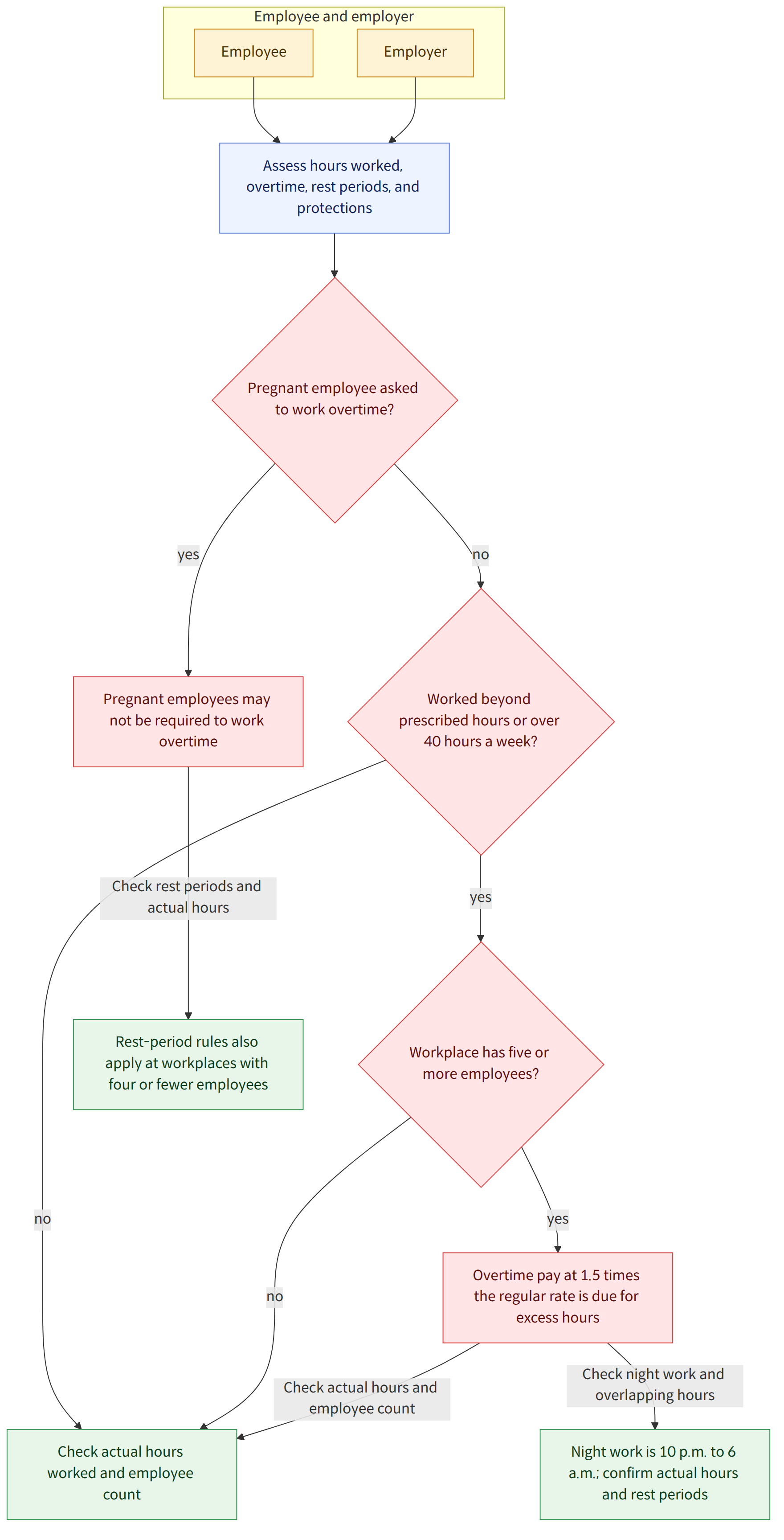
When assessing working hours, distinguish actual hours worked from rest periods and check whether overtime pay is due. The example states that the rest-period provisions also apply to workplaces with four or fewer employees, and that pregnant employees may not be required to work overtime.
At a glance
Key points
- The monthly standard working hours of 209 include weekly holiday hours. The example explains that working eight hours a day, five days a week, meets the actual working-hour requirement.
- If you work more than 40 hours a week, you may be entitled to additional overtime pay at a workplace with five or more employees.
- Even when you work beyond your prescribed working hours, the example states that pay at 1.5 times the regular rate is due for those hours at a workplace with five or more employees.
- The rest-period provisions of the Labor Standards Act apply to workplaces that regularly employ four or fewer employees (Labor Standards Act, Articles 11(2) and 54 (근로기준법 제11조 제2항, 제54조)).
- The example explains that pregnant employees may not be required to work overtime. It states that night work and holiday work may be permitted in certain cases with authorization from the Ministry of Employment and Labor.
- A woman who has not yet passed the first year after childbirth may be required to work overtime, but even if a collective agreement exists, the overtime may not exceed two hours a day, six hours a week, or 150 hours a year (Labor Standards Act, Article 71 (근로기준법 제71조)).
- The period from 10 p.m. to 6 a.m. is the night-work period. If overtime and night work overlap, pay must be calculated after confirming the actual working hours and rest periods (Labor Standards Act, Article 70 (근로기준법 제70조)).
Frequently asked questions
Q. Am I entitled to a rest period after working four hours at a workplace with four or fewer employees?
Yes. According to the example, the rest-period provisions of Article 54 of the Labor Standards Act (근로기준법 제54조) also apply to workplaces that regularly employ four or fewer workers. Therefore, even if you work at a small café, you may be entitled to rest periods under these provisions.
Q. Does a monthly working-hour figure of 209 hours mean that I have to actually work 209 hours?
No. The example explains that the 209 hours include weekly holiday hours. It states that the actual working hours are met by working eight hours a day, five days a week.
Q. Can I receive additional pay if I work more than 40 hours a week?
According to the example, if you work more than 40 hours a week at a workplace with five or more employees, you should be entitled to additional overtime pay. You should check your actual working hours and the number of employees at the workplace, among other things.
Q. I worked standby duty beyond the hours specified in my contract. Can I claim additional pay?
If you work beyond your prescribed working hours, the example explains that, at a workplace with five or more employees, pay at 1.5 times the regular rate is due for the excess hours. However, as the example notes regarding standby duty, if the overtime is very limited, it may be difficult to obtain recognition for it in practice, and the amount at stake may be small.
Q. How is pay calculated when overtime and night work overlap?
The calculation in the example assumes eight regular hours, 13 overtime hours, and seven night-work hours, and calculates pay by applying the relevant premium portions to the hourly wage. However, because the calculation is based on assumptions about rest periods and when night work begins, the actual amount must be calculated after confirming the actual hours worked.
Q. I am pregnant. Do I have to work overtime because of my company's circumstances?
The example states that overtime work by a pregnant employee is prohibited without exception. It explains that night work and holiday work may be permitted in some cases with authorization from the Ministry of Employment and Labor, but these should be distinguished from overtime work.
Q. How much overtime may an employee who has not yet passed the first year after childbirth work?
According to the example, a woman who has not yet passed the first year after childbirth may not be required to work overtime exceeding two hours a day, six hours a week, or 150 hours a year, even if a collective agreement exists (Labor Standards Act, Article 71 (근로기준법 제71조)).
Relevant laws
- Labor Standards Act, Article 11(2) (근로기준법 제11조 제2항)
- Labor Standards Act, Article 54 (근로기준법 제54조)
- Labor Standards Act, Article 65 (근로기준법 제65조)
- Labor Standards Act, Article 70 (근로기준법 제70조)
- Labor Standards Act, Article 71 (근로기준법 제71조)
- Labor Standards Act, Article 74 (근로기준법 제74조)
Watch out for
- Some examples concerning overtime pay specify that they apply to workplaces with five or more employees, so you should check the size of the workplace.
- Rest periods and actual working hours may differ, so check and distinguish attendance records, standby hours, and the time during which you were actually able to rest.
- The pay calculation examples are based on assumptions about working hours and rest periods, so their amounts should not be applied as-is to every type of work arrangement.
- The explanations of the law in the examples are based on the consultation cases presented; for an individual matter, the actual work arrangement and applicable conditions must be considered.
Source cases
This guide was compiled by AI from the following Korea Legal Aid Corporation consultation cases (in Korean).
This guide is general legal information about Korean law, not legal advice for your situation. For a specific case, consult a lawyer or the Korea Legal Aid Corporation (call 132 in Korea).