
Essential Guide to Other Labor and Employment Issues
Based on 26 consultation cases · Updated · Translated from the Korean original.
As a general rule, an unfavorable amendment to the rules of employment requires the consent of the group of workers, and whether consent is required and who is covered may vary depending on when the amendment was made and the circumstances of the group of workers. Wages during industrial action, disciplinary action, collective bargaining, and violations of working conditions must also be assessed in light of the specific circumstances and procedures.
At a glance
Key points
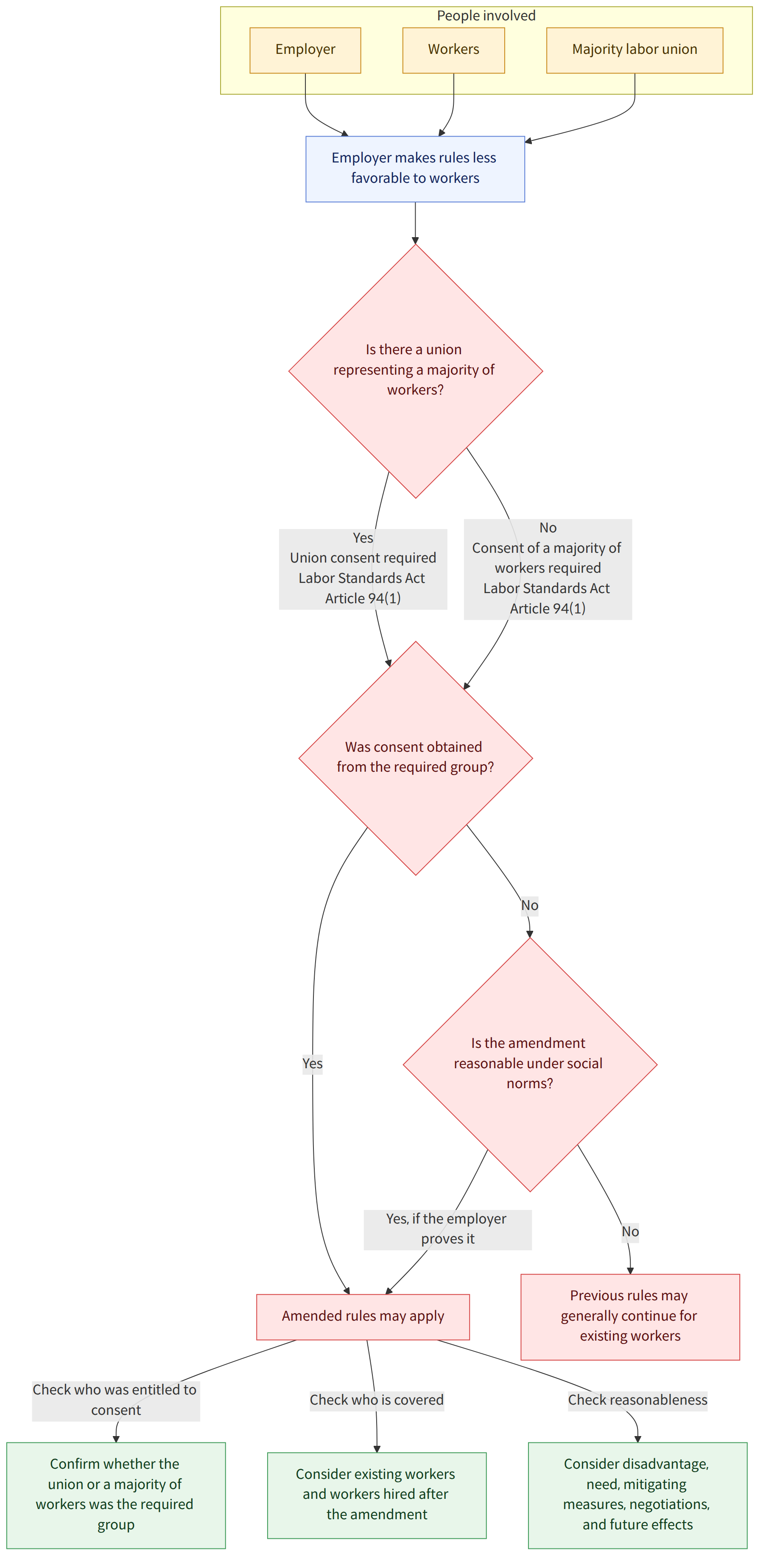
- To amend the rules of employment to the disadvantage of workers, the consent of the labor union is required if there is a labor union representing a majority of the workers; if there is no such union, the consent of a majority of the workers is required (Labor Standards Act, Article 94(1) (근로기준법 제94조 제1항)).
- If the consent required for an unfavorable amendment is not obtained, the previous rules of employment may generally continue to apply to existing workers, while the amended rules may apply to workers hired after the amendment (Cases 1 and 3).
- If there is a labor union representing a majority of the workers, the union chair may consent on behalf of the union unless there are special circumstances; separate consent from a majority of the union members is not necessarily required (Case 3).
- Whether an amendment to the rules of employment is reasonable in light of social norms is assessed by considering the extent of the disadvantage, the need for the amendment, any mitigating measures, and the course of negotiations between labor and management, among other factors. Even if the amendment applied to only some workers when made, it must also be considered whether other workers could foreseeably be disadvantaged in the future (Cases 7 and 24).
- During legitimate industrial action, workers generally cannot claim wages for work they did not perform. For a slowdown, the extent of any wage reduction is assessed based on the proportion of work not actually performed; according to the cases, workers also cannot claim wages for paid holidays falling within a strike period (Cases 6 and 21).
- A lockout must be legitimate as a countermeasure or defensive measure against industrial action by workers. If a lockout is not legitimate, the employer cannot avoid its obligation to pay wages for that period (Case 5).
- Industrial action must generally be led by a labor union, and independent work obstruction by some union members may not be recognized as legitimate union activity. Using replacement workers to perform work interrupted by industrial action may be unlawful even if they were hired before the action (Cases 8 and 15).
- It is stated that if the working conditions specified in an employment contract differ from the actual conditions, the worker may claim damages or terminate the employment contract (Labor Standards Act, Article 17 (근로기준법 제17조); Labor Standards Act, Article 19 (근로기준법 제19조)).
Frequently asked questions
Q. Can a company apply unfavorable changes to working conditions, such as severance pay, without consent?
As a general rule, an unfavorable amendment requires the consent of a labor union representing a majority of the workers or a majority of the workers. If consent is not obtained, the previous rules may continue to apply to existing workers, while the amended rules may apply to workers hired after the amendment.
Q. Is consent to an amendment of the rules of employment invalid if the company holds an information session and collects consent forms?
The fact that the company held an information session or explained the amendments does not, by itself, invalidate the consent. What matters is whether workers had an opportunity to exchange views freely among themselves and whether the employer undermined collective decision-making, for example by coercing consent.
Q. Can an amendment to the rules of employment apply without workers’ consent if it is reasonable?
According to the cases, there is precedent holding that an amendment may not be denied effect solely because consent was not obtained if, in light of all the circumstances—including the need for and content of the amendment and the extent of the disadvantages to workers—it is reasonable in light of social norms. However, the company must assert and prove that the amendment is reasonable, and the workers covered and any future disadvantages must also be considered.
Q. Can workers receive wages and paid-holiday pay during a strike or slowdown?
According to the cases, workers generally have no claim to wages for a strike period, including paid holidays falling within that period. A slowdown involves the partial provision of labor, so the extent of any wage reduction is assessed based on the specific proportion of work not actually performed.
Q. If a company imposes a lockout, are workers unable to receive wages for that period?
If a lockout is lawful, the employer may have no obligation to pay wages to the affected workers. However, if the lockout is not found to be legitimate as a defensive measure against industrial action by workers, the company cannot avoid its obligation to pay wages for the lockout period.
Q. If a company hired replacement workers before a strike, can it deploy them during the strike?
According to the cases, even if replacement workers were hired before a strike, hiring them to perform the work of workers participating in industrial action and actually assigning that work to them during the strike may violate the law. Whether the hiring was lawful is not determined solely by when the replacements were hired.
Q. Can a company automatically retire an employee who receives a suspended sentence?
In the precedent cited in the cases, the phrase “when sentenced to imprisonment or a heavier punishment” was interpreted narrowly to mean a sentence of imprisonment without suspension. Therefore, it cannot be assumed that a suspended sentence alone justifies automatic retirement; the other provisions of the rules of employment and the specific circumstances must be reviewed.
Q. Can I claim damages if I am paid less than the wage stated in my employment contract?
It is stated that if actual working conditions differ from those specified in the employment contract, including wages, the worker may claim damages on the grounds that the working conditions have been violated. The case also explains that the worker may terminate the employment contract immediately.
Q. Can I claim unpaid wages in a Korean court even if I agreed when entering into an employment contract abroad not to sue there?
It is stated that an agreement in an employment contract made before a dispute arises to exclude the international jurisdiction of the courts of the Republic of Korea is invalid. If the matter is substantially connected with the Republic of Korea, a wage claim may be brought in a Korean court.
Relevant laws
- Labor Standards Act, Article 17 (근로기준법 제17조)
- Labor Standards Act, Article 19 (근로기준법 제19조)
- Labor Standards Act, Article 23 (근로기준법 제23조)
- Labor Standards Act, Article 94(1) (근로기준법 제94조 제1항)
- Labor Standards Act, Article 96(1) (근로기준법 제96조 제1항)
- Trade Union and Labor Relations Adjustment Act, Article 37 (노동조합 및 노동관계조정법 제37조)
- Trade Union and Labor Relations Adjustment Act, Article 43 (노동조합 및 노동관계조정법 제43조)
- Trade Union and Labor Relations Adjustment Act, Article 46 (노동조합 및 노동관계조정법 제46조)
- Enforcement Decree of the Trade Union and Labor Relations Adjustment Act, Article 7 (노동조합 및 노동관계조정법 시행령 제7조)
- Act on Private International Law, Article 2(1) (국제사법 제2조 제1항)
- Act on Private International Law, Article 28(5) (국제사법 제28조 제5항)
- Civil Procedure Act, Article 8 (민사소송법 제8조)
- Civil Procedure Act, Article 12 (민사소송법 제12조)
- Constitution of the Republic of Korea, Article 15 (헌법 제15조)
- Constitution of the Republic of Korea, Article 23(1) (헌법 제23조 제1항)
Watch out for
- Whether an amendment to the rules of employment is favorable or unfavorable may be assessed by considering not only the severance-pay rate but also related terms, such as the wage used as the basis for calculating severance pay.
- The effect of an amendment to the rules of employment may vary depending on whether a worker was already employed or was hired after the amendment, whether a collective agreement was concluded, and other factors.
- Wages during a strike or slowdown, the legitimacy of a lockout, and the use of replacement workers must be assessed in light of the specific circumstances, including how the industrial action unfolded and what work was actually performed.
- If the rules of employment are amended between the time the grounds for discipline arise and the time disciplinary proceedings are required, any transitional provisions and circumstances relevant to protecting the worker’s legitimate expectations should be reviewed.
Source cases
This guide was compiled by AI from the following Korea Legal Aid Corporation consultation cases (in Korean).
- 근로자의 동의 없이 변경된 취업규칙의 효력
- 집행유예선고가 당연면직사유인 ‘금고 이상의 형 선고’에 해당되는지
- 근로자에게 불리하게 취업규칙 개정 시 누구의 동의가 필요한지
- 대한민국 법원의 국제재판관할권을 배제하기로 한 약정의 효력
- 직장폐쇄와 임금지급의무
- 쟁의행위기간 중 유급휴일
- 취업규칙의 변경이 사회통념상 합리성이 있는 경우에도 근로자의 동의를 얻어야 하는지 여부
- 일부 조합원에 의한 비공인 쟁의행위
- 징계사유 발생 시와 징계절차 요구 시 사이에 취업규칙이 개정된 경우 징계절차에서 적용할 취업규칙
- 근로자에게 불리하게 취업규칙을 변경할 경우 근로자의 동의를 얻는 방법
- 노동조합전임자에 대하여도 취업규칙 등이 적용되는지
- 정리해고의 쟁위행위 대상성
- 노동조합 산하조직의 쟁위행위
- 근로자들의 동의 없이 취업규칙이 불리하게 변경된 후 노동조합과 사용자가 변경된 취업규칙에 따르기로 단체협약을 체결한 경우
- 쟁의행위 중 신규채용의 제한
- 근로자 일부에게만 적용되는 취업규칙을 작성할 수 있는지 여부
- 단체교섭의 임의적 교섭사항
- 근로자들의 동의를 얻지 못한 취업규칙 변경의 효력
- 근로자에게 불리한 취업규칙의 개정에 노조만이 동의를 한 경우 효력이 있는지 여부
- 인사·경영에 관한 사항의 단체교섭 대상 여부
- 태업과 임금삭감
- 취업규칙에서 규정하고 있는 징계권 발동행위의 한계
- 취업규칙의 법적 성격 및 해석의 원칙
- 팀장 등 간부급 직원을 팀원으로 강등시킬 수 있는 회사 취업규칙을 직원 전원의 동의까지 받아야 하는지 여부
- 근로조건이 사실과 다를 경우 손해배상청구가 가능한지
This guide is general legal information about Korean law, not legal advice for your situation. For a specific case, consult a lawyer or the Korea Legal Aid Corporation (call 132 in Korea).