
Guide to the End of a Lease, Security Deposits, and Demands to Purchase Structures on Land
Based on 61 consultation cases · Updated · Translated from the Korean original.
Whether you can demand the purchase of a building or facility when a lease ends, and whether a leasehold right can be asserted against a new owner, depends on factors such as the purpose of the lease, the reason it ended, and whether registration or resident registration was completed. Whether rent arrears and other amounts may be deducted from the security deposit also depends on how the claim arose and whether the lease has ended.
At a glance
Key points
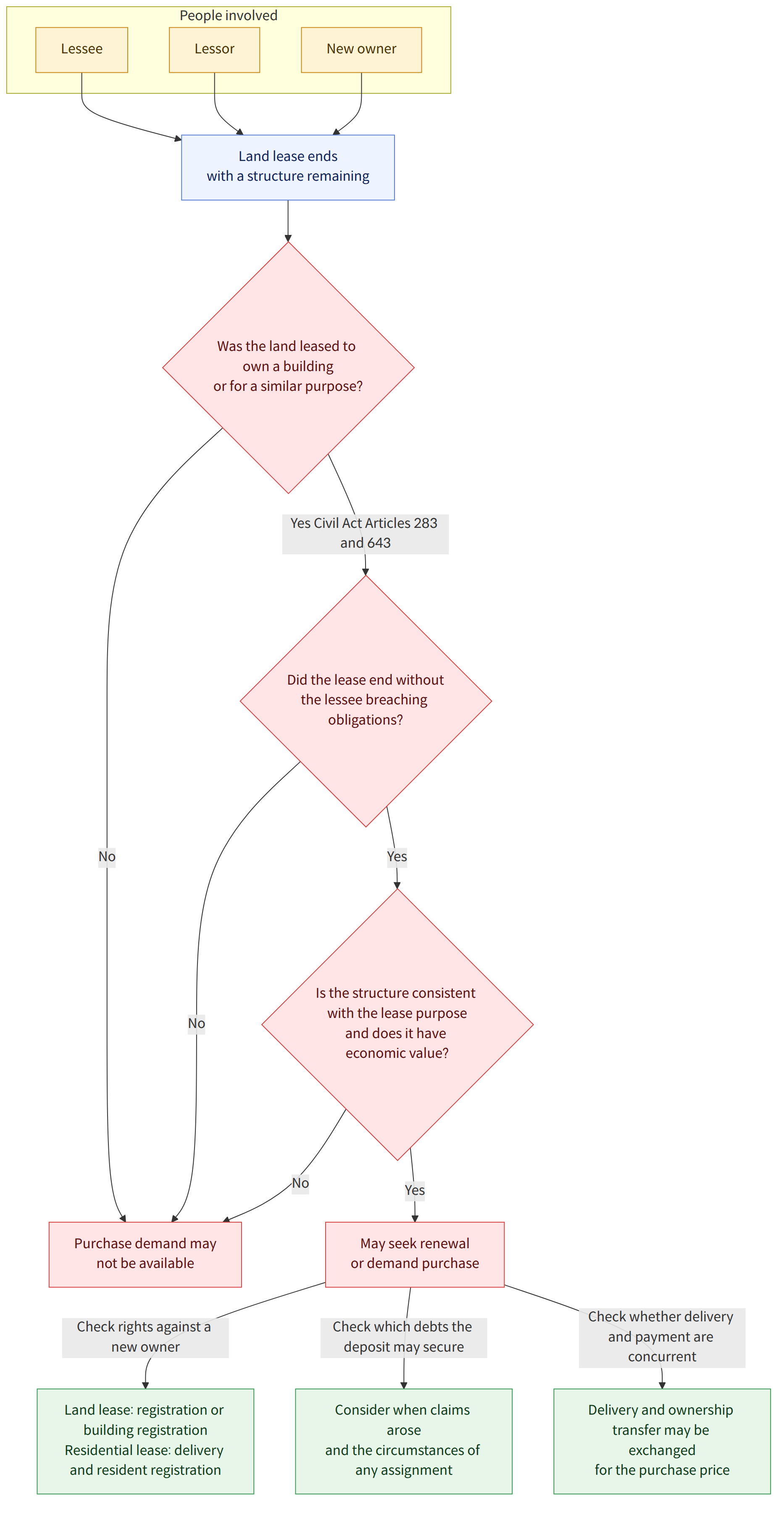
- If you lease land for the purpose of owning a building or for a similar purpose, and the lease ends upon expiration of its term or for another reason while structures remain on the land, you may, if certain requirements are met, demand renewal or demand that the structures be purchased (Civil Act, Articles 283 and 643 (민법 제283조, 제643조)).
- The lessee’s right to demand the purchase of structures on the land may not be recognized if the lease was terminated because of the lessee’s breach of obligations. It may also be restricted if the structures are contrary to the purpose of the lease or lack economic value (Cases 2, 12, and 14).
- If the right to demand the purchase of structures on the land is recognized, the obligations to deliver the building and transfer its ownership and the lessor’s obligation to pay the purchase price may be mutually concurrent obligations (Cases 1 and 2).
- In principle, a land leasehold right must be registered to be asserted against a third party. However, a lease for the purpose of owning a building may be asserted against a third party if the building on the land is registered. If the leasehold right is transferred to another person, the separate issue of the lessor’s consent may arise (Civil Act, Articles 622 and 629 (민법 제622조, 제629조); Cases 3, 6, and 25).
- For commercial building leases, the lessor may terminate the contract if rent arrears amount to two rental periods. The threshold for rent arrears that allows the lessor to refuse a renewal demand must be considered separately (Civil Act, Article 640 (민법 제640조); Case 7).
- A lease security deposit may secure the lessee’s debts that arise up to the return of the leased property after the lease ends. However, who owns rent claims that arose before an assignment, and whether separate costs payable under an agreement may be deducted, depend on the nature of the claim and the circumstances when the assignment was accepted (Cases 9, 10, and 16).
- To assert a residential lease against a third party, the lessee must take delivery of the residence and complete resident registration, which must remain in effect for as long as the right is asserted. However, depending on the circumstances, the right may remain effective if resident registration is restored through the statutory objection procedure after being canceled ex officio (Housing Lease Protection Act, Article 3 (주택임대차보호법 제3조); Cases 17 and 20).
- For a loan for use with no fixed term, whether a sufficient period for use and enjoyment has elapsed is determined by considering the circumstances at the time of the contract, the period and circumstances of use, and the reasons the property needs to be returned (Civil Act, Article 613 (민법 제613조); Case 15).
Frequently asked questions
Q. My land lease has ended. Do I have to demolish the house?
If you lease land for the purpose of owning a building on it and the building remains when the lease ends, such as upon expiration of the contract term, you may demand renewal of the contract. If the lessor does not wish to renew it, you may demand that the structures on the land be purchased. However, the right to demand purchase may not be recognized if the contract was terminated due to the lessee’s breach of obligations.
Q. Can an unauthorized building be subject to a right to demand the purchase of structures on the land?
Even an unauthorized building may be eligible for a purchase demand if it retains economic value when the lease ends. The outcome may differ, however, if there are special circumstances, such as the building having been constructed contrary to the purpose for which the land was leased or being so expensive that the lessor could not reasonably have anticipated it.
Q. Can I still demand that the building be purchased if the lease was terminated because I fell behind on rent?
It is explained that the right to demand the purchase of structures on the land is not recognized when a land lease is terminated because of the lessee’s breach of obligations, such as failure to pay rent. A lease that ends upon expiration of its term must be distinguished from one terminated for breach of obligations.
Q. If I acquire land or a building at auction, do I also acquire the existing leasehold right?
If a mortgage on a building is enforced and ownership of the building passes to the successful auction bidder, the land leasehold right for the purpose of owning the building may also be transferred, barring special circumstances. However, whether the leasehold right can be asserted against the lessor must be assessed separately if it was transferred without the lessor’s consent.
Q. Can the lease be terminated if a commercial tenant falls two months behind on rent?
According to the explanation of the case, Article 640 of the Civil Act also applies to commercial building leases, and the lessor may terminate the contract if the rent arrears amount to two rental periods. The threshold for rent arrears that allows the lessor to refuse a renewal demand must be distinguished from the threshold for terminating the contract.
Q. Can the new building owner deduct rent arrears from the time of the previous owner from the security deposit?
After succeeding to the lessor’s position, the new owner must return the security deposit when the lease ends. Rent arrears that arose while the previous owner was the lessor are not, in principle, transferred to the new owner without a separate assignment of the claim. However, the case-law explanation in the example takes the view that, when the lease ends, those arrears are also deducted from the security deposit unless there are special circumstances.
Q. Can monthly rent for which the limitation period has already expired be deducted from the security deposit?
Rent arrears are not automatically deducted from the security deposit while the lease continues, but it is explained that they may be deducted when the lease ends. Depending on the circumstances, including whether the parties continued the lease despite the arrears, rent for which the limitation period has already expired may also be deducted.
Q. If I continue using the land after the lease ends until I receive the purchase price for the building, do I have to pay rent?
Example 1 addresses whether restitution for unjust enrichment is owed for possession and use after the lessee demands purchase of the structures on the land, but the answer provided ends midway, so its conclusion cannot be confirmed. Accordingly, this example alone does not make it possible to determine whether, or to what extent, a usage fee is payable before the purchase price is paid.
Relevant laws
- Constitution, Article 121 (헌법 제121조)
- Civil Act, Article 163, Subparagraph 1 (민법 제163조 제1호)
- Civil Act, Article 203 (민법 제203조)
- Civil Act, Article 211 (민법 제211조)
- Civil Act, Article 283 (민법 제283조)
- Civil Act, Article 358 (민법 제358조)
- Civil Act, Article 390 (민법 제390조)
- Civil Act, Article 391 (민법 제391조)
- Civil Act, Article 451(1) (민법 제451조 제1항)
- Civil Act, Article 495 (민법 제495조)
- Civil Act, Article 609 (민법 제609조)
- Civil Act, Article 613 (민법 제613조)
- Civil Act, Article 615 (민법 제615조)
- Civil Act, Article 622 (민법 제622조)
- Civil Act, Article 629 (민법 제629조)
Watch out for
- The right to demand the purchase of structures on the land may depend on why the lease ended. First determine whether it ended upon expiration of its term or was terminated because of the lessee’s breach of obligations.
- Whether a land leasehold right can be asserted against a third party depends on whether it was registered. The protection available when the building on the land is registered must also be distinguished from the issue of the lessor’s consent when the leasehold right is transferred.
- The outcome may differ depending on whether the debt is one that may be deducted from the security deposit or is a claim arising under a separate agreement. Particular care is needed when the claim for return of the security deposit has been assigned and the lessor has consented without objection.
- Cases 5 and 13 concern former laws. Do not assume that their content applies unchanged under current law; check the relevant date and whether the law has been amended.
Source cases
This guide was compiled by AI from the following Korea Legal Aid Corporation consultation cases (in Korean).
- 지상물매수대금 지급전까지 계속 점유·사용한 경우 부당이득반환 범위
- 토지임차인에게 인정되는 지상물매수청구권은 어떠한 것인지
- 건물등기 있는 토지임대차에서 건물을 경락받은 자의 대항력 여부
- 임차인의 건물매수청구권을 포기하기로 한 약정이 유효한지
- 구 농지법 제23조가 규정한 예외사유에 해당하지 아니함에도 이를 위반하여 농지를 임대하기로 한 임대차계약의 효력
- 토지가 양도된 경우 등기하지 않은 토지임차권의 보호 여부
- 상가건물 임대차보호법의 적용을 받는 상가건물의 임대차에도 민법 제640조에서 정한 계약해지 규정이 적용되는지 여부
- 수급인의 과실로 인한 임대인의 손해배상책임 여부
- 임차건물의 양수인이 임대차 종료시 임대인의 지위를 승계하기 전까지 발생한 연체차임을 공제하고 보증금을 반환할 수 있는지 여부
- 임대차보증금반환 채권양도시 이의를 보류하지 않고 승낙한 임대인이 임차인과의 약정사항으로 채권양수인에게 대항할 수 있는지 여부
- 토지소유자 변경된 경우 토지임차인의 지상물매수청구권 상대방
- 무허가건물에 대하여도 토지임차인의 매수청구권이 인정되는지
- 구 상가건물 임대차보호법 제10조 제4항에 따른 임대인의 갱신 거절의 정당한 사유가 없는 경우, 임대인의 갱신 거절 통지의 선...
- 토지임대차에서 그 지상 임차인소유 비닐하우스에 대한 매수청구권
- 기간을 정하지 않은 사용대차에서 사용수익에 충분한 기간
- 소멸시효가 완성된 월차임을 보증금에서 공제하고 반환할 수 있는지
- 주택임대차보호법 제3조 제1항 소정의 대항요건으로서의 주민등록의 유효 여부에 관한 판단 기준(2)
- 매수인이 매매 목적물에 관한 임대차보증금 반환채무 등을 인수하면서 그 채무액을 매매대금에서 공제하기로 한 경우, 그 채무인수의...
- 토지임차인이 타인 토지에 걸쳐서 축조한 건물에 대한 매수청구권
- 주택임대차보호법상 대항력을 주장하기 위해 주민등록이 계속 존속하여야 하는지 여부
- 민법 제643조에 따른 임차인의 지상물매수청구권 행사의 상대방이 누구인지
- 임차인의 매수청구권에 관한 약정이 민법 제643조를 위반하는 약정인지에 대한 판단기준
- 임대차기간 중의 해제 해지 의사표시에 어떠한 제한이 따르는 경우, 기간만료로 인한 임대차계약의 종료시에도 적용되는지 여부
- 토지인도 및 건물철거소송에서 패소한 경우의 지상물매수청구권
- 저당권의 효력과 임차권의 포함 여부(1)
This guide is general legal information about Korean law, not legal advice for your situation. For a specific case, consult a lawyer or the Korea Legal Aid Corporation (call 132 in Korea).