
Liens and Pledges: Requirements for Creation and Methods of Enforcement
Based on 44 consultation cases · Updated · Translated from the Korean original.
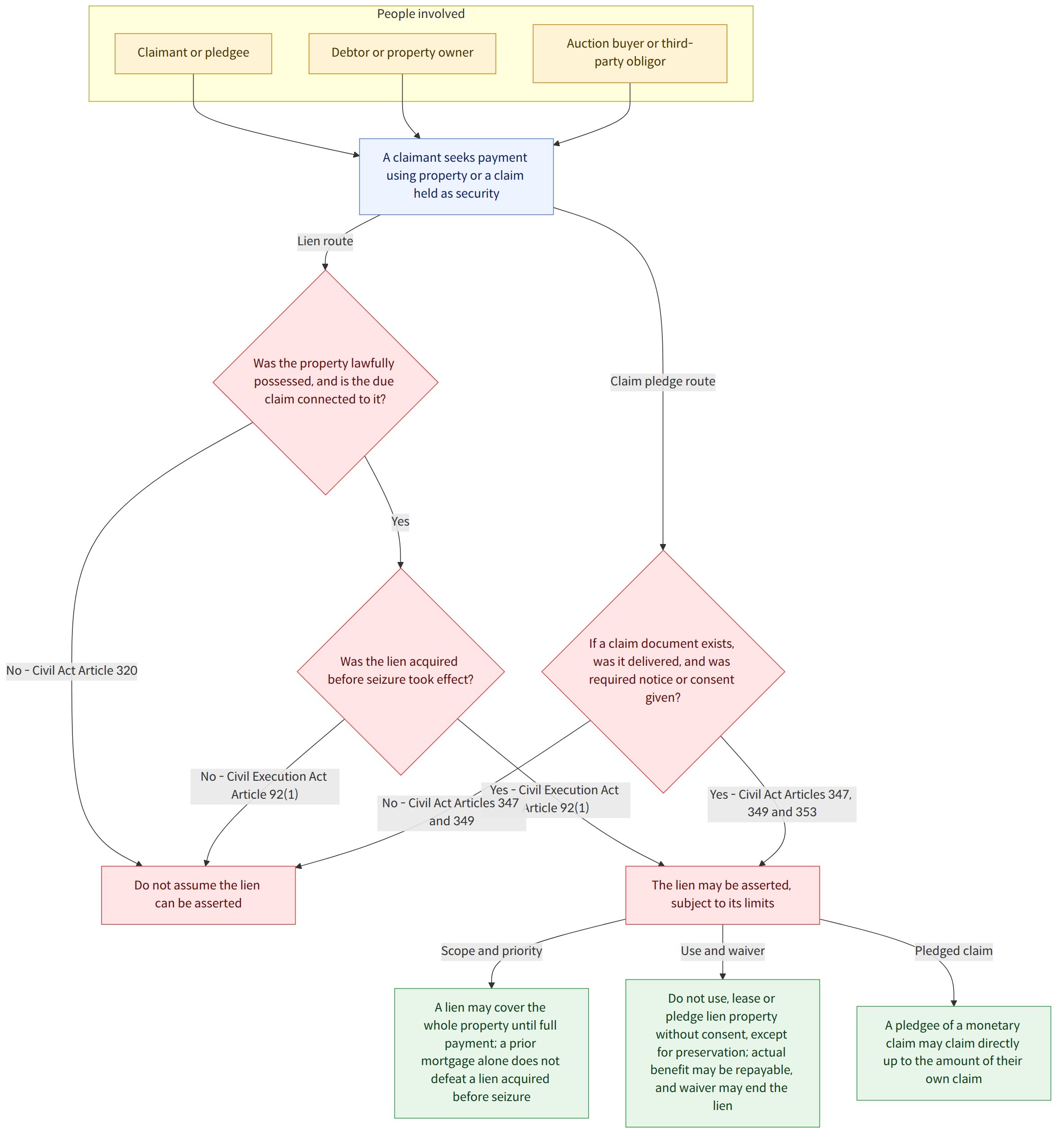
A possessory lien arises when a person lawfully possesses another person’s property and has a due claim relating to that property; the connection between the possession and the claim is important. A pledge requires checking how a right, such as a claim or bearer claim, is pledged as security, the requirements for asserting it against third parties, and how it is enforced.
At a glance
Key points
- A lien arises when a person possesses another person’s property and has a due claim that arose in connection with that property. A lien is not recognized if possession began through an unlawful act (Civil Act, Article 320 (민법 제320조)).
- A claim for the price of construction materials does not become a claim arising in connection with the building itself merely because the materials were used in the building (Case 10).
- There must be a connection between the property subject to the lien and the claim, but a lien is not excluded merely because the claim arose before possession was acquired (Case 18).
- A lienholder may exercise the lien over the entire property until the claim is paid in full. If construction payments are not allocated separately to each property, a property of which only part is possessed may secure the full amount of the claim (Civil Act, Article 321 (민법 제321조); Case 9).
- A lien acquired by taking possession after the seizure takes effect through registration of the entry of the decision to commence an auction is difficult to assert against the auction purchaser. By contrast, a lien acquired before the seizure takes effect is not rendered unenforceable merely because a mortgage was created first (Civil Execution Act, Article 92(1) (민사집행법 제92조 제1항); Cases 4 and 17).
- A lienholder may not use, lease, or provide the property subject to the lien as security without the debtor’s consent, but use necessary for preservation may be permitted. Even lawful use may give rise to liability to return any benefit actually obtained as unjust enrichment (Civil Act, Article 324 (민법 제324조); Cases 13 and 23).
- An agreement to waive a lien is valid, and even if the lienholder continues to possess the property after waiving the lien, exercise of the lien may not be recognized in the absence of another legal basis (Case 20).
- When a pledge is created over a claim, any document evidencing the claim must be delivered to the pledgee, if one exists. A pledge over a claim payable to a named creditor must meet the requirements for asserting it against third parties, such as notice to or consent from the third-party obligor. The pledgee of a monetary claim may claim directly up to the amount of their own claim (Civil Act, Articles 347, 349, and 353 (민법 제347조·제349조·제353조); Case 2).
Frequently asked questions
Q. If I have not been paid for construction work, can I exercise a lien over the building?
The construction payment claim must have arisen in connection with the building, be due, and satisfy other requirements, including lawful possession of the building. The price of materials supplied under a separate materials supply contract does not become a claim in connection with the building merely because the materials were used in it.
Q. Do I have to keep possession continuously from the time the claim arises in order to exercise a lien?
According to the precedent cited in the case, no particular sequence is required between the claim and possession of the property. Even if the claim relating to the property arose before possession of that property was acquired, a lien may be asserted if the other requirements are met.
Q. If I acquire a lien by taking possession after an auction has commenced, can I assert it against the purchaser?
If a lien is acquired by taking possession from the debtor after the seizure takes effect through registration of the entry of the decision to commence an auction, it is difficult to refuse delivery to the auction purchaser by asserting that lien. One case held that whether the person who took possession knew that the auction had commenced does not affect the outcome.
Q. Can a lien arising after a mortgage was created first be asserted against an auction purchaser?
The fact that a mortgage was created first does not, by itself, defeat the lien’s enforceability against others. The case explains that if the lien was acquired before the seizure took effect through registration of the entry of the decision to commence an auction, it may be asserted against the purchaser regardless of when the mortgage was created.
Q. Can a lienholder live in a house or building, or rent it to a third party?
A lienholder may not use or lease the property subject to the lien without the debtor’s consent, but living in a residence may, absent special circumstances, be recognized as use necessary for its preservation. However, if the lienholder actually obtains a benefit from its use, they may be liable to return that benefit as unjust enrichment. If the property is leased to a third party, the specific nature of the benefit actually obtained must be considered.
Q. If I agreed to waive my lien, can I still assert it if I continue to possess the property?
An agreement to waive a lien is valid, and a lien may be extinguished if it is waived afterward. Continuing to possess the property after waiving the lien does not, by itself, revive the lien; without a separate legal basis for possession, the possession may be unauthorized.
Q. Can a contractor exercise a lien if the final payment is withheld because of defects in the construction work?
A claim for repair of defects or a claim for damages in lieu of repair may be subject to simultaneous performance with the construction payment claim. If the amount corresponding to the defects and damages is at least equal to the balance, and the owner of the contracted work has invoked the right to withhold the entire balance until simultaneous performance, the contractor may be unable to exercise a lien if they have not repaired the defects or paid damages.
Q. What procedures are required to create a pledge over a claim for a fixed-term deposit?
If a document evidencing the claim exists, it must be delivered to the pledgee. A pledge over a claim payable to a named creditor may be asserted against third parties only if the third-party obligor is notified of the pledge or consents to it. The case also explains that one way to meet the requirements is to obtain the bank’s consent and then establish a fixed date.
Q. If a pledge is created over a deposit claim, can the pledgee receive the money directly?
If the subject of the pledge is a monetary claim, the pledgee may claim directly from the third-party obligor up to the amount of the pledgee’s own claim. The pledge may also extend to accessory claims, such as damages for delay on the claim that is the subject of the pledge.
Relevant laws
- Civil Act, Article 320 (민법 제320조)
- Civil Act, Article 321 (민법 제321조)
- Civil Act, Article 322(1) (민법 제322조 제1항)
- Civil Act, Article 324(2) (민법 제324조 제2항)
- Civil Act, Article 346 (민법 제346조)
- Civil Act, Article 347 (민법 제347조)
- Civil Act, Article 349 (민법 제349조)
- Civil Act, Article 353(1) and (2) (민법 제353조 제1항·제2항)
- Civil Act, Article 450 (민법 제450조)
- Civil Act, Article 451(1) (민법 제451조 제1항)
- Civil Act, Article 514 (민법 제514조)
- Civil Act, Article 523 (민법 제523조)
- Civil Act, Article 524 (민법 제524조)
- Civil Act, Article 667 (민법 제667조)
- Civil Execution Act, Article 83(4) (민사집행법 제83조 제4항)
Watch out for
- A lien does not arise from possession alone. The connection between the claim and the property, whether the claim is due, and whether possession is lawful must all be considered.
- In an auction, the time when possession was acquired is important. A lien acquired by taking possession after the seizure takes effect through registration of the entry of the decision to commence an auction may be difficult to assert against the purchaser.
- Even if property subject to a lien is lawfully used to the extent necessary for its preservation, the user may be liable to return any benefit obtained as unjust enrichment.
- Do not assume that a pledge over a claim can be asserted against third parties merely because the pledge was created. Check the required steps, including delivery of any document evidencing the claim and notice to or consent from the third-party obligor.
Source cases
This guide was compiled by AI from the following Korea Legal Aid Corporation consultation cases (in Korean).
- 명도단행가처분의 집행으로 집행채무자의 점유가 상실되는지 여부
- 채권질권의 효력범위 및 그 실행방법
- 유치권의 주장, 행사가 신의칙에 반하는 경우
- 근저당권설정 후 경매로 인한 압류의 효력 발생 전에 취득한 유치권으로 경매절차의 매수인에게 대항할 수 있는지 여부
- 유치권의 피담보채권의 소멸시효기간이 확정판결 등에 의하여 10년으로 연장된 경우,유치권이 성립된 부동산의 매수인이 종전의 단기...
- 계약명의신탁자의 매매대금상당 부당이득반환청구권에 기초한 유치권행사
- 유치권에 의한 강제경매
- 근질권이 설정된 금전채권에 대하여 제3자의 압류로 강제집행절차가 개시된 경우,근질권의 피담보채권의 확정 시기
- 유치권의 불가분성
- 유치권의 피담보채권이 되기 위한 요건
- 입질채권의 발생원인인 계약관계에 무효 등의 흠이 있어 입질채권이 부존재하는 경우,제3채무자가 질권자를 상대로 직접 부당이득반환...
- 도급인의 하자보수청구권과 수급인의 유치권 성립시기
- 유치권자의 유치물 사용시, 반환하여야 할 부당이득의 범위
- 유치권자의 신청으로 강제경매절차가 개시된 후 근저당권자에 의하여 임의경매절차가 개시된 경우, 유치권의 소멸 여부
- 건물의 유치권자가 실제로 그 건물을 점유하고 있다면 그 건물의 부지를 점유하는 자로 볼 수 있는지 여부
- 매도인의 대금채권에 기한 유치권 행사 가부
- 경매개시결정 기입등기 후, 해당 부동산의 점유를 이전받아 건물과 관련된 채권을 취득한 사람이 유치권을 행사할 수 있는지 여부
- 유치물 점유 전에 발생한 채권을 유치권의 피담보채권으로 삼을 수 있는지 여부
- 질권의 목적이 된 무기명채권을 실행함에 있어 청구할 수 있는 금액
- 유치권 포기 특약의 유효 여부
- 유치권 행사 요건으로서의 ‘점유’의 의미
- 유치물의 점유·보관을 위탁받은 자가 소유권자의 반환청구를 거부할 수 있는지 여부
- 유치권자의 유치물 사용 가부 및 배상여부
- 적법점유의 입증책임
- 질권설정계약의 해지와 제3자에 대한 대항력
This guide is general legal information about Korean law, not legal advice for your situation. For a specific case, consult a lawyer or the Korea Legal Aid Corporation (call 132 in Korea).