
Guide to Legal Acts by Persons with Limited Capacity and the Guardianship System
Based on 36 consultation cases · Updated · Translated from the Korean original.
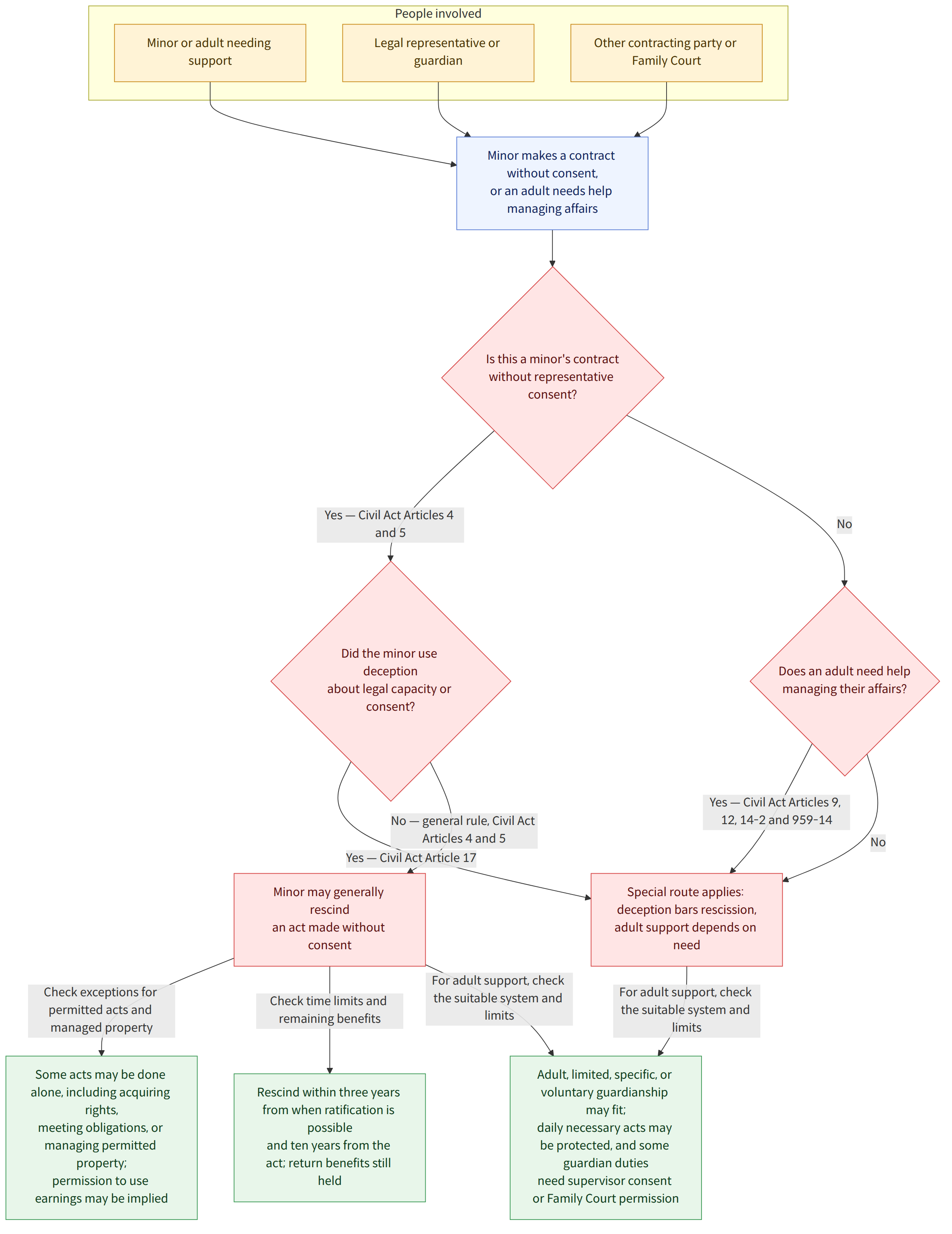
As a general rule, a contract made by a minor without the consent of a legal representative may be rescinded. However, rescission may be restricted in cases such as where the minor used deception to make the other party believe the minor was an adult or had consent. The protection available to an adult depends on the circumstances and may take the form of adult guardianship, limited guardianship, specific guardianship, or voluntary guardianship. The scope of each system and whether court permission is required should be considered.
At a glance
Key points
- According to the standard explained in the example, a minor under the age of 19 may, as a general rule, rescind a legal act performed without the consent of a legal representative (Civil Act, Articles 4 and 5 (민법 제4조, 제5조)).
- Exceptions allow a minor to act alone, including acts that merely acquire rights or release the minor from obligations, and disposal of property the minor was permitted to manage. A contract may also be valid if permission to dispose of the minor’s own earnings is found to have been implied (Civil Act, Articles 5 and 6 (민법 제5조, 제6조); Supreme Court Decision 2005Da71659, November 16, 2007 (대법원 2007. 11. 16. 선고 2005다71659 판결)).
- A legal act cannot be rescinded if the minor used deception to make the other party believe the minor had legal capacity or had the consent of the legal representative (Civil Act, Article 17 (민법 제17조)).
- The right to rescind must be exercised within three years from the date on which the contract can be ratified and within ten years from the date on which the legal act was performed (Civil Act, Article 146 (민법 제146조)). Even if the contract is rescinded, a person with limited capacity may be liable to return benefits received to the extent those benefits still exist (Civil Act, Article 141 (민법 제141조)).
- Adult guardianship is for a person who continuously lacks the ability to manage their affairs; limited guardianship is for a person whose ability is diminished; and specific guardianship is for a person who needs help temporarily or with specific matters. Voluntary guardianship involves making a guardianship agreement in advance (Civil Act, Articles 9, 12, 14-2, and 959-14 (민법 제9조, 제12조, 제14조의2, 제959조의14)).
- Even after adult guardianship begins, acts necessary for daily life and involving no excessive consideration cannot be rescinded. The court may also specify the scope of acts that cannot be rescinded (Civil Act, Article 10 (민법 제10조)).
- Depending on the guardianship duties involved, a guardian may need the consent of a supervisor of guardianship or permission from the Family Court. For example, the Family Court’s permission is required to isolate an adult ward in a psychiatric hospital or elsewhere (Civil Act, Articles 947-2 and 950 (민법 제947조의2, 제950조)).
Frequently asked questions
Q. Can a minor rescind a purchase made without parental consent?
As a general rule, a contract entered into without the consent of a legal representative may be rescinded. There are exceptions, such as disposing of property that the minor was permitted to manage. In addition, a contract may be valid if permission to dispose of actual earnings is found to have been implied. The circumstances in which the contract was made and the nature of the money used should therefore be examined.
Q. Can a minor rescind a contract even after falsely claiming to be an adult?
If a minor deceives the other party into believing that the minor is an adult, the contract cannot be rescinded. Rescission may also be restricted if the minor deceived the other party into believing that the legal representative had consented.
Q. If a minor’s contract is rescinded, does the minor have to return none of the purchase price?
As a general rule, a rescinded contract is treated as void from the beginning. However, a person with limited capacity may be liable to return benefits received under the contract to the extent those benefits still exist. A court decision is cited as holding that, in a credit-card transaction, a benefit equivalent to the price of the goods may be presumed to remain.
Q. Until when can a contract made as a minor be rescinded after reaching adulthood?
The time limits described in the example are three years from the date on which the contract can be ratified and ten years from the date on which the legal act was performed. You should confirm when the person reached adulthood and when the contract was made. If an order for payment or a limitation period is at issue, the date the order became final and any subsequent proceedings should also be examined separately.
Q. Can a guardian provide help only with a particular contract or task?
Yes. Specific guardianship is described as a system for adults who need temporary support or assistance with specific matters, and it does not restrict the person’s capacity to act.
Q. Can an adult guardian admit the person to a psychiatric hospital?
A Family Court’s permission is required to isolate an adult ward in a psychiatric hospital or elsewhere for treatment or other purposes. A guardian therefore cannot isolate the person without following the required procedure simply because they are the guardian.
Q. Do I need to be a lawyer or judicial scrivener to become a guardian?
According to the example, a professional qualification such as that of a lawyer or judicial scrivener is not required to become a guardian. However, there may be statutory grounds for disqualification, and preparation may be needed to perform guardianship duties appropriately.
Q. When does a voluntary guardianship agreement take effect?
A guardianship agreement must be made as a notarized deed, and it takes effect when the Family Court appoints a supervisor of voluntary guardianship. The agreement does not take effect as soon as it is made.
Q. Can a contract be rescinded if the person has an intellectual disability?
The fact that a person has a disability does not, by itself, establish that a contract can be rescinded. In the example, the issue was whether, at the time of contracting, the person lacked the mental capacity to understand the legal meaning and effect of the contract. A court decision finding a lack of such capacity in a similar case is cited.
Relevant laws
- Civil Act, Article 4 (민법 제4조)
- Civil Act, Article 5 (민법 제5조)
- Civil Act, Article 6 (민법 제6조)
- Civil Act, Article 9 (민법 제9조)
- Civil Act, Article 10 (민법 제10조)
- Civil Act, Article 12 (민법 제12조)
- Civil Act, Article 14-2 (민법 제14조의2)
- Civil Act, Article 17 (민법 제17조)
- Civil Act, Article 140 (민법 제140조)
- Civil Act, Article 141 (민법 제141조)
- Civil Act, Article 146 (민법 제146조)
- Civil Act, Article 163, subparagraph 6 (민법 제163조 제6호)
- Civil Act, Article 928 (민법 제928조)
- Civil Act, Article 946 (민법 제946조)
- Civil Act, Article 947-2 (민법 제947조의2)
Watch out for
- The period for exercising the right to rescind is calculated separately from the date on which the contract can be ratified and from the date on which the legal act was performed. Confirm the contract date, the date the person reached adulthood, and other relevant dates.
- Even if a contract is rescinded, the person may have to return benefits that still exist. Do not assume that rescission alone resolves all issues concerning payment.
- If enforcement based on an order for payment or a limitation period is at issue, the result may depend on when the order became final and on the applicable laws.
- The scope of protection and the manner in which it ends differ among the types of guardianship. A guardian may need the consent of a supervisor of guardianship or permission from the Family Court for certain acts.
Source cases
This guide was compiled by AI from the following Korea Legal Aid Corporation consultation cases (in Korean).
- 미성년자의 법률행위를 성인이 된 후 취소할 수 있는 기간
- 미성년자 단독으로 책을 할부구입한 때 이를 취소할 수 있는지
- 미성년자가 사술로써 상대방으로 하여금 성년자로 믿게 하고 한 의사표시의 취소 가부
- 후견계약과 한정후견개시심판 청구
- 성년후견제도 선택시 고려사항
- 후견사무의 범위
- 피성년후견인과 정신병원
- 미성년 자녀가 신용카드계약을 체결하여 물건을 구입한 경우 취소가능여부
- 성년후견의 종류
- 성년후견제도의 의의
- 특정후견인의 의견충돌
- 후견등기사항증명서의 내용
- 성년후견의 불복
- 한정후견인 결격사유
- 후견계약 체결
- 미성년후견 종료
- 특정후견제도
- 후견인의 자격
- 성년후견의 범위
- 성년후견인과 성년후견감독인
- 미성년후견인의 감독 범위
- 후견제도의 종류
- 후견등기제도
- 의사능력이 없는 사례
- 미성년자의 신용구매계약의 유효성
This guide is general legal information about Korean law, not legal advice for your situation. For a specific case, consult a lawyer or the Korea Legal Aid Corporation (call 132 in Korea).