
Guide to Contractual Loans, Interest, and Claims for Repayment
Based on 23 consultation cases · Updated · Translated from the Korean original.
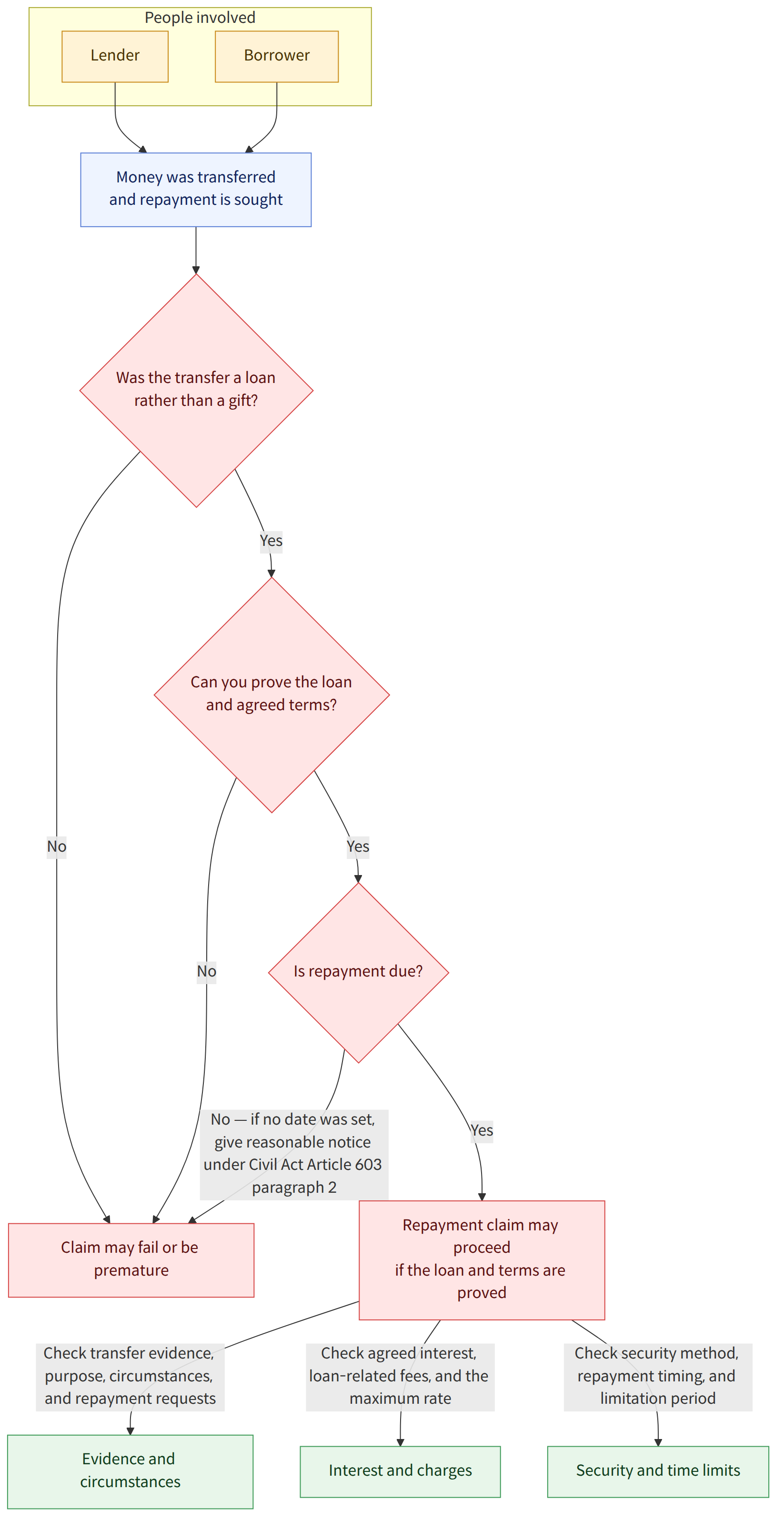
To claim repayment of a loan, you must prove that the money was lent and establish the agreed terms, and you should consider the repayment date and limitation period. Even where interest has been agreed or security provided, the scope of a claim may vary depending on the maximum interest rate, the method used to create the security, and the actual purpose of the contract.
At a glance
Key points
- Whether an agreement is a loan or an investment is not determined solely by the title of the contract. Its nature is determined by considering the wording, the circumstances in which it was made, the parties’ purposes, and other relevant factors.
- For a loan with no repayment date set, you may claim repayment after first setting and giving notice of a reasonable period. For a civil loan with no interest agreement, you generally cannot claim agreed interest, but the commercial interest rate may apply to a loan made by a merchant for business purposes (Civil Act, Article 603(2) (민법 제603조 제2항); Commercial Act, Article 55(1) and Article 47 (상법 제55조 제1항·제47조)).
- Money received by a loan business in connection with a loan—including fees, notarization costs, or advance interest—may be treated as interest regardless of what it is called. Interest exceeding the maximum interest rate may be invalid or applied toward the principal. The applicable interest rate depends on the contract date and type of loan (Act on Registration of Loan Businesses and Protection of Finance Users, Articles 8, 4, and 5 (대부업 등의 등록 및 금융이용자 보호에 관한 법률 제8조, 제4조·제5조); Enforcement Decree of the same Act, Article 5 (같은 법 시행령 제5조)).
- A loan must be proven not only through a loan document or agreement but also through evidence such as the circumstances in which the money was transferred. Depending on the circumstances, a transfer or payment of living expenses between romantic partners may be found to be a gift rather than a loan.
- To secure repayment, you may consider creating appropriate security, such as a mortgage, or obtaining a notarial deed that constitutes an enforceable title. Merely taking and keeping possession of a vehicle may not create a pledge or lien.
- If, through no fault of your own, you cannot identify the creditor or the person entitled to receive payment, you may discharge the debt by depositing the payment with the court (Civil Act, Article 487 (민법 제487조)).
- The limitation period may vary depending on the nature of the claim. Even after the period has expired, circumstances such as the debtor’s acknowledgment of the debt or partial repayment may result in a finding that the debtor waived the benefit of the limitation period (Civil Act, Article 162(1) (민법 제162조 제1항); Commercial Act, Article 64 (상법 제64조)).
- If the debtor does not actually intend to reside in the home and merely creates the appearance of a lease to recover a loan, priority repayment may not be recognized under the Housing Lease Protection Act.
Frequently asked questions
Q. If I lent someone money without setting a repayment date or interest, when can I get it back?
If no repayment date was set, you may demand repayment after first setting and giving notice of a reasonable period for repayment. For a civil loan, you generally cannot claim agreed interest if no interest was agreed, but you may claim damages for delay after the repayment date has passed.
Q. I paid a loan business a fee or notarization costs. Are these included as interest?
Money received in connection with a loan may be treated as interest if it can be regarded as consideration, whatever it is called, including a fee or notarization cost. If the principal actually received was reduced by advance interest or similar deductions, the interest rate and any excess payment should be calculated based on the amount actually received.
Q. Can I recover money I sent to my romantic partner as a loan after we break up?
The fact that money was transferred does not, by itself, establish that it was a loan. Whether it was a loan or a gift is determined by considering all relevant circumstances, including whether the loan document is authentic, the circumstances and purpose of the transfer, and when repayment was requested.
Q. Can I keep possession of a vehicle given as security until the loan is repaid?
In the case discussed, the court did not recognize the creation of a pledge by placing the vehicle in someone’s possession, and it did not recognize a lien over the vehicle based solely on the loan claim. If you want to secure a loan with a vehicle, you should consider an appropriate procedure, such as creating a mortgage over the vehicle.
Q. What should I do if it is unclear whom I should repay?
If, through an assignment or attachment of the claim, you cannot identify the creditor or the person entitled to receive payment through no fault of your own, you may deposit the payment with the court on the ground that the creditor is unknown. The case explains that the creditors concerned may be designated as the persons entitled to receive the deposit, and that the loan principal and interest, together with damages for delay through the date of deposit, may be deposited.
Q. When does the limitation period for a loan claim expire, and what happens if I make a partial repayment?
According to the cases, the limitation period may be 10 years for ordinary civil claims and, in the absence of a separate provision, 5 years for claims arising from commercial activities. If a debtor makes a partial payment after the limitation period has expired, the debtor may, absent special circumstances, be found to have acknowledged the entire debt and waived the benefit of the limitation period.
Q. Does a guarantee liability end if a new loan agreement is made to extend the repayment date?
If no funds actually change hands and an existing debt is repaid on the books using a new loan, that refinancing may, absent special circumstances, be treated as an extension of the repayment date for the existing debt. In that case, the guarantee liability may generally continue as well.
Q. Can I obtain priority repayment by taking security in the form of a home lease instead of a loan?
Even if a lease is made and the tenant completes resident registration and obtains a fixed date, the tenant may not be protected as a small-sum tenant if the principal purpose was to recover the loan in priority rather than to use and enjoy the home. The actual purpose of the contract matters more than its form.
Relevant laws
- Civil Act, Article 107 (민법 제107조)
- Civil Act, Article 108 (민법 제108조)
- Civil Act, Article 162(1) (민법 제162조 제1항)
- Civil Act, Article 320(1) (민법 제320조 제1항)
- Civil Act, Article 356 (민법 제356조)
- Civil Act, Article 379 (민법 제379조)
- Civil Act, Article 397 (민법 제397조)
- Civil Act, Article 487 (민법 제487조)
- Civil Act, Article 603(2) (민법 제603조 제2항)
- Civil Act, Article 607 (민법 제607조)
- Civil Act, Article 608 (민법 제608조)
- Civil Act, Article 746 (민법 제746조)
- Commercial Act, Article 3 (상법 제3조)
- Commercial Act, Article 47(1) and (2) (상법 제47조 제1항·제2항)
- Commercial Act, Article 55(1) (상법 제55조 제1항)
Watch out for
- The maximum interest rate mentioned in the cases concerning interest limits is based on the contract date and laws applicable in those cases. Rather than applying it automatically to a current contract, check the contract date and type of loan.
- You cannot assume that a creditor may fill in blank spaces in a loan document or notarial deed at the creditor’s discretion. Check the authority to complete the document and the specific terms agreed, and make sure in particular that the interest rate and repayment date are clear.
- The mere fact that security was provided does not create a right to priority repayment or a right to possession. Check the contract and any required procedures, such as registration or recordation, that apply to the type of security.
- Whether the limitation period has expired may depend on the nature of the claim and subsequent circumstances, such as repayment or acknowledgment of the debt. Before making a payment or responding to foreclosure proceedings, check the relevant documents and the course of events.
Related articles
Source cases
This guide was compiled by AI from the following Korea Legal Aid Corporation consultation cases (in Korean).
- 의사가 아닌 자가 의사에게 의료사업자금명목으로 1억원을 대여한 것이 의료법을 위반한 것으로서 무효인지 여부
- 대부업자로부터 금전을 대차할 때 할인금·수수료·공제금·선이자 등의 명목으로 차주로부터 금전을 징수한 경우, 채무자 보호를 위한...
- 건물 매매잔대금을 소비대차의 목적물로 한 준소비대차계약에 있어서 그 차용금에 대한 이자지급청구가 그 준소비대차계약 체결 경위 ...
- 연인사이에 교제 중 지급한 금원에 대해 이별 후 반환청구 가능여부
- 금전거래에 있어서 확실한 이행확보방법은 어떤 것이 있는지
- 주채무자의 차용금채무를 보증할 의사로 공정증서에 연대보증인으로 서명·날인하였으나 그 공정증서가 주채무자의 기존의 구상금채무 등...
- 상인인 주식회사와 함께 금원을 차용한 비상인에게도 상법 제64조의 상사시효가 적용되는지 여부
- 대여금계약 체결 시 대여금반환을 담보할 목적으로 인도받은 차량에 저당권을 설정하지 않은 경우 대주의 점유할 권리
- 채권자 또는 변제수령권자가 누구인지 알 수 없는 경우의 변제방법(변제공탁)
- 소멸시효가 완성된 채무를 피담보채권으로 하는 근저당권이 실행되어 채무자 소유의 부동산이 경락되고 그 대금이 배당되어 채무의 일...
- 채권자가 채무자의 대리인으로서 채무 금액이나 이율,변제기 등 일부 백지상태의 위임장을 보충하여 금전소비대차계약 공정증서의 작성...
- 대여금채권을 회수하기 위해 채무자와 가장임대차계약을 체결하는 방식의 담보효과
- 대출금 채무자로서 명의를 빌려준 자의 법적책임
- 대부업법상 최고이자율을 초과하는 이자약정의 효력 및 이미 지급한 이자를 부당이득으로 반환받을 수 있는지 여부
- 대여금계역의 목적이나 내용이 위법한 경우 대여금을 불법원인급여로 보아 반환을 청구할 수 없는지 여부.
- 변제기와 이자를 약정하지 않은 대여금
- 대여금반환청구와 소멸시효
- 대환의 경우 기존 채무에 대한 보증책임이 존속하는지 여부
- 주식회사가 타인으로부터 돈을 빌리는 소비대차계약을 체결하면서 차용금액의 일부 또는 전부를 액면가에 따라 주식으로 전환할 수 있...
- 준소비대차계약에 기하여 대물변제의 약정을 한 경우, 민법 제607조 , 제608조 의 적용 여부
- 예금계약의 당사자
- 변제기 후의 이자약정(지연손해금)이 없는 경우 당사자의 의사해석방법
- 이자제한법상 최고이자율을 초과한 금전소비대차
This guide is general legal information about Korean law, not legal advice for your situation. For a specific case, consult a lawyer or the Korea Legal Aid Corporation (call 132 in Korea).