
Mandate Agreement Guide: Duties, Fees, Termination, and Damages
Based on 40 consultation cases · Updated · Translated from the Korean original.
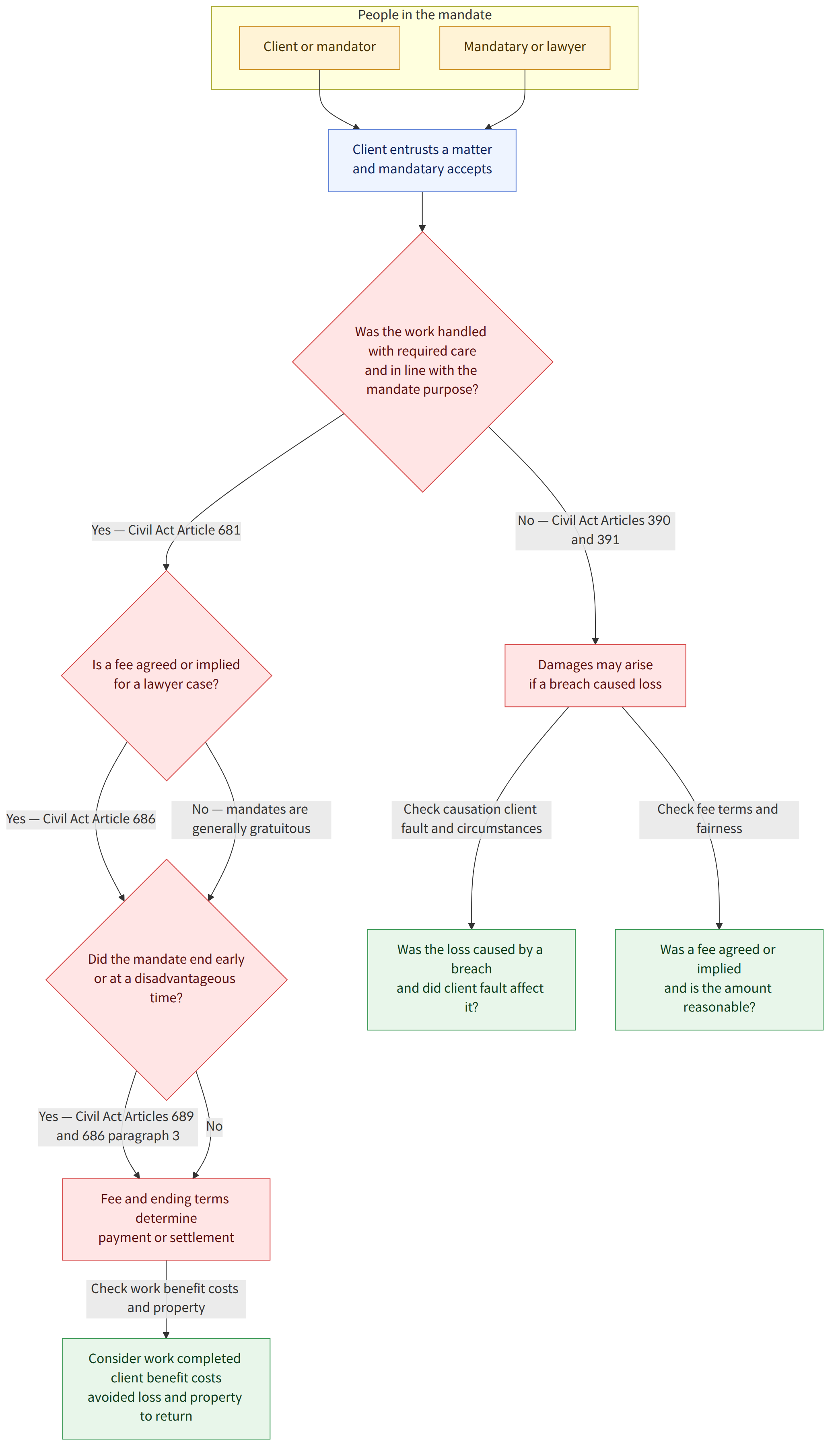
The terms of a mandate agreement are determined by the parties’ agreement, and the mandatary must handle the matter with the care of a good manager, in accordance with the purpose of the mandate. Whether fees are payable and whether termination or damages are justified must be assessed by considering the agreed terms, how the work was actually handled, and the circumstances in which the agreement ended.
At a glance
Key points
- A mandate is formed when one party entrusts the handling of a matter to the other and the other party accepts. The mandatary must handle the work with the care of a good manager, in accordance with the mandate’s purpose (Civil Act, Articles 680 and 681 (민법 제680조, 제681조)).
- The mandatary’s duties may go beyond simply carrying out the procedures requested. In professional work, the mandatary may be required to explain and advise or take measures to protect the client’s rights if an unfavorable outcome is foreseeable or a choice needs to be made (Examples 4, 7, and 18).
- If the mandatary breaches the duty of care and causes loss, liability for damages may arise. However, the causal connection between the loss and the breach, any fault on the client’s part, and other specific circumstances must also be considered (Civil Act, Articles 390 and 391 (민법 제390조, 제391조); Examples 2, 5, 10, and 20).
- A mandate is generally a gratuitous contract, so an agreement is required to claim a fee. However, when a lawyer is retained for a case, an implied fee agreement may be recognized unless there are special circumstances, such as an agreement to work without compensation. The amount may take into account the complexity of the case, the effort involved, and the benefit obtained by the client (Civil Act, Article 686 (민법 제686조); Example 16).
- The agreed fee may generally be claimed. However, if it is unreasonably excessive in light of special circumstances, it may be limited to a reasonable amount under the principles of good faith or fairness (Examples 14 and 16).
- Either party may terminate a mandate agreement at any time. However, if a party terminates it without unavoidable cause at a time disadvantageous to the other party, that party may have to compensate for loss that could have been avoided by terminating at an appropriate time (Civil Act, Article 689 (민법 제689조); Examples 17 and 25).
- If the agreement ends before completion, the advance fee is not necessarily always returned in full or automatically retained by the mandatary. The parties may settle the amount by considering the extent of the work already performed, the effort involved, the benefit obtained by the client, and the costs of the work (Civil Act, Article 686, Paragraph 3 (민법 제686조 제3항); Examples 9 and 11).
- The mandatary must deliver to the mandator any money or property received in handling the mandated matter. Benefits obtained in a manner that undermines the relationship of trust underlying the mandate may also be subject to return (Civil Act, Article 684 (민법 제684조); Example 23).
Frequently asked questions
Q. Can I recover damages if my lawyer misses the appeal deadline or fails to tell me that an appeal is possible?
If the appeal deadline is missed, the mandatary may have breached the duty of care of a good manager. Even where the mandatary did not advise the client to appeal, the mandatary may have been required to explain the judgment and the likelihood of success on appeal. Whether compensation is actually payable, and in what amount, depends on factors such as the benefit that could have been obtained through an appeal and the causal connection between the breach and the loss.
Q. Does the mandatary have to tell me about important risks related to the work I entrusted to them?
If, while carrying out the work, it becomes apparent that the client’s instructions may lead to an unfavorable result or that measures are needed to protect the client’s rights, the mandatary may be required to explain the situation, give advice, or take appropriate measures. The scope of the specific duty depends on the work entrusted and on the circumstances that were known or foreseeable at the time.
Q. If we did not agree on a fee in advance, do I have to pay the full amount the lawyer demands?
When a lawyer is retained for a case, an implied fee agreement may be recognized unless there are special circumstances, such as an agreement to work without compensation. Even so, the amount claimed is not automatically accepted in full. Its reasonableness may be disputed by considering the circumstances and complexity of the case, the effort involved in handling it, and the benefit obtained by the client.
Q. Can I get back the advance fee I already paid if the mandate agreement ends partway through?
An advance fee may serve not only to cover the costs of handling the work but also as an advance payment of part of the fee. It is therefore difficult to conclude that it must be returned in full or is automatically retained in full just because the contract has ended. The parties may settle the amount by considering the work actually performed, the effort involved, the client’s benefit, and the expenses. A reasonable fee may also be recognized when the mandatary’s efforts lead to a settlement outside court.
Q. Do I have to pay damages to the other party if I terminate a mandate agreement?
As a general rule, a mandate may be terminated at any time, and the fact alone that the termination causes the other party a loss does not create liability for damages. However, if the mandate is terminated without unavoidable cause at a time that is disadvantageous to the other party, the terminating party may have to compensate for loss that could have been avoided by terminating at an appropriate time.
Q. Is a success-fee agreement in a criminal case, conditional on release or a suspended sentence, valid?
The Supreme Court en banc decision cited in the example held that agreements for success fees in criminal cases entered into after that decision are void for violating Article 103 of the Civil Act (민법 제103조). The example explains that an agreement entered into before the decision cannot necessarily be deemed void solely because of that decision.
Q. If the mandatary sells entrusted real estate for a low price, is it enough to return only the money actually received?
It is not necessarily sufficient to return only the actual sale proceeds received. In the example, the court held that, in light of the terms of the mandate and the circumstances of the transaction, the mandatary had to return to the mandator an amount equivalent to the fair market value.
Q. If the lawyer in charge leaves the firm, can the original law firm claim part of the success fee?
In the example, the law firm was held responsible for ending the contract where the relationship of trust had broken down because the client had not been adequately informed that the responsible lawyer was leaving the firm or of the firm’s response. The firm could not claim a success fee calculated according to the proportion of work already completed. In practice, both the contract terms and the circumstances in which it ended must be considered.
Relevant laws
- Civil Act, Article 103 (민법 제103조)
- Civil Act, Article 390 (민법 제390조)
- Civil Act, Article 391 (민법 제391조)
- Civil Act, Article 680 (민법 제680조)
- Civil Act, Article 681 (민법 제681조)
- Civil Act, Article 684 (민법 제684조)
- Civil Act, Article 686 (민법 제686조)
- Civil Act, Article 689 (민법 제689조)
- Civil Act, Article 690 (민법 제690조)
- Civil Act, Article 691 (민법 제691조)
- Civil Act, Article 746 (민법 제746조)
- Civil Procedure Act, Article 89 (민사소송법 제89조)
- Civil Procedure Act, Article 90 (민사소송법 제90조)
- Civil Procedure Act, Article 268 (민사소송법 제268조)
- Certified Judicial Scrivener Act, Article 30 (법무사법 제30조)
Watch out for
- The fact that a mandatary has authority to represent a party in litigation does not, by itself, mean that the mandatary is contractually required to take every action within the scope of that authority. The actual duty must be determined in light of the mandate agreement and the specific circumstances.
- If a mandate agreement ends before completion, fees and expenses may be settled according to the extent of the work performed. It is best not to assume as a rule that the entire advance fee must be returned or that the entire success fee is payable.
- A claim for damages involves not only a breach of duty but also the resulting loss and the causal connection between them. If the client was at fault in causing or increasing the loss, that may be taken into account in determining the amount of damages.
- A mandate agreement may be terminated because it is based on a relationship of trust between the parties. However, terminating it without unavoidable cause at a time disadvantageous to the other party may give rise to liability for damages.
Source cases
This guide was compiled by AI from the following Korea Legal Aid Corporation consultation cases (in Korean).
- 처분금지가처분의 필요성을 설명하지 않은 수임변호사의 책임
- 법무사 사무원이 채무자의 잘못된 말만 듣고 관련서류를 반환한 경우
- 임기만료 된 이사 등 퇴임이사의 긴급처리권
- 법무사의 등기신청 위임자에 대한 권리보호의무의 정도
- 수임변호사가 실수로 항소기간을 넘긴 경우 손해배상액 산정방법
- 쌍방 불출석으로 취하간주 되어도 약정한 성공보수금을 지급해야 하는지
- 아파트관리회사와 아파트입주자대표회의 사이의 법률관계
- 유료주차장에 도둑이 들어 주차된 차량이 도난당한 경우 주차장 책임
- 소송위임계약이 중도에 종료하거나 소제기가 불필요하게 된 경우 착수금의 반환
- 부동산중개업자의 주의의무
- 법률사무소에서 소송을 담당하던 변호사가 중간에 이직하여 법률사무소와의 위임계약을 해지한 경우 성공보수금을 지급하여야 하는지 여...
- 의사의 연명치료중단이 허용되는지 여부
- 연명치료 중단과 위임계약의 종료 여부
- 위임계약의 약정 보수액이 과다한 경우
- 지입계약 당사자들이 정한 지입계약의 해지사유 해석 방법
- 명시적 약정 없는 경우의 변호사보수는 어떻게 결정되는지
- 인수합병
- 위임사무처리의무
- 형사사건의 성공보수
- 공인중개사가 중개 사무를 해태하여 손해가 발생한 경우 손해배상 청구가 가능한지 여부
- 민법상 법인의 대표가 사임 후 후임 대표가 선출되지 않은 상태에서 위 법인을 대표한 행위의 효력
- 콘도와 공유제 회원 간의 법률관계가 위임에 해당하는지
- 매도를 위임받은 수임인의 반환 범위
- 투자일임계약에 의하여 고객의 자산을 관리하는 투자자문회사가 고객에 대하여 부담하는 선관주의의무의 내용
- 위임계약 해지의 자유 및 상대방이 불리한 시기에 해지 제한의 의미
This guide is general legal information about Korean law, not legal advice for your situation. For a specific case, consult a lawyer or the Korea Legal Aid Corporation (call 132 in Korea).