
Guide to the Formation, Nullity, and Annulment of Marriage
Based on 66 consultation cases · Updated · Translated from the Korean original.
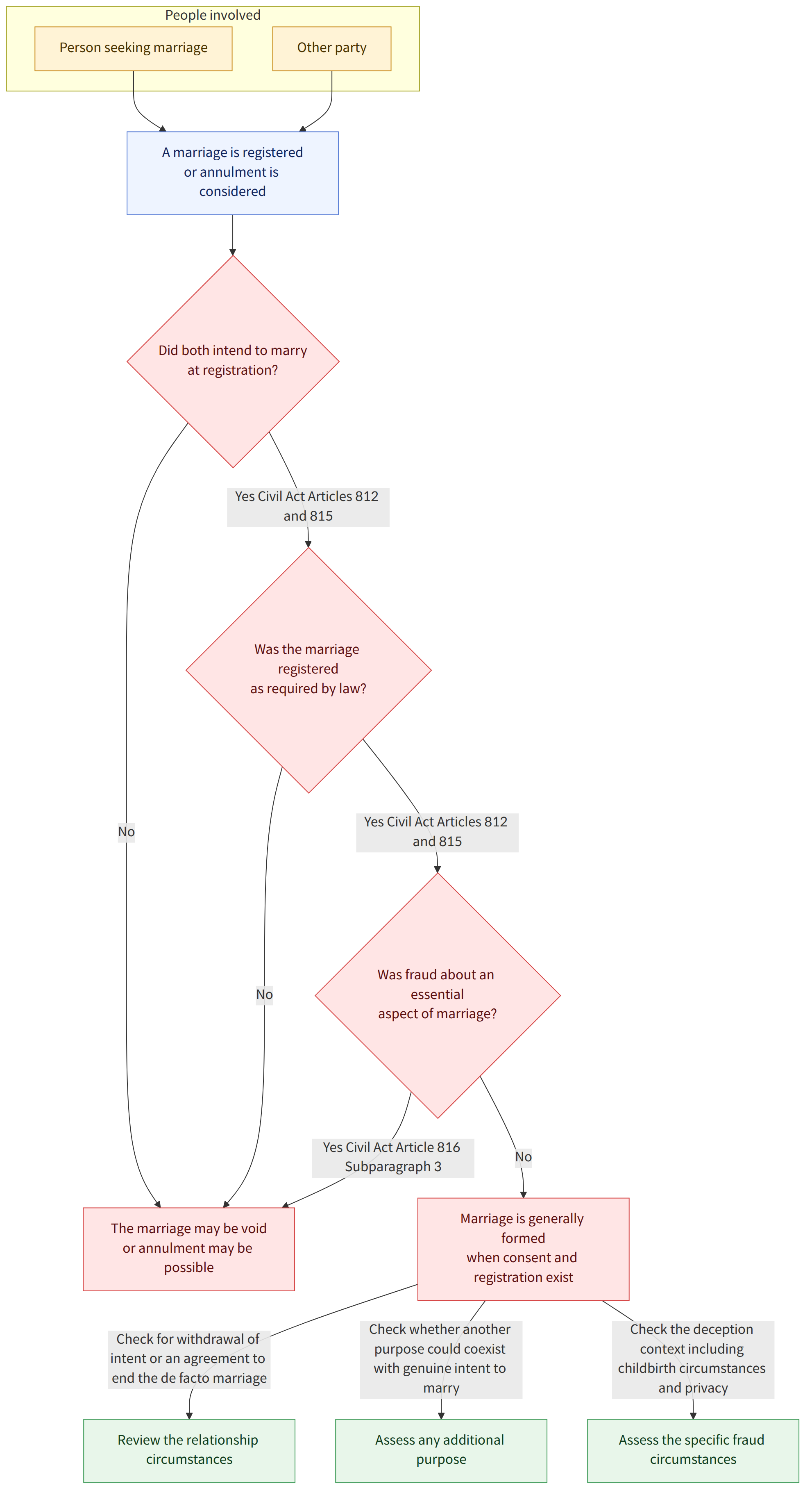
A marriage is formed when the parties agree to enter into a legal marriage and register it as required by law. If there was no intention to marry when the marriage was registered, it may be void. Even where grounds for annulment, such as fraud, exist, the specific circumstances and statutory requirements must be considered.
At a glance
Key points
- The essential requirements for forming a marriage are the parties' agreement to marry and registration of the marriage as prescribed by law (Civil Act, Articles 812 and 815 (민법 제812조, 제815조)).
- The intention to marry must exist at the time the marriage is registered. Even if the parties previously held a wedding ceremony and lived together, the marriage may be void if one party secretly registered it after they had already agreed to end their de facto marriage (Supreme Court Decision 94Meu1089, June 28, 1996; Supreme Court Decision 86Meu41, July 22, 1986).
- If one party registers a marriage while the parties are in a de facto marital relationship, the other party's intention to marry may be presumed from the circumstances in which the de facto marriage was formed if that intention is unclear. Whether the other party clearly withdrew that intention or the parties agreed to end the de facto marriage is among the circumstances considered (Supreme Court Decision 99Meu1329, April 11, 2000).
- The fact that the parties also had a purpose unrelated to marriage, such as obtaining residence status, does not automatically make the marriage a sham marriage and therefore void. What matters is whether that purpose was incompatible with a genuine intention to marry (Seoul Northern District Court Decision 2008No1702, February 19, 2009).
- Annulment for fraud is not established by mere exaggeration or silence. It is necessary to consider whether the deception concerned an essential aspect of marriage and examine the specific circumstances, including the circumstances of a past childbirth and the need to protect privacy (Civil Act, Article 816, Subparagraph 3 (민법 제816조 제3호); Supreme Court Decisions 2015Meu654 and 2015Meu661, February 18, 2016).
- Even when a foreign national and a Korean national marry in Korea, whether the marriage is valid is determined by examining the law of each party's home country and the law governing the form of marriage. The form of a marriage between a Korean national and a foreign national in Korea is governed by Korean law (Private International Law Act, Article 36, Paragraphs 1 and 2 (국제사법 제36조 제1항·제2항)).
- It is difficult to seek a declaration that a marriage already ended by divorce by agreement was void solely because the entry of divorce in the family relations register is burdensome. The issue is whether there is an interest in obtaining the declaration, such as a direct effect on a current legal relationship (Supreme Court Decision 82Meu67, February 28, 1984).
- A claim to annul a bigamous marriage is not immediately barred solely because the right was not exercised for a long time. However, depending on the specific circumstances, it may not be allowed as an abuse of rights (Supreme Court Decision 92Meu907, August 24, 1993).
Frequently asked questions
Q. If we had a wedding ceremony and lived together but did not register the marriage, are we legally married?
If the marriage was not registered, the wedding ceremony and cohabitation alone do not create a legally recognized marriage. However, the relationship may be recognized as a de facto marriage if there was an intention to marry and the substance of married life together.
Q. Can a marriage be declared void if my former partner secretly registered it after we broke up?
If the two parties did not agree to marry when the marriage was registered, you may seek a declaration that the marriage is void. Whether you had already withdrawn your intention to marry or agreed to end the de facto marriage before the other party registered the marriage without your consent is important to the decision.
Q. Is a marriage void if one purpose at the time of registration was to obtain a residence status?
A marriage is not automatically void merely because the parties also had a purpose unrelated to marriage. It is necessary to consider whether that purpose was so inconsistent with a genuine intention to maintain the marriage for life that the two could not coexist.
Q. Can I have my marriage annulled if my spouse did not disclose a past childbirth?
The fact that a spouse did not disclose a past childbirth does not, by itself, automatically constitute grounds for annulment. The duty to disclose and whether it was breached are assessed in light of all the circumstances, including the circumstances of the childbirth, the relationship with the child, responsibilities for the child's care and support, and the impact on privacy and reputation.
Q. Can I have my marriage annulled if I discover that my spouse lied about their property?
When a spouse lies about property or financial means, it is important to determine whether the deception concerned an essential aspect of marriage. The specific circumstances must be examined to determine whether, for example, an affirmative false statement caused a mistake so significant that the marriage would not otherwise have taken place. Annulment cannot be assumed to be available based on mere exaggeration.
Q. Does having sexual relations after filing an annulment action ratify the marriage?
Having sexual relations after filing an action for annulment does not, by itself, mean that the marriage's validity has been ratified. Whether there was ratification depends on the specific circumstances, including whether the person expressed an intention to maintain the marriage while aware of the grounds for annulment.
Q. Can I have the divorce entry in the family relations register removed by claiming that a marriage ended by divorce by agreement was void?
It is difficult to seek a declaration that a marriage already dissolved is void solely because an entry of divorce in the register is burdensome. It is important to determine whether there is a legally cognizable interest in obtaining the declaration, such as a direct and significant effect on a current legal relationship.
Q. Can a claim to annul a bigamous marriage no longer be brought after a long time has passed?
According to the case, a claim to annul a bigamous marriage cannot be said to be extinguished solely because the right was not exercised for a long time. However, the claim may not be allowed if, in the specific circumstances, it amounts to an abuse of rights.
Relevant laws
- Civil Act, Article 812 (민법 제812조)
- Civil Act, Article 815 (민법 제815조)
- Civil Act, Article 816, Subparagraph 3 (민법 제816조 제3호)
- Civil Act, Articles 819 through 823 (민법 제819조 내지 제823조)
- Private International Law Act, Article 36, Paragraphs 1 and 2 (국제사법 제36조 제1항·제2항)
- Act on Registration of Family Relations, Article 104 (가족관계의 등록 등에 관한 법률 제104조)
- Act on Registration of Family Relations, Article 107 (가족관계의 등록 등에 관한 법률 제107조)
- Enforcement Decree of the Immigration Control Act, Article 12 and Annex 1 (출입국관리법 시행령 제12조 별표 1)
Watch out for
- The fact that a marriage was registered does not always conclusively establish its validity. It is necessary to consider whether there was an intention and agreement to marry at the time of registration.
- To claim that a past marriage was void, you must establish a current legal interest, not merely a desire to restore your reputation or remove an entry from the register.
- Whether fraud or a breach of a duty to disclose occurred may depend on the facts. You should carefully consider what was concealed and how it affected the decision to marry.
Source cases
This guide was compiled by AI from the following Korea Legal Aid Corporation consultation cases (in Korean).
- 외국인과의 사실혼 부당파기에 따른 손해배상청구권
- 사실혼관계를 일방적으로 파기한 자에 대한 손해배상청구권
- 당사자 쌍방의 자유의사에 의하지 아니한 혼인신고의 효력
- 이혼경력의 말소를 위하여 혼인무효확인청구를 할 수 있는지
- 법률상 배우자가 제3자와 부부생활을 하는 경우 사실혼으로 볼 수 있는지
- 동성(同性) 간의 사실혼관계가 성립가능한지 여부
- 교직원연금 수령을 위한 과거 사실혼관계존재확인청구권
- 사실혼 부당파기로 인한 손해배상청구권의 소멸시효 기산점
- 사실혼 부부의 재산분할시 취득세 특례세율이 적용되는지
- 사망한 사실혼배우자 명의 재산에 대한 공유지분권 청구방법
- 상처한 형부와 사실혼 관계인 처제가 유족연금을 지급받을 수 있는지
- 사실혼 관계가 3개월만에 파탄된 경우 결혼·예물비를 돌려받을 수 있는지
- 신혼여행 직후부터 혼인신고 없이 파탄된 경우 손해배상청구권
- 법률혼배우자의 장기 가출 중 발생한 동거관계도 사실혼인지
- 자동차보험금 수령을 위한 과거 사실혼관계존재확인청구권
- 사실혼관계에 있는 처에 대한 증여의 효과
- 혼인에서의 상대방에 대한 고지의무
- 중혼에 대한 취소청구권의 행사가부
- 사실혼 배우자에게 상속권이 인정되는지 여부
- 혼인 외의 목적을 가진 혼인의 유효성
- 아내가 남편 병원비를 위해 돈을 빌린 경우 남편의 법적책임
- 혼인 성립 여부의 판단 기준
- 부부 간의 재산약정
- 사기로 혼인을 취소하는 경우 및 그 추인
- 채무를 갚지 않는 지인과 사실혼 관계에 있는 처의 재산에 강제집행이 가능한지
This guide is general legal information about Korean law, not legal advice for your situation. For a specific case, consult a lawyer or the Korea Legal Aid Corporation (call 132 in Korea).