
Medical Malpractice Damages: Liability and Claim Standards
Based on 28 consultation cases · Updated · Translated from the Korean original.
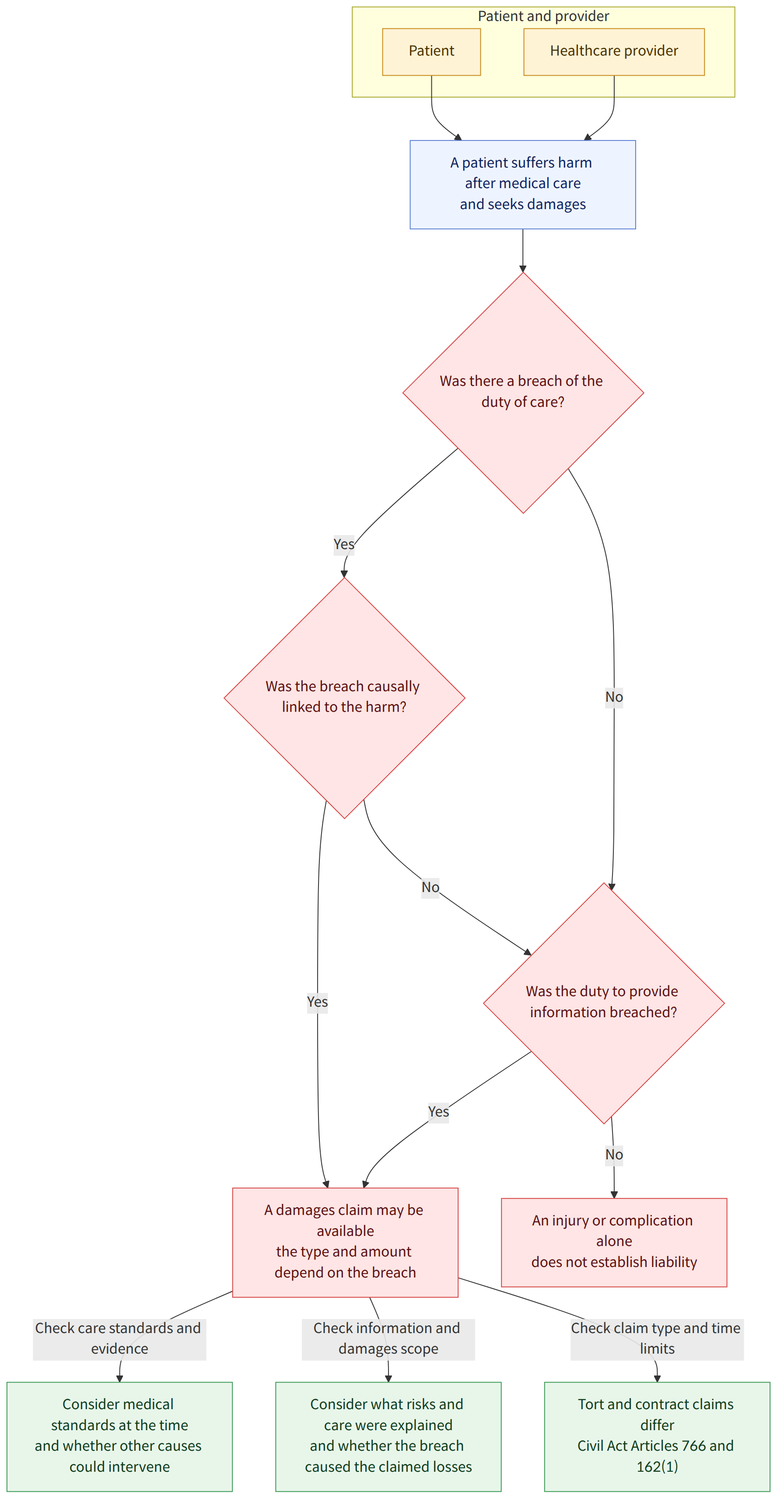
The mere occurrence of a medical injury does not establish that the hospital or healthcare provider is liable for damages. The specific circumstances must be examined, including whether there was a causal relationship between a breach of the duty of care and the harm, and whether the duty to provide information was breached. The burden of proof and scope of damages vary depending on the case.
At a glance
Key points
- To claim damages, the healthcare provider’s intent or negligence and a causal relationship with the harm are generally at issue. When proof is difficult because of the specialized nature of medical care, the burden of proof may be eased by allowing causation to be presumed if circumstances are established showing negligence in the course of medical care and that no other cause could have intervened (Cases 1 and 3).
- The occurrence of a complication or permanent aftereffect does not, by itself, give rise to a presumption of medical malpractice. It is necessary to consider whether the complication could have occurred despite the taking of the best possible measures under the medical standards at the time, and whether it fell outside the generally accepted range (Case 24).
- Healthcare providers may have duties not only to provide medical care and perform surgery, but also to protect patient safety, give instructions on post-treatment care and how to address aftereffects, and explain or recommend necessary tests or measures if a condition is suspected during treatment (Cases 5, 7, and 14).
- The duty to provide information requires informing the patient of necessary risks and the nature of the medical care so that the patient can make a meaningful decision about whether to undergo treatment. Failure to provide information does not entitle the patient to compensation for all property losses. A claim for all losses raises issues such as whether there was a causal relationship between the breach of that duty and the outcome (Cases 9, 12, and 17).
- Unless special circumstances apply, the healthcare provider must prove that the duty to provide information was fulfilled. An explanation given by the attending physician or another doctor, rather than the physician performing the procedure, may also be accepted unless special circumstances apply (Cases 22 and 23).
- A tort claim for damages arising from a medical injury and a claim for damages for breach of obligations under a medical treatment contract may have different legal bases and limitation periods. It is therefore necessary to consider which type of liability to assert. The cases describe the limitation period for a tort claim as three years from the date the claimant knew of the harm and the person who caused it, and ten years from the date of the tort; they describe the period for a claim for breach of contract as ten years (Civil Act, Articles 766 and 162(1); Case 2).
- Even factors for which the victim is not at fault, such as a physical predisposition or disease-related risk, may be considered in determining the amount of damages on grounds of fairness if they contributed to the occurrence or worsening of the harm (Cases 3 and 19).
- If bodily function has been irreversibly impaired due to medical malpractice and treatment thereafter is continued only to address aftereffects or prevent deterioration, the cases state that the hospital cannot charge for that treatment (Case 25).
Frequently asked questions
Q. If my treatment outcome was poor, can I receive compensation for medical malpractice?
The fact that an adverse outcome occurred does not, by itself, establish liability. The issue is whether there was a causal relationship between a healthcare provider’s breach of the duty of care and the harm, which is assessed based on the nature of the medical treatment, medical records, and other evidence.
Q. Does the patient have to prove medical malpractice directly?
Because of the specialized nature of medical care, proving medical malpractice and causation can be difficult. However, the burden of proof may be eased by allowing causation to be presumed if circumstances are established showing negligence based on common knowledge and that no other cause could have intervened.
Q. If I develop a complication after surgery, can I claim compensation from the hospital?
The occurrence of a complication does not, by itself, give rise to a presumption of negligence. It is important to determine whether the complication could have occurred despite the taking of the best possible measures, and whether it fell outside the usual range in light of the medical standards at the time and the procedure performed.
Q. If the doctor did not explain the risks or side effects of treatment, can I receive compensation for all my losses?
A claim for consolation money for the infringement of a patient’s right to self-determination due to a failure to provide information is distinct from a claim for all losses resulting from the outcome. To claim property losses and other damages, issues include whether the failure to provide information was equivalent to a breach of the duty of care in the specific course of treatment, and whether there was a causal relationship between that breach and the outcome.
Q. Who has to prove that the doctor fulfilled the duty to provide information?
Unless special circumstances apply, the healthcare provider must prove that the duty to provide information was fulfilled. One reason given is that the information provided should be documented and preserved.
Q. Can I claim damages from the hospital as well as the doctor who treated me?
The cases explain that, if the healthcare provider is found negligent, the provider and the hospital director, as the provider’s employer, may be held liable for damages. Whether a particular person can be held liable depends on the facts, including the healthcare provider’s status and the hospital’s operational arrangements.
Q. Does filing a criminal complaint start the limitation period for a medical injury damages claim?
The limitation period for a tort claim for damages does not necessarily begin merely when a criminal complaint is filed. The cases explain that determining when the period begins involves whether the claimant knew that the harm resulted from the medical treatment and that it was wrongful and negligent.
Q. Can my compensation be reduced if I had a pre-existing condition or physical predisposition?
Even a pre-existing physical predisposition or disease-related risk that is not the victim’s fault may be considered when calculating damages if it contributed to the occurrence or worsening of the harm and requiring the defendant to compensate the entire loss would be inequitable.
Q. Can I claim again for new treatment costs that arise after a damages judgment becomes final?
An additional claim may be possible if special circumstances apply, such as when new harm arises that could not have been foreseen when the proceedings in the earlier action concluded, and the claimant cannot be regarded as having waived the claim for that harm. In the case discussed, treatment costs that became newly necessary because the person lived longer than expected were treated as separate losses.
Relevant laws
- Civil Act, Article 750 (민법 제750조)
- Civil Act, Article 766 (민법 제766조)
- Civil Act, Article 162(1) (민법 제162조 제1항)
- Framework Act on Health and Medical Services, Article 3(3) (보건의료기본법 제3조 제3호)
- Framework Act on Health and Medical Services, Article 5(1) (보건의료기본법 제5조 제1항)
- Act on Medical Technicians, etc., Article 2(2)2 (의료기사 등에 관한 법률 제2조 제2항 제2호)
- Act on Medical Technicians, etc., Article 4(1) (의료기사 등에 관한 법률 제4조 제1항)
- Medical Service Act, Article 24 (의료법 제24조)
- Mother and Child Health Act, Article 14(1)1 (모자보건법 제14조 제1항 제1호)
- Enforcement Decree of the Mother and Child Health Act, Article 15(2) (모자보건법 시행령 제15조 제2항)
- Emergency Medical Service Act, Article 9 (응급의료에 관한 법률 제9조)
- Enforcement Rule of the Emergency Medical Service Act, Article 3 (응급의료에 관한 법률 시행규칙 제3조)
Watch out for
- Do not assume that negligence or causation is automatically established simply because of the outcome of a medical injury. Review specific evidence, including medical records and the course of treatment.
- The limitation period may vary depending on the basis for the claim, and the date a criminal complaint is filed is not automatically the date from which the limitation period for a tort damages claim begins to run. Whether the periods mentioned in the cases apply to an actual situation must be assessed separately.
- The requirements for a claim for consolation money based on a breach of the duty to provide information differ from those for a claim for all property losses resulting from the outcome.
- Whether medical malpractice occurred and the scope of damages may vary depending on the patient’s condition, the healthcare provider’s actions, and whether another cause intervened.
Source cases
This guide was compiled by AI from the following Korea Legal Aid Corporation consultation cases (in Korean).
- 안과치료를 잘못하여 실명된 경우 병원 및 의사의 책임 여부
- 의사의 수술 지연으로 인하여 태아가 사망한 경우 병원의 책임
- 제왕절개수술 후의 임산부를 방치하여 폐전색증으로 사망케 한 경우
- 마취제인 프로포폴을 투여한 후 경과관찰의무 소홀히 한 의사의 손해배상책임
- 환자에 대한 안전배려의무를 다하지 않은 병원, 의료진에 대한 손해배상책임
- 기형아임을 발견하지 못한 산부인과 의사에게 책임이 있는지
- 의사의 지도 설명의무의 범위
- 수술 중 수혈로 인하여 에이즈에 감염된 경우 대한적십자사의 손해배상책임 인정여부
- 의사의 설명의무의 범위
- 연명치료 중단을 명하는 판결이 확정된 경우 기존 의료계약의 효력
- 수인한도를 넘은 현저히 불성실한 진료에 대한 손해배상책임
- 투약업무에 있어서 의사의 설명의무
- 가정적 승낙에 의한 설명의무의 면책요건
- 진료과정에서의 의사의 설명의무 인정여부
- 환자의 자살에 의한 병원의 손해배상책임
- 건강진단상의 과오로 인한 손해배상책임
- 의사의 설명의무 위반에 따른 손해배상책임
- 의료사고의 불법행위로 인한 손해배상책임의 소멸시효 기산점
- 피해자 측의 귀책사유와 무관한 체질적 소인 또는 질병의 위험도 등을 손해배상책임의 감액사유로 고려할 수 있는지 여부
- 의료진이 신속한 의료 조치를 취하지 못한 경우의 과실 인정여부
- 식물인간이 된 경우 손해배상액 판결 이후 추가적인 손해배상이 가능한지 여부
- 의사의 설명의무의 주체
- 의사의 설명의무 이행에 대한 입증책임
- 합병증이 발생한 경우 의사의 손해배상책임
- 의료사고 발생의 경우 환자에 대한 치료비 청구의 범위
This guide is general legal information about Korean law, not legal advice for your situation. For a specific case, consult a lawyer or the Korea Legal Aid Corporation (call 132 in Korea).