
Guide to the Appointment, Powers, Change, and Termination of Guardians
Based on 29 consultation cases · Updated · Translated from the Korean original.
Minor and adult guardians are not appointed automatically merely because they are relatives. Their appointment is decided by the court, with the ward’s welfare at the center of its consideration. A guardian’s powers to represent the ward and manage the ward’s property are also subject to limits, and any required reporting and accounting of property when guardianship ends should be checked.
At a glance
Key points
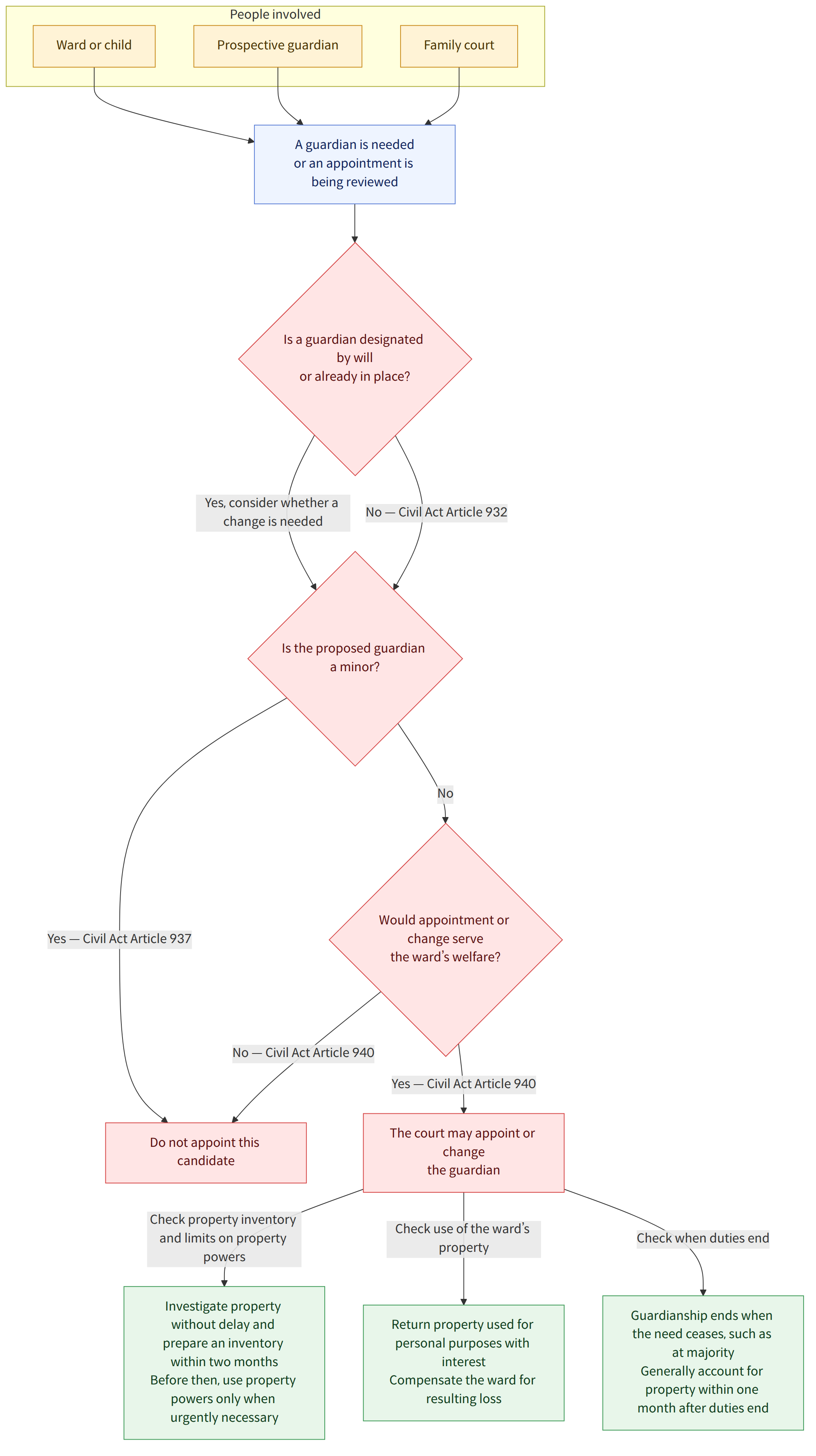
- If a person with parental authority has not designated a minor guardian by will, or if there is no guardian, the family court appoints a minor guardian. No relative automatically becomes the guardian (Civil Act, Article 932 (민법 제932조)).
- The ward’s welfare is an important consideration when appointing or changing a guardian. Taking into account various circumstances, including the care environment, the ward’s wishes, and the prospective guardian’s willingness and financial ability to provide care, a person who is not a relative may also be appointed as guardian (Civil Act, Article 940 (민법 제940조); Cases 1, 16, and 20).
- A minor is disqualified from serving as a guardian and therefore cannot be appointed as an adult guardian (Civil Act, Article 937 (민법 제937조)).
- A minor guardian is responsible for the ward’s care and upbringing and property management, and acts as the ward’s legal representative. However, certain acts may require the consent of a guardian supervisor or the appointment of a special representative (Civil Act, Articles 945, 949-3, and 950 (민법 제945조, 제949조의3, 제950조)).
- A guardian must investigate the ward’s property without delay after assuming office and prepare an inventory of the property within two months. Before completing this, the guardian may not exercise powers over the ward’s property except where urgently necessary (Civil Act, Articles 941 and 943 (민법 제941조, 제943조)).
- If a guardian uses the ward’s property for the guardian’s own purposes, the guardian must return it with interest from the date of use and compensate the ward for any resulting loss (Civil Act, Article 958(2) (민법 제958조 제2항)).
- Minor guardianship ends when the need for guardianship ceases, such as when the minor reaches the age of majority. When a guardian’s duties end, the guardian must generally account for the property within one month (Civil Act, Articles 928 and 957 (민법 제928조, 제957조)).
Frequently asked questions
Q. If both parents die, do a grandparent or uncle automatically become the guardian?
No. If a minor guardian has not been designated by the person with parental authority in a will, or if there is no guardian, the family court appoints a minor guardian. A person is not automatically appointed merely because they are a close relative (Civil Act, Article 932 (민법 제932조)).
Q. Can a grandparent be appointed as a minor guardian of a grandchild?
Yes, they may be appointed. However, the relationship alone does not determine the appointment. The court considers the child’s welfare as a whole, including the child’s wishes and age, the child’s living and care environment, and the current caregiver’s willingness and ability to provide care. In one case, a grandfather was appointed after the court considered, among other things, circumstances making it difficult to expect the surviving parent with parental authority to provide appropriate care and upbringing.
Q. Can someone who is not a relative become a guardian?
It is possible. The family court may change a guardian if it considers the change necessary for the ward’s welfare, and a case has recognized that a lawyer who is not a relative may also be appointed or become the guardian following a change. The specific decision depends on the circumstances relevant to the ward’s welfare (Civil Act, Article 940 (민법 제940조)).
Q. Can a minor child be an adult guardian for a parent?
No. A minor is disqualified from serving as a guardian, so even if that child is the only close family member, the child cannot be appointed as an adult guardian (Civil Act, Article 937, subparagraph 1 (민법 제937조 제1호)).
Q. Can a minor guardian be appointed even if a parent remains a person with parental authority?
A minor guardian may be appointed when a person with parental authority is unable to exercise part of that authority, such as the authority to represent the child in legal acts or to manage the child’s property being lost. However, a case explains that a person with parental authority who lacks the authority to represent the child in legal acts and to manage the child’s property cannot designate a minor guardian by will (Civil Act, Articles 925, 928, and 931 (민법 제925조, 제928조, 제931조)).
Q. Can a minor guardian use the ward’s property as security for the guardian’s own debt?
If an act involves a conflict of interest between the guardian and the ward, the guardian must not represent the ward directly. If there is a guardian supervisor, that supervisor represents the ward; otherwise, a special representative must be appointed. A representative act carried out without following this procedure may be void (Civil Act, Articles 949-3, 949-6(3), and 921 (민법 제949조의3, 제949조의6 제3항, 제921조)).
Q. Does an adult guardian need court permission to terminate the lease for the ward’s home?
Even if the guardian has the relevant power of representation, the family court’s permission is required to terminate a lease concerning a building in which the adult ward resides. The scope of the adult guardian’s power of representation should also be checked (Civil Act, Articles 938 and 947-2(5) (민법 제938조, 제947조의2 제5항)).
Q. Can an adult guardian consent on the ward’s behalf to risky surgery?
If the adult ward is unable to give consent, the adult guardian may consent on the ward’s behalf. The family court’s permission is required if surgery carries a risk of death or substantial disability. However, if waiting for permission could create a serious risk to the ward’s life or body, permission may be sought afterward (Civil Act, Article 947-2(3) and (4) (민법 제947조의2 제3항·제4항)).
Q. What procedure must a guardian follow when a minor reaches the age of majority?
Minor guardianship ends when the minor reaches the age of majority. When a guardian’s duties end, the guardian must generally account for the ward’s property within one month. A case explains that when guardianship ends because the minor has reached the age of majority, no separate report of the termination of minor guardianship is required (Civil Act, Article 957 (민법 제957조); Act on the Registration, etc. of Family Relationships, Article 83 (가족관계의 등록 등에 관한 법률 제83조)).
Relevant laws
- Civil Act, Article 5 (민법 제5조)
- Civil Act, Article 690 (민법 제690조)
- Civil Act, Article 691 (민법 제691조)
- Civil Act, Article 692 (민법 제692조)
- Civil Act, Article 826-2 (민법 제826조의2)
- Civil Act, Article 909-2 (민법 제909조의2)
- Civil Act, Article 921 (민법 제921조)
- Civil Act, Article 925 (민법 제925조)
- Civil Act, Article 927-2 (민법 제927조의2)
- Civil Act, Article 928 (민법 제928조)
- Civil Act, Article 931 (민법 제931조)
- Civil Act, Article 932 (민법 제932조)
- Civil Act, Article 937 (민법 제937조)
- Civil Act, Article 938 (민법 제938조)
- Civil Act, Article 939 (민법 제939조)
Watch out for
- The appointment of a guardian is not determined solely by degree of kinship or seniority among relatives. The ward’s welfare and the specific circumstances of care and protection must be considered.
- The deadline for a surviving parent to petition for designation as the person exercising parental authority, mentioned in Case 1, concerns the particular circumstances of that case. It should not be treated as a deadline that applies uniformly to all guardianship matters.
- A guardian may not exercise powers over the ward’s property before completing the investigation of the property and preparation of an inventory, except where urgently necessary. One case found that urgency could not be established merely because the guardian wished to expedite a move abroad.
Related articles
Source cases
This guide was compiled by AI from the following Korea Legal Aid Corporation consultation cases (in Korean).
- 조부가 미성년후견인으로 선임될 수 있는지
- 부모가 모두 사망한 경우 후견인은 누가 되는지
- 노모(老母)에 대한 부양의무자와 부양 범위
- 부양 의무자 간의 부양비용 상환청구
- 노부모를 부양한 자의 다른 부양의무자에 대한 부양료구상권
- 미성년후견의 종료
- 성년후견인에게 인터넷뱅킹에 관한 권한을 부여할 수 있는지
- 재산조사와 재산목록작성을 완료하기 이전의 후견인의 권한
- 부양관계의 변경이 가능한지
- 미성년후견인의 후견사무 범위
- 피부양자의 과실로 다른 사람이 부양을 요하는 경우
- 후견인과 피후견인 사이의 이해상반행위
- 부부 사이의 부양 의무
- 성년후견인이 피성년후견인에 대한 수술에 동의할 수 있는지
- 부양료 상환청구가 민사소송에 해당하는지
- 친족이 아닌 다른 적합한 사람으로 후견인을 변경할 수 있는지
- 후견인의 결격사유
- 부양 의무 불이행으로 인한 정신적 손해
- 임의후견 제도
- 후견인 변경
- 법률행위의 대리권과 재산관리권이 없는 친권자가 유언으로 미성년자의 후견인을 지정할 수 있는지
- 성년후견인이 피성년후견인이 거주하고 있는 건물에 대한 임대차를 해지할 수 있는지
- 부양청구권의 법적 성질
- 후견인이 피후견인의 금전을 소비한 경우 반환 및 배상의무
- 미성년자에 대한 친권자와 후견인이 병존할 수 있는지
This guide is general legal information about Korean law, not legal advice for your situation. For a specific case, consult a lawyer or the Korea Legal Aid Corporation (call 132 in Korea).