
Guide to Enforcing Monetary Claims under Civil Execution
Based on 131 consultation cases · Updated · Translated from the Korean original.
If you have an enforceable title, such as a final judgment, you can attach and collect or take by assignment monetary claims that the debtor is entitled to receive from a third party, such as construction payments, a lease deposit, or bank deposits. The actual method and scope of recovery depend on the effects of a collection order or assignment order, whether other creditors have competing claims, and whether the claim is exempt from attachment.
At a glance
Key points
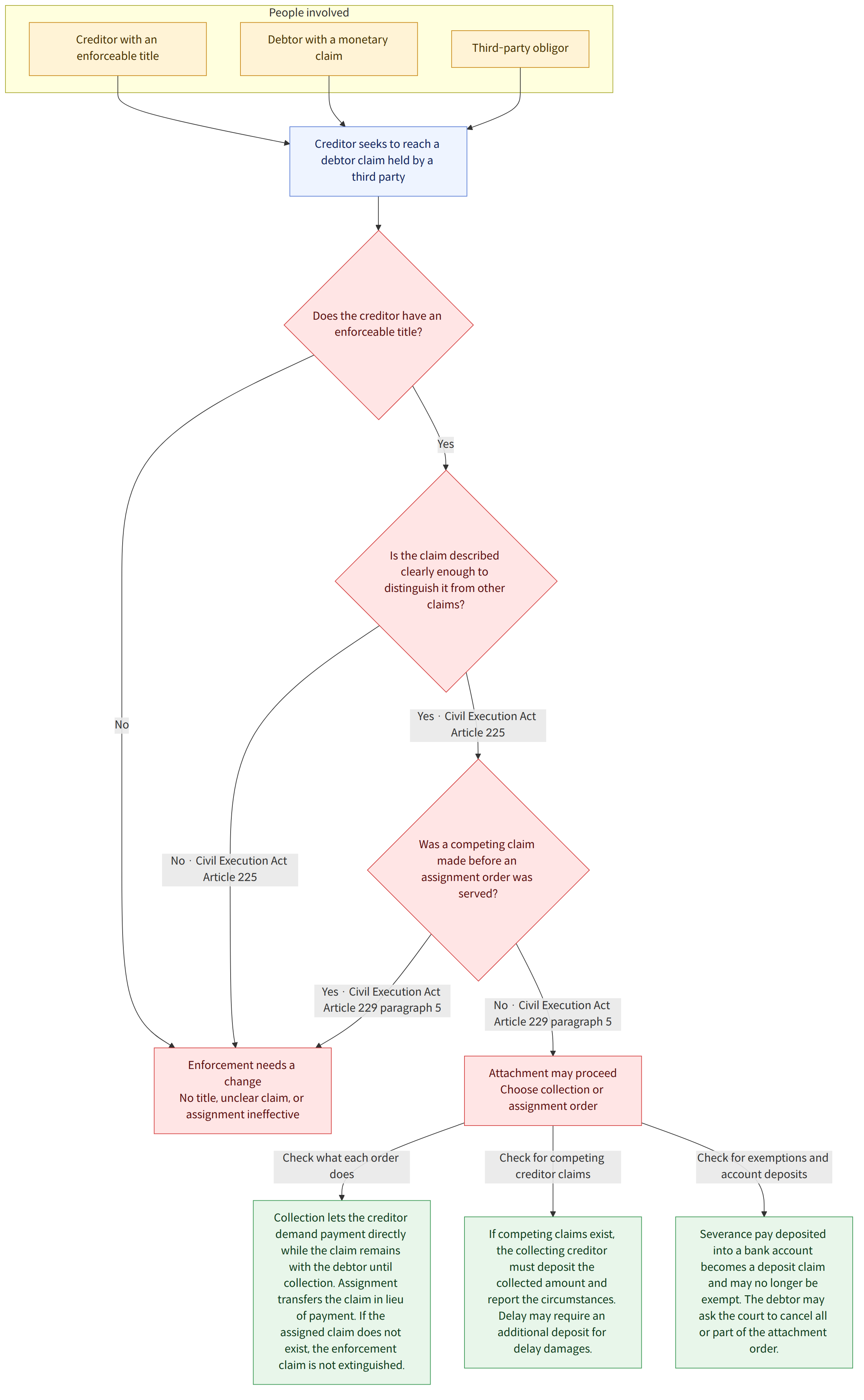
- A debtor’s claim against a third-party obligor may be attached. The claim to be attached must be described so that the third-party obligor can distinguish it from other claims (Civil Execution Act, Article 225 (민사집행법 제225조)).
- A collection order allows the creditor to make a direct demand on the third-party obligor on the debtor’s behalf, but until collection, the attached claim belongs to the debtor. An assignment order transfers the claim to the creditor in lieu of payment; if the assigned claim does not exist, the enforcement claim is not extinguished (Civil Execution Act, Articles 229 and 231 (민사집행법 제229조·제231조), Cases 2 and 15).
- If another attachment, provisional attachment, or demand for distribution is made before an assignment order is served on the third-party obligor, the assignment order is ineffective and only the effect of the attachment may remain (Civil Execution Act, Article 229(5) (민사집행법 제229조 제5항), Cases 2 and 9).
- If other attachments or similar measures compete with an attached claim, the collecting creditor must deposit the collected amount and report the circumstances. If the creditor delays doing so, the creditor may be required to deposit an additional amount equivalent to delay damages accruing from the end of the applicable period until the deposit is made (Civil Execution Act, Article 236 (민사집행법 제236조), Cases 3 and 20).
- The third-party obligor is not required to notify the creditor directly that the attached claim exists, but the creditor may ask the court to order the third-party obligor to make a statement (Civil Execution Act, Article 237 (민사집행법 제237조), Case 4).
- If severance pay or another claim exempt from attachment is deposited into a bank account, it becomes a deposit claim and may no longer be exempt from attachment. However, the debtor may apply to the court to cancel all or part of the attachment order (Civil Execution Act, Article 246 (민사집행법 제246조), Cases 8 and 17).
- A creditor who has received a collection order may, unless special circumstances apply, exercise the debtor’s right to terminate an insurance contract in order to collect a claim for the policy’s surrender value (Case 19).
Frequently asked questions
Q. What is the difference between a collection order and an assignment order?
If a collection order is issued, the creditor may directly demand payment from the third-party obligor on the debtor’s behalf, but until collection, the claim itself remains with the debtor. An assignment order transfers the attached claim to the creditor in lieu of payment; if the assigned claim does not exist, the enforcement claim is not extinguished (Civil Execution Act, Articles 229 and 231 (민사집행법 제229조·제231조)).
Q. I want to attach the debtor’s claim for return of a lease deposit, but I do not know the contract details. What can I do?
The existence of the claim to be attached does not have to be definitively confirmed when an attachment is applied for, but the claim must be described by type and amount so that it can be distinguished from other claims. If the third-party obligor does not provide the information, you may ask the court to order the third-party obligor to make a statement (Civil Execution Act, Articles 225 and 237 (민사집행법 제225조·제237조)).
Q. If another creditor collects money first but does not deposit it, can I claim payment again from the third-party obligor?
If the third-party obligor has lawfully paid a creditor who received a collection order, a creditor with a provisional attachment cannot demand payment from the third-party obligor again. However, if the collecting creditor failed to deposit the collected amount and report the circumstances despite competing claims, another creditor may claim from that collecting creditor an amount equal to its share of the distribution.
Q. Can severance pay that is exempt from attachment be attached after it is deposited into a bank account?
According to the case, once severance pay is deposited into a bank account, it becomes a deposit claim, so the exemption from attachment applicable to severance pay does not automatically extend to the deposit claim. However, the debtor may apply to the court to cancel all or part of the attachment order based on circumstances such as the debtor’s financial situation (Civil Execution Act, Article 246(3) (민사집행법 제246조 제3항)).
Q. Can I terminate the debtor’s insurance policy after receiving a collection order?
A claim for the surrender value of an insurance policy may be subject to an attachment and collection order. Unless special circumstances apply, the collecting creditor may exercise the right to terminate the insurance contract in its own name in order to collect the claim. If the creditor files a lawsuit to recover the collected amount, the termination may take effect when a copy of the complaint is served on the insurer.
Q. Can I bring an action for collection even if the debtor has already sued the third-party obligor?
Yes. Once an attachment and collection order is issued, the debtor loses standing to bring an action for performance against the third-party obligor concerning the relevant claim, and the attaching creditor may separately bring an action for collection. The case explains that this collection action is not a duplicative action alongside the debtor’s earlier action for performance.
Q. Can I prevent attachment if money sent by mistake goes into the recipient’s attached account?
Once a bank transfer is made, the recipient generally acquires a deposit claim against the bank for the amount transferred, unless special circumstances apply. The sender may claim restitution for unjust enrichment from the recipient, but cannot prevent the recipient’s creditor from attaching the deposit claim merely because the transfer was made by mistake.
Q. Can I obtain a collection order under the Civil Execution Act for a claim that was already attached in a tax delinquency collection procedure?
According to the case, even if an attachment under a tax delinquency collection procedure was made first, an attachment and collection order may still be obtained under the Civil Execution Act, and the collecting creditor may bring an action for collection against the third-party obligor. The third-party obligor cannot refuse the collection claim solely because of the prior tax delinquency attachment, and may also be discharged by payment or by making a deposit with the court in satisfaction of enforcement.
Relevant laws
- Civil Execution Act, Article 9 (민사집행법 제9조)
- Civil Execution Act, Article 48 (민사집행법 제48조)
- Civil Execution Act, Article 225 (민사집행법 제225조)
- Civil Execution Act, Article 226 (민사집행법 제226조)
- Civil Execution Act, Article 227 (민사집행법 제227조)
- Civil Execution Act, Article 229 (민사집행법 제229조)
- Civil Execution Act, Article 231 (민사집행법 제231조)
- Civil Execution Act, Article 234 (민사집행법 제234조)
- Civil Execution Act, Article 236 (민사집행법 제236조)
- Civil Execution Act, Article 237 (민사집행법 제237조)
- Civil Execution Act, Article 238 (민사집행법 제238조)
- Civil Execution Act, Article 246 (민사집행법 제246조)
- Civil Execution Act, Article 247 (민사집행법 제247조)
- Civil Execution Act, Article 248 (민사집행법 제248조)
- Civil Execution Act, Article 249 (민사집행법 제249조)
Watch out for
- The effect of an assignment order may depend on whether another attachment, provisional attachment, or demand for distribution was made before the order was served on the third-party obligor. You should therefore confirm the time of service and whether there are competing claims.
- If a creditor collects a claim subject to competing claims under a collection order, the collecting creditor must deposit the collected amount without delay and report the circumstances. Failure to do so may give rise to additional damages.
- Even a claim exempt from attachment may be treated as a deposit claim once paid into an account. If the debtor needs protection, consider applying to the court to cancel the attachment order.
Source cases
This guide was compiled by AI from the following Korea Legal Aid Corporation consultation cases (in Korean).
- 제3채무자가 소유권이전등기청구권가압류 사실의 주장의무를 지는지
- 전부명령과 추심명령은 어떠한 차이가 있는지
- 채권가압류 후 압류 및 추심명령이 발부된 경우 가압류의 효력
- 채권압류 시 제3채무자로부터 피압류채권의 내용을 확인하는 방법
- 금전채권에 대한 강제집행의 불허를 구하는 제3자 이의의 소가 허용되는지
- 임대차계약 해제된 때 임차보증금채권에 대한 압류·추심명령의 효력
- 사망한 자를 제3채무자로 표시한 채권압류 및 전부명령의 효력
- 공무원의 명예퇴직수당도 압류의 대상이 되는지
- 추심명령과 전부명령 그리고 또 추심명령이 순차로 송달된 경우 그 효력
- 수 개 전부명령의 피압류채권액이 전부금액 합계액에 미달된 때 배분방법
- 공동명의 예금반환채권자 중 1인의 압류추심채권자의 예금반환청구 가능 여부
- 집행채권이 가압류된 경우 그에 대한 채권압류 및 전부명령의 효력
- 전부명령의 원인이 된 무효인 법률행위에 대한 집행채권자의 부당이득반환의무와 그 방법
- 해방공탁금의 집행방법
- 임금채권의 압류 및 전부명령송달 전 채무자 퇴사 시 전부명령의 효력
- 임대차보증금반환채권이 가압류된 상태에서 임대주택이 양도된 경우, 제3채무자의 지위
- 압류금지채권이 채무자의 예금계좌에 입금된 경우 압류가 가능한지
- 체납처분절차에 의한 채권 압류와 민사집행법에 의한 채권압류의 경합
- 추심명령을 얻은 채권자가 채무자의 보험계약을 해지할 수 있는지 여부
- 경합이 있는 채권의 추심채권자가 공탁 및 사유신고를 하지 않은 경우, 추심금 이외에 지연손해금도 추가 공탁하여야 하는지
- 무효인 공정증서에 의한 강제집행 종료 후 청구이의의 소로 다툴 수 있는지
- 전부명령을 받은 자에 대한 제3채무자의 상계권 주장 여부
- 채무자가 제3채무자를 상대로 제기한 이행의 소와 압류채권자가 제3채무자를 상대로 제기한 추심의 소 사이의 관계
- 전세권이 존속기간 만료 등으로 종료한 경우, 최선순위 전세권자의 채권자가 전세권이 설정된 부동산에 대한 경매절차에서 채권자대위...
- 착오송금한 수취인의 계좌가 압류된 상태라면 돈을 돌려받을 수 없는지?
This guide is general legal information about Korean law, not legal advice for your situation. For a specific case, consult a lawyer or the Korea Legal Aid Corporation (call 132 in Korea).