
Guide to the Effect and Enforcement of Mortgages
Based on 113 consultation cases · Updated · Translated from the Korean original.
A mortgage entitles its holder to priority payment over other creditors from the exchange value of the mortgaged property. Its scope and the way it is enforced depend on the condition of the collateral and the progress of the auction. When collateral is replaced by another right, such as expropriation compensation or a claim for repayment of a lease deposit, the right of subrogation must be exercised through the prescribed procedures. Joint mortgages, building additions, and the point at which claims secured by a floating-rate mortgage become fixed must also be considered separately.
At a glance
Key points
- As a general rule, a mortgage extends to items that have become part of the mortgaged real property and to its appurtenances. Whether an item is a separate object of ownership and the terms agreed upon when the mortgage was created must also be considered (Civil Act, Article 358 (민법 제358조), Cases 13 and 14).
- The statutory requirements and inventory for a factory mortgage must be checked. However, when real property subject to a factory mortgage is attached, the factory appurtenances that are the subject of the mortgage are generally also subject to enforcement (Factory and Mining Foundation Mortgage Act, Articles 3, 4, 6, and 8 (공장 및 광업재단 저당법 제3조·제4조·제6조·제8조), Cases 2, 19, and 20).
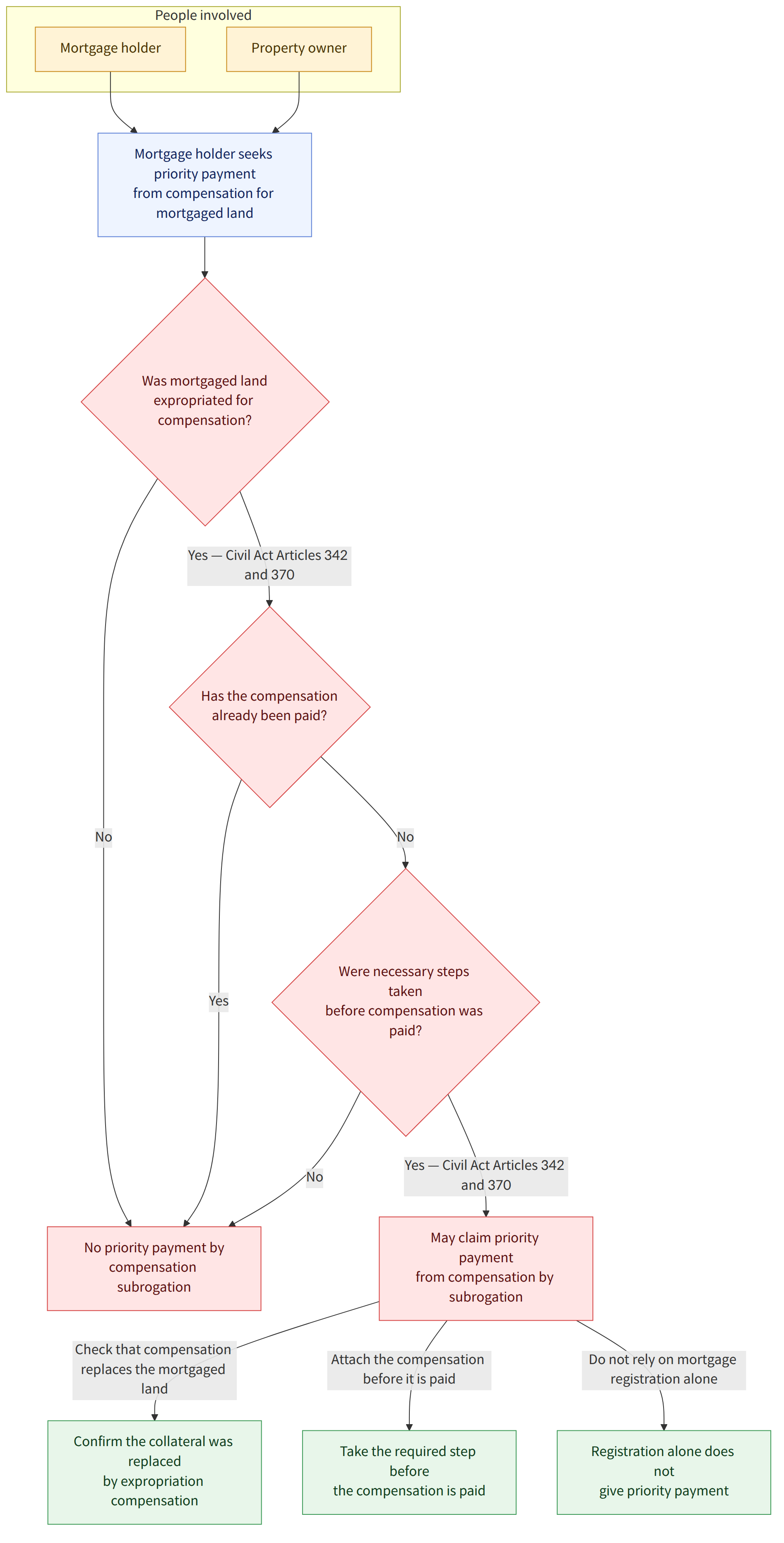
- If mortgaged land is expropriated, the mortgagee may exercise a right of subrogation against the compensation, but must take the necessary steps, such as attachment, before the compensation is paid. Registration alone does not confer a right to priority payment (Civil Act, Articles 342 and 370 (민법 제342조·제370조), Cases 9 and 10).
- When property owned by the debtor and property owned by a third-party security provider are jointly mortgaged and auctioned at the same time, the proceeds may be distributed first from the property owned by the debtor, with any shortfall distributed from the property owned by the third-party security provider (Case 5).
- If only some of the jointly mortgaged properties are auctioned first, a junior mortgagee may in some cases exercise, by subrogation, the senior mortgage over the other jointly mortgaged property. However, one case held that this right of subrogation does not apply where real property and a ship are jointly provided as collateral (Civil Act, Article 368 (민법 제368조), Cases 6 and 22).
- If an existing building is demolished and a new building is constructed, the mortgage on the existing building does not extend to the new building unless the two buildings are found to be identical. However, if the owner of the mortgaged land constructs a new building on it, the mortgagee of the land may, subject to certain requirements, apply to auction the building together with the land (Civil Act, Article 365 (민법 제365조), Case 7).
- The point at which a claim secured by a floating-rate mortgage becomes fixed depends on the business relationship and the progress of the auction. One case held that, when a junior floating-rate mortgagee applies for an auction, the claim secured by a senior floating-rate mortgage generally becomes fixed when the purchaser pays the full sale price (Case 25).
- A third-party security provider may exercise a right of recourse after losing ownership of the collateral or repaying the debt. One case held that the provider cannot seek recourse in advance of enforcement of the security right. Depending on the circumstances, the scope of recourse may be determined by reference to the collateral’s market value (Civil Act, Articles 341 and 370 (민법 제341조·제370조), Cases 4 and 24).
Frequently asked questions
Q. If mortgaged land is expropriated, can the mortgagee receive priority payment from the compensation?
If property subject to a mortgage is expropriated and replaced by compensation, the mortgagee may exercise a right of subrogation against the compensation. However, the mortgagee must take the necessary steps, such as attaching the compensation, before it is paid; the mere fact that a mortgage is registered does not entitle the mortgagee to priority payment from the compensation.
Q. Does a mortgage on an existing building extend to a new building constructed after the mortgage was created?
If an existing building is demolished and a new building is constructed, the mortgage on the existing building does not extend to the new building unless the two buildings are found to be identical, even if they look similar or are in similar locations. However, in some cases, an application may be made to auction the new building together with the land when the building was constructed on land subject to a mortgage.
Q. Can machinery omitted from a factory mortgage inventory be excluded from an auction?
For machinery and equipment that are the subject of a factory mortgage, it is necessary to check whether they are listed and whether the requirements for a factory mortgage are met. However, one case held that when the real property subject to a factory mortgage was attached pursuant to an order commencing an auction, the factory appurtenances could be regarded as included in the auction, absent special circumstances, even if the court omitted them from the order commencing the auction or the order approving the sale.
Q. How are proceeds distributed when property owned by both the debtor and a third-party security provider is jointly mortgaged?
When two properties are auctioned together, a distribution method may apply under which the joint mortgagee is paid first from the proceeds of the property owned by the debtor, and any shortfall is then paid from the property owned by the third-party security provider. This may differ from the usual method of distributing the proceeds of a joint mortgage in proportion to the sale proceeds of both properties.
Q. If I have fully repaid the secured debt but the mortgage registration remains, can it be used again?
When the secured claim is extinguished, the mortgage is also extinguished and the registration must be cancelled. However, if no third party with an interest in the registration arose before the parties agreed to reuse it, the parties may in some cases use the existing registration to secure a new debt between themselves.
Q. What happens to a mortgage over a registered leasehold right when the right expires at the end of its term?
When a registered leasehold right expires at the end of its term, a mortgage created over that right may be extinguished. The mortgagee may then enforce its rights by attaching and collecting the claim for repayment of the lease deposit, obtaining an assignment order, or filing a claim for distribution in enforcement proceedings concerning that claim.
Q. Can a third-party security provider claim reimbursement from the debtor before the auction is completed?
As a general rule, a third-party security provider acquires a right of recourse after repaying the debt or losing ownership of the collateral through enforcement of the mortgage. One case held that the provisions on a guarantor’s right of recourse before payment do not apply to a third-party security provider, who therefore cannot seek recourse in advance of the auction.
Q. When does the debt secured by a senior floating-rate mortgage become fixed if a junior floating-rate mortgagee applies for an auction?
One case held that when a junior floating-rate mortgagee applies for an auction, the claim secured by the senior floating-rate mortgage becomes fixed when that mortgage is extinguished. Specifically, the claim was held to become fixed when the purchaser paid the full sale price.
Relevant laws
- Civil Act, Article 100 (민법 제100조)
- Civil Act, Article 186 (민법 제186조)
- Civil Act, Article 214 (민법 제214조)
- Civil Act, Article 215 (민법 제215조)
- Civil Act, Article 256 (민법 제256조)
- Civil Act, Article 320 (민법 제320조)
- Civil Act, Article 321 (민법 제321조)
- Civil Act, Article 322 (민법 제322조)
- Civil Act, Article 323 (민법 제323조)
- Civil Act, Article 324 (민법 제324조)
- Civil Act, Article 328 (민법 제328조)
- Civil Act, Article 341 (민법 제341조)
- Civil Act, Article 342 (민법 제342조)
- Civil Act, Article 356 (민법 제356조)
- Civil Act, Article 357 (민법 제357조)
Watch out for
- A right of subrogation against expropriation compensation cannot be exercised merely by registering the mortgage. The necessary steps, such as attachment, must be taken before the compensation is paid.
- Whether a mortgage extends to an addition to a building or to factory machinery depends on matters such as whether the item has become part of the property, whether it is an independent object of ownership, the factory mortgage inventory, and the terms of the mortgage agreement.
- The point at which claims secured by a floating-rate mortgage become fixed may depend on who applied for the auction and whether the relevant business relationship has ended. If an auction is underway, the date on which the claim becomes fixed should be checked separately.
- As a general rule, a third-party security provider’s right of recourse arises after the provider repays the debt or loses ownership of the collateral through enforcement of the security right. This should not be confused with a guarantor’s right of recourse before payment.
Source cases
This guide was compiled by AI from the following Korea Legal Aid Corporation consultation cases (in Korean).
- 공사대금채권 유치권자, 유치물 보존·사용의 경우 부당이득공제여부
- 공장저당목적이 된 농지 위에 공장건물 등이 없는 경우 일괄매각여부
- 공익사업을 위한 협의취득으로 토지소유권이 이전된 경우 저당권자 보호
- 담보권 실행으로 부동산소유권을 상실한 물상보증인의 구상권
- 채무자·물상보증인 공동저당부동산 동시배당의 경우 배당방법
- 공동저당 부동산 중 일부만 경매할 경우 경매부동산의 후순위 저당권자보호
- 철거 후 신축한 건물에 대해 구 건물에 관한 저당권으로 경매청구 가능한지
- 돈을 다시 빌려주면서 무효인 기존의 근저당권등기를 이용할 수 있는지
- 저당권이 설정된 토지가 수용된 경우 저당권자의 물상대위권 행사방법
- 저당권 설정토지의 수용보상금에 전부명령이 발령된 경우 저당권의 보호
- 은행의 포괄근저당권이 미치는 범위
- 전세계약기간이 만료된 경우 전세권에 설정된 저당권의 실행방법
- 증축으로 인한 건물표시변경등기 된 경우 기존건물저당권의 효력범위
- 임차인이 증축한 건물부분에 기존 저당권의 효력이 미치는지
- 피담보채무 확정 전 대위변제를 한 경우 근저당권의 이전 여부
- 토지에 설정한 근저당권에 기초하여 건축공사 중지를 청구할 수 있는지
- 임대차보증금반환채무 등을 담보하기 위해 설정된 포괄근저당권이 임대차계약이 종료되기 전 순차적으로 양도된 경우, 위 근저당권의 ...
- 저당권설정 전후 가압류가 있는 경우 매각대금의 배당방법
- 공장저당권이 타인의 토지에 설치된 폐수처리시설에도 미치는지
- 공장저당권실행의 경우 일부기계가 경매목적물로 명시되지 않은 경우
- 저당권 설정된 토지를 양도한 후 양도인이 저당권등기말소청구 가능한지
- 동일채권으로 부동산 및 선박에 저당권 설정한 경우 민법상 공동저당인지
- 저당권자와 채무자를 실제와는 달리 제3자 명의로 해놓은 경우
- 물상보증인이 사전구상권을 행사할 수 있는지
- 후순위근저당권자가 경매를 신청한 경우 선순위근저당권의 피담보채권이 확정되는 시기
This guide is general legal information about Korean law, not legal advice for your situation. For a specific case, consult a lawyer or the Korea Legal Aid Corporation (call 132 in Korea).