
Compulsory Enforcement Against Movable Property: Procedures and Responses
Based on 32 consultation cases · Updated · Translated from the Korean original.
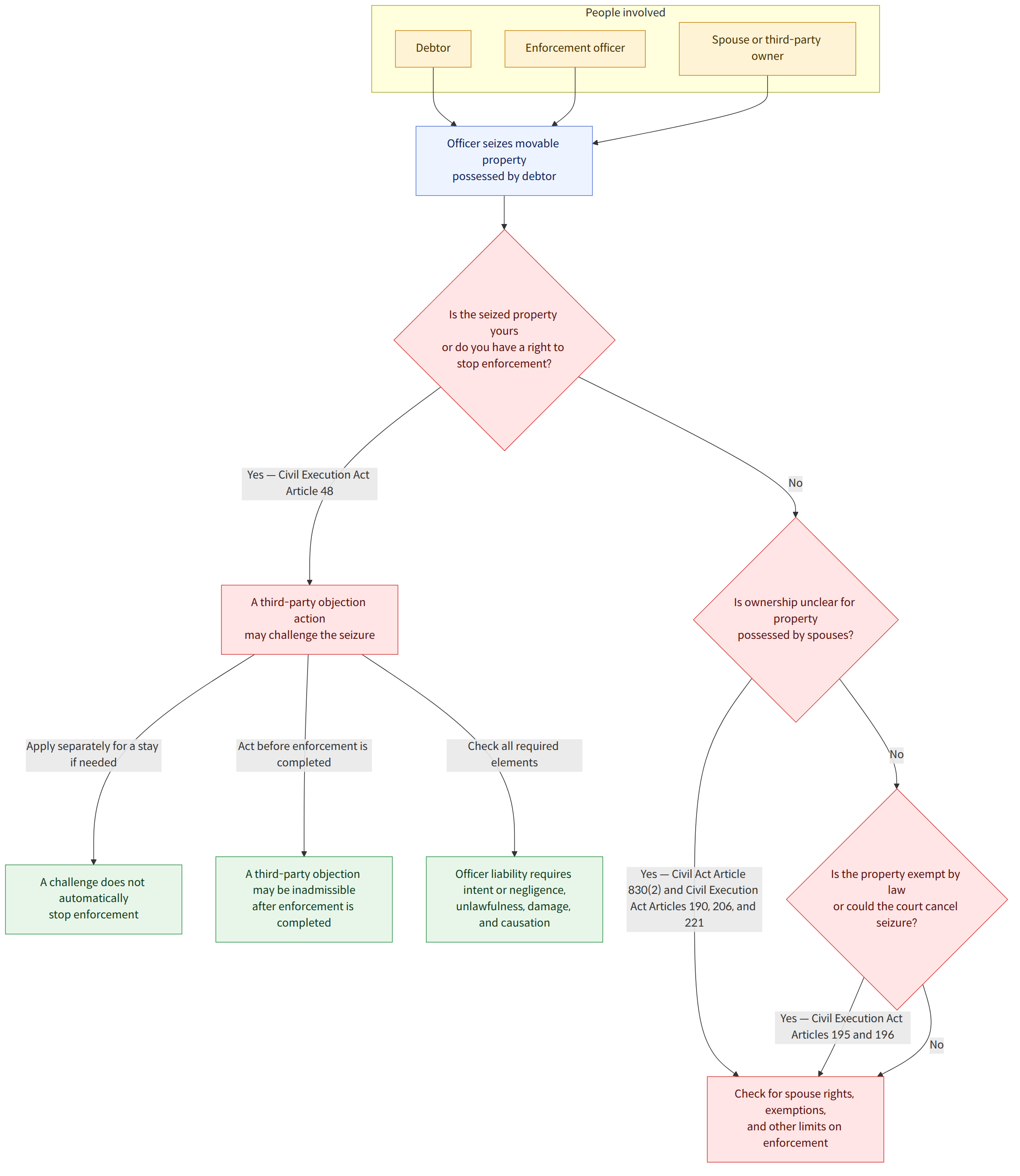
As a rule, movable property is seized by an enforcement officer taking possession of it. Property possessed jointly by a debtor and the debtor’s spouse may be presumed to be jointly owned and therefore subject to enforcement. It is important to understand in advance the remedies available for property owned by a third party or exempt from seizure, the spouse’s rights to purchase or receive a distribution, and the timing of sale and double seizure.
At a glance
Key points
- As a rule, the enforcement officer takes possession of movable property possessed by the debtor in order to seize it. If the property is difficult to transport or the creditor consents, the seizure may instead be indicated by a seal or other marking, and the debtor may be allowed to keep the property in custody (Civil Execution Act, Article 189 (민사집행법 제189조)).
- Movable property possessed by a married couple whose owner is unclear may be presumed to be jointly owned by them and may be seized. The spouse may declare an intention to exercise a preferential right to purchase at the sale date or request payment of the sale proceeds corresponding to their share of the jointly owned property (Civil Act, Article 830(2) (민법 제830조 제2항); Civil Execution Act, Articles 190, 206, and 221 (민사집행법 제190조·제206조·제221조)).
- If the seized property belongs to you or you have a right to prevent enforcement, you may bring a third-party objection action against the creditor. You may also need to apply separately for a stay of enforcement to prevent it from continuing (Civil Execution Act, Article 48 (민사집행법 제48조)).
- Items specified by law, including tools essential to farming, fishing, or a person’s occupation, may be exempt from seizure. In light of the parties’ circumstances, including their living conditions, a court may also cancel a seizure or order one (Civil Execution Act, Articles 195 and 196 (민사집행법 제195조·제196조)).
- Property may be sold early if its value is likely to decline significantly while in custody or if the cost of keeping it is excessive. The enforcement officer may take any measures necessary to preserve seized property (Civil Execution Act, Articles 198 and 202 (민사집행법 제198조·제202조)).
- A double seizure of movable property may be permitted before the sale date on which the property is actually sold, rather than merely until the first sale date (Civil Execution Act, Article 215 (민사집행법 제215조); Supreme Court Decision 2010Da83939, rendered January 27, 2011 (대법원 2011. 1. 27. 선고 2010다83939 판결)).
- If the purchaser fails to pay by the payment deadline, the property is resold. The former purchaser may not participate in the resale and may be liable for the difference if the resale price is lower (Civil Execution Act, Article 205 (민사집행법 제205조)).
- State liability for damages may arise if the enforcement officer’s intent or negligence in the performance of official duties, unlawfulness, damages, and causation are established. However, the mere fact that the officer seized property possessed by the debtor but owned by a third party does not establish the officer’s liability (Cases 2, 17, and 25).
Frequently asked questions
Q. What should I do if household appliances are seized because of my spouse’s debt?
If you can prove that the seized property is your separate property, you may challenge the seizure by bringing a third-party objection action. If the property is jointly owned or ownership is unclear, you may declare your intention to exercise a preferential right to purchase at the sale date or request payment of the sale proceeds corresponding to your share (Civil Execution Act, Articles 48, 206, and 221 (민사집행법 제48조·제206조·제221조)).
Q. An item I lent to a debtor has been seized. Can I ask the enforcement officer to return it right away?
As a rule, the enforcement officer seizes property based on whether the debtor possesses it, not on who owns it. A third party claiming to be the owner may challenge the seizure by bringing a third-party objection action against the creditor. It is important to act before enforcement is completed (Civil Execution Act, Articles 48 and 189 (민사집행법 제48조, 제189조)).
Q. Does filing a third-party objection action automatically stop the auction?
No. Filing a third-party objection action may not prevent enforcement from proceeding, so you may need to separately apply for a stay of compulsory enforcement to stop it. If enforcement has already been completed, the third-party objection action may be inadmissible (Civil Execution Act, Article 48 (민사집행법 제48조)).
Q. Can the belongings of a cohabitant with whom I have not registered a marriage also be seized?
According to the case described, the rules on movable property jointly owned by spouses may also apply by analogy to a de facto marital relationship where the parties live together as a married couple. However, only the debtor’s share may be subject to enforcement, and whether a de facto marital relationship existed and whether the parties actually shared a household may be at issue.
Q. Can I challenge a spouse’s request for the sale proceeds based on a claimed ownership share?
If a creditor objects to the spouse’s claim of joint ownership, the creditor may bring an action against the spouse to deny the alleged joint ownership. If an action is brought, the portion of the sale proceeds corresponding to the amount to be paid to the spouse will be deposited, and payment or distribution will be made depending on the outcome of the action (Civil Execution Act, Article 221(3) (민사집행법 제221조 제3항)).
Q. Can tools needed for fishing or for my job also be seized?
Fishing tools and nets that are essential for a person who fishes primarily through their own labor may be exempt from seizure. Farming tools, uniforms and tools essential to a person’s occupation, and similar items may also be exempt, within the scope set by law (Civil Execution Act, Article 195 (민사집행법 제195조)).
Q. Can I apply for a double seizure even though the property did not sell at the first auction?
The precedent cited in the case treated the relevant deadline for a double seizure as the period before the sale date on which the property is actually sold, not the first sale date. Accordingly, even if the property was not sold on the first date, a double seizure may still be possible if no actual sale has yet taken place (Civil Execution Act, Article 215 (민사집행법 제215조); Supreme Court Decision 2010Da83939, rendered January 27, 2011 (대법원 2011. 1. 27. 선고 2010다83939 판결)).
Q. What happens if, after I buy property seized by an enforcement officer at auction, a third party says it belongs to them and demands its return?
The precedent cited in the case held that if a purchaser pays the sale price and takes delivery of the property, the purchaser may acquire possession and ownership if a third party did not challenge the matter before enforcement ended, by objecting to the method of enforcement or bringing a third-party objection action, for example. The outcome may differ depending on the specific rights involved and the course of enforcement (Supreme Court Decision 72Da51, rendered April 25, 1972 (대법원 1972. 4. 25. 선고 72다51 판결)).
Relevant laws
- Civil Execution Act, Article 48 (민사집행법 제48조)
- Civil Execution Act, Article 189 (민사집행법 제189조)
- Civil Execution Act, Article 190 (민사집행법 제190조)
- Civil Execution Act, Article 191 (민사집행법 제191조)
- Civil Execution Act, Article 192 (민사집행법 제192조)
- Civil Execution Act, Article 195 (민사집행법 제195조)
- Civil Execution Act, Article 196 (민사집행법 제196조)
- Civil Execution Act, Article 197 (민사집행법 제197조)
- Civil Execution Act, Article 198 (민사집행법 제198조)
- Civil Execution Act, Article 202 (민사집행법 제202조)
- Civil Execution Act, Article 205 (민사집행법 제205조)
- Civil Execution Act, Article 206 (민사집행법 제206조)
- Civil Execution Act, Article 215 (민사집행법 제215조)
- Civil Execution Act, Article 216 (민사집행법 제216조)
- Civil Execution Act, Article 219 (민사집행법 제219조)
Watch out for
- Filing a third-party objection action does not, by itself, stay enforcement. A separate application for a stay of enforcement may be necessary to stop it.
- A third-party objection action must be brought before enforcement is completed. After the auction and delivery have already taken place, the action may be inadmissible for lack of a legal interest in bringing it.
- A spouse must request payment of their share of jointly owned property before the deadline for filing distribution claims. The case notes that, in the usual case involving movable property, this deadline is when the enforcement officer receives the sale proceeds.
- Even for a claim whose limitation period has expired, if enforcement results in the sale proceeds being paid to the creditor and applied toward partial repayment, and the debtor raises no objection, the debtor may be deemed to have waived the benefit of the limitation period absent special circumstances. However, the conclusion may differ if, for example, the debtor was unaware of the enforcement proceedings.
Source cases
This guide was compiled by AI from the following Korea Legal Aid Corporation consultation cases (in Korean).
- 압류된 피아노를 압류된 물건에서 제외하는 방법
- 유체동산 매각일 연기로 인한 국가배상청구 여부
- 유치권자의 승낙 없이 압류된 목적물이 강제경매된 경우 목적물에 대한 유치권자의 권리
- 처의 빚 때문에 가재도구가 경매에 넘어갈 경우 남편의 권리행사방법
- 양도담보된 동산의 강제집행 시 양도담보권자에 대한 부당이득반환의무
- 냉동 수산물에 대한 보존 및 현금화는 어떠한 방법으로 하게 되는지
- 채무자와 사실혼관계에 있는 자의 물건에도 강제집행이 가능한지
- 채무자의 배우자가 부당한 지급요구를 한 경우 대처방법
- 유체동산에 대한 이중압류의 기한
- 유체동산이 매각된 후 채권자가 유체동산 강제집행을 재신청할 수 있는지 여부(제3자이의의 소)
- 세무서에서 채무자 아닌 제3자 소유의 물건을 압류한 경우 구제방법
- 재매각시 매각대금을 납부하지 못한 전 매수인에 대한 제재
- 유체동산의 소유자라고 주장하는 제3자가 매수인에게 유체동산 인도청구를 한 경우 매수인의 대처방법
- 동종의 압류물에 대하여 일괄매각이 가능한지 여부
- 유체동산의 압류방법, 민사집행법이 유체동산으로 간주하는 것
- 별거 중인 처의 물건을 강제집행할 경우 그 구제절차
- 제3자 소유의 물건이 압류된 경우 구제방법
- 유체동산에 대한 강제집행절차에서 매각대금이 채무에 일부 변제 충당될 때까지 채무자가 아무런 이의를 제기하지 아니한 경우 소멸시...
- 압류가 금지되는 물건(직업 등에 관련된 물건들)
- 소멸시효 완성된 어음채권에 기한 유체동산 강제집행절차에서 매각대금이 채무의 일부변제에 충당될 때까지 채무자가 이의를 진술하지 ...
- 동산양도담보권자가 집행수락의 공정증서에 기하여 담보목적물에 대한 강제경매를 신청할 경우에, 양도담보설정자의 다른 채권자가 압류...
- 소멸시효가 완성된 어음채권을 원인으로 하여 진행된 유체동산에 대한 강제집행절차에서 매각대금이 채무의 일부변제에 충당될 때까지 ...
- 동산양도담보권자가 집행수락의 공정증서에 기하여 담보목적물에 대한 강제경매를 실행할 경우 그 성질
- 원고가 가집행선고부 판결에 기하여 피고로부터 인도받은 유체동산에 대하여 경매절차가 진행되어 제3자가 이를 경락받아 점유하고 있...
- 유체동산의 집행에 있어 집행관이 관계 법규에 대한 부지와 조사부실로 인해 타인에게 손해를 가한 경우 불법행위가 성립하는지 여부...
This guide is general legal information about Korean law, not legal advice for your situation. For a specific case, consult a lawyer or the Korea Legal Aid Corporation (call 132 in Korea).