
Requirements for Murder and Attempted and Preparatory Offenses
Based on 25 consultation cases · Updated · Translated from the Korean original.
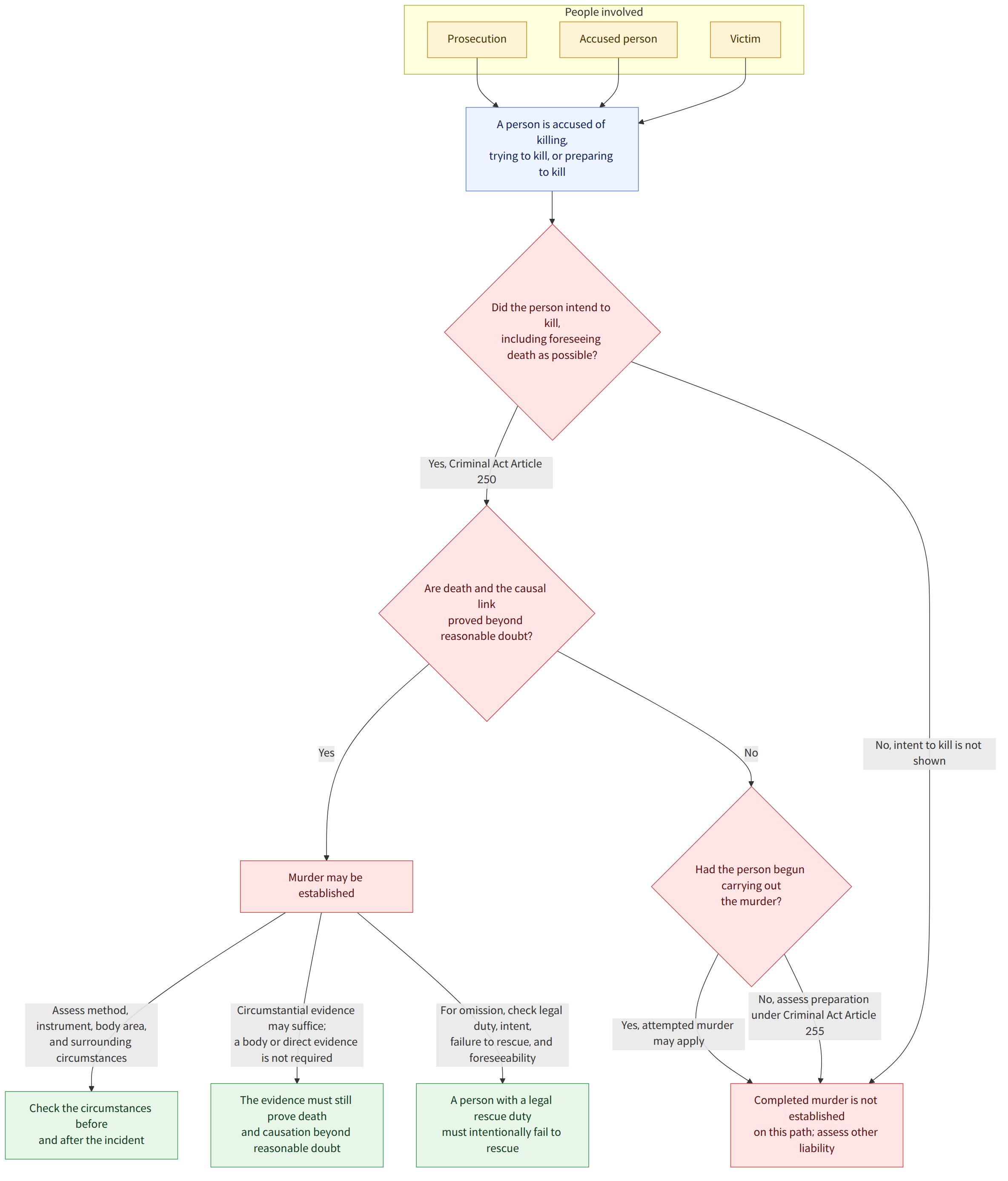
Murder is not established merely by the fact that the victim died; the prosecution must prove intent to kill and a causal link between the conduct and the death. It may be established by circumstantial evidence even where there is no direct evidence or no body has been found, but the evidence must prove the charge beyond a reasonable doubt.
At a glance
Key points
- Intent to kill may be established if a person knows or foresees that their conduct could cause the victim’s death; it is not necessary that they want or intend the victim to die. This includes dolus eventualis (Criminal Act, Article 250 (형법 제250조), Case 4).
- Intent to kill and whether the crime was committed are assessed by considering the method, instrument, and area of the body involved, together with the circumstances before and after the crime. Intent to kill may be found even if the person did not prepare for the crime in advance (Cases 16 and 20).
- Murder may be established based on a body of circumstantial evidence even where there is no direct evidence or no body has been found. However, both the victim’s death and the fact that the defendant’s conduct caused the death must be proved beyond a reasonable doubt (Cases 2 and 11).
- A causal link may be found even if the conduct was not the sole or direct cause of death, provided that the intervening circumstances were reasonably foreseeable (Case 5).
- Even without directly attacking the victim, a person may be guilty of murder by omission if they had a legal duty to rescue the victim and, with intent to kill, left the victim in danger without providing rescue (Cases 8 and 13).
- Once a person has begun to carry out a murder, they may be guilty of attempted murder even if no death or injury results. Whether the case involves an impossible crime, in which there was no possibility of the result occurring, must be assessed in light of the specific means and circumstances (Cases 10, 14, 18, and 21).
- Preparation for murder requires not only an intent to kill and an intent to prepare, but also an external act that substantially contributes to carrying out the murder. Mere thoughts or plans are insufficient. Case law has held that the offense cannot be established where the intended victim has not been identified (Criminal Act, Article 255 (형법 제255조), Cases 12 and 25).
- The existence of a mental disorder or intoxication does not automatically warrant a reduced sentence on the basis of lack of or diminished mental capacity. The person’s capacity to make judgments at the time of the crime and the circumstances before and after the crime must be examined (Criminal Act, Article 10(1) and (2) (형법 제10조 제1항·제2항), Case 1).
Frequently asked questions
Q. If I say I did not intend to kill the other person, can I avoid a murder conviction?
Not necessarily. If the person knew or foresaw that their actions could cause the other person’s death, they may be guilty of murder based on dolus eventualis, even if they did not want the person to die. The determination is made by considering the specific conduct and the circumstances at the time.
Q. Can someone be convicted of murder even if no body has been found?
Yes. A conviction may be based on a body of circumstantial evidence, even if there is no direct evidence. However, both the fact that the victim died and the fact that the defendant’s act of killing caused the death must be proved beyond a reasonable doubt.
Q. Can murder be established solely because someone could receive a large insurance payout?
The possibility of receiving insurance proceeds alone does not prove a motive or intent to kill. It is necessary to carefully examine objective evidence that the incident was intentional, as well as circumstances that resolve questions about the method of the crime and the circumstances of the incident.
Q. Can it be murder if the victim slips into the water but is not rescued?
It may, depending on the circumstances. If someone takes the victim to a dangerous place, has a legal duty to prevent danger and provide rescue, and fails to rescue the victim with intent to kill, the omission may be treated as the act of committing murder.
Q. Can someone be guilty of attempted murder even if they did not manage to injure the victim?
Yes. If a person has begun to carry out an act of murder but fails to achieve their purpose because a third party intervenes or the victim escapes, they may be guilty of attempted murder. Whether the person has begun to carry out the crime is determined by reference to their specific actions.
Q. Can someone be punished for planning or soliciting a murder if no murder actually occurs?
A mere thought or plan does not constitute preparation for murder, but an external preparatory act that substantially contributes to carrying out a murder may do so. In one case, hiring a contract killer after deciding on the target and payment was treated as a preparatory act.
Q. Can someone be punished for advising or helping a person who wants to commit suicide?
Advice or encouragement, or material assistance, intended to make it easier for someone to carry out a suicide may constitute aiding suicide. However, the person must perform an act that assists the other person in carrying out a specific suicide and must be aware of what they are doing. Advertising for the purpose of obtaining money may not, by itself, constitute aiding suicide.
Q. Is the sentence for murder automatically reduced if someone has an intellectual disability or was intoxicated?
The sentence is not automatically reduced. Whether the person lacked or had diminished capacity to discern right from wrong or make decisions at the time of the crime is determined by examining the circumstances before and after the crime, among other things.
Q. Does killing a stepmother or a two-month-old infant constitute a separate offense of parricide or infanticide?
According to the cases, a stepmother is not a lineal ascendant under the law, so killing a stepmother constitutes ordinary murder, not parricide. The cases also held that a two-month-old infant was not a victim to whom the offense of infanticide applied.
Relevant laws
- Criminal Act, Article 10(1) and (2) (형법 제10조 제1항·제2항)
- Criminal Act, Article 250 (형법 제250조)
- Criminal Act, Article 250(2) (형법 제250조 제2항)
- Criminal Act, Article 252(2) (형법 제252조 제2항)
- Criminal Act, Article 255 (형법 제255조)
- Civil Act, Article 772 (민법 제772조)
- Civil Act, Article 769 (민법 제769조)
Watch out for
- Even where circumstances give rise to suspicion of guilt, a person cannot be found guilty unless the facts of the crime are proved beyond a reasonable doubt.
- A mental disorder or intoxication alone does not warrant a reduced sentence on the basis of lack of or diminished mental capacity. The person’s condition at the time of the crime must be assessed specifically.
- Preparation for murder and attempted murder must be distinguished. The determination depends on whether there was an external preparatory act beyond mere planning and whether the person began to carry out the murder.
Source cases
This guide was compiled by AI from the following Korea Legal Aid Corporation consultation cases (in Korean).
- 정신박약자의 살인행위는 항상 심신상실이나 심신미약의 상태에서 이루어졌다고 보는지 여부
- 살인죄의 죄책을 인정하기 위한 증명의 정도
- 거액의 보험금 수령이 예상된다는 금전적 이유만으로 살인 범행의 동기를 인정할 때 유의할 사항
- 살인죄의 범의
- 살인의 실행행위와 사망 사이의 인과관계 유무의 판단기준
- 자살방조죄에 있어서 방조의 의미
- 자살방조죄의 구성요건 및 그 방법
- 살해의 의사로 위험한 저수지로 유인한 조카(10세)가 물에 빠지자 구호하지 아니한 채 방치한 행위가 살인행위에 해당하는지 여부...
- 자살방조죄의 성립요건 및 방조의 방법
- 불능범과 살인미수죄
- 살인죄의 죄책을 인정하기 위한 증명의 정도
- 살인예비죄가 성립하기 위한 요건
- 피감금자에 대한 위험발생을 방지함이 없이 방치한 경우 살인죄의 성부
- 피해자에게 농약을 건네고, 피해자 소유 승용차의 브레이크호스를 잘라 제동기능을 상실케 한 행위가 살인미수죄를 구성하는지 여부
- 살인의 범행시기 등에 대한 착오가 판결에 영향을 미친 위법에 해당하는지 여부
- 살인의 고의 인정 여부
- 존속살인죄의 성립 여부
- 독살하려다 실패한 경우 장애미수와 불능미수의 판별심리 필요 여부
- 살인죄의 공소에 대하여 공소장변경 없이 폭행치사죄로 처단할 수 있는지 여부
- 계획적 의도 없이 범행현장에 가서, 소지하고 있던 과도로 살인을 한 경우 살인의 범의 유무
- 살인행위의 착수시기
- 이미 총격을 받은 피해자에 대한 확인사살과 살인죄의 성립 여부
- 타격의 착오가 있었던 경우에도 살인의 고의가 인정되는지 여부
- 생후 2개월 된 아이가 영아살해죄의 영아인지 여부
- 살인예비죄가 성립하기 위하여 살인대상이 특정되어야 하는지 여부
This guide is general legal information about Korean law, not legal advice for your situation. For a specific case, consult a lawyer or the Korea Legal Aid Corporation (call 132 in Korea).