
Guide to Divorce by Agreement: Procedure, Withdrawal, Children, and Division of Property
Based on 22 consultation cases · Updated · Translated from the Korean original.
A divorce by agreement is not completed merely because the spouses agree to divorce; it takes effect only after confirmation of their intentions by the court and registration of the divorce. If there are minor children, arrangements must be made for their care and parental authority. Property matters may be claimed after the divorce even if they were not agreed upon at the time.
At a glance
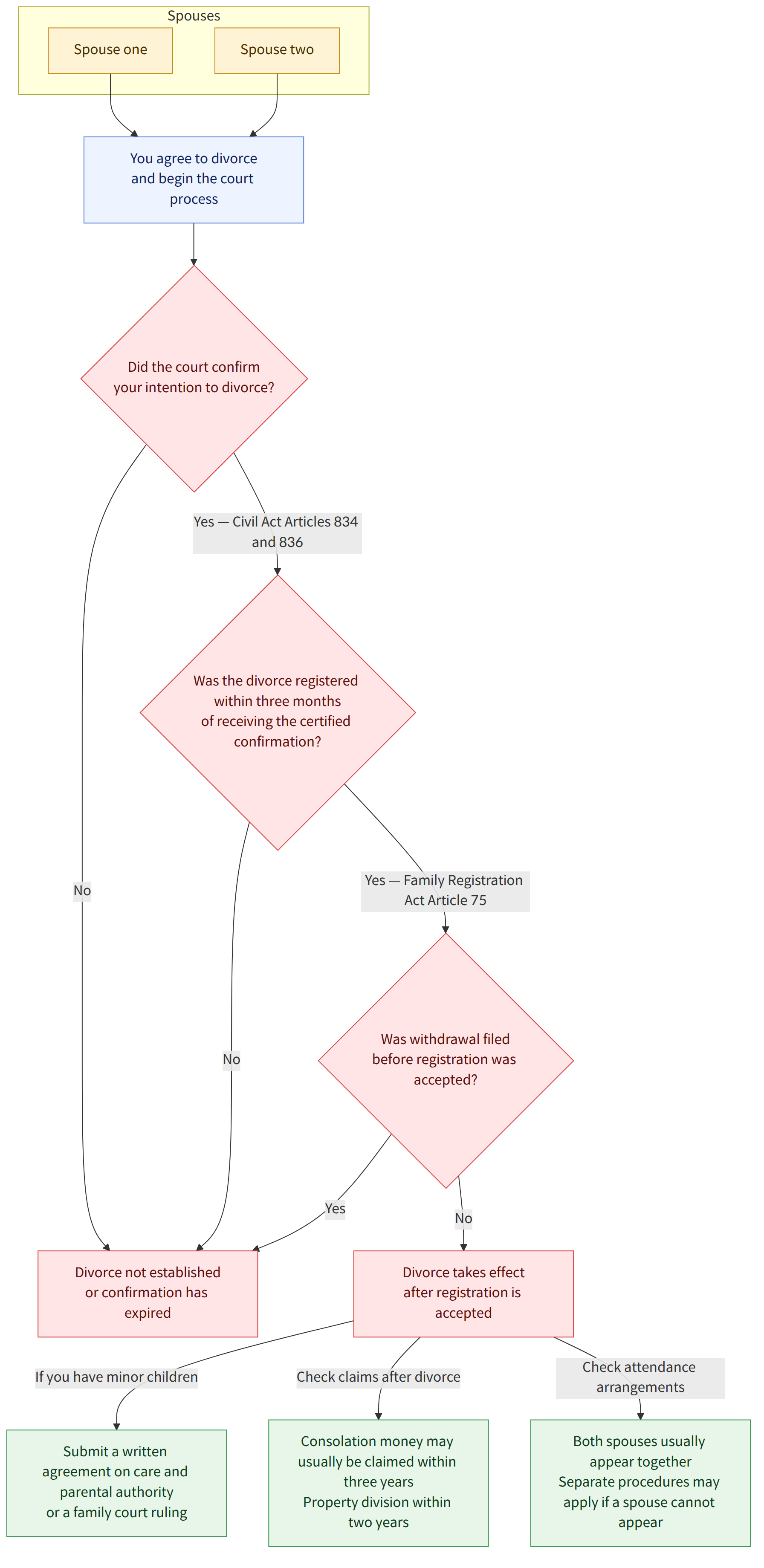
Key points
- A divorce by agreement is established when the spouses agree to end their legal marital relationship, obtain confirmation from the court, and then register the divorce (Civil Act, Articles 834 and 836 (민법 제834조·제836조)).
- A divorce is not established merely by the court’s confirmation of the spouses’ intention to divorce by agreement. If the divorce is not registered within three months from the date a certified copy of the confirmation is received, the confirmation loses its effect (Act on Registration of Family Relations, Article 75 (가족관계의 등록 등에 관한 법률 제75조)).
- As a rule, both spouses must appear together to apply for and obtain confirmation of a divorce by agreement. Separate procedures may apply when a spouse has difficulty appearing, such as in the case of an overseas resident or prisoner (Rules on Registration of Family Relations, Articles 73 and 74 (가족관계의 등록 등에 관한 규칙 제73조·제74조)).
- The consideration period is three months if the spouses have a child to raise and one month if they do not. If there are urgent circumstances, such as violence likely to cause unbearable suffering, the court may shorten or waive the period (Civil Act, Article 836-2 (민법 제836조의2)).
- If the spouses have minor children, they must submit a written agreement on the custodial parent, child support, visitation, and parental authority. If they cannot agree, they must obtain and submit a family court ruling (Civil Act, Articles 836-2 and 837 (민법 제836조의2·제837조)).
- The intention to divorce may be withdrawn before the divorce registration is accepted. A Supreme Court decision holds that if the withdrawal is submitted before the divorce registration form, the divorce does not take effect even if an official overlooks the withdrawal and accepts the registration form (Supreme Court Decision of February 8, 1994, Case No. 93Do2869).
- Consolation money and division of property may be claimed after a divorce even if the spouses did not agree on them at the time of the divorce by agreement. The examples state that the usual time limits are three years from the divorce for consolation money and two years from the date of divorce for division of property (Civil Act, Articles 766 and 839-2 (민법 제766조·제839조의2)).
- Even if a divorce is alleged to be a sham, it may not be void if the spouses agreed to end their legal marital relationship, even temporarily. To have it recognized as void, special circumstances supporting the claim and sufficient evidence are required (Supreme Court Decision of September 14, 1976, Case No. 76Do107, and others).
Frequently asked questions
Q. Does a divorce by agreement take effect as soon as it is confirmed by the court?
No. The divorce takes effect only if you register it within three months from the date you receive a certified copy of the court’s confirmation. If that period expires, the confirmation loses its effect, and you must go through the confirmation procedure again.
Q. Can I apply for a divorce by agreement if my spouse does not appear in court?
As a rule, both spouses must appear together at court to apply, and both must also appear on the confirmation date. However, the examples describe alternative procedures for people who have difficulty appearing, such as overseas residents and prisoners: the other spouse may apply first, or confirmation by a diplomatic mission abroad, prison, or other relevant institution may take the place of an appearance.
Q. Can I cancel a divorce by agreement if I change my mind after agreeing to it?
If the divorce has not yet been registered, you can prevent it by not registering it or by submitting a withdrawal of intention to divorce to the competent administrative agency before the divorce registration form is submitted. Once the other spouse’s divorce registration has been accepted, submitting a withdrawal alone cannot reverse it.
Q. Can we get a divorce by agreement even if we cannot agree on the care or parental authority of our minor children?
If you have children, you must decide matters concerning the custodial parent, child support, visitation, and parental authority, and submit a written agreement. If you cannot reach an agreement, you must ask the family court to decide the matter and then submit a certified copy of its ruling or equivalent document.
Q. Can the consideration period be shortened if I want to divorce quickly because of violence?
According to the examples, a consideration period of three months applies if you have a child to raise, and one month if you do not. If there are urgent circumstances requiring a divorce—for example, where violence is likely to cause unbearable suffering—the court may shorten or waive the period.
Q. Can we get a divorce by agreement first without deciding on consolation money or division of property?
Yes. According to the examples, because agreements on consolation money and division of property are not matters the court confirms as part of a divorce by agreement, you may claim them separately after the divorce. Note, however, that the usual time limits are three years from the divorce for consolation money and two years from the date of divorce for division of property.
Q. Can a divorce by agreement be annulled if it was obtained through fraud or duress?
The examples state that if you expressed an intention to divorce through fraud or duress, you may seek to have the divorce annulled in family court. Note that you cannot seek annulment after three months have passed from the date you learned of the fraud or were freed from the duress, and that conciliation proceedings are required.
Q. Is a sham divorce intended to avoid debt void?
The mere fact that there was another purpose does not automatically make a sham divorce void. The question is whether the spouses agreed to end their legal marital relationship, even temporarily. To establish that there was no such agreement, there must be convincing special circumstances and sufficient evidence.
Relevant laws
- Civil Act, Article 834 (민법 제834조)
- Civil Act, Article 835 (민법 제835조)
- Civil Act, Article 836 (민법 제836조)
- Civil Act, Article 836-2 (민법 제836조의2)
- Civil Act, Article 837 (민법 제837조)
- Civil Act, Article 838 (민법 제838조)
- Civil Act, Article 839 (민법 제839조)
- Civil Act, Article 839-2 (민법 제839조의2)
- Civil Act, Article 843 (민법 제843조)
- Civil Act, Article 806 (민법 제806조)
- Civil Act, Article 766 (민법 제766조)
- Civil Act, Article 909 (민법 제909조)
- Act on Registration of Family Relations, Article 34 (가족관계의 등록 등에 관한 법률 제34조)
- Act on Registration of Family Relations, Article 36 (가족관계의 등록 등에 관한 법률 제36조)
- Act on Registration of Family Relations, Article 74 (가족관계의 등록 등에 관한 법률 제74조)
Watch out for
- The court’s confirmation of the intention to divorce and registration of the divorce are separate procedures. You must register the divorce within three months from the date you receive a certified copy of the confirmation.
- To withdraw your intention to divorce, the withdrawal must be received before your spouse’s divorce registration form is accepted.
- If you have minor children, you must prepare a written agreement on matters concerning their care and parental authority, or a certified copy of a family court ruling or equivalent document.
- Time limits apply to claims for consolation money and division of property, respectively, so take care not to delay making a claim after the divorce.
Source cases
This guide was compiled by AI from the following Korea Legal Aid Corporation consultation cases (in Korean).
- 가장이혼(假裝離婚)의 법적효력
- 협의이혼을 하려면 당사자 본인이 법원에 출석해야만 하는지
- 협의이혼에 합의한 후 마음이 변한 경우
- 협의이혼의 절차
- 재판상 이혼의 유형
- 협의이혼의 방법
- 협의이혼을 할 당시 위자료, 재산분할 등 재산문제가 합의되지 않아도 이혼이 가능한지
- 일방적 혼인신고사실을 알고도 계속 동거생활 한 경우의 효력
- 3개월 이내에 이혼신고하지 않은 협의이혼의사확인의 효력
- 협의이혼의사의 철회방법
- 협의이혼을 할 때 자녀의 양육사항이나 친권자가 정해지지 않을 경우 해결방법
- 협의이혼시 숙려기간과 숙려기간의 단축·면제사유
- 협의이혼의사확인의 효력
- 해외거주 중인 부부의 협의이혼방법
- 협의이혼의사 철회신고서 접수 후 제출된 협의이혼신고서를 수리한 경우 이혼의 효력
- 외국에 있는 배우자와 협의이혼하는 방법
- 협의이혼신고서가 위조된 경우 신고의 효력
- 협의이혼에 합의하고 일정 금원을 받았으나, 불성립되어 재판상 이혼을 한 경우 위자료 청구가 가능한지 여부
- 협의이혼에 합의한 후 이혼을 번복할 수 있는지 여부
- 협의이혼 의사확인을 받은 사실이 재판상의 이혼사유가 되는지 여부
- 강박이나 사기로 인한 이혼의 취소
- 피성년후견인의 협의상 이혼
This guide is general legal information about Korean law, not legal advice for your situation. For a specific case, consult a lawyer or the Korea Legal Aid Corporation (call 132 in Korea).